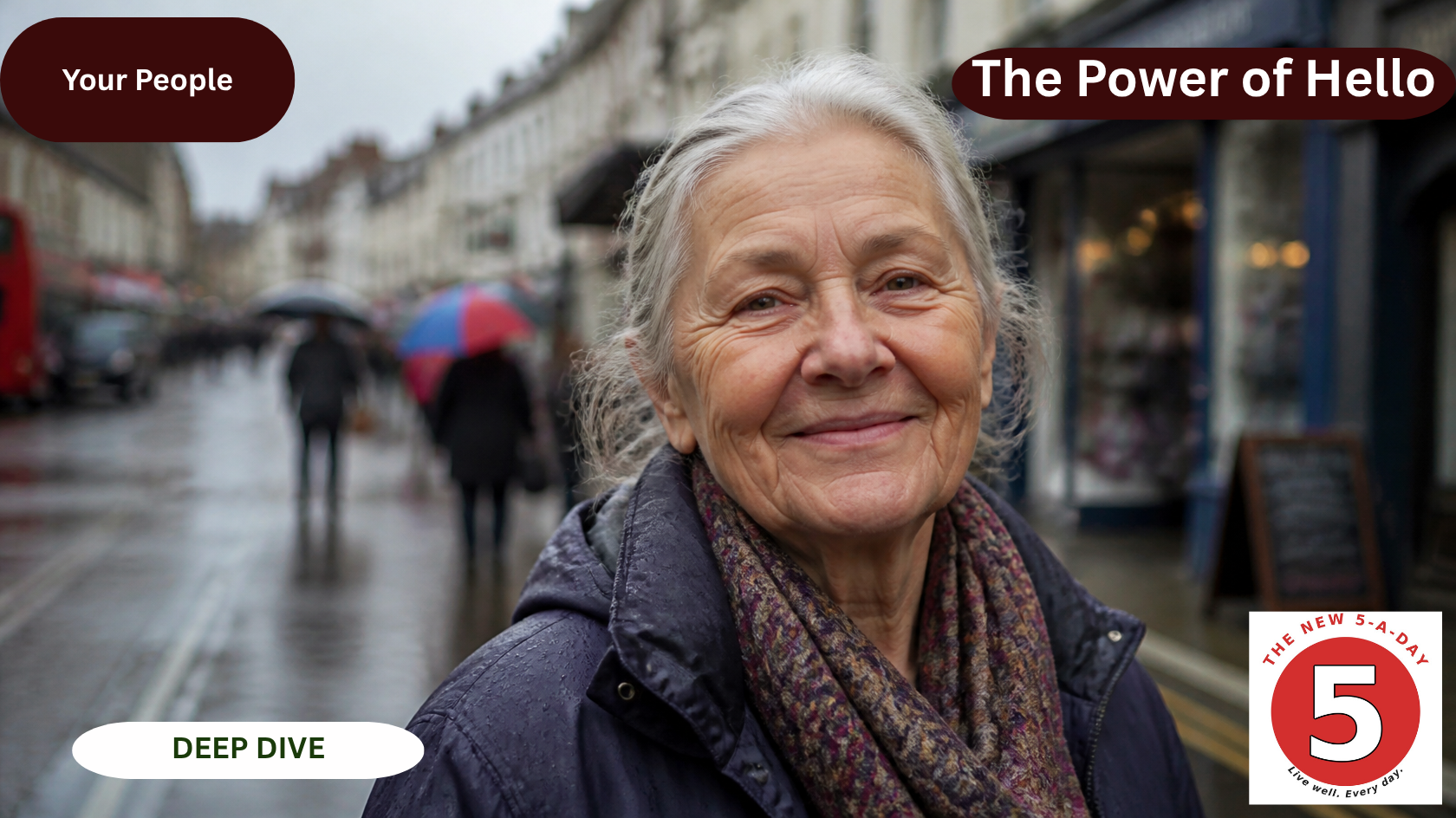
The Power of Hello - What the Science Says
Key takeaways
• Minimal social interactions — including greetings, brief thanks, and good wishes — are robustly associated with higher life satisfaction and positive affect across multiple cultures and study designs.
• Effects are primarily observed in the person initiating the greeting, though recipient benefits are also documented. The initiator advantage is well-replicated and theoretically coherent.
• Weak ties — acquaintances, service workers, neighbours, colleagues — independently predict wellbeing over and above close relationships, partly through mechanisms of belonging and reduced loneliness.
• Neighbourhood-level greeting behaviour is associated with greater social capital, community cohesion, and sense of safety. Community-level interventions that encourage neighbour contact show measurable reductions in loneliness.
• Shy individuals benefit from brief social contact with strangers in terms of mood, and do not show worse outcomes than less-shy counterparts — suggesting that greeting is a low-risk, high-return social behaviour across personality types.
• Effects are modest per interaction but cumulative in nature. The research supports greeting as a health behaviour that accrues value through repetition rather than through isolated episodes of contact.

The Power of Hello - How one little word can change your world!
Saying hello is one of the smallest things a person can do. It takes a second, costs nothing, and requires no particular skill or charisma. And yet the research on this type of minimal social interaction is consistent and striking: greeting people — neighbours, colleagues, strangers, the person at the counter — is reliably linked to higher life satisfaction, better mood, a stronger sense of belonging, and a warmer experience of everyday life. The benefits flow in both directions: to the person doing the greeting and the person being greeted. And they ripple outwards too, quietly shaping the feel of workplaces, streets, and whole communities. This post looks at what the evidence says, why it matters, and how to build the habit — especially if the idea of speaking to someone you don’t know feels anywhere between slightly awkward and mildly alarming.

Colleagues, connection, and belonging at work: what the evidence shows
Positive workplace relationships are consistently and reliably associated with higher wellbeing, stronger work engagement, lower burnout risk, and reduced intention to leave. Social connection at work acts as a buffer against occupational stress, but the relationship is not linear: certain configurations of workplace ties — particularly those characterised by high density and cross-departmental bridging — can increase role strain and stress. Social stressors, including conflict, exclusion, and perceived marginalisation, have moderate negative effects on job satisfaction and health. The evidence supports a model of colleague connection that is warm, consistent, and autonomous rather than obligatory or high-intensity. For introverted employees, the research confirms that low-pressure, choice-based interaction is not a compromise but the mode of engagement most likely to be sustainable. Workplace friendship and organisational social climate independently predict retention, commitment, and psychological wellbeing, with work-based social ties primarily supporting occupational wellbeing and non-work ties supporting general wellbeing.

Colleagues - why work connections matter and how to get the balance right
The relationships you build with colleagues — inside and outside the workplace — are one of the most consistently overlooked contributors to how well and how happily you move through working life. Good colleague connections reduce stress, increase engagement, and make even difficult weeks feel more manageable. They do not require you to become someone you are not. They do not demand a full social calendar or an open-door policy on your inner life. They require something smaller and more sustainable: a little warmth, some consistency, and knowing where your own limits lie. This post explains the evidence, explores the balance, and offers practical ways in — especially if the idea of workplace socialising makes you want to eat lunch alone in a stairwell.

How Many Friends - What the Science Says…
This Deep Dive examines three interrelated questions that sit at the heart of social connection research: whether there is an empirically supportable answer to how many close friends a person needs; whether friendship quality or friendship quantity is the stronger predictor of wellbeing outcomes; and what the current evidence says about the comparative health value of online versus face-to-face social relationships.

How Many Friends Do You Need?
Most of us have been conditioned to think that more friends means a better life. But the science tells a different story. What matters far more than the size of your social circle is the quality of the connections inside it — the friends who actually pick up the phone, remember what you told them last time, and show up when things get hard. Research suggests that a small handful of genuinely close friendships does more for your health and happiness than hundreds of shallow ones. And when it comes to online connections — the question is not whether they count, but whether they really function like friendships at all.

I’m too shy! Overcoming shyness to reach Your People
Shyness is one of the most common barriers to building the social connections that keep us healthy and happy. It is not a personality flaw, a character weakness, or a life sentence — it is a learned anxiety response, and it can be unlearned. The good news: you do not need to become a social butterfly to benefit. Small, consistent steps are enough to begin opening up your world, building confidence, and finding Your People.

Shyness, Social Anxiety, and the Science of Change
Key takeaways
• Shyness is clinically distinct from introversion and overlaps substantially with social anxiety disorder; both involve fear of negative evaluation rather than a simple preference for solitude.
• Chronic shyness is associated with elevated rates of depression, social anxiety disorder, loneliness, and lower life satisfaction, with longitudinal evidence linking childhood shyness to later psychopathology.
• Acute social stress reliably activates the hypothalamic-pituitary-adrenal (HPA) axis, producing measurable increases in cortisol and autonomic arousal — the physiological basis of shyness symptoms.
• Cognitive behavioural therapy (CBT), particularly exposure-based approaches, has the strongest evidence base for reducing shyness-related difficulties. Digital and VR-delivered formats show effects comparable to in-person therapy.
• Mindfulness and yoga-based interventions demonstrate significant reductions in anxiety and physiological stress markers, offering an accessible complement to CBT-based approaches.

The science of human connection
Key takeaways
• Social connection meets Bradford Hill criteria for a causal — not merely associative — link with health and mortality.
• Loneliness and isolation elevate mortality risk comparably to smoking 15 cigarettes a day, exceeding physical inactivity and obesity.
• Mechanisms are biological: stress-axis dysregulation, elevated inflammation, disrupted sleep, and immune suppression.
• Quality of social ties predicts health outcomes more reliably than quantity; conflict-heavy relationships can be actively harmful.
• Social connection shapes health behaviours across the life course — dietary choices, physical activity, sleep, and healthcare engagement.
• Even modest improvements in social connection produce measurable changes in physical and mental health markers.

Why human connection matters more than we think…
Human connection — with friends, family, colleagues, neighbours, and community — is not a lifestyle bonus. The research is unambiguous: strong social ties reduce the risk of depression, cardiovascular disease, cognitive decline, and early death. Loneliness, by contrast, carries health risks comparable to smoking 15 cigarettes a day. The quality of our relationships is one of the most powerful — and most overlooked — determinants of how well and how long we live.

Why human connection matters - Citations

Your People - Pillar 5 of The New 5-a-day
Your People is Pillar 5 of the New 5-a-day because we all need someone or a group of people to connect with, to share with, to feel a bond with. Whether that is family, colleagues, old friends, or new, and whether you are confident or shy, extroverted or introverted, we will be looking at ways to engage with Your People to help you connect.