Shyness, Social Anxiety, and the Science of Change
Key takeaways
• Shyness is clinically distinct from introversion and overlaps substantially with social anxiety disorder; both involve fear of negative evaluation rather than a simple preference for solitude.
• Chronic shyness is associated with elevated rates of depression, social anxiety disorder, loneliness, and lower life satisfaction, with longitudinal evidence linking childhood shyness to later psychopathology.
• Acute social stress reliably activates the hypothalamic-pituitary-adrenal (HPA) axis, producing measurable increases in cortisol and autonomic arousal — the physiological basis of shyness symptoms.
• Cognitive behavioural therapy (CBT), particularly exposure-based approaches, has the strongest evidence base for reducing shyness-related difficulties. Digital and VR-delivered formats show effects comparable to in-person therapy.
• Mindfulness and yoga-based interventions demonstrate significant reductions in anxiety and physiological stress markers, offering an accessible complement to CBT-based approaches.
This Deep Dive accompanies the Open Post on overcoming shyness — Post 5-2 of Find Your People. It examines the research base in greater depth: the clinical definitions, the physiological mechanisms, the outcomes literature, and the intervention evidence. Where the Open Post aims to inspire and guide, this companion piece aims to explain and substantiate.
Defining shyness: clinical and research perspectives
In everyday language, shyness and introversion are often used interchangeably. In research, they are carefully distinguished — and the distinction matters clinically.
Introversion is a stable personality dimension reflecting a preference for lower levels of external stimulation. Introverts often prefer smaller gatherings, quieter environments, and more reflective activity — but this preference is not driven by fear. Introverts can be socially capable and comfortable; they simply find sustained social engagement more draining than extroverts do.
Shyness is characterised by wariness, self-consciousness, and anxiety in social situations — particularly those that involve potential evaluation by others. The defining feature is inhibition in the presence of social threat, rather than a simple preference for solitude. A shy person typically wants social connection but is held back by fear of negative evaluation, embarrassment, or rejection.
This distinction is well-established in the psychometric literature. Shyness measures and introversion measures capture related but distinct constructs, and the two do not reliably co-occur: introverted people are not necessarily shy, and shy people are not necessarily introverted. The more clinically significant overlap is between shyness and social anxiety.
KEY RESEARCH
Brook, C., & Willoughby, T. (2019). Shyness and social anxiety assessed through self-report: What are we measuring? Journal of Personality Assessment, 101, 54–63. https://doi.org/10.1080/00223891.2017.1388808
Psychometric analysis found that shyness and social anxiety self-report scales largely measure a single underlying construct centred on fear of negative evaluation and interaction anxiety. This suggests that much of what is commonly called shyness represents the lower-to-moderate range of social anxiety, rather than a categorically distinct condition.
Social anxiety disorder (SAD) — also known as social phobia — represents the clinical end of this spectrum: persistent, marked fear or anxiety about social situations in which the individual is exposed to possible scrutiny, leading to avoidance or significant functional impairment. Many people who describe themselves as "just shy" experience subthreshold social anxiety that, while not meeting full diagnostic criteria for SAD, still meaningfully affects their social functioning, wellbeing, and opportunities.
It is also worth noting the distinction between shyness and another form of social withdrawal: unsociability. Unsociable individuals prefer solitary activity not because of fear, but because they genuinely find it more rewarding. Research consistently shows that unsociable individuals — unlike shy or socially anxious individuals — report relatively good psychosocial adjustment and life satisfaction. The clinical concern is with fear-based withdrawal, not solitary preference per se.
The neuroscience of social threat: what happens in the shy brain
When a shy or socially anxious person enters a situation they perceive as evaluative, their nervous system responds in ways that are physiologically very similar to how it would respond to a physical threat. Understanding this mechanism helps explain both the subjective experience of shyness and the logic of the interventions that work best.
HPA axis activation and cortisol
The hypothalamic-pituitary-adrenal (HPA) axis is the body's primary stress response system. In response to perceived threat, the hypothalamus signals the pituitary gland to release adrenocorticotropic hormone (ACTH), which in turn triggers the adrenal glands to release cortisol — the primary glucocorticoid stress hormone. Cortisol mobilises energy, heightens alertness, and prepares the body for action.
Evaluative social situations reliably activate this system, as demonstrated by the extensive use of the Trier Social Stress Test (TSST) in laboratory research. The TSST involves giving an unrehearsed speech and performing mental arithmetic in front of an evaluating panel — and it consistently produces substantial cortisol elevations, increased heart rate, and elevated blood pressure in healthy participants.
KEY RESEARCH
Gu, H., Lei, Y., Yao, Y., Chen, C., & Liu, C. (2025). Physiological and psychological responses to acute stress: A meta-analysis of 171 studies of Trier Social Stress Test including 8,452 healthy adults. Psychoneuroendocrinology, 180. https://doi.org/10.1016/j.psyneuen.2025.107566
This large-scale meta-analysis of TSST studies confirmed that acute social-evaluative stress produces reliable, significant increases in cortisol, heart rate, and systolic blood pressure across healthy adults. Individual differences in HPA reactivity are substantial — with trait anxiety, neuroticism, and social anxiety all associated with heightened cortisol responses — providing a direct physiological link between social fear and bodily stress.
For chronically shy individuals, this stress response is triggered more readily, more intensely, and in situations that most people would not find threatening. The racing heart, sweating, vocal tension, and cognitive disruption that shy people experience in social situations are not imagined or irrational — they are real physiological events produced by the activation of an oversensitive threat detection system.
Chronic activation of the HPA axis — through repeated social avoidance and the anticipatory anxiety that accompanies it — carries potential longer-term health costs. Sustained elevated cortisol is associated with impairments to immune function, sleep quality, cardiovascular health, and cognitive performance. This is the physiological pathway through which chronic social anxiety may exert broader effects on physical health over time.
Autonomic nervous system responses
Alongside HPA axis activation, social threat also engages the sympathetic branch of the autonomic nervous system — the "fight or flight" system — producing increased heart rate, peripheral vasoconstriction, and altered breathing patterns. Shy individuals often show heightened baseline sympathetic tone and reduced heart rate variability compared with less shy peers, suggesting a chronic state of heightened physiological vigilance.
This pattern has implications for intervention: techniques that activate the parasympathetic nervous system — particularly controlled breathing with extended exhalation — work in part by directly opposing sympathetic arousal, explaining why breathing-based tools can produce rapid and noticeable reductions in the physical symptoms of social anxiety.
Health and wellbeing outcomes: what chronic shyness costs
A substantial body of longitudinal and cross-sectional research documents the associations between shyness, social withdrawal, and a range of adverse mental health outcomes.
Mental health: depression, anxiety, and loneliness
Shyness and social withdrawal are among the most consistent predictors of internalising problems — a broad category that encompasses depression, anxiety disorders, and social isolation. This relationship has been documented across childhood, adolescence, and emerging adulthood, and holds across different cultures and methodological approaches.
KEY RESEARCH
Cheng, J., Ding, W., Jia, Y., Yao, H., Li, W., & Xie, R. (2025). The bidirectional relationships between shyness, loneliness and depressive symptoms in Chinese adolescents. Journal of Youth and Adolescence, 54, 2628–2643. https://doi.org/10.1007/s10964-025-02248-y
Longitudinal analysis found bidirectional relationships between shyness, loneliness, and depressive symptoms: shyness predicted increases in loneliness and depression over time, and loneliness and depression in turn reinforced shyness. This confirms the self-perpetuating nature of the shyness–isolation–depression cycle and underscores the importance of early intervention.
Loneliness is a particularly important intermediary outcome. Shy individuals who avoid social situations accumulate fewer positive social experiences, develop smaller social networks, and are at elevated risk of chronic loneliness — which itself carries independent health risks. A comprehensive meta-analysis found that loneliness produces medium-to-large negative effects on mental health, wellbeing, sleep quality, and physical functioning (Park et al., 2020).
Childhood shyness is also a well-established risk factor for the development of social anxiety disorder. Longitudinal meta-analytic work confirms that shy children are significantly more likely to develop clinical-level social anxiety in adolescence and adulthood, particularly in the absence of supportive social environments and early intervention.
Social functioning and life outcomes
Beyond clinical mental health outcomes, shyness carries costs in social functioning and life opportunities. Research consistently finds that shy individuals experience more peer rejection and exclusion — not because they are disliked, but because their inhibited behaviour (avoiding eye contact, speaking less, contributing less to group interactions) is sometimes misread as aloofness or disinterest.
This creates a particularly frustrating dynamic: shy individuals often strongly desire connection but behave in ways that make connection harder to achieve. Intervention therefore needs to address both the internal fear response and the external behavioural patterns that shy individuals adopt in response to it.
Intervention evidence: what actually works
The evidence base for treating shyness-related social anxiety is substantial and reasonably well-converged. The most extensively studied approaches are reviewed below, with particular attention to systematic reviews and meta-analyses.
Cognitive behavioural therapy (CBT) and exposure-based approaches
CBT is the most evidence-based psychological intervention for social anxiety, and within CBT, exposure-based components — graduated, systematic contact with feared social situations — consistently produce the largest effects.
The theoretical mechanism is straightforward: avoidance maintains fear by preventing the disconfirmation of threat-related beliefs. Exposure creates the conditions for inhibitory learning — the development of new, non-threatening associations with previously feared situations. Repeated exposure, when conducted in a graduated and manageable way, progressively reduces the fear response through a process of extinction.
KEY RESEARCH
Cordier, R., Speyer, R., Mahoney, N., Arnesen, A., Mjelve, L., & Nyborg, G. (2021). Effects of interventions for social anxiety and shyness in school-aged children: A systematic review and meta-analysis. PLoS ONE, 16. https://doi.org/10.1371/journal.pone.0254117
This systematic review and meta-analysis of interventions for social anxiety and shyness in children found large positive effects for CBT-based programmes on psychosocial outcomes including social competence, anxiety symptoms, and peer relationships. School-based group delivery was particularly effective, combining the social context (a form of graduated exposure in itself) with structured skills training.
KEY RESEARCH
Whiteside, S., Sim, L., Morrow, A., Farah, W., Hilliker, D., Murad, M., & Wang, Z. (2019). A meta-analysis to guide the enhancement of CBT for childhood anxiety: Exposure over anxiety management. Clinical Child and Family Psychology Review, 23, 102–121. https://doi.org/10.1007/s10567-019-00303-2
This meta-analysis compared CBT approaches for childhood anxiety with high versus low exposure components. Exposure-heavy CBT produced significantly larger effects than anxiety management strategies alone, providing direct evidence that the mechanism of behaviour change — graduated contact with feared situations — is the active ingredient rather than cognitive restructuring or relaxation alone.
The cognitive component of CBT — challenging distorted beliefs such as the overestimation of threat and the underestimation of one's ability to cope — works synergistically with exposure. Identifying and examining automatic negative thoughts ("everyone will judge me," "I will embarrass myself") reduces their subjective credibility, lowers anticipatory anxiety, and makes approach behaviour more likely.
Digital and VR-delivered interventions
A growing body of evidence supports the effectiveness of digitally delivered CBT-based interventions and virtual reality (VR) exposure therapy for social anxiety. These formats offer important advantages: accessibility, anonymity, scalability, and the ability to provide controlled exposure to social scenarios that would be difficult to engineer in real life.
KEY RESEARCH
Walder, N., Frey, A., Berger, T., & Schmidt, S. (2025). Digital mental health interventions for the prevention and treatment of social anxiety disorder in children, adolescents, and young adults: Systematic review and meta-analysis of randomised controlled trials. Journal of Medical Internet Research, 27. https://doi.org/10.2196/67067
This 2025 meta-analysis of RCTs found that digital mental health interventions — including app-based CBT, internet-delivered CBT, and VR exposure — produced significant and sustained reductions in social anxiety symptoms in young people, with effect sizes comparable to in-person therapy. Digital formats were particularly effective for prevention in high-risk groups.
KEY RESEARCH
Tan, Y., Chang, V., Ang, W., Ang, W., & Lau, Y. (2024). Virtual reality exposure therapy for social anxiety disorders: a meta-analysis and meta-regression of randomised controlled trials. Anxiety, Stress, & Coping, 38, 141–160. https://doi.org/10.1080/10615806.2024.2392195
Meta-analysis of VR exposure therapy trials found significant reductions in social anxiety symptoms relative to control conditions, with effects maintained at follow-up. VR environments allow graduated exposure to social scenarios (public speaking, group conversations, networking) in a safe, controllable context — addressing the same mechanism as in-person exposure while lowering the barrier to entry.
Mindfulness and yoga-based interventions
Mindfulness-based interventions (MBIs) and yoga have been studied as complementary approaches to anxiety and stress reduction. While the evidence base is less extensive than for CBT, it supports meaningful effects on anxiety symptoms and physiological stress markers.
KEY RESEARCH
Pascoe, M., Thompson, D., & Ski, C. (2017). Yoga, mindfulness-based stress reduction and stress-related physiological measures: A meta-analysis. Psychoneuroendocrinology, 86, 152–168. https://doi.org/10.1016/j.psyneuen.2017.08.008
This meta-analysis found that both yoga and mindfulness-based stress reduction (MBSR) produced significant reductions in cortisol, blood pressure, heart rate, and self-reported anxiety, with effects sustained beyond the intervention period. These physiological changes correspond directly to the autonomic and HPA dysregulation observed in shy and socially anxious individuals.
Mindfulness approaches are thought to help social anxiety through several mechanisms: reducing cognitive fusion (the tendency to treat anxious thoughts as facts), increasing present-moment awareness that interrupts anticipatory worry, and building tolerance for uncomfortable physical sensations rather than responding to them with avoidance.
Yoga combines these psychological mechanisms with direct autonomic nervous system modulation through controlled breathing and movement — making it a particularly plausible complementary intervention for the physiological component of social anxiety.
Social skills training and structured social participation
For some individuals, shyness reflects not only fear but also a genuine gap in social skills — limited practice with conversation initiation, active listening, and turn-taking. Social skills training programmes provide structured rehearsal of these behaviours, typically in group formats that themselves constitute a form of graduated exposure.
Research on group-based social interventions — including structured activity groups, volunteer programmes, and community organisations — supports their value in reducing social anxiety and building social confidence. The shared-task structure of these settings reduces the evaluative pressure of purely social interaction, provides natural conversation starting points, and creates the conditions for positive social experience to accumulate.
This is consistent with the broader therapeutic principle: the context of social interaction matters enormously. Settings that reduce evaluation threat while providing positive interpersonal experience create the ideal conditions for gradual confidence-building.
What context shapes: family, peers, and culture
The research on shyness consistently highlights the role of environmental context in determining whether shyness becomes a stable, impairing trait or a transient and manageable characteristic. Several contextual factors are well-evidenced.
Parenting and family environment. Overprotective or controlling parenting — though often well-intentioned — can maintain shyness by reducing children's opportunities for independent social problem-solving. Warm, responsive parenting that encourages gradually expanding social challenges without forcing uncomfortable exposure produces better outcomes.
Peer relationships. Peer rejection and exclusion create a particularly damaging feedback loop: shy children who receive less peer acceptance have fewer opportunities to develop social confidence, reinforcing their withdrawal and increasing the likelihood of later social anxiety. Conversely, supportive peer relationships act as a protective buffer against the escalation of shyness.
Cultural context. Shyness is not uniformly pathologised across cultures. In some collectivist cultural contexts, reticence and social deference are valued qualities rather than problems to be overcome. The clinical concern arises when social inhibition causes significant distress or impairs functioning — rather than when it simply deviates from culturally dominant norms of sociability.
Clinical thresholds and when to seek professional support
The practical advice in the Open Post is appropriate for the broad range of people who experience shyness as a limiting factor in their social lives but are not significantly impaired by it. For those whose social anxiety is more severe — producing significant avoidance, occupational or educational impairment, or considerable distress — the evidence strongly supports seeking professional assessment and treatment.
NICE (the National Institute for Health and Care Excellence) recommends CBT as the first-line psychological treatment for social anxiety disorder. Stepped-care models offer increasing levels of intervention intensity — from self-guided digital programmes through to individual therapy — matched to the severity of impairment.
Selective serotonin reuptake inhibitors (SSRIs) are the first-line pharmacological treatment for SAD, with good evidence for efficacy and tolerability. They are typically used in combination with CBT rather than as a standalone treatment, and are particularly indicated for moderate-to-severe disorder.
The key message for readers is that social anxiety — even when severe — is a highly treatable condition. Effective, evidence-based treatment is available, and the threshold for seeking help should be lower than many people assume. If shyness is genuinely limiting your life, that is sufficient reason to have a conversation with your GP.
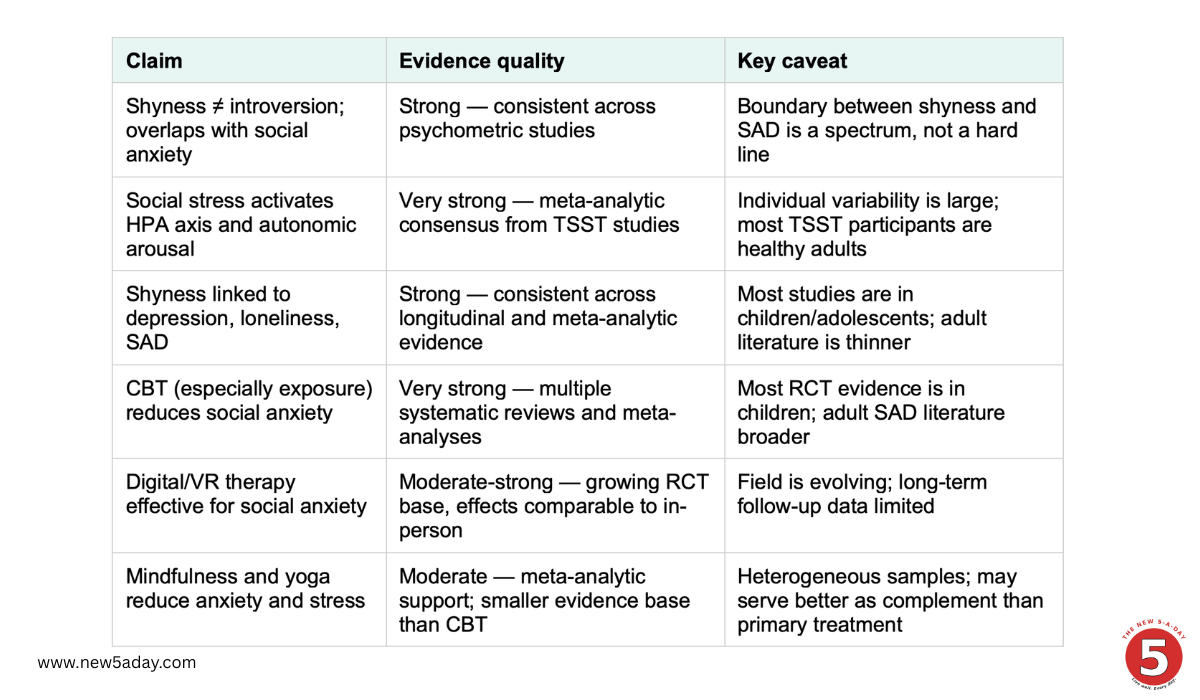
Summary of the evidence
A note on medical advice: This Deep Dive is intended to inform and educate, not to replace professional medical guidance. If you are experiencing significant social anxiety, please speak to your GP or a qualified health professional.
