Colleagues - why work connections matter and how to get the balance right

Quick summary: The relationships you build with colleagues — inside and outside the workplace — are one of the most consistently overlooked contributors to how well and how happily you move through working life. Good colleague connections reduce stress, increase engagement, and make even difficult weeks feel more manageable. They do not require you to become someone you are not. They do not demand a full social calendar or an open-door policy on your inner life. They require something smaller and more sustainable: a little warmth, some consistency, and knowing where your own limits lie. This post explains the evidence, explores the balance, and offers practical ways in — especially if the idea of workplace socialising makes you want to eat lunch alone in a stairwell.
Work takes up an enormous amount of adult life. For most of us, it accounts for more waking hours than almost anything else. And yet the social dimension of work — the people sitting near you, the person who always seems to have biscuits, the colleague who explained the printer in a way that actually made sense — is something we rarely think about deliberately.
That is a missed opportunity. Because the research is clear: the quality of your relationships with the people you work alongside has a measurable effect on how you feel, how you perform, and how well you hold up when things get hard.
This is Post Four in Find Your People — Pillar Five of The New 5-a-Day — and the focus here is on a group of people who are already in your life, whether you have made much of them or not. Your colleagues.
What the evidence actually shows
Studies consistently show that positive workplace relationships are connected to higher wellbeing, stronger engagement, lower stress, and greater resilience when things go wrong. People who feel socially supported at work are more likely to stay engaged with their jobs, collaborate more effectively, and cope better with pressure.
The benefits are not just psychological. Teams with stronger social bonds tend to communicate more easily, solve problems more efficiently, and report fewer of the misunderstandings that make office life unnecessarily complicated. Feeling that you have someone you can turn to — to sanity-check an idea, to debrief after a difficult meeting, or simply to have lunch with — changes the texture of a working day in ways that matter.
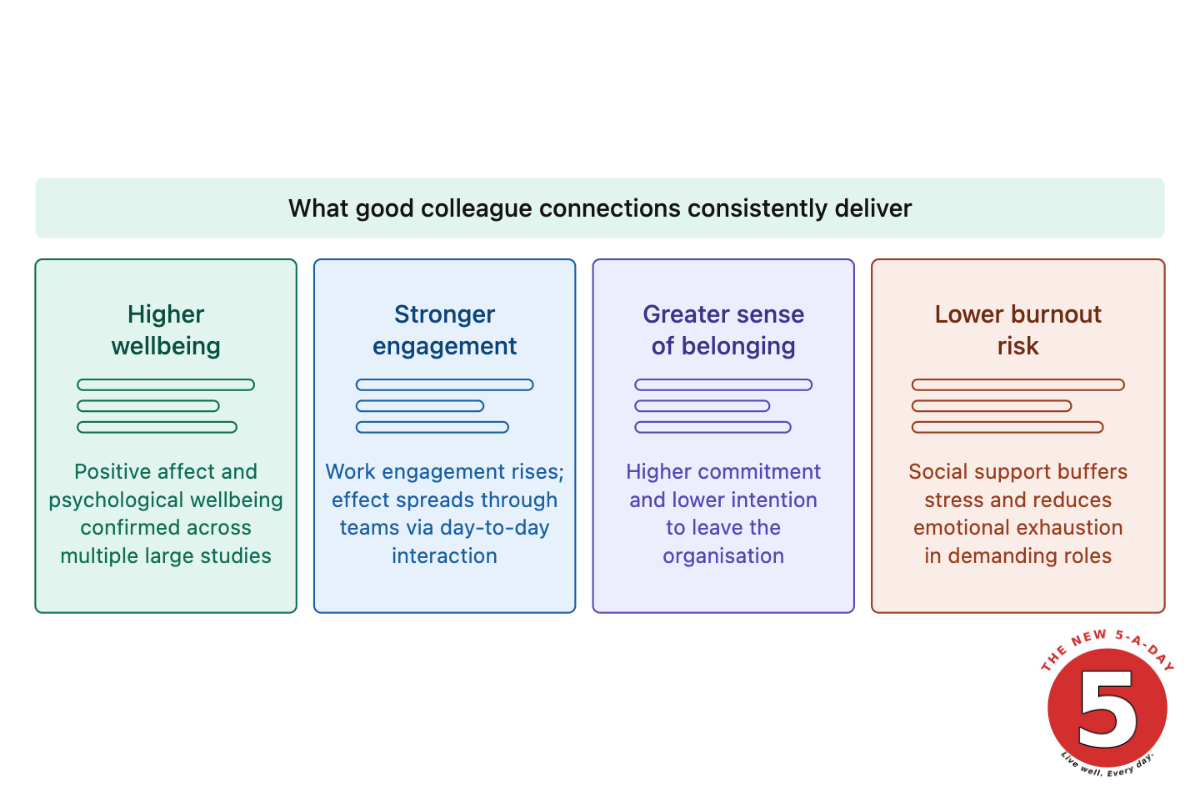
Research also shows that workplace friendship contributes to lower rates of burnout and a reduced likelihood of leaving a job. In other words, colleague connections are not a pleasant extra on top of work. For many people, they are part of what makes work sustainable.
The case for getting the balance right
None of this means that work should feel like a social marathon. There is an important difference between having good working relationships and feeling obliged to perform constant friendliness, attend every social event, and share more of yourself than you are comfortable with.
The research supports this nuance. Social connection at work generally protects against stress — but social stressors at work, things like conflict, exclusion, or the feeling that you have to be “on” all the time, actively cause harm. The goal is not maximum social contact. It is the right kind of social contact, at a level that genuinely suits you.
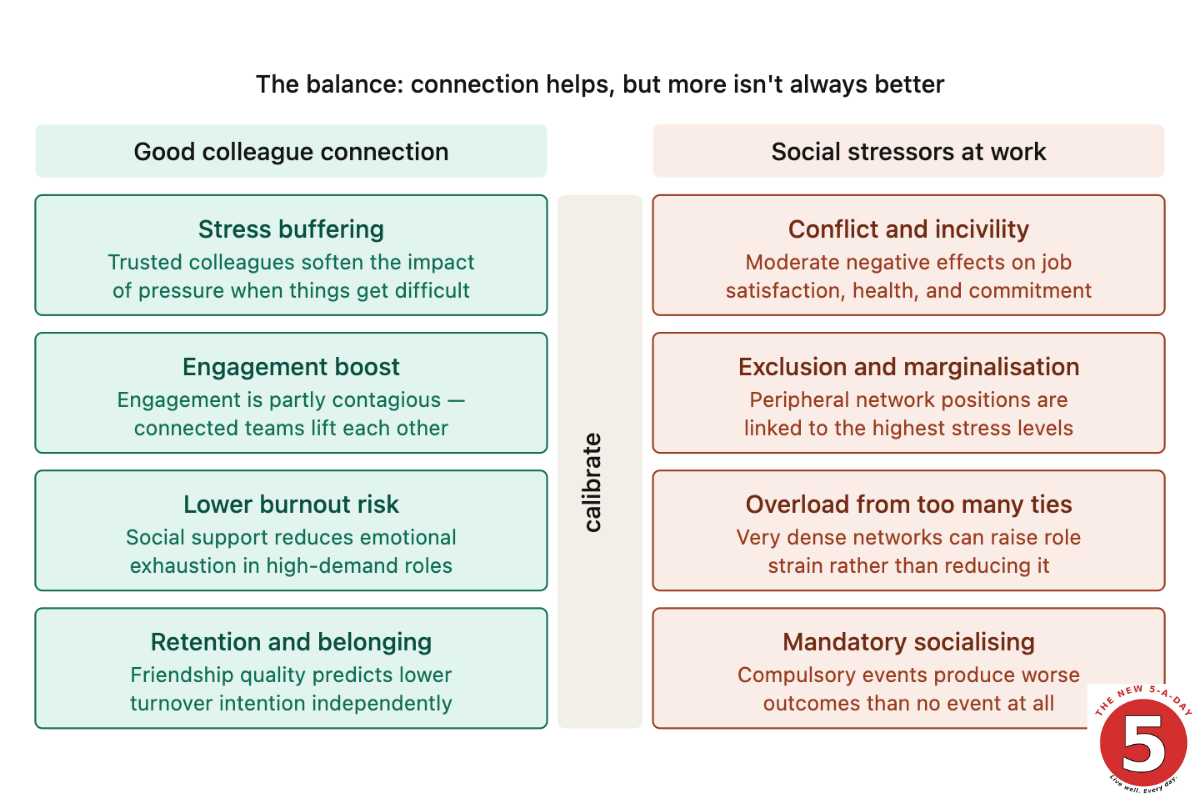
A useful question to keep in your pocket is this: does this connection leave me feeling more supported, or more drained? That answer is personal, and it is worth paying attention to. Some people thrive on constant interaction. Others do better with warmer one-on-one conversations and clear time to themselves. Neither version is wrong. Both can be built into a working life, if you are a little intentional about it.
Inside work: the value of ordinary moments
Most solid workplace relationships are built not through grand gestures but through accumulated small ones. The colleague whose name you actually know. The person you ask how their weekend went and actually listen to the answer. The brief exchange after a meeting about how things went.
These moments create familiarity, and familiarity is the foundation of trust. Trust is what makes working alongside someone feel easy rather than effortful. It is what allows you to ask a question without worrying about looking incompetent, to offer feedback without it feeling like a challenge, and to ask for help when you need it without the conversation becoming fraught.
Informal connections inside work are also contagious in a genuinely useful way. Engaged, socially connected people tend to bring some of that energy into their teams. Positivity, it turns out, is not just a personality trait — it is also something that moves between people who spend time together.
Outside work: keeping it optional, making it count
There is reasonable evidence that relationships formed outside the workplace — informal lunches, occasional social events, shared activities — deepen in ways that purely professional interactions do not. When colleagues see each other as whole people rather than just job titles, collaboration tends to get easier and communication tends to get clearer.
Many organisations encourage this kind of informal connection for exactly that reason. A team lunch, a shared interest group, a volunteer day — these create the conditions for relationships to develop more naturally than they can across a meeting table.
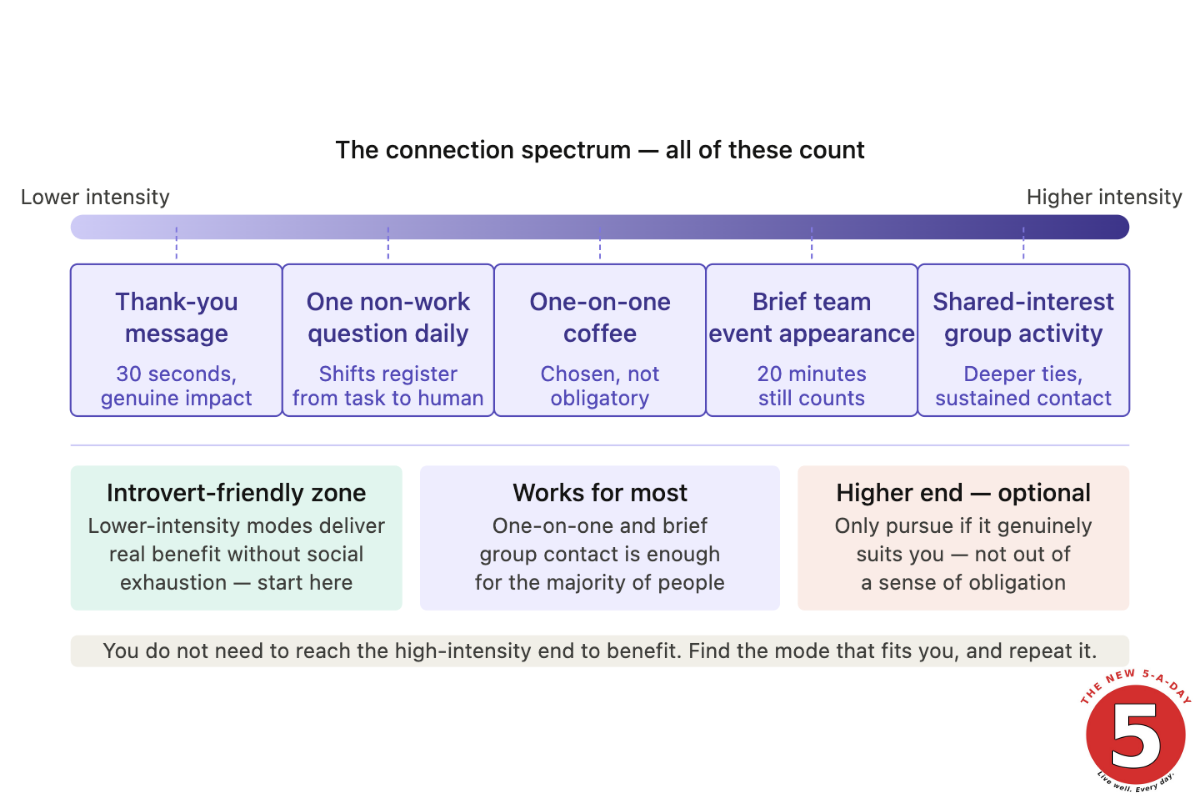
The important caveat is that outside-work connection should feel chosen, not compelled. The version that genuinely benefits people is the one that fits their preferences and schedule — not the one they dread but attend anyway out of a sense of obligation. Showing up occasionally and briefly still counts. Suggesting a one-on-one coffee rather than a group event still counts. Connecting over something you both care about — a walking route, a shared podcast, a lunchtime interest group — still counts.
A particular note for introverts and the shy
If workplace socialising sits somewhere between “mild inconvenience” and “low-grade dread” on your personal scale, you are not alone, and you are not broken.
Introverts, and many people who are shy without necessarily being introverted, often find that constant social interaction is genuinely tiring in a way that is not laziness or unsociability. It costs something. That is real, it is well-documented, and it is worth working with rather than against.
The encouraging news is that you do not need to transform yourself into someone louder, warmer, or more available than feels natural in order to build good working relationships. What the research actually supports is low-pressure, chosen, consistent connection — and that is a description that suits introverts very well.
Start smaller than feels necessary. A smile and a brief question costs very little and builds more than people expect. One-on-one conversations are almost always easier than group situations, and often more meaningful too. A short coffee, a walking meeting, a quick message of thanks after someone helps you — these things add up over time without demanding the social stamina of a networking event.
It also helps to give yourself permission to leave early. Attending a team event for twenty minutes and then slipping away is not a failure. It is participation, on your terms. Prepare a few simple conversation topics if spontaneity feels difficult — weekend plans, a project that is going well, something you have been reading. A little preparation removes the pressure and makes the conversation feel easier once it starts.
Practical habits that help
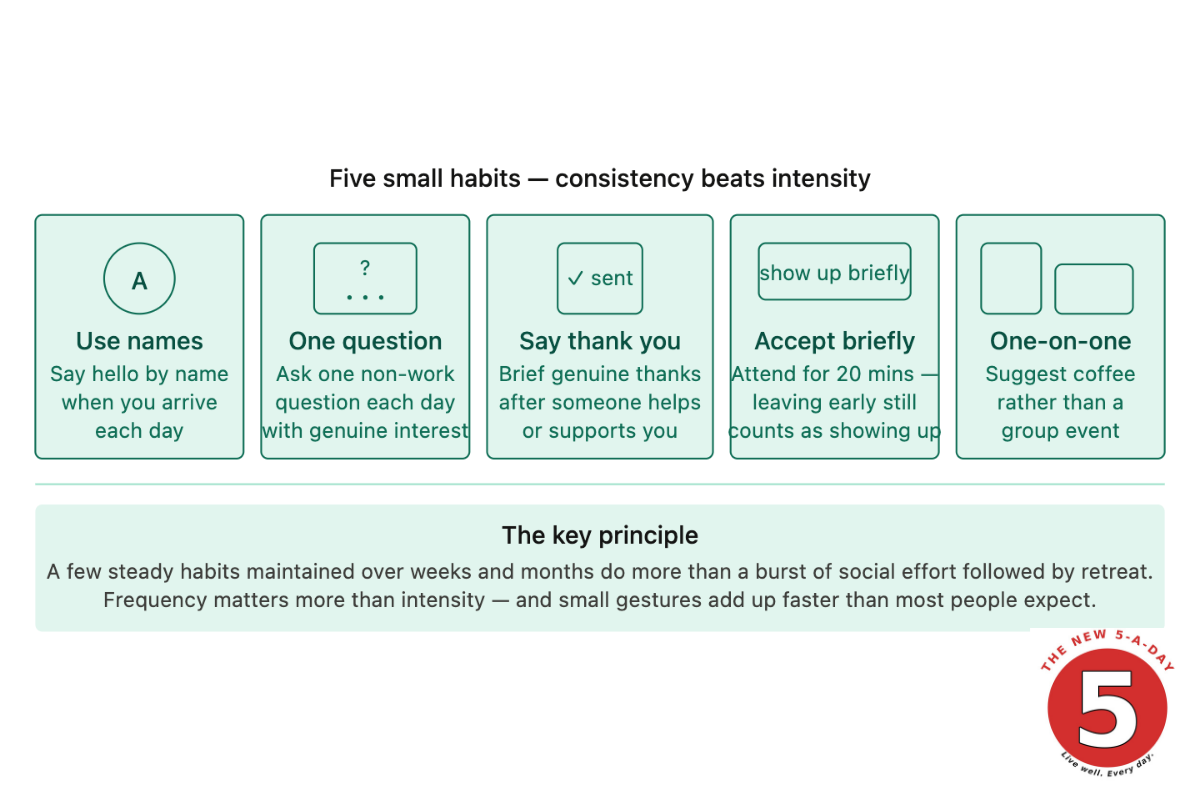
For most people, improving workplace relationships is less about doing something dramatic and more about building a few small, sustainable habits.
• Say hello by name when you arrive. It sounds trivially simple, but it signals that you see people — and people notice.
• Ask one non-work question a day. Not intrusively, just genuinely. How something went. What someone is looking forward to. It shifts the register from transactional to human.
• Send a brief thank-you after someone helps you. Not a formal acknowledgement — just a quick, genuine one. These matter more than most people realise.
• Accept occasional invitations, even briefly. Showing up — even for a short time — keeps you visible and connected in ways that sporadic non-attendance does not.
• Suggest a one-on-one alternative to group events if groups are not your thing. Most people appreciate being asked directly, and the conversation is usually better anyway.
• Look for a shared-interest activity if one exists — a walking group, a book group, a team sport, a volunteering opportunity. Connecting around something other than work makes it feel less like obligation and more like choice.
Knowing when to pull back
There are also times when more connection is not the answer. If workplace relationships begin to demand emotional labour that extends into your evenings, if there is pressure to be permanently available or to share more than you want to, those are signals worth attending to.
Professional warmth and personal privacy are not in conflict. You can be kind without being overexposed. You can be sociable without losing large parts of your off-work life to it. The aim is not to dissolve the boundary between work and everything else, but to make what happens at work feel human and supported enough to sustain.
Bringing it back to The New 5-a-Day
Your People is Pillar Five — and it covers the full range of human connection, from the people closest to you to the communities you belong to and the strangers you pass in the street. Colleagues sit in a specific and interesting position in that picture: they are people you did not necessarily choose, in circumstances you did not necessarily design, who nonetheless spend more time in your vicinity than almost anyone else in your life.
That is worth something. Not always friendship. Not always anything deeper than good working relations. But consistently, reliably, it is worth more than the nothing that comes from treating the people around you as furniture.
The healthiest version of colleague connection tends to have three qualities: it is warm, it is optional enough to be sustainable, and it is low enough on drama to feel like a resource rather than a drain. Whatever that looks like for you — a handful of trusted conversations, a regular lunch companion, the person you can send a message to when something has gone sideways — that is enough.
Start there. The rest follows.
A note on medical advice: The content in this post is intended to inform and inspire, not to replace professional medical guidance. If anything you’ve read raises questions or concerns about your own health, please speak to your GP or another qualified health professional.
Want to explore further? This post is the accessible introduction. A detailed evidence-based Deep Dive, a full Reference List, and a podcast episode are all available on this site.
The New 5-a-Day | Find Your People 5-4 | Live well. Every day.
