
Good morning! What time should you wake up? Citations

Good morning! When is the best time to wake up?
There is no single best time to wake up that works for everyone — but there is a right approach for you. Your ideal wake-up time is one that fits your natural body clock, gives you enough sleep, and stays consistent from day to day. Getting light into your eyes soon after waking, moving your body, and anchoring your mornings to a steady time are the three habits that matter most. The specific hour is far less important than whether you can stick to it.

Good morning! What time does science say you should wake up?
There is no universal optimal wake-up time, but the research points consistently to three factors that matter most: circadian alignment (waking at a point compatible with your biological clock), adequate sleep duration (seven to nine hours for most adults), and regularity (consistent wake and bed times day to day). Sleep regularity is an independently supported predictor of cardiometabolic and mental health outcomes — not just duration. Chronotype is biologically real, heritable, and shifts across the lifespan; the ~4-hour difference in habitual wake time between extreme morning and evening types reflects genuine clock differences, not lifestyle choices. Morning light is the most powerful and accessible tool for anchoring the circadian clock and improving wakefulness. The snooze reflex degrades sleep quality without meaningful additional rest.
The bedtime habit: how what you do before bed shapes how well you sleep
What you do in the hour or two before bed has a surprisingly big effect on how quickly you fall asleep and how well you stay asleep. Good bedtime habits — consistent timing, winding down gradually, dimming the lights, stepping away from screens — help your body and brain shift smoothly into sleep mode. Habits that work against you — late caffeine, alcohol, heavy meals, and staying mentally switched on until the moment your head hits the pillow — can make sleep harder to find, and harder to keep. The good news: small, consistent changes can make a genuine difference.
Bedtime habits and sleep quality: what the science actually shows
The evidence consistently supports a set of behaviours in the hours before sleep that promote faster sleep onset, better sleep continuity, and improved sleep quality. The strongest evidence exists for consistent sleep scheduling, light reduction in the evening (particularly blue-spectrum light from screens), caffeine avoidance in the afternoon and evening, and limiting alcohol close to bedtime. Pre-sleep cognitive arousal — an overactive, problem-solving mind at bedtime — is a key driver of insomnia and responds well to structured wind-down behaviours and cognitive techniques. Bedroom environment (temperature, darkness, noise) plays a supporting but meaningful role. Sleep hygiene advice alone is insufficient for clinical insomnia, where cognitive behavioural therapy for insomnia (CBT-I) represents the gold-standard treatment, but it remains valuable background guidance for the general population.
Bedtime habit: Citations

Good night! When is the best time to go to bed..?
There is no single perfect bedtime — but there is a right approach for you. Your ideal bedtime is the one that gives you seven to nine hours of sleep, fits your natural body clock, and stays roughly consistent from night to night. Work backwards from when you need to wake up, pay attention to when you naturally feel sleepy, and prioritise keeping your schedule steady. The specific hour matters far less than whether you can actually stick to it.

When is the best time to go to bed…? Citations

When is the best time to go to bed? What the science actually shows
There is no universal optimal bedtime, but the evidence consistently points to three factors that matter most: circadian alignment (going to bed when your biological clock is ready), adequate duration (seven to nine hours for most adults), and regularity (consistent bed and wake times). Irregular sleep timing — even when total sleep hours appear sufficient — is independently associated with poorer cardiometabolic and mental health outcomes. Chronotype (morning vs evening preference) is biologically real, partly genetic, and shifts predictably across the lifespan. Forcing sleep against your chronotype carries measurable health costs. The concept of ‘social jet lag’ — the mismatch between biological and social time — is an emerging risk factor in its own right.

DEEP DIVE 1. How long do we really need to sleep?
Key takeaways
• Habitual sleep duration under 7 hours is robustly associated with worse outcomes across metabolic, cardiovascular, immune, cognitive, and mental health domains.
• Short sleep disrupts appetite-regulating hormones, reducing insulin sensitivity and increasing risk of type 2 diabetes and obesity.
• Cardiovascular risk is elevated by chronically short or fragmented sleep, via sustained blood pressure elevation and increased systemic inflammation.
• Sleep plays an active role in immune defence and vaccine response; short sleepers are more susceptible to infection.
• The brain’s glymphatic waste-clearance system operates primarily during sleep; chronic sleep insufficiency may impair clearance of proteins associated with Alzheimer’s disease.
• Chronic insomnia is bidirectionally linked with depression and anxiety; CBT-I is the NICE-recommended first-line treatment.
• Effects are systemic and cumulative. Sleep is most usefully treated as a health behaviour on a par with diet and exercise, not as a passive default state.
CITATIONS 1. How much sleep do we really need?
APA Reference List — Open Post & Deep Dive
Citations cover both the Open Post and the Deep Dive. Where a source underpins content in both posts, this is noted. All citations are formatted in APA 7th edition style. DOIs are provided where available. All citations should be verified via Consensus (consensus.app) or PubMed before use.
Sleep well 1 - How much sleep do we really need?
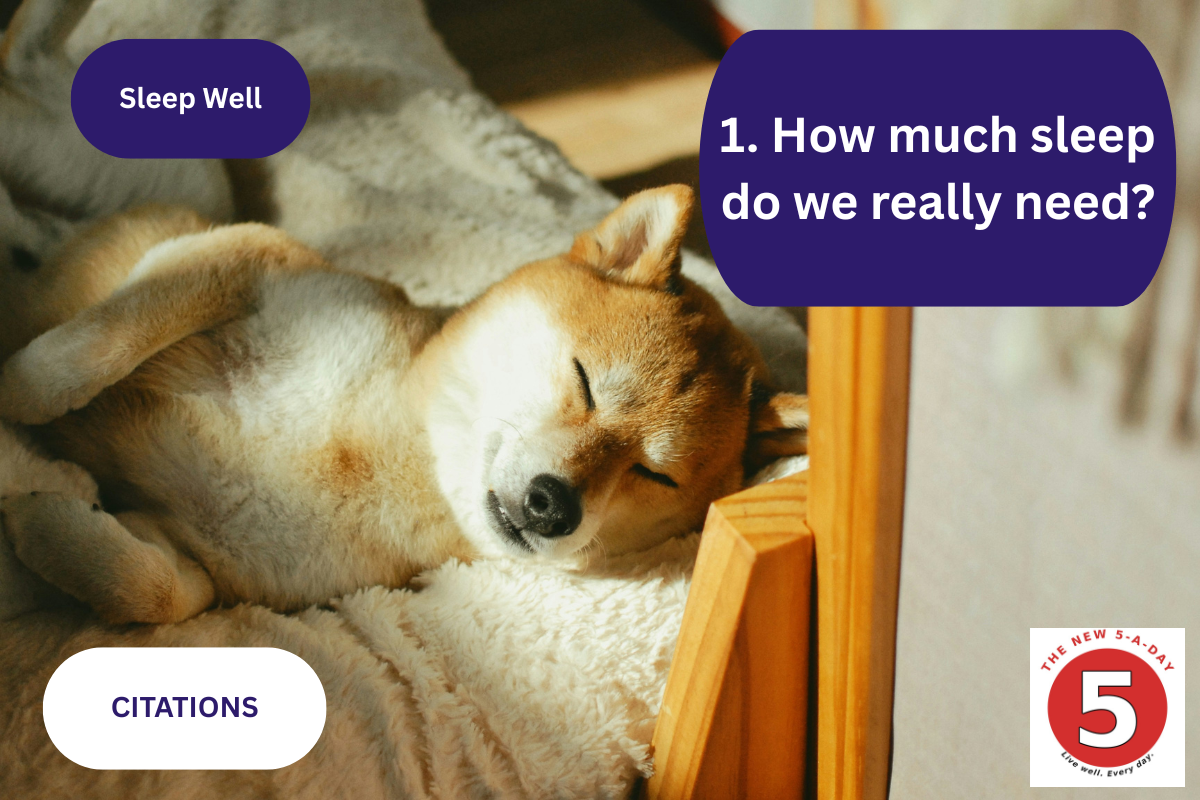
Most healthy adults need between 7 and 9 hours of sleep a night. That is not a suggestion or a lifestyle preference — it is what the evidence consistently shows, backed by sleep researchers and medical bodies around the world. Yet a significant number of people are regularly getting less, and most of them think they’re coping fine. This post looks at what sleep actually does for you, what happens when you cut it short, how to find your own personal sweet spot, and a few simple changes that make better sleep more likely — without requiring you to become a different person.

Sleep Well - Pillar 1 of the New 5-a-day
Sleep Well is Pillar 1 of the New 5-a-day because we believe good sleep is the foundation for feeling good and living our best lives.