How Many Friends - What the Science Says…

The evidence on social network size, friendship quality, and the differential effects of online versus in-person connection
Overview and scope
This Deep Dive examines three interrelated questions that sit at the heart of social connection research: whether there is an empirically supportable answer to how many close friends a person needs; whether friendship quality or friendship quantity is the stronger predictor of wellbeing outcomes; and what the current evidence says about the comparative health value of online versus face-to-face social relationships.
The evidence base draws on meta-analyses, systematic reviews, and large prospective cohort studies. Key methodological limitations are noted where they affect the interpretation of findings.
1. Defining friendship: the distinction between close ties and weak ties
Social network researchers typically distinguish between strong ties — close, emotionally significant relationships characterised by high frequency of contact, mutual investment, trust, and reciprocity — and weak ties, which are more numerous but lower in emotional depth. This distinction, introduced formally by sociologist Mark Granovetter in the 1970s, remains central to understanding how social relationships affect health.
Weak ties have their own value — they are important for information flow, job opportunities, and a sense of broader social belonging — but the health benefits most robustly associated with social connection in clinical and epidemiological research are driven primarily by strong ties. The presence of close, supportive friendships predicts loneliness, depression, anxiety, and physical health outcomes more reliably than simply counting the total number of social contacts a person has.
This distinction is not merely academic. It has direct implications for how we interpret the superficially large 'social networks' that modern digital platforms make visible: a person may have hundreds of online contacts and still be functionally socially isolated if none of those contacts constitute strong ties.
2. How many close friends? The evidence on optimal network size
The Dunbar number and its layers
The most widely cited framework for thinking about social network size comes from evolutionary anthropologist Robin Dunbar, whose work on social brain theory proposes that cognitive capacity — specifically, the size of the prefrontal cortex — constrains the number of meaningful social relationships an individual can maintain simultaneously.
Dunbar's research proposes a series of nested layers: an innermost 'support clique' of approximately three to five people (those with whom an individual has the closest emotional bonds); a sympathy group of roughly fifteen; a broader active network of around fifty; and a recognisable social layer of approximately 150 — the figure that became popularly known as 'Dunbar's number'. Beyond 150, social cohesion typically requires formal hierarchical structures to maintain.
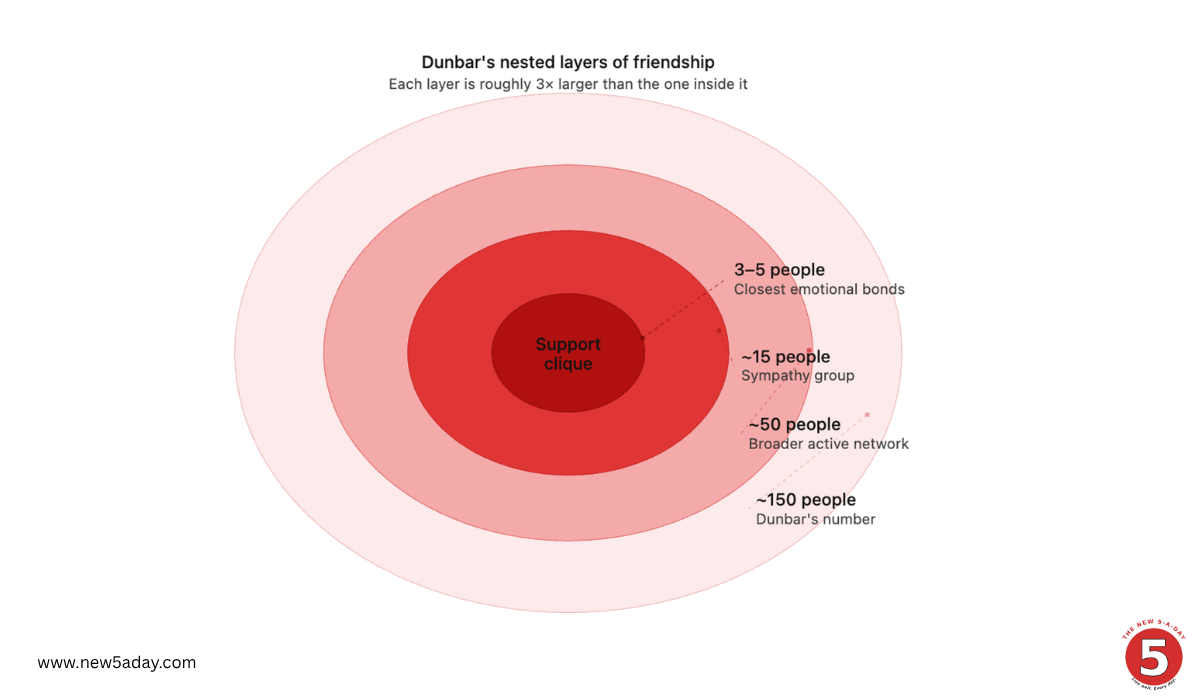
A 2020 study in the Proceedings of the National Academy of Sciences, examining the relationship between network layer size and functional complexity in social behaviour, provided further support for the nested structure of these layers. A 2025 review by Dunbar in the Annals of the New York Academy of Sciences reaffirmed the central role of the innermost layer in determining health and loneliness outcomes, noting that the support clique — not the total network — is the principal determinant of whether someone experiences social loneliness.
KEY RESEARCH
Dunbar, R. (2025). Why friendship and loneliness affect our health. Annals of the New York Academy of Sciences, 1545, 52–65. https://doi.org/10.1111/nyas.15309
Empirical thresholds for specific outcomes
A particularly useful contribution to the 'how many friends' question comes from a longitudinal analysis of older adults examining curvilinear relationships between close friend count and four distinct wellbeing outcomes. Using threshold analysis, Thompson and colleagues (2022) identified approximate inflection points beyond which additional close friendships contributed little further benefit:
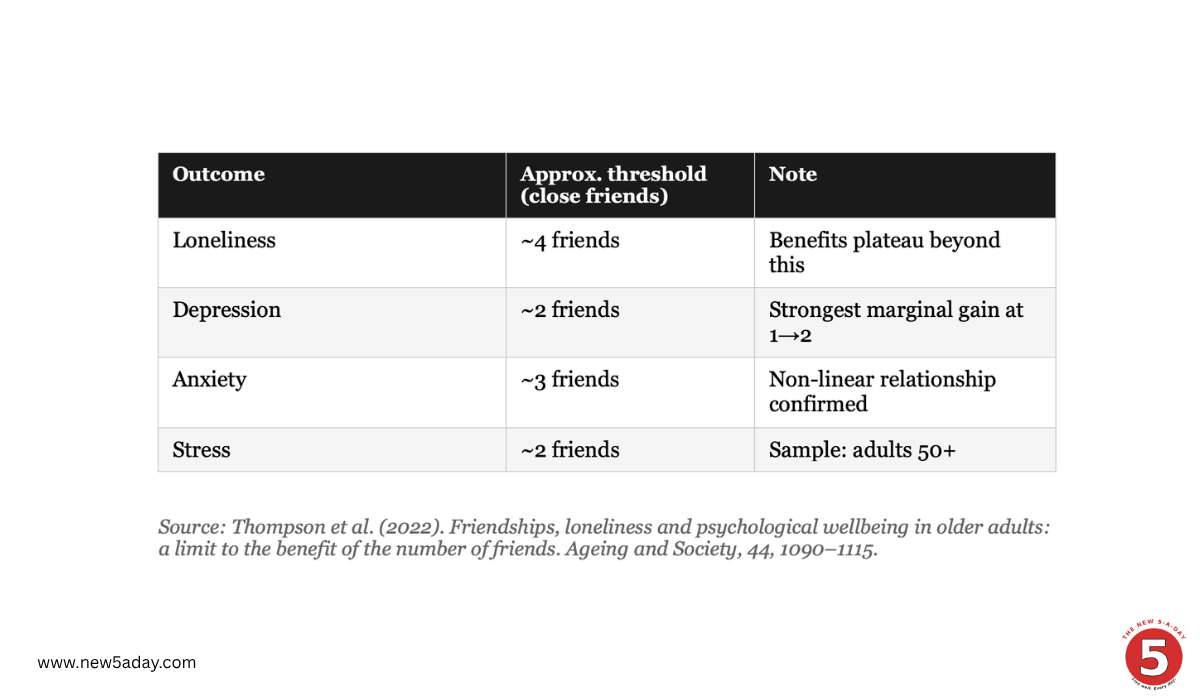
These thresholds are specific to an older adult sample and should not be generalised uncritically to other age groups. However, the non-linear pattern they describe — meaningful gains at low friend counts, rapidly diminishing returns at higher counts — is consistent with findings from other study designs, including a 2022 neuroimaging study in children (Shen et al., 2022) that identified non-linear associations between close friend count and brain structure and mental health outcomes, and a stability analysis of social networks by Acharjee and Oza (2024) in Royal Society Open Science.
3. Quality versus quantity: which matters more?
The most consistent finding across the friendship and wellbeing literature is that relationship quality is a stronger predictor of health outcomes than network size. This holds across age groups, study designs, and the specific outcomes measured.
A 2022 systematic review (Alsarrani et al.) examining friendship quality and subjective wellbeing in adolescents found that perceived friendship support was more strongly associated with lower loneliness and better mood than simply having more friends. A 2025 study in older Japanese adults (Inoue et al.) found that relationship quality — specifically the closeness of friendships and the level of perceived support — explained loneliness more reliably than the number of friends reported. A systematic review and meta-analysis by Norlin and colleagues (2025) in Ageing & Mental Health confirmed this pattern, finding that both quantity and quality of social relationships were associated with loneliness, but that quality measures — particularly relationship closeness and satisfaction — were more strongly predictive.
KEY RESEARCH
Norlin, J., McKee, K., Lennartsson, C., & Dahlberg, L. (2025). Quantity and quality of social relationships and their associations with loneliness in older adults. Aging & Mental Health, 29, 1198–1208. https://doi.org/10.1080/13607863.2025.2460068
A meta-analytic review of childhood and adolescent friendship by Schwartz-Mette and colleagues (2020) found that close friendship quality — specifically the positive supportiveness dimension — was associated with lower depressive symptoms, while friendship quantity was not independently predictive. The 2023 umbrella review by Pearce and colleagues (BMC Psychiatry), which synthesised relationships between social constructs and mental health conditions across the literature, found converging evidence that perceived social support — a quality measure — was among the most robustly associated social variables with mental health outcomes.
An important nuance here is that large social networks are not inherently protective. Several studies have found evidence that very large networks — maintained at the cost of depth per relationship — can increase emotional loneliness even as they reduce social isolation. The distinction between social loneliness (absence of a broad social group) and emotional loneliness (absence of intimate, close connection) is theoretically important: having many acquaintances addresses the former but not the latter. Quality friendships address both.
4. Online versus in-person friendship: what the research actually shows
The framing question
Much public debate about online versus offline friendship is poorly framed. The relevant research question is not 'are online friendships real?' but rather: under what conditions does online social connection provide the same or similar health benefits as in-person connection, and where does it fall short?
The evidence suggests a more nuanced answer than either dismissal or uncritical equivalence.
Online contact with existing offline friends
The clearest finding in the online/offline literature is that online contact with people one already knows in the physical world is associated with positive wellbeing outcomes, whereas contact with unknown individuals or purely virtual acquaintances is associated with neutral or negative outcomes.
A large study of adolescents using 2018 Health Behaviour in School-Aged Children (HBSC) survey data (Lyyra et al., 2022, Frontiers in Psychiatry) found that online communication with offline friends was positively associated with wellbeing, while communication with online-only contacts and unknown individuals was negatively associated with wellbeing. A UK survey of young people (Anthony et al., 2022, Child and Adolescent Mental Health) replicated this pattern, finding that online contact with offline friends did not harm and modestly supported wellbeing, while heavy use for virtual-only connections was associated with poorer outcomes.
KEY RESEARCH
Lyyra, N., Junttila, N., Gustafsson, J., Lahti, H., & Paakkari, L. (2022). Adolescents' online communication and well-being: Findings from the 2018 HBSC study. Frontiers in Psychiatry, 13. https://doi.org/10.3389/fpsyt.2022.976404
COVID-19 evidence: digital contact and its limits
The pandemic period provided a natural experiment in the substitutability of digital for in-person social contact. Two studies are particularly informative.
Juvonen and colleagues (2021, Journal of Social and Personal Relationships) examined electronic connection as a coping mechanism during COVID-19 lockdowns, finding that satisfaction with electronic contact — not frequency — was the key predictor of lower loneliness, anxiety, and depression. This is consistent with the quality-over-quantity finding in in-person friendship research.
Newson and colleagues (2021, New Media & Society) conducted a cross-national survey finding that face-to-face contact was more strongly associated with wellbeing than digital contact, and that digital contact alone did not replicate the wellbeing benefits of in-person connection. This was true even when digital contact was frequent.
KEY RESEARCH
Newson, M., et al. (2021). Digital contact does not promote wellbeing, but face-to-face contact does: A cross-national survey during the COVID-19 pandemic. New Media & Society, 26, 426–449. https://doi.org/10.1177/14614448211062164
Online social support: the meta-analytic picture
A 2022 systematic review and meta-analysis by Alsarrani and colleagues (BMC Public Health) found that offline or real-life friendship support was associated with better wellbeing outcomes than online-only social support, though online support was still better than no support. A meta-analysis focused specifically on adolescent online social support (Zhou & Cheng, 2022, Journal of Adolescence) found positive associations between online social support and mental health, but noted that the effect sizes were modest and that the quality of support — whether it involved genuine reciprocity and emotional validation — was the moderating factor.
The evidence-base on online social support during the COVID period was reviewed by Juvonen and colleagues (2021), who confirmed that digital connection was most beneficial when it facilitated communication with close friends rather than functioned as a substitute for broader social engagement.
Mechanisms: why in-person contact may carry additional value
Several mechanisms have been proposed to explain why face-to-face interaction appears to confer health benefits not fully replicated by digital contact. These include the role of non-verbal communication — body language, touch, facial expression, and prosodic features of voice — in creating felt connection and reducing physiological stress markers; the accumulation of shared embodied experience (shared meals, physical co-presence, incidental interaction) that builds relationship depth over time; and the role of physical proximity in triggering neurobiological bonding mechanisms, including opioid and oxytocin system activation, that may not be equivalently triggered by digital communication.
These are hypothesised mechanisms rather than definitively established pathways, and the neuroscience of social bonding in digital contexts remains an active area of research. What the behavioural data does consistently show is a gap in outcomes between in-person and purely online relationships — a gap that matters for how we evaluate social connection quality.
5. Social support and health outcomes: the evidence base
The broader literature linking social support to mental health outcomes is substantial. A 2022 meta-analysis by Zhang and Dong (Acta Psychologica) covering the relationship between perceived social support and loneliness found a robust negative association across studies, with higher perceived support consistently predicting lower loneliness. A 2018 systematic review by Wang and colleagues (BMC Psychiatry) found that perceived social support was associated with better outcomes across a range of mental health conditions, including depression and anxiety.
A 2023 umbrella review (Pearce et al., BMC Psychiatry) synthesising associations between social relationship constructs and mental health across the literature confirmed that friendship-related variables — particularly perceived support, relationship quality, and emotional closeness — were among the most consistently and strongly associated with mental health outcomes across conditions.
The mechanism through which close friendships exert their protective effects appears to involve several pathways: buffering against the physiological effects of stress (the social buffering hypothesis); providing cognitive reappraisal and meaning-making support during adversity; promoting health behaviours through social norms and practical help; and reducing the chronic neurobiological activation associated with perceived social threat and isolation.
6. Methodological notes and limitations
Several methodological considerations affect the interpretation of evidence in this area.
Most research on friendship quality and quantity relies on self-reported measures. The subjectivity inherent in rating the closeness or quality of a friendship means that what counts as a 'close friend' may vary substantially between participants and across cultures. Researchers attempt to standardise this through validated scales, but measurement error remains.
The threshold findings from Thompson and colleagues (2022) are specific to an older adult sample and may not generalise to younger age groups, in whom the relevant friendship dynamics and developmental contexts differ substantially. The Shen et al. (2022) study in children provides some support for non-linear patterns in a younger population, but direct comparison across studies is complicated by different outcome measures and methodologies.
Research on online versus offline social connection faces a particular methodological challenge: the distinction between 'online-only' and 'online contact with offline friends' is not always clearly operationalised, and the literature varies in how carefully this distinction is maintained. Studies that conflate all online social activity tend to find weaker or null effects; studies that distinguish contact type find more consistent patterns.
Longitudinal evidence is stronger than cross-sectional evidence for establishing direction of effect. Most of the higher-quality studies referenced here are longitudinal, but reverse causation — whereby people who are already more depressed or lonely have fewer close friends — remains a possibility that cannot be fully ruled out even in prospective designs.
Summary of key findings
The evidence supports the following conclusions with reasonable confidence:
● Friendship quality is a more reliable predictor of wellbeing outcomes than friendship quantity across most study designs and age groups.
● The relationship between close friend count and wellbeing appears non-linear: substantial gains are associated with moving from zero or one close friend to two to four; gains diminish substantially beyond that point.
● The 'inner circle' — approximately three to five people with whom an individual has close, reciprocal bonds — is more strongly associated with health outcomes than the broader network.
● Online contact with existing offline friends is associated with positive or neutral wellbeing outcomes; contact with virtual-only acquaintances shows weaker or negative associations.
● Face-to-face contact retains advantages over digital contact even when digital contact is frequent; satisfaction with contact quality matters more than contact frequency.
A note on medical advice: The content in this post is intended to inform and educate, not to replace professional medical guidance. If anything you've read raises questions or concerns about your own health, please speak to your GP or another qualified health professional.
