Companion to: Find Your People Open Post 5-5 — The Power of Hello. This Deep Dive examines the evidence base in greater technical depth. Readers seeking the accessible introduction should begin with the Open Post.
Key takeaways
• Minimal social interactions — including greetings, brief thanks, and good wishes — are robustly associated with higher life satisfaction and positive affect across multiple cultures and study designs.
• Effects are primarily observed in the person initiating the greeting, though recipient benefits are also documented. The initiator advantage is well-replicated and theoretically coherent.
• Weak ties — acquaintances, service workers, neighbours, colleagues — independently predict wellbeing over and above close relationships, partly through mechanisms of belonging and reduced loneliness.
• Neighbourhood-level greeting behaviour is associated with greater social capital, community cohesion, and sense of safety. Community-level interventions that encourage neighbour contact show measurable reductions in loneliness.
• Shy individuals benefit from brief social contact with strangers in terms of mood, and do not show worse outcomes than less-shy counterparts — suggesting that greeting is a low-risk, high-return social behaviour across personality types.
• Effects are modest per interaction but cumulative in nature. The research supports greeting as a health behaviour that accrues value through repetition rather than through isolated episodes of contact.
This Deep Dive accompanies Open Post 5-5 of Find Your People. It examines the research underpinning the claim that brief social greetings — hello, good morning, a nod of acknowledgement, a brief thank you — constitute a genuine, evidence-supported health behaviour. The post draws on social psychology, epidemiology, and the emerging literature on minimal social interactions. Methodological limitations are noted where they bear on interpretation.
1. Conceptual framework: minimal social interactions and weak ties
Two overlapping theoretical constructs underpin the research on greetings and wellbeing: the concept of the minimal social interaction and the sociological concept of the weak tie.
Minimal social interactions
The term minimal social interaction (MSI) refers to the briefest category of interpersonal contact — interactions that fall below the threshold of what would ordinarily be considered conversation. Greetings, expressions of thanks, good wishes, and brief acknowledgements all qualify. MSIs are distinguished from small talk (which typically involves some reciprocal exchange of content) and from substantive conversation (which involves extended mutual engagement).
The academic study of MSIs developed partly from a puzzle: social psychology had long established that close, high-quality relationships predict wellbeing, but it was less clear whether the very lowest-intensity forms of social contact carried any independent health value at all. Research from the 2010s and 2020s has progressively answered this question in the affirmative.
Weak tie theory
The concept of weak ties originates in the work of sociologist Mark Granovetter, whose 1973 paper “The Strength of Weak Ties” argued that low-intensity social relationships — acquaintances, casual contacts, people one knows by sight rather than by name — serve distinct social functions from close relationships. Where strong ties provide emotional support, deep reciprocity, and identity reinforcement, weak ties serve as bridges between social clusters, facilitating the flow of information, novel opportunities, and broader social belonging.
The relevance to greetings is direct: the person you say good morning to in your building corridor, the barista whose name you know, the neighbour you nod to on a walk — these are all weak-tie relationships. Research on weak ties has consistently shown they contribute to wellbeing independently of strong-tie quality and quantity, and through partially distinct mechanisms. Sandstrom and Dunn’s landmark 2014 study in Psychological and Personality Social Psychology Bulletin was among the first to document this rigorously in everyday social settings.
KEY RESEARCH
Sandstrom, G. M., & Dunn, E. W. (2014). Social interactions and well-being: The surprising power of weak ties. Personality and Social Psychology Bulletin, 40, 910–922. https://doi.org/10.1177/0146167214529799
In a study of university students’ daily social interactions, Sandstrom and Dunn found that interactions with weak ties (acquaintances such as the regular café server or a fellow commuter) were associated with greater positive affect and belonging on the days they occurred, even when controlling for strong-tie interaction frequency. The study provided foundational evidence that the social contact needed to support daily wellbeing does not require close friendship.
2. Minimal social interactions and wellbeing: the evidence base
Life satisfaction and positive affect
The most comprehensive body of evidence on MSIs comes from a series of studies by Gunaydin, Ascigil, Selcuk, and colleagues, drawing on both experimental and large-scale observational designs across multiple countries.
Gunaydin et al. (2020) conducted a landmark study in Turkey in which participants reported their daily MSIs — greetings, thank-yous, and similar brief exchanges — and their same-day positive affect, negative affect, and life satisfaction. More frequent MSIs were associated with significantly higher life satisfaction and positive affect, and lower negative affect, even after controlling for the frequency of deeper social interactions. A separate experimental component found that participants instructed to say “hi,” “thank you,” or “have a nice day” to a shuttle driver reported higher positive mood than those who rode in silence. The effect, while modest in magnitude, was statistically robust.
KEY RESEARCH
Gunaydin, G., Oztekin, H., Karabulut, D., & Salman-Engin, S. (2020). Minimal social interactions with strangers predict greater subjective well-being. Journal of Happiness Studies, 22, 1839–1853. https://doi.org/10.1007/s10902-020-00298-6
Both correlational and experimental evidence in a Turkish sample. Frequency of MSIs with strangers independently predicted life satisfaction, positive affect, and lower negative affect. Experimental manipulation (brief verbal contact vs. silence with a shuttle driver) produced reliable mood elevation in the contact condition. One of the most methodologically rigorous demonstrations of the MSI-wellbeing link to date.
Ascigil et al. (2023) extended this work in a study published in Social Psychological and Personality Science, examining the specific roles of greeting, thanking, and conversing in predicting life satisfaction. Using data from multiple time points, the study found that all three types of MSI independently predicted higher life satisfaction, with effects remaining significant after controlling for personality, strong-tie quality, and other potential confounds. Greeting — the simplest and most universally available of the three — showed reliable independent effects.
Ishiguro (2023), drawing on a nationally representative Japanese sample, replicated these findings in a markedly different cultural context. The study found that MSI frequency predicted higher subjective wellbeing, with effects partially mediated by reduced loneliness and increased sense of belonging. The cross-cultural replication strengthens the case that MSI effects are not culturally specific artefacts.
Mechanisms: belonging and loneliness reduction
The most consistently supported mechanistic pathway from MSIs to wellbeing operates through belonging and loneliness. Brief social contact — even with strangers or acquaintances — appears to satisfy, to a modest but meaningful degree, the fundamental human need to feel noticed and included.
Fong and colleagues (2021) demonstrated this in a community intervention study: a whole-of-community programme that encouraged residents to connect with neighbours — including through simple greetings — produced measurable reductions in loneliness and increases in neighbourhood identification over a six-month period. The study is notable for operating at a community rather than individual level, suggesting that normative greeting behaviour has aggregate social effects beyond the dyad.
KEY RESEARCH
Fong, P., Cruwys, T., Robinson, S., Haslam, S., Haslam, C., Mance, P., & Fisher, C. (2021). Evidence that loneliness can be reduced by a whole-of-community intervention to increase neighbourhood identification. Social Science & Medicine, 277, 113909.
A controlled community intervention study. Residents encouraged to engage in neighbour-connecting behaviours — including greetings — over six months showed significant reductions in loneliness and increased neighbourhood identification compared with control communities. Demonstrates that greeting-level social behaviour can produce meaningful population-level effects.
3. Initiator effects: why saying hello benefits the speaker
One of the more counterintuitive findings in the MSI literature is that the initiator of a greeting typically benefits at least as much — and in some studies more — than the person being greeted. Several mechanisms have been proposed to account for this.
Positive emotion generation
Offering a greeting creates a brief episode of prosocial behaviour — an act of warmth toward another person. Research on prosocial behaviour consistently shows that acting kindly toward others generates positive affect in the actor, through mechanisms that include positive self-perception, social validation, and the intrinsic reward of warm social contact. The greeting initiator experiences a micro-dose of the wellbeing benefit associated with larger acts of kindness.
This effect is not dependent on the interaction being extensive or reciprocated at length. The initiatory act itself appears sufficient to generate a modest affective lift, which is why studies find mood benefits from brief contact even when the recipient’s response is limited.
Interruption of ruminative cognition
Greeting someone requires, briefly, directing attention outward — to another person, their presence, and the social moment. This constitutes a mild attentional interruption of whatever internal processing was previously occurring. For individuals prone to ruminative thinking — a well-established risk factor for depression and anxiety — even brief outward attentional redirections can have disproportionate mood benefits.
The mechanism is related to, though distinct from, mindfulness: it is not deliberate present-moment awareness per se, but rather the practical effect of social engagement on attention allocation. The greeting is not a therapeutic technique, but its attentional demands may incidentally serve a similar function.
Accumulated self-efficacy
Each successfully executed greeting constitutes a small piece of behavioural evidence that social contact is manageable. For individuals with elevated social anxiety or low social confidence, this accumulation of positive micro-experiences provides repeated disconfirmation of feared social outcomes — the same mechanism that underlies graduated exposure therapy for social anxiety disorder, albeit operating at a much lower intensity.
Over time, the consistent experience of initiating greetings without negative consequences may gradually reduce avoidance motivation and increase approach behaviour in social contexts more broadly. This is speculative as a long-term mechanism, but is theoretically coherent with established models of social anxiety maintenance and reduction.
4. Recipient effects and dyadic benefits
Being greeted produces a form of social recognition — the experience of being seen and acknowledged by another person. This recognition satisfies, at a modest level, the fundamental need to belong, and can reduce the sense of social invisibility that many people experience in large urban or institutional environments.
Research on the recipient side of MSIs is less extensive than on the initiator side, but the evidence that exists is consistent. Appau, Churchill, and Farrell (2018), examining social integration and subjective wellbeing in a large Australian sample, found that the frequency of acknowledgement from others in daily life was independently associated with wellbeing, even after controlling for close relationship quality. The effect was described as “social integration” rather than greeting specifically, but the operational definition encompassed brief social acknowledgements of exactly the type that characterise greetings.
From a theoretical perspective, greetings function as micro-affirmations — small acts that confirm another person’s membership in the shared social space. For individuals who are new to an environment, socially isolated, or experiencing a period of reduced social contact, these micro-affirmations may carry outsized significance relative to their apparent simplicity.
5. Neighbourhood social capital and community-level effects
The effects of greeting behaviour extend beyond the dyad. At a neighbourhood level, the aggregate pattern of greeting — whether or not neighbours acknowledge one another, whether strangers in shared spaces make eye contact or avert gaze — constitutes a component of what sociologists term neighbourhood social capital: the stock of trust, reciprocity, and social connection that makes a community more than the sum of its residential units.
Gallup evidence on neighbour greetings
A large Gallup survey examining the relationship between greeting behaviour and wellbeing found that people who greeted more of their neighbours reported higher scores on wellbeing measures, and that the association appeared to increase with the number of neighbours greeted — up to a point, after which returns diminished. The survey was conducted across a nationally representative US sample and is notable for its scale, though its cross-sectional design limits causal inference.
Neighbourhood interaction and life satisfaction
Krämer, Sauer, and Ellison (2021) and Hoogerbrugge and Burger (2018) have documented associations between neighbourhood-level social capital — including neighbourly interaction — and life satisfaction, with effects remaining meaningful after controlling for individual-level sociodemographic factors. Du and colleagues (2023) found that neighbourly interactions mediated the relationship between neighbourhood environment quality and sense of community belonging in a study of urban China.
Taken together, these findings suggest that greeting behaviour is not merely a personal health behaviour — it is also a component of the collective social environment that shapes wellbeing for all residents of a shared space. This gives greeting a public health dimension that individual-level framing tends to obscure.
6. Shyness, introversion, and the accessibility of greeting
A potential concern about greeting as a recommended behaviour is that it may be more difficult — and therefore less beneficial — for people who are shy or introverted. The available evidence does not support this concern.
Sprecher and colleagues (2022) examined whether shy individuals benefit from brief getting-acquainted interactions with strangers. Using a controlled interaction design, they found that both shy and less-shy participants reported elevated positive mood and reduced negative mood following a brief conversation with an unfamiliar person. Shy participants began the interaction with higher anxiety, but their post-interaction mood improvement was comparable to that of their less-shy counterparts.
KEY RESEARCH
Sprecher, S., Miller, R., Fehr, B., Kanter, J., Perlman, D., & Felmlee, D. (2022). Enhanced mood after a getting-acquainted interaction with a stranger: Do shy people benefit too? Journal of Social and Personal Relationships, 40, 2110–2126. https://doi.org/10.1177/02654075221141433
Controlled interaction study showing that both shy and non-shy individuals experienced mood elevation following a brief stranger interaction. Shyness was associated with higher pre-interaction anxiety but did not attenuate the post-interaction wellbeing benefit. Supports the conclusion that brief social contact — including greeting-level interaction — is accessible and beneficial across the shyness spectrum.
The distinction between shyness and introversion is relevant here. Introversion reflects a preference for lower levels of external stimulation, not a fear of social contact. Introverts may find sustained social engagement more effortful, but brief, predictable interactions of the type that characterise greetings make minimal attentional and energetic demands — they do not require the sustained social performance that introverts find more tiring.
For shy individuals, there is a further advantage: the greeting is perhaps the most structured and predictable form of social interaction available. The scripts are largely fixed (“good morning”, “hi”, “how are you?”), the duration is brief, the exit is natural, and the stakes are low. This makes greeting a relatively tractable form of graduated social exposure for individuals working to build social confidence.
7. Dose, context, and limits of the evidence
Effect size and accumulation
The effects of individual MSIs on wellbeing are modest in magnitude. Most studies report small-to-medium effect sizes at the level of a single interaction, and the research frame most consistent with the data treats MSIs as a health behaviour whose benefits accumulate across many repetitions rather than one whose benefits are detectable from any single episode.
This is analogous to other health behaviours — a single serving of vegetables, a single ten-minute walk — whose effects are individually small but whose cumulative contribution to health over time is substantial. The appropriate unit of analysis for greeting is not the individual exchange but the established habit.
Context and relationship quality
Not all social contact is beneficial. Zangger (2025), examining the dual effects of neighbour interaction and relative deprivation on wellbeing, found that more frequent neighbour contact was not uniformly positive — in contexts of economic inequality, interactions that reinforced awareness of relative poverty attenuated or reversed the wellbeing benefit. This is consistent with the broader social comparison literature and underscores that the quality and context of social contact modulates its effects.
Context-sensitivity also means that greetings offered intrusively — in situations where the recipient has signalled desire for privacy, or in ways that feel obligatory rather than warm — are unlikely to produce the same benefits as naturally offered, low-pressure acknowledgements. The evidence supports greeting as an invitation, not as an imposition.
Causal inference limitations
The majority of evidence on MSIs and wellbeing is correlational or quasi-experimental. The experimental evidence (particularly Gunaydin et al., 2020) provides the strongest causal support for the initiator’s mood benefit, but experimental designs typically capture short-term affect rather than longer-term wellbeing outcomes. Longitudinal evidence on whether greeting habits produce sustained wellbeing gains over months or years remains limited.
Reverse causation is a live concern in correlational studies: people who feel better may greet more, rather than — or in addition to — greeting more causing them to feel better. Most authors acknowledge this limitation and interpret their findings accordingly. The experimental data are the most useful counterweight to this concern.
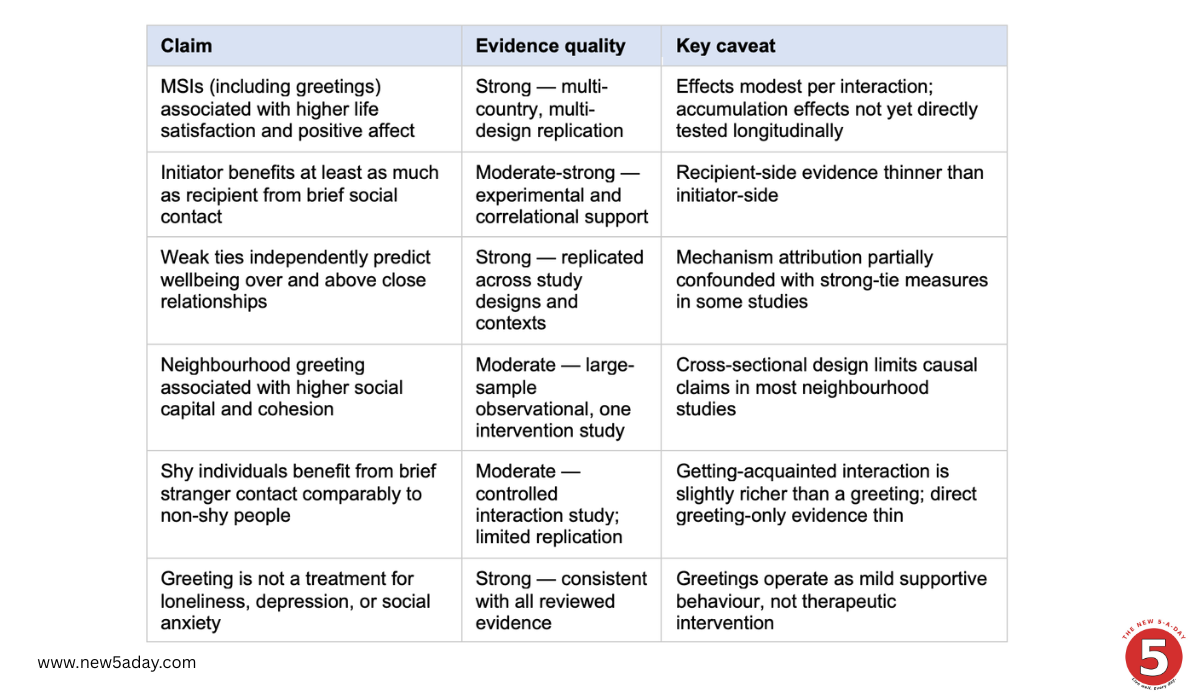
Summary of the evidence
The evidence supports the following conclusions:
A note on medical advice: This Deep Dive is intended to inform and educate, not to replace professional medical guidance. If anything you’ve read raises questions or concerns about your own health, please speak to your GP or another qualified health professional.
