I’m too shy! Overcoming shyness to reach Your People

Shyness is one of the most common barriers to building the social connections that keep us healthy and happy. It is not a personality flaw, a character weakness, or a life sentence — it is a learned anxiety response, and it can be unlearned. The good news: you do not need to become a social butterfly to benefit. Small, consistent steps are enough to begin opening up your world, building confidence, and finding Your People.
You know the feeling. You walk into a room full of people and something tightens in your chest. You rehearse what you might say, then decide it is probably not worth the risk. You hover near the edge of the group, nurse your drink a little too long, and leave earlier than you planned — relieved, but also a little deflated.
If that sounds familiar, you are in very good company. Shyness is one of the most widely shared human experiences there is. Studies suggest that around forty percent of people consider themselves shy, and many more experience shyness in particular situations — at work, with strangers, in large groups, or when they are out of their usual routine.
The problem is not the feeling itself. A little self-consciousness is perfectly normal, and in the right dose it makes us more thoughtful and empathetic. The problem arises when shyness becomes a wall that keeps us from the connections we genuinely want and need.
Because here is what the research on human health tells us clearly: connection matters. Enormously. Having people in your life — people you can be honest with, who notice when you go quiet, who show up when things get hard — is one of the most powerful things you can do for your long-term wellbeing. Loneliness and social isolation carry serious health risks. Strong relationships protect against depression, anxiety, physical illness, and early death.
So if shyness is getting in the way of finding Your People, it is worth taking seriously. And the encouraging news is this: shyness is not fixed. It can be worked with, gradually and gently, in ways that do not require you to fake an extroverted personality or put yourself through social ordeals. This post is about how.
First: shyness is not the same as introversion
This distinction matters, and it is worth getting clear on it before we go any further.
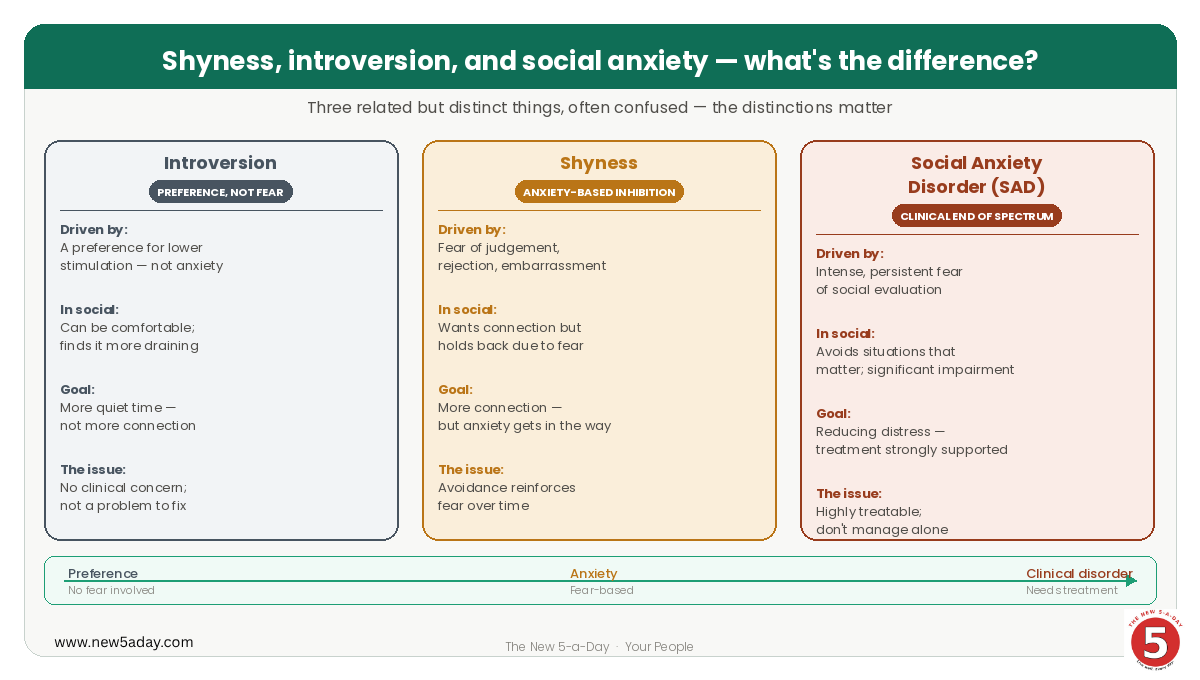
Introversion is about energy. Introverts recharge through time alone and find large social gatherings draining — but they can be perfectly comfortable in social situations. They simply need more quiet time to recover from them. There is nothing wrong with being an introvert. It is not a problem to be solved.
Shyness is different. It is about anxiety. Shy people often want connection — they want to join in, make friends, speak up — but they hold back because of fear: fear of judgment, of saying something wrong, of being rejected, of embarrassing themselves. That fear is the thing that gets in the way.
If you are an introvert who is happy with your social life and your own company, you may not need this post. But if you want more connection, more ease in social situations, more confidence to reach out — and shyness is what is stopping you — read on.
What is actually happening when shyness kicks in
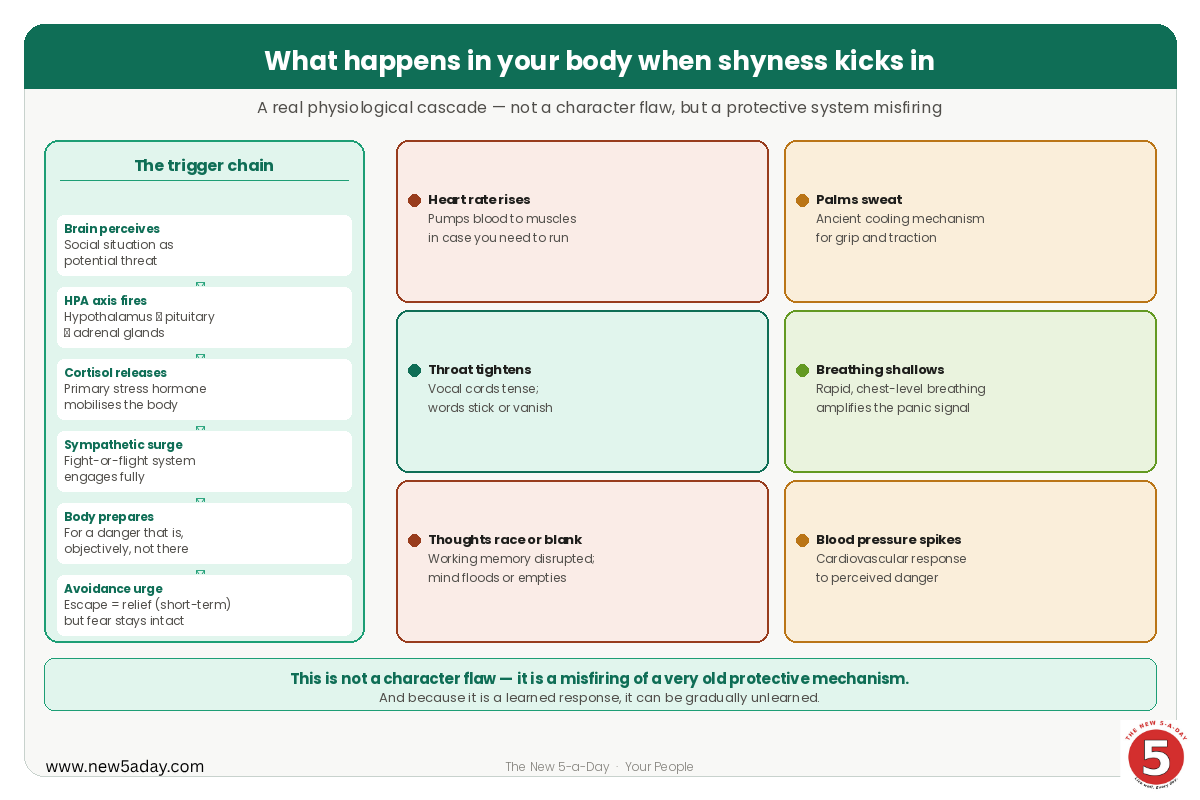
Shyness is not just a feeling. It has a real, physical component. When the brain perceives a social situation as a potential threat — even if that threat is simply the possibility of being judged unfavourably — it triggers the same basic alarm system it uses for danger. Heart rate rises. Palms sweat. Throat tightens. Thoughts race or go blank. The body is essentially preparing to fight or flee from a situation that is, objectively, safe.
This is not a character flaw. It is a misfiring of a very old protective mechanism. And because it is a learned response — one that has typically been reinforced over years of avoidance — it can be gradually unlearned.
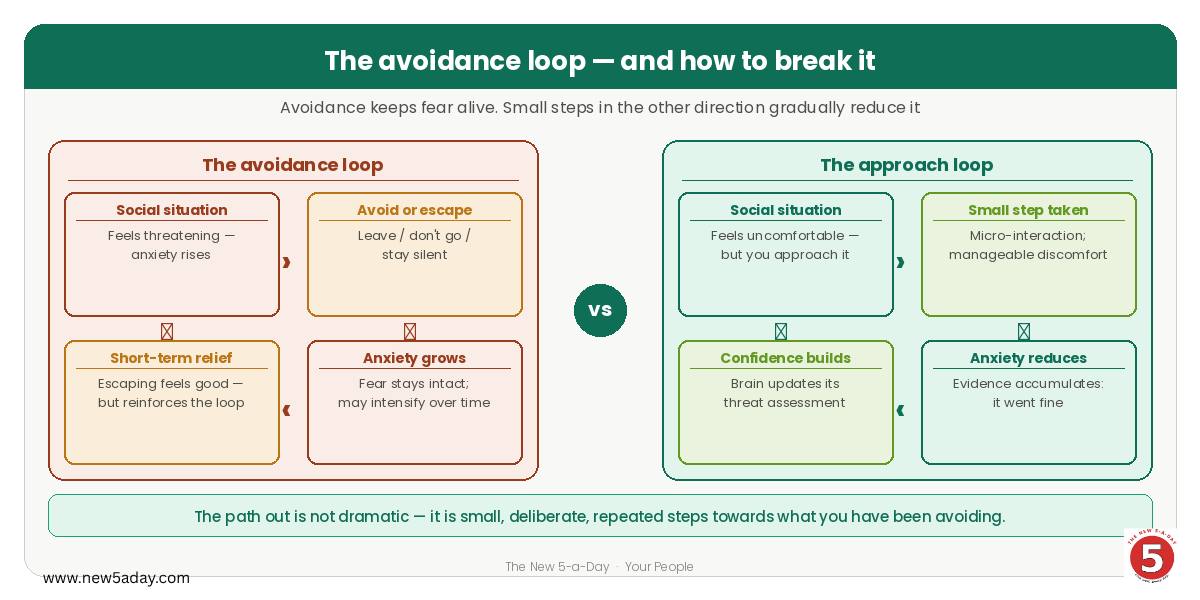
The key insight from decades of research on anxiety is this: avoidance keeps the fear alive. Every time we skip the party, dodge the conversation, or stay silent when we wanted to speak, we send our nervous system a message that the threat was real and we were right to escape. The anxiety stays in place, and often grows.
The path out runs in the opposite direction — not through grand gestures or dramatic exposure, but through small, deliberate, manageable steps towards the things we have been avoiding.
Start smaller than you think you need to
The most consistent finding in research on overcoming social anxiety is that gradual, repeated exposure to social situations — starting well within your comfort zone — is the most effective way to build confidence over time. The goal is not to prove anything to anyone. It is simply to accumulate evidence that social interactions can go fine.
That evidence starts with very small interactions:
• Make eye contact and smile at someone in a shop or on the street.
• Exchange a few words with a cashier, a barista, or a neighbour.
• Ask a simple question — about the bus, about the weather, about the menu.
• Say good morning to a colleague you usually walk past in silence.
These micro-interactions matter more than they seem. Each one is a small piece of evidence that social contact is not dangerous — that people are, in the main, perfectly pleasant. Over time, that evidence accumulates, and the brain's alarm response begins to settle.
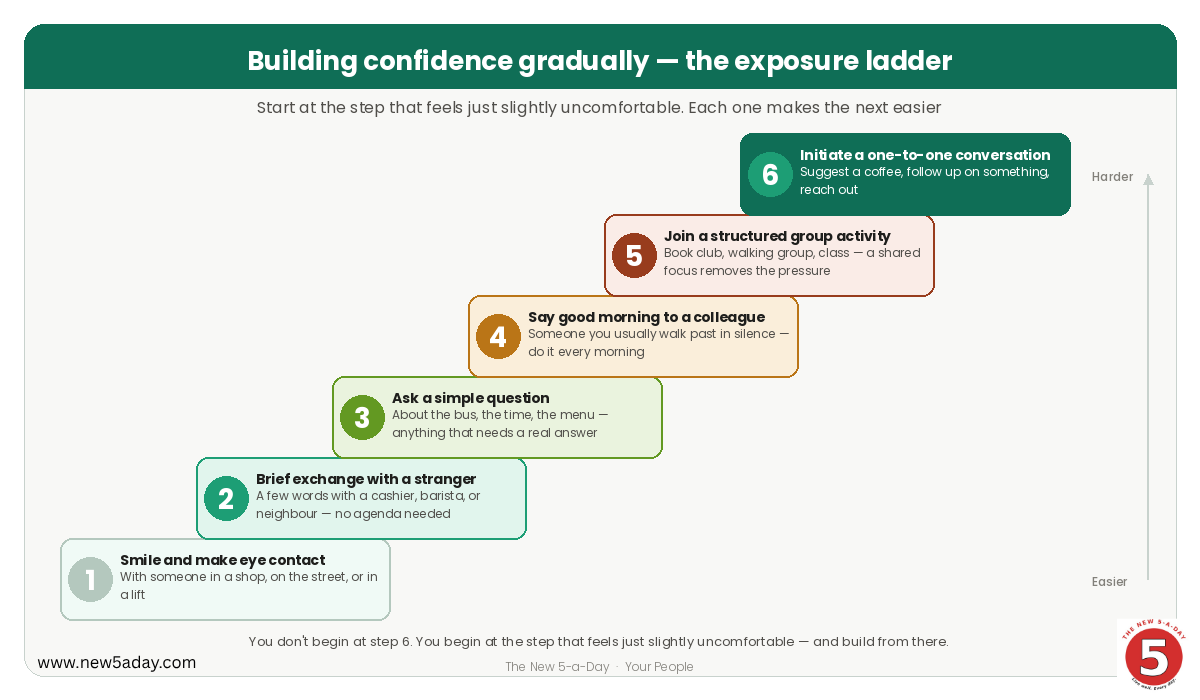
The principle is the same one that applies to any kind of fitness: you do not begin by running a marathon. You begin where you are, and you build from there.
Work with your thoughts, not against them
Shyness is often driven as much by what we think as by what we feel. A big part of what keeps it in place is a set of unhelpful mental habits — assumptions that feel true but are worth examining.
The most common one: the belief that everyone is watching and judging. In reality, most people are far more focused on how they themselves are coming across than on scrutinising you. The self-conscious feeling that all eyes are on you is almost always an exaggeration.
A useful technique borrowed from talking therapies is to gently challenge these automatic thoughts. When you notice yourself thinking "Everyone will think I'm boring" or "I'll say something stupid and they'll all remember it," try asking:
• Is this actually true, or is it what my anxiety is telling me?
• What is the realistic worst case here — and could I survive it?
• What would I say to a friend who was thinking this about themselves?
The aim is not to talk yourself into false confidence. It is to introduce a bit of realistic balance into thoughts that have been distorted by anxiety. Most social mishaps are forgotten within minutes, by everyone including you.
Being kind to yourself is part of this too. Progress in overcoming shyness is not linear. There will be conversations that feel awkward, events that do not go as hoped, moments when the anxiety spikes unexpectedly. That is normal. It is not evidence that you have failed — it is evidence that you are trying.
Your body can help
Shyness tends to show up in the body — and the body can be a tool for managing it. Posture, breathing, and simple grounding techniques can all make a real difference in how anxious you feel walking into a social situation.
Breathing. When anxiety spikes, breathing tends to become shallow and rapid, which amplifies the sense of panic. Slowing down your out-breath — making it longer than your in-breath — activates the part of your nervous system that calms things down. Try breathing in for four counts and out for six. Even a few rounds of this before you walk through the door can take the edge off.
Posture. Shyness often shows up as a closed-off physical stance — rounded shoulders, crossed arms, eyes down. Deliberately standing a little taller, uncrossing your arms, and meeting people's gaze (a soft, relaxed gaze, not a stare) both signals approachability to others and can gently shift how you feel about yourself. The relationship between body and mind runs in both directions.
Grounding. If you feel overwhelmed or anxious in a social situation, a simple grounding technique can help you re-anchor to the present moment: notice five things you can see, four you can touch, three you can hear. It sounds simple — because it is — but it genuinely works to interrupt a spiral of anxious thinking.
Build social momentum — find the right settings
Overcoming shyness is much easier in some settings than others. The environments that tend to work best share a few features: they are structured, they have a clear purpose beyond just "talking to people," and they reduce the pressure of filling silences.
This is why activities that bring people together around a shared interest tend to be such an effective route to connection for shy people. A book club, a walking group, a cookery class, a volunteer project, a choir, a running club — these all give you something to focus on and talk about that is not just yourself. The conversation has a built-in starting point.
Some practical pointers for building social momentum:
• Set yourself a single, modest goal for a social event — not "have lots of great conversations" but "speak to one new person." That is enough. One conversation is a success.
• Lean into your natural strengths. Shy people are often excellent listeners — genuinely attentive, warm, and thoughtful. That is not a consolation prize. It is a real social gift. People feel heard and valued when someone really listens. You do not need to dominate the conversation.
• Prepare a few simple questions you can use when things go quiet. Open-ended questions work best — ones that invite a proper answer rather than a yes or no. "How do you know the host?" "What brought you to this group?" "Have you been doing this long?" Let the other person talk.
• After the interaction — even a small one — take a moment to notice what went well. This sounds almost too straightforward, but deliberately registering the positives helps to gradually retrain the brain away from automatically focusing on what went wrong.
When to consider extra support
For many people, shyness is a manageable challenge — one that responds well to the kind of gradual, practical steps described above. But for some, what presents as shyness is closer to social anxiety disorder — a more intense and persistent difficulty with social situations that can significantly affect daily life.
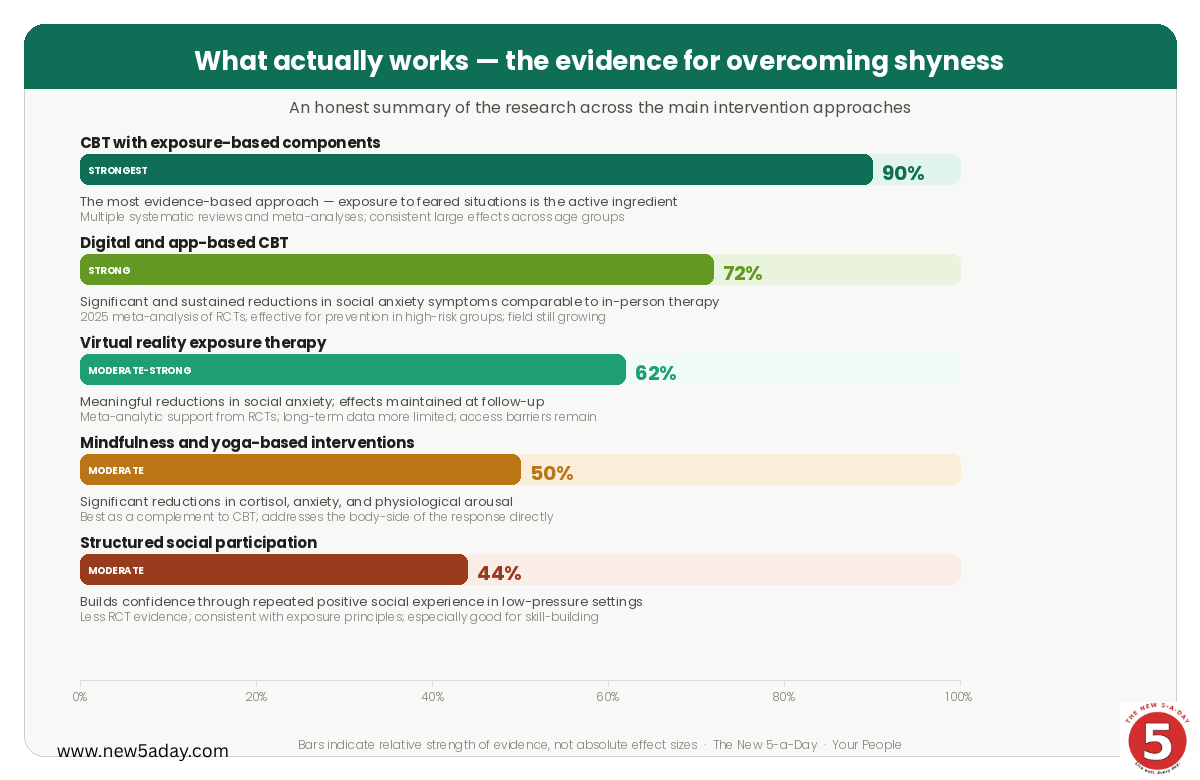
If your shyness is causing real distress, leading you to avoid situations that matter to you (work events, family gatherings, new opportunities), or if it has been a major barrier for a long time, it is worth talking to your GP. Effective treatments are available — including forms of talking therapy that have a strong evidence base for exactly this kind of difficulty — and there is no reason to manage it alone.
Seeking support is not a sign that you have failed to sort yourself out. It is a sign that you know what you need.
Bringing it back to the New 5-A-Day - the bigger picture
Here is something worth remembering: the goal is not to become someone who loves small talk and never feels nervous in a crowd. The goal is simply to feel a little freer — to be able to choose engagement when it matters to you, rather than having shyness make that choice on your behalf.
Every small step in that direction counts. Every conversation you have despite the nerves. Every event you go to when staying home would have been easier. Every moment you decide that connection is worth a little discomfort.
The connections on the other side of that discomfort — the friendships, the sense of belonging, the feeling of being known — are among the most valuable things in a human life. The research on what they do for health and longevity is, as we have explored elsewhere in this series, genuinely remarkable.
You do not have to be fearless to find Your People. You just have to be willing to take one small step, and then another, and then another after that.
That is more than enough to begin.
A note on medical advice: The content in this post is intended to inform and inspire, not to replace professional medical guidance. If anything you've read raises questions or concerns about your own health, please speak to your GP or another qualified health professional.
Want to explore further? This post is the accessible introduction. A detailed evidence-based Deep Dive, a full Reference List, and a podcast episode are all available on this site.
