Good morning! When is the best time to wake up?

Quick summary: There is no single best time to wake up that works for everyone — but there is a right approach for you. Your ideal wake-up time is one that fits your natural body clock, gives you enough sleep, and stays consistent from day to day. Getting light into your eyes soon after waking, moving your body, and anchoring your mornings to a steady time are the three habits that matter most. The specific hour is far less important than whether you can stick to it.
Here is a question that sounds like it ought to have a clean, scientific answer. What time should I wake up? Six o’clock? Half past seven? Something virtuous and early enough that it involves a sunrise jog and a protein-rich breakfast before most people have reached for their phones?
The honest answer is: it depends. But before that classic non-answer sends you back to bed, here is the more useful version: it depends on — and it can be tuned to — you. Your natural body clock, your sleep needs, your commitments, and crucially, your consistency. Get those things roughly right, and the specific number on the clock matters far less than you might think.
This post is about how to find your own best wake-up time — not someone else’s ideal, not a number from a productivity blog, and not a number chosen because it sounds disciplined. Let’s get into it.
There is no magic hour (but there is a right method)
Sleep researchers are in broad agreement on this: no single wake-up time suits everyone. What matters far more is that your wake-up time is consistent, fits your natural rhythm, and allows you to get enough sleep before it arrives.
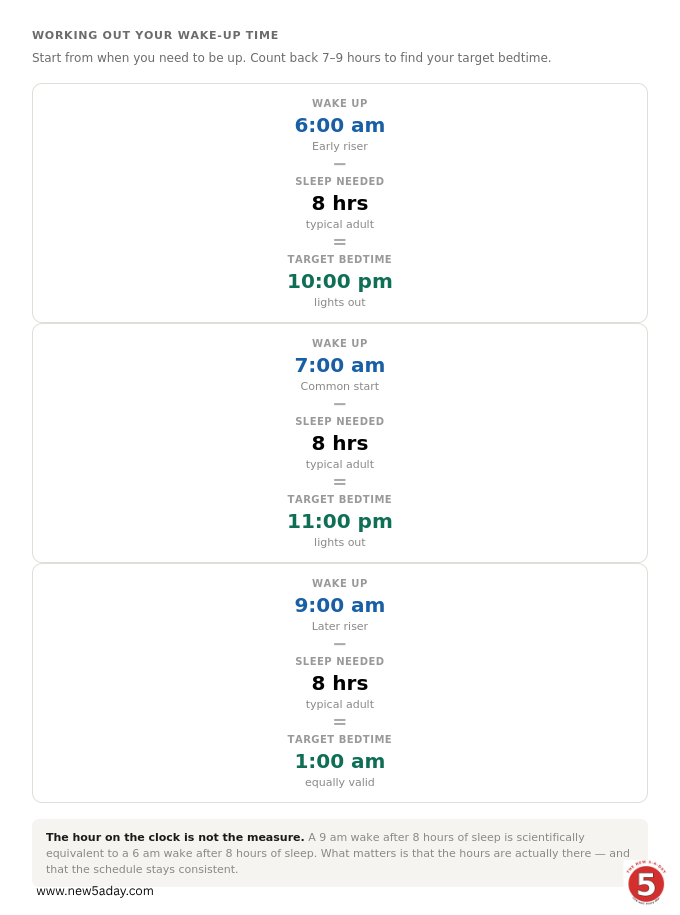
The simplest way to find your target wake-up time is to start from the other end. Decide when you need to be up, count back seven to nine hours, and you’ve found your target bedtime. Do that calculation honestly and most of us discover we’re already cutting things short.
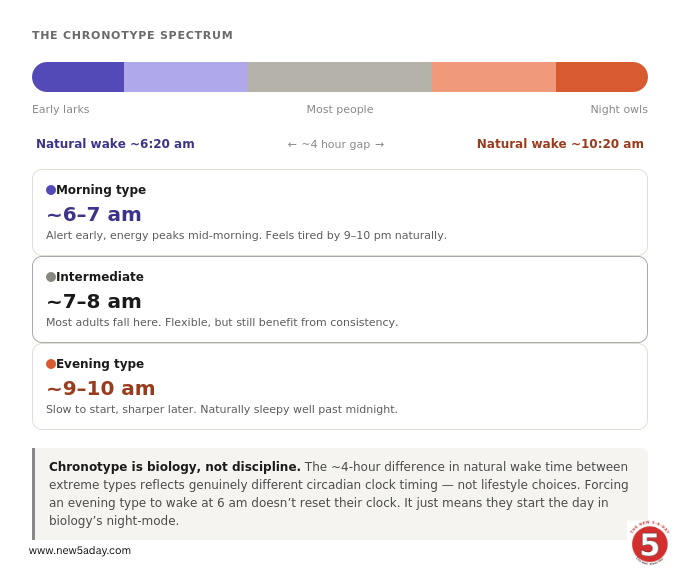
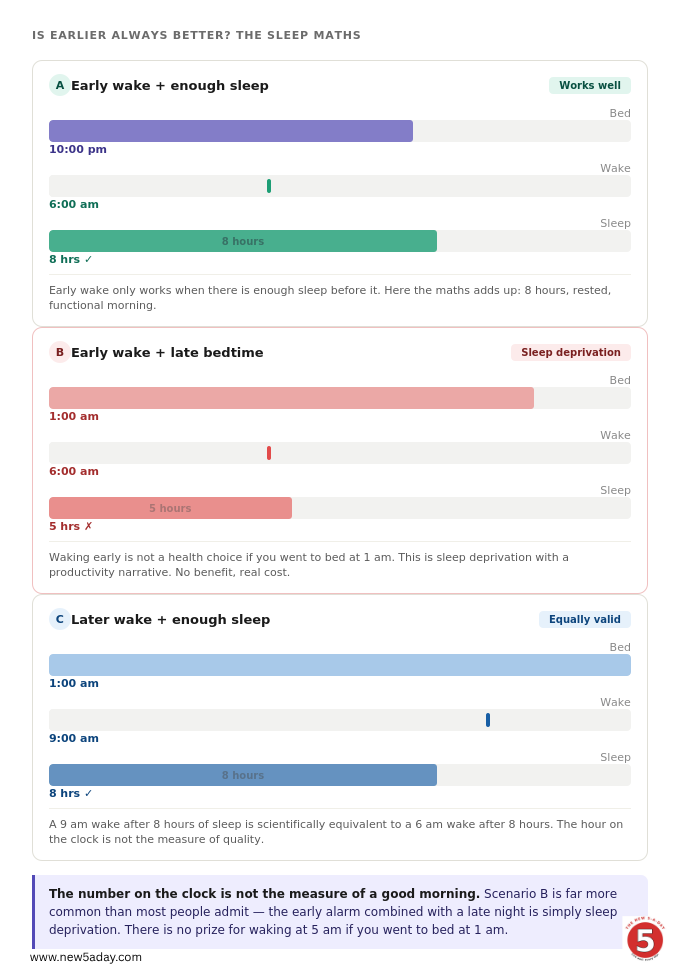
If you need to be up at 7 a.m. and you function well on eight hours of sleep, you’re looking at an 11 p.m. bedtime. If you’re a 6 a.m. riser, that means lights out around 10 p.m. And if your life genuinely allows a 9 a.m. start, then waking at 9 a.m. after going to bed at 1 a.m. is, from a sleep science perspective, perfectly valid — as long as the hours are actually there and the schedule is steady.
Your body clock is real — and it has opinions
Your body runs on an internal clock — a roughly 24-hour biological rhythm that regulates when you feel sleepy, when you feel alert, when your temperature rises and falls, and when hormones are released. Cortisol, which helps you feel awake and ready, naturally peaks in the early morning. Melatonin, which signals darkness and wind-down, rises in the evening.
Waking up when your body clock is ready for it makes everything easier: you feel more alert sooner, your mood is steadier, and you don’t spend the first hour of the day fighting your own biology. Waking significantly earlier than your clock wants — or later, interrupting natural sleep — creates friction. You know the feeling. The groggy, where-am-I confusion that can take half the morning to shift.
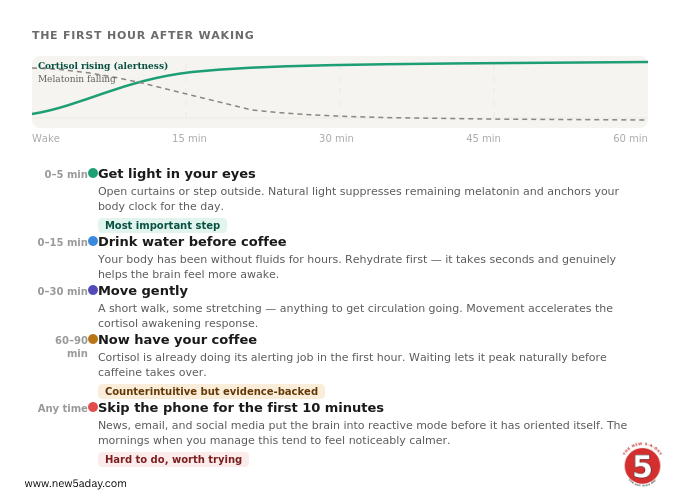
Interestingly, light is your body clock’s primary reset signal. Getting bright light into your eyes within the first thirty minutes of waking — ideally by going outside, even briefly — tells your brain that morning has arrived, suppresses any remaining melatonin, and sets the clock running for the day. It’s one of the most effective and completely free things you can do to improve your wakefulness and, as a bonus, your sleep that evening.
Are you a lark or an owl? (And why it genuinely matters)
Some people naturally come alive at 6 a.m. Others are genuinely sharper at 10 a.m., or even later. These tendencies — sometimes called your ‘chronotype’ — are partly written into your biology. They’re influenced by genetics, shaped by age, and reinforced by habit. They are not a measure of character or discipline.
Research shows that extreme morning and evening types can differ in their natural wake time by as much as four hours. That’s not laziness or virtue — it’s biology. And forcing an evening type to operate like a morning type, without adjusting their sleep, just produces a tired evening type.
Chronotype also shifts with age. Children tend to wake early. Teenagers experience a genuine biological drift towards later sleep — which is why asking a 16-year-old to be sharp at 8:30 a.m. is, from a sleep science perspective, a fairly unreasonable request. Many adults find their clock gradually moves earlier again through their forties and fifties. Older adults often wake earlier still, which is a normal shift in the body clock, not a sign of anything wrong.
None of this means your chronotype is locked in forever. Light exposure, regular schedules, exercise, and meal timing can all nudge your natural rhythm earlier or later over time. But it does mean that the ‘ideal’ wake-up time for a genuine night owl is legitimately different from an early bird — and both are fine, as long as enough sleep is happening.
Consistency is the real superpower
If there is one finding from sleep research that applies almost universally, it is this: waking at roughly the same time most days matters more than waking at any particular time.
Your body clock sets itself based on patterns. It notices when you habitually get up, when light arrives, when you eat and move. A consistent wake-up time — even more than a consistent bedtime — anchors your entire sleep-wake rhythm. When that anchor holds, falling asleep at night becomes easier, mornings feel less brutal, and your energy across the day becomes more predictable.
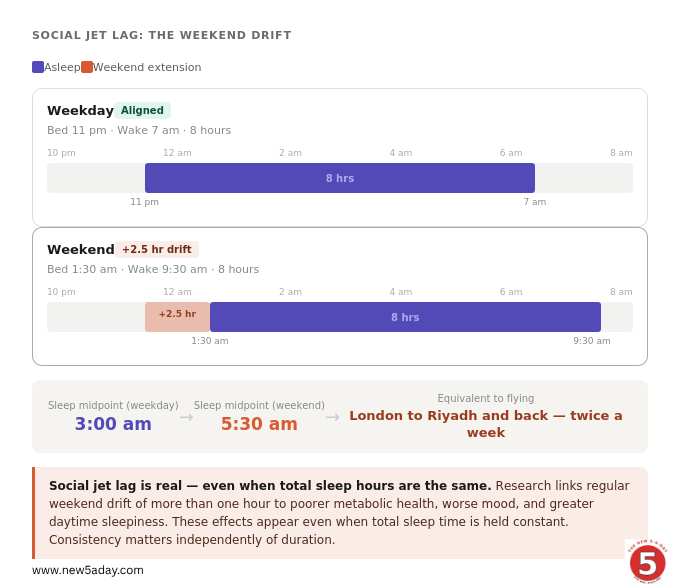
The trouble most of us run into is the weekend. Staying up late on Friday and Saturday and then sleeping until noon on Sunday feels like a reward. But what you’re actually doing is asking your body to cross two or three time zones, twice a week. Researchers call this ‘social jet lag’, and its effects are real: grogginess on Monday, disrupted sleep on Sunday night, and a body that never quite settles into a reliable rhythm.
The good news is that you don’t need to be rigid about it. Aiming for a wake-up time within a roughly one-hour window — say, any time between 7 and 8 a.m. — rather than a precise minute, is much more achievable and still delivers most of the benefits. Consistency, not perfection.
Is earlier always better?
There is a persistent cultural idea that early rising is inherently virtuous. The 5 a.m. club. The sunrise jog. The two hours of deep work before anyone else has started. The research tells a more complicated story.
Getting up early is only useful if you’re getting enough sleep before that alarm goes off. An early wake time paired with a late bedtime is simply sleep deprivation with a productivity narrative attached. There’s no prize for waking at 5 a.m. if you went to bed at 1 a.m.
There is also good evidence that people perform best — mentally and physically — when their activities are timed to match their chronotype. Morning types genuinely do think more clearly in the morning. Evening types genuinely perform better later. Forcing the wrong timing on yourself doesn’t overcome this; it just means you’re doing things at a disadvantage.
That said, very late wake times — consistently past 10 or 11 a.m. for working adults — often come with their own complications: misalignment with social and work schedules, reduced morning light, and the compounding effects of irregular rhythms. The most practical principle remains the same: find a wake time that lets you get enough sleep, fits your natural rhythm, and can actually be sustained.
How to find your own best wake-up time
Rather than guessing, try this simple approach over a week or two:
• Pick a consistent wake-up time that suits your life — factoring in work, your commute, and your commitments — and stick to it, including at weekends where possible (or stay within an hour of it).
• Count back seven to nine hours and make that your target bedtime.
• Get outside or near a window as soon as possible after waking. Even five to ten minutes of natural light makes a meaningful difference to how awake you feel.
• Drink a glass of water before coffee. Your body has been without fluids for hours.
• Move gently within the first half hour if you can — a short walk, some stretching, anything to get circulation going.
• Judge success by how you feel during the day: if you’re waking without an alarm most mornings, feel reasonably alert by mid-morning, and aren’t crashing by early afternoon, you’re probably in the right zone.
A note on sleep trackers: wearable devices — fitness watches, rings, and the like — can give useful data on sleep patterns, and some will even offer a gentle wake-up during a lighter sleep phase. If you enjoy that kind of feedback, they can be helpful. But how you actually feel during the day is a perfectly good measure in itself.
The first few minutes matter more than you think
Getting the timing right is part of the puzzle. What you do in the first fifteen to thirty minutes after waking shapes how the rest of the morning goes, and habits formed in that window tend to stick.
A few things that reliably help:
• Avoid your phone for at least the first ten minutes. Starting the day with news, email, or social media activates a reactive mode before your brain has had a chance to orient itself. This sounds obvious and is genuinely hard to do, but the mornings when you manage it tend to feel noticeably calmer.
• Wait sixty to ninety minutes before your first coffee. Counterintuitive, but cortisol — your natural alertness hormone — is already rising in the first hour after waking. Hitting it immediately with caffeine can blunt that natural response. Let the cortisol do its job first, then add the coffee.
• Resist the snooze button. When your alarm goes off and you hit snooze, your brain tries to re-enter sleep. It often can’t complete a full sleep cycle in nine minutes, which means you’re more likely to wake from a lighter, more fragmented phase and feel worse. The grogginess you’re trying to avoid often comes from the extra nine minutes, not the initial alarm.
• Eat breakfast when you’re actually hungry. There’s no requirement to eat the moment you wake up. Some people feel better eating within an hour; others prefer to wait. What matters is eating something before your energy flags, and choosing something with protein and fibre rather than sugar that will spike and crash.
When life doesn’t cooperate
Real life — shift work, young children, early flights, genuinely unmissable television — does not always bend to an ideal sleep schedule. That’s fine. The goal isn’t perfection; it’s a better average.
A late night or an unavoidable early start is not going to derail your health. A pattern of those things, compounded over weeks and months, is what quietly erodes things over time. If you know a disrupted night is coming, the most useful thing you can do is protect the nights around it: get to bed on time the night before, and resume your normal wake-up time the following day rather than trying to catch up with a long sleep-in.
Shift workers face a genuinely harder version of this puzzle. The same principles apply where they can: consistency within your shift pattern, morning light when you’re meant to be waking (blackout curtains and light therapy lamps earn their keep here), and protecting the sleep window you do have. It’s a more difficult problem, but not an unsolvable one.
Bringing it back to The New 5-a-Day
Sleep is one of the five pillars of The New 5-a-Day, and how you wake up is one of the most underestimated levers within it. You don’t need to become a 5 a.m. person, follow a complicated morning protocol, or invest in expensive gadgets.
The question ‘what time should I wake up?’ is really three questions in one:
• What time lets me get enough sleep before I need to be up?
• What time fits my natural body clock?
• What time can I actually sustain on most days?
Answer those honestly, and you’ve found your wake-up time. Not a universal one. Yours.
Most of us already know, somewhere in the back of our minds, that our mornings could be going better. We know we’re cutting sleep short. We know the snooze button isn’t actually helping. We know that the first thing we reach for probably shouldn’t be our phone. That’s not a moral failing — it’s just the gap between what we know and what we do.
So: pick a wake-up time that makes sense for your life. Keep it roughly consistent. Get some light in your eyes within the first half hour. And if you find yourself waking just before your alarm most mornings, feeling more human than usual — that’s your body clock settling into its rhythm. That’s the experiment working.
Good morning.
A note on medical advice: The content in this post is intended to inform and inspire, not to replace professional medical guidance. If anything you've read raises questions or concerns about your own health, please speak to your GP or another qualified health professional.
Want to explore further? This post is the accessible introduction. A detailed evidence-based Deep Dive, a full Reference List, and a podcast episode are all available on this site.
