The bedtime habit: how what you do before bed shapes how well you sleep
Quick summary: What you do in the hour or two before bed has a surprisingly big effect on how quickly you fall asleep and how well you stay asleep. Good bedtime habits — consistent timing, winding down gradually, dimming the lights, stepping away from screens — help your body and brain shift smoothly into sleep mode. Habits that work against you — late caffeine, alcohol, heavy meals, and staying mentally switched on until the moment your head hits the pillow — can make sleep harder to find, and harder to keep. The good news: small, consistent changes can make a genuine difference.
Most of us treat sleep like an on/off switch. We finish whatever we were doing — work, screens, scrolling, catching up with something we've been half-watching for three weeks — and then we wonder why it takes so long to actually fall asleep.
The truth is that sleep isn't something that happens the moment you lie down. It's something your body prepares for — or doesn't. And the hour or two before bed is where that preparation either happens or gets quietly sabotaged.
This post is about bedtime habits: what helps, what doesn't, and why the difference matters more than most people realise.
Why the run-up to bed matters
Your body doesn't switch from full alertness to deep sleep in one step. There's a wind-down period — a biological transition during which your heart rate slows, your core body temperature drops slightly, and a hormone called melatonin gradually rises to signal that it's time to rest. This process takes time, and it can be supported or disrupted by the things you do in the evening.
The brain also has an internal body clock — a 24-hour rhythm that regulates when you feel sleepy and when you feel alert. Good bedtime habits work with that clock. Poor ones work against it, keeping you in a state of alertness long past the point when your body was ready to rest.
Understanding this helps explain why some things that feel relaxing — a glass of wine, a late-night snack, another episode of something absorbing — can actually make sleep worse. It's not just about how tired you feel. It's about whether the conditions for good sleep are actually in place.
Habits that help: building the right conditions for sleep
Keep a consistent bedtime — and stick to it most nights
Consistency is probably the single most powerful sleep habit there is. Going to bed and waking up at roughly the same time most days helps your body clock settle into a reliable rhythm, making it easier to feel sleepy at the right time and wake up feeling more rested. You don't need to be a monk about it — a window of around an hour either side of your usual bedtime is realistic enough. But the wider that window gets, the more your body clock gets confused.
Give yourself a genuine wind-down period
The brain learns from repetition. If you follow the same calming steps each night — even something as simple as dimming the lights, changing into comfortable clothes, and doing something quiet — your body begins to recognise these as signals that sleep is coming. You're essentially teaching yourself to slow down. It doesn't need to be an elaborate ritual. It just needs to be something you repeat.
A short wind-down period of around 30 to 60 minutes is generally enough for most people — enough time to shift your nervous system out of active mode without turning the whole evening into a bedtime ceremony.
Dim the lights as the evening progresses
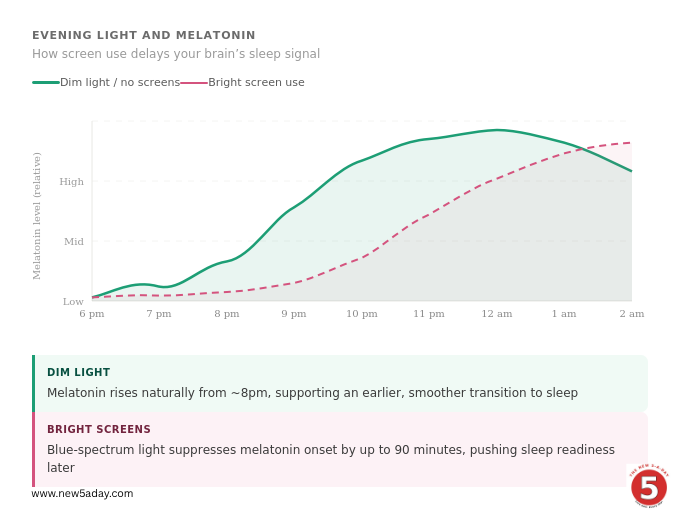
Light is one of the most powerful signals your brain uses to regulate its internal clock. Bright light — especially the blue-tinted light from overhead LEDs and screens — tells the brain it's still daytime and delays the rise of melatonin. Switching to lamps, warmer tones, or simply turning off some lights in the hour or so before bed helps melatonin rise naturally and makes the whole process of feeling sleepy go more smoothly.
Give your mind somewhere to put things
Worrying in bed is one of the most common reasons people struggle to fall asleep. The harder you try to stop thinking, the more your brain resists. A useful workaround is to do a brief 'thought dump' earlier in the evening — jotting down tomorrow's tasks, outstanding worries, or anything your mind keeps returning to. The act of writing it down isn't magic, but it does give the brain a kind of permission to let go. It's been noted for now. It doesn't need to be rehearsed repeatedly while you're trying to sleep.
Some people also find that a short breathing exercise or a few minutes of quiet reflection helps quieten mental activity before bed. None of this needs to be formal or time-consuming — the goal is simply to create a little space between the busyness of the day and the stillness you're hoping for at night.
Keep your bedroom cool, dark, and calm
Your body temperature naturally drops slightly as you fall asleep, so a cooler room makes that process easier. Darkness — genuine darkness, not just dimness — tells your body clock that it's genuinely night. Blackout curtains, a slightly open window, and keeping the bedroom as a place for rest rather than work or entertainment are all small, inexpensive adjustments that can make a real difference over time.
Habits that work against you: what to watch for
Caffeine in the afternoon and evening
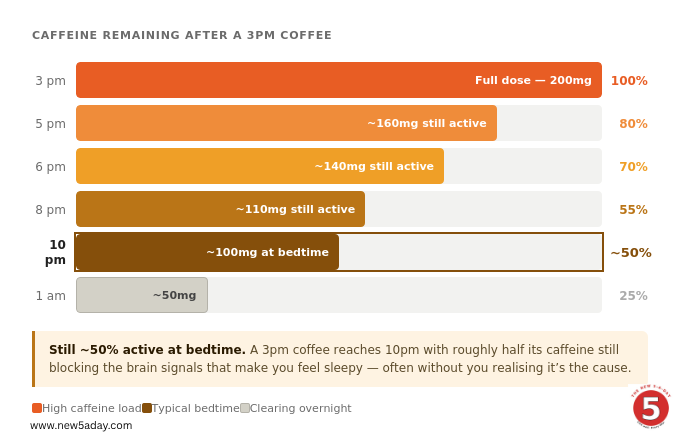
Caffeine is a stimulant that works by blocking the brain's receptors for adenosine — the chemical that builds up during the day and makes you feel progressively sleepier. The problem is that caffeine lingers. In most adults, roughly half of the caffeine from a cup of coffee is still active in the body five to six hours later. A coffee at 4 p.m. can still be interfering with your ability to fall asleep at 10 p.m., often without you even realising that's the cause.
It's not just coffee. Tea, cola, energy drinks, and even chocolate contain enough caffeine to be worth thinking about. For many people, cutting caffeine off by early afternoon is one of the simplest and most effective changes they can make for better sleep.
Alcohol close to bedtime
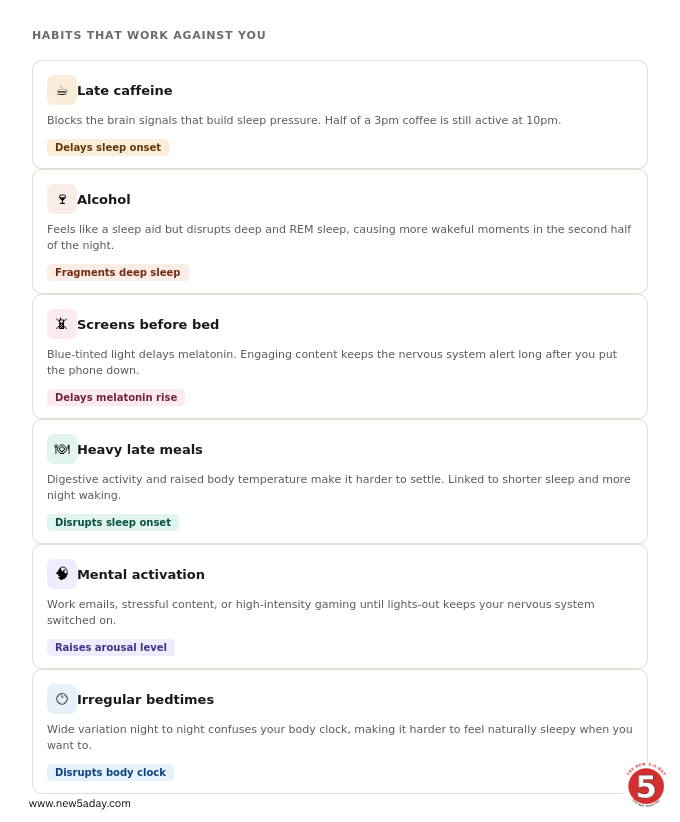
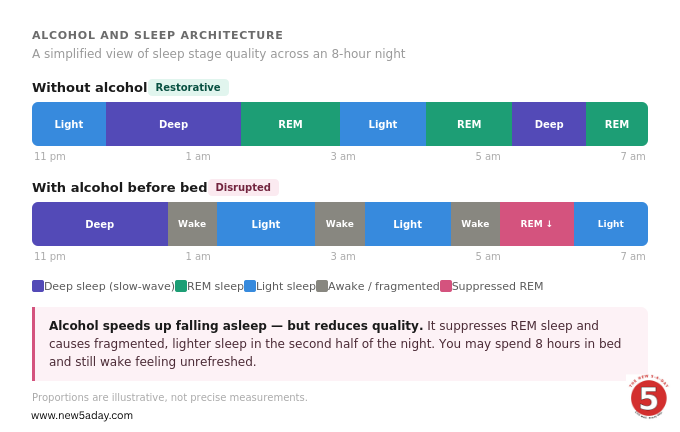
This one surprises a lot of people, because alcohol can genuinely make you feel drowsy. The catch is what happens once you're asleep. Alcohol disrupts the architecture of sleep — particularly the deeper, more restorative stages — causing more fragmented rest, more wakeful moments in the second half of the night, and often a less refreshed feeling in the morning, even after a full night in bed.
A drink now and then is unlikely to ruin your sleep completely. But if you're regularly drinking in the evening and wondering why you're not sleeping as well as you'd like, it's worth connecting those dots.
Eating late and eating heavily
A large meal close to bedtime can cause discomfort, reflux, and a general sense of fullness that makes it harder to settle. Your digestive system is still working while the rest of you is trying to wind down, which isn't a great combination. This doesn't mean you need to stop eating after 6 p.m. — timing will vary by person and lifestyle — but finishing your main meal a couple of hours before bed is generally a helpful principle. If you're genuinely hungry later, a light snack is a better option than a heavy one.
Screens and mental stimulation right before bed
Screens are a double problem. The light they emit — particularly the blue-tinted spectrum — delays melatonin. But they're also mentally engaging in a way that's genuinely difficult for the brain to step back from. Social media, news, games, and videos all involve rapid switching between stimuli, which keeps the nervous system alert. Even 'relaxing' screen activity tends to be more activating than genuinely restful alternatives.
Putting your phone away 30 to 60 minutes before bed is one of the most consistently cited pieces of sleep advice — and it's annoying advice, because most of us find it genuinely difficult. If stopping completely feels unrealistic, reducing brightness, switching to night mode, and choosing calmer content are reasonable compromises. But the more you can replace screen time with lower-stimulation activity, the easier you're likely to find falling asleep.
Staying 'on' until the last moment
Work emails, heated conversations, stressful content, or high-stakes gaming until the moment the lights go off are all forms of mental activation that don't simply switch off when you do. Your nervous system needs time to downshift, and expecting it to go from full alertness to restful sleep in the space of a few minutes is asking rather a lot. This is where irregular sleep schedules also cause problems: going to bed very late one night and much earlier the next confuses your body clock, making it harder to feel naturally sleepy when you want to.
Using your bed for waking activities
This one sounds almost too obvious to mention, but it's worth saying: if you regularly work, eat, or scroll in bed, your brain gradually stops associating the bed with sleep. The bedroom becomes a place of activity rather than rest, and that association can genuinely make it harder to fall asleep when you want to. Keeping the bed primarily for sleep (and intimacy) helps preserve the mental link between lying down and switching off.
What a realistic bedtime routine actually looks like
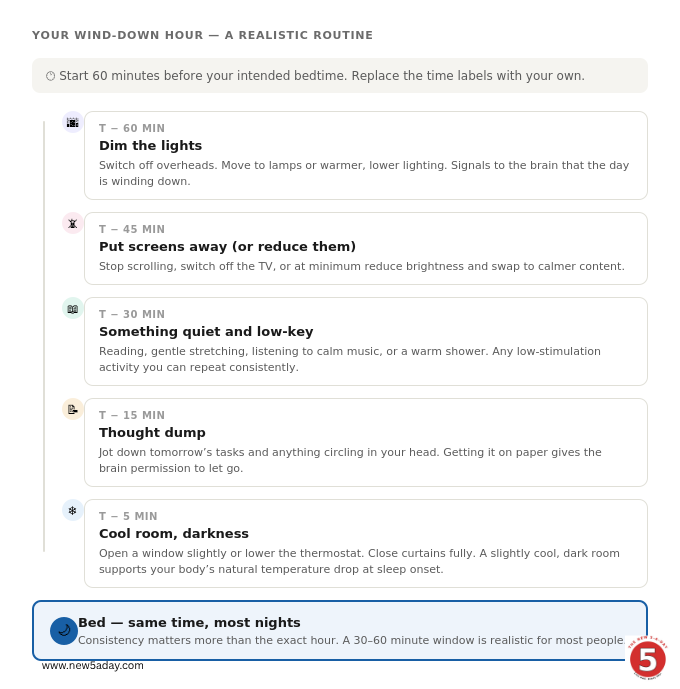
The best bedtime routine is the one you can actually repeat. It doesn't need to be complicated, expensive, or time-consuming. Here's what a straightforward version might look like:
• Finish your main meal at least a couple of hours before bed.
• Switch your last caffeine of the day to the early afternoon — tea or coffee before 2 p.m. is a reasonable guide for most people.
• Dim the lights as the evening progresses.
• Put screens away or at least reduce their brightness and stimulation in the 30 to 60 minutes before bed.
• Do something quiet and low-key — reading, gentle stretching, listening to calm music, a warm shower.
• If your mind is busy, jot down tomorrow's tasks or whatever is circling in your head — to get it out of your head and onto paper.
• Go to bed at roughly the same time most nights.
None of this is radical. But that's the point. The most effective sleep habits are not the most complicated ones — they're the ones that are simple enough to actually stick to.
A note on difficult nights
Good sleep habits significantly improve the odds of sleeping well — but they don't guarantee it every single night. Stress, illness, disrupted schedules, and life's general unpredictability will get in the way sometimes, and that's completely normal.
If a bad night happens, the most useful thing you can do is resist the urge to compensate by going to bed much earlier the following night, or sleeping in for longer than usual. Both can disrupt your body clock further. Instead, keep your wake time roughly consistent, let yourself feel naturally sleepy the next evening, and trust that a good night's sleep usually follows a bad one when your routine stays stable.
If poor sleep is persistent — if you regularly struggle to fall asleep, wake frequently, or feel consistently unrefreshed despite enough time in bed — it's worth speaking to a GP. Good habits help enormously, but ongoing sleep difficulties can sometimes have underlying causes that benefit from professional input.
Bringing it back to The New 5-a-Day
Sleep is one of the five pillars of The New 5-a-Day for a reason. The evidence that good sleep supports almost every aspect of health — physical, mental, cognitive, emotional — is overwhelming. And bedtime habits are one of the most direct levers you have.
The beauty of this particular pillar is that you don't need to overhaul your life to see benefits. You don't need a special mattress, a sleep tracker, a new supplement regime, or a 12-step evening protocol. You mostly need to be a little more intentional about the hour or two before bed — dialling down stimulation, keeping things consistent, and giving your body and brain the conditions they need to do what they're already designed to do.
Sleep doesn't happen by accident. It happens when you prepare for it.
Start tonight with one small change — whichever feels most manageable. Cut your caffeine off an hour earlier. Dim the lights at 9 p.m. Leave your phone charging in another room. Spend the last twenty minutes reading rather than scrolling.
Small changes, consistently repeated, are how good sleep habits are actually built.
Good night.
A note on medical advice: The content in this post is intended to inform and inspire, not to replace professional medical guidance. If anything you've read raises questions or concerns about your own health, please speak to your GP or another qualified health professional.
Want to explore further? This post is the accessible introduction. A detailed evidence-based Deep Dive, a full Reference List, and a podcast episode are all available on this site.
