Good morning! Rise and shine!

Quick summary: The first hour of your day is quietly powerful. A few simple habits — a bit of daylight, a glass of water, a little movement, and a pause before you pick up your phone — can shift how alert, calm, and focused you feel for the rest of the day. A good morning routine is not the longest or most impressive one. It is the short, sensible one you can actually repeat most days. Start with one or two small things, keep them consistent, and build from there.
Mornings have a reputation problem. Open any wellness magazine or scroll any corner of social media and you will find someone explaining how their flawless five-a.m. routine — ice plunge, thirty minutes of journalling, green smoothie, two-hour workout, meditation, sunrise photograph — is the reason they are winning at life. By the end of it you feel either inspired or mildly depressed, depending on the day.
The honest truth is more useful. A good morning routine does not need to be elaborate, and it certainly does not need to start at five a.m. It just needs to do a few simple things well: help your body wake up, your mind settle, and the rest of your day start with a bit less friction. This post is about what really matters in the first hour after waking, what to avoid, and how to build something that survives the reality of a busy life.
Why the first hour actually matters
What you do in the hour or two after waking sends your body and brain a set of signals. Natural light tells your body clock that the day has officially started. A little movement shakes off the grogginess that normal people experience after sleep (yes, including you). Hydration and something sensible to eat help your energy level stabilise rather than spike and crash. A calm minute before the inbox opens lets your brain catch up with itself.
Get these roughly right and you set yourself up for steadier energy, better mood, and easier sleep the following night. Get them badly wrong — no light, no movement, a cortisol-spiking headline scroll before your eyes are fully open — and the rest of the day tends to feel harder than it needs to.
This is not about perfection. It is about the first few dominoes.
The building blocks of a good morning
You will find dozens of ‘perfect morning routines’ online, most of them trying to sell you something. Strip away the marketing and the research points repeatedly to the same short list of things that actually help most people most of the time.
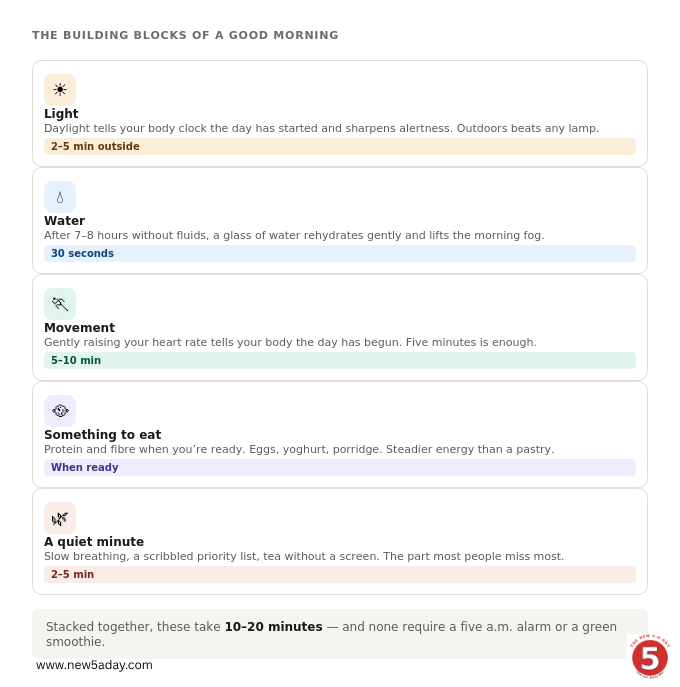
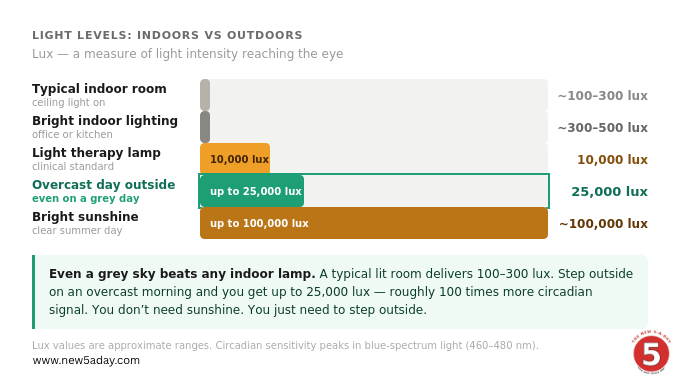
Light. Daylight soon after waking is probably the single most useful habit on this list. It tells your body clock that it is morning, sharpens your alertness, and — usefully — helps you feel sleepy at a sensible time that evening. You do not need a sunrise hike. Opening the curtains, eating breakfast by a bright window, or stepping outside for a few minutes while the kettle boils is enough. Even on an overcast day, outdoor light is far brighter than any indoor lamp.
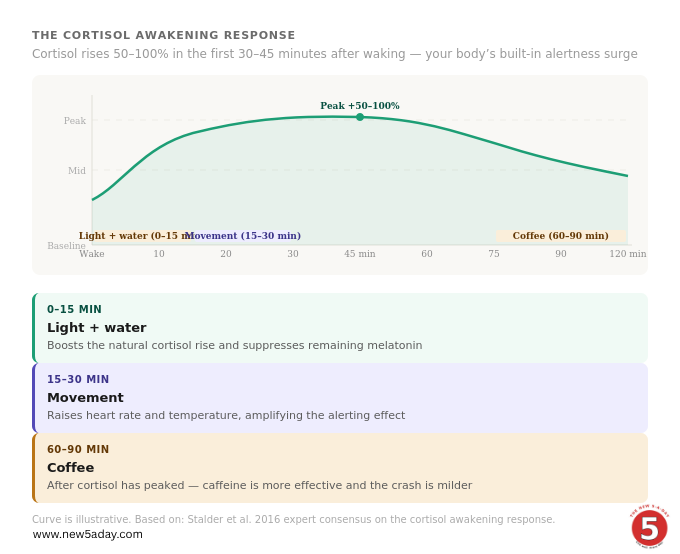
Water. You have just gone seven or eight hours without drinking anything. A glass of water first thing is the least glamorous tip in wellness, and one of the most effective. It wakes up your digestion, rehydrates you gently, and — for many people — reduces the fog of the first thirty minutes.
Movement. Anything that gently raises your heart rate helps shift your body out of sleep mode. A five-minute stretch, a walk round the block, a quick set of bodyweight moves, or a proper workout if you are that kind of person. The point is not to train for a marathon before breakfast; it is to tell your body that the day has begun.
Something sensible to eat, when you are ready. Breakfast is not compulsory, despite what cereal boxes have told us for decades. If you are not hungry straight away, that is fine. When you do eat, aim for something with a bit of protein and fibre rather than a pure sugar hit. Eggs, yoghurt, porridge, wholegrain toast with something on it, last night’s leftovers — they will all keep your energy steadier than a pastry on the way to work.
A quiet minute. A short pause before the day rolls over you is surprisingly powerful. It might be two minutes of slow breathing, a moment of prayer, a scribbled list of the three things that actually matter today, or simply drinking your tea without looking at a screen. This is the part most morning routines skip, and it is often the part people miss most when it is gone.
None of these take long on their own. Stacked together, ten to twenty minutes is usually plenty.
What to avoid (and why)
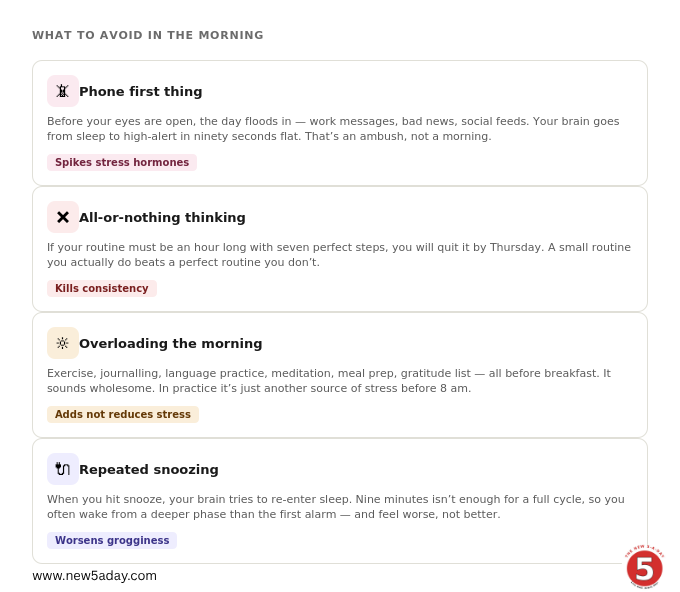
There is one habit that undoes a surprising amount of everything above: reaching straight for your phone. Before you have even sat up, the day floods in — work messages, bad news, somebody else’s holiday photos, an email you do not want to answer. Your brain goes from sleep to high-alert input processing in about ninety seconds flat. That is not a morning routine. That is an ambush.
Giving yourself even fifteen to thirty phone-free minutes at the start of the day changes how you feel for the hours that follow. You do not need to turn it into a rule. Just try it for a week and see.
A few other things quietly sabotage mornings.
• The ‘all or nothing’ trap. If your routine has to be an hour long and involve seven perfect steps, you will quit it by Thursday. A small routine you actually do beats a perfect routine you do not.
• Overloading the morning. Exercise, journalling, language practice, meditation, meal prep, reading, a gratitude list — all before breakfast. It sounds wholesome. In practice, it is just another source of stress.
• Snoozing repeatedly. Hitting snooze gives you fragmented, shallow sleep in the last part of the night — the part where some of the best sleep actually happens. You usually feel worse, not better. Set the alarm for when you actually need to get up.
• Caffeine straight on top of an empty, dehydrated body. Coffee is not the enemy. But a glass of water first, then the coffee, is almost always the better order.
A morning routine that fits a real life
If you are reading this with small children climbing on you, a long commute ahead, or a job that starts before you are ready, ‘ideal morning routine’ can sound faintly ridiculous. It is not. It just has to be scaled.
Think of it as a minimum effective dose. Here is a version that takes roughly ten minutes and does most of the heavy lifting:
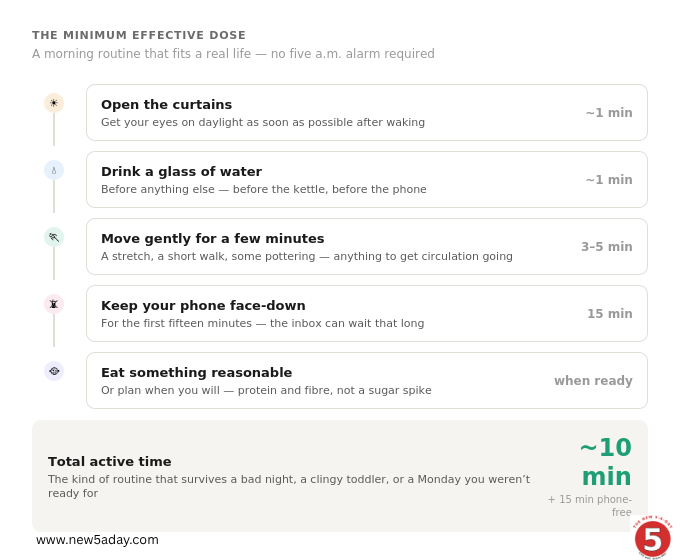
• Open the curtains. Get your eyes on some daylight.
• Drink a glass of water before anything else.
• Move gently for a few minutes — a stretch, a short walk, a bit of pottering about.
• Keep your phone face-down for the first fifteen minutes.
• Eat something reasonable, or plan when you will.
That is enough. If you have more time and want to add a proper walk, a stretch, a workout, or a few quiet minutes with a notebook, brilliant. But the core should stay short, simple, and portable — the kind of thing that survives a bad night, a clingy toddler, or a Monday you are not ready for.
One practical point: the morning before often starts the night before. Laying clothes out, sorting bags and keys, knowing what is for breakfast, and going to bed at a reasonable hour all make the next morning easier in ways you do not always notice until you skip them.
How to actually build the habit
The most common mistake is trying to do everything at once. Pick one habit. Water on the bedside table. Curtains open before anything else. Phone in another room overnight. Whichever one feels most realistic for your life. Do it every day for a couple of weeks until it stops feeling like a decision. Only then add another.
Consistency matters far more than intensity here. A small routine you manage most days will shift how you feel more than a complicated routine you abandon after a week.
And give yourself permission to have bad mornings. You will have them. Travel, illness, late nights, small humans with opinions — life does not always cooperate. A routine is a default to return to, not a test to pass.
Bringing it back to The New 5-a-Day
Sleep is Pillar One of The New 5-a-Day, and your mornings are part of it. How you wake up shapes how well you sleep that night, which shapes how you wake up the day after. The loop runs in both directions.
You do not need to become a different person to have a better morning. You do not need special equipment, or an earlier alarm, or a life without responsibilities. You just need a few small, sensible habits, repeated often enough that your body starts to expect them.
Open the curtains. Drink the water. Move a little. Keep the phone out of the first fifteen minutes. See how the day feels.
Good morning.
