Quick summary: Saying hello is one of the smallest things a person can do. It takes a second, costs nothing, and requires no particular skill or charisma. And yet the research on this type of minimal social interaction is consistent and striking: greeting people — neighbours, colleagues, strangers, the person at the counter — is reliably linked to higher life satisfaction, better mood, a stronger sense of belonging, and a warmer experience of everyday life. The benefits flow in both directions: to the person doing the greeting and the person being greeted. And they ripple outwards too, quietly shaping the feel of workplaces, streets, and whole communities. This post looks at what the evidence says, why it matters, and how to build the habit — especially if the idea of speaking to someone you don’t know feels anywhere between slightly awkward and mildly alarming.
Think about the last time someone greeted you unexpectedly. A neighbour catching your eye and saying good morning. A colleague using your name when they passed you in the corridor. A stranger at a bus stop offering a brief, easy smile and a hello. Chances are it lifted something in you — some small, almost imperceptible shift in the texture of the day.
Now think about the last time you did the same for someone else.
That is what this post is about. Not grand acts of social bravery, not building a network, not becoming someone who lights up every room they walk into. Just hello. One small word, offered consistently, in the ordinary moments of an ordinary day — and what it turns out to be worth.
This is Post Five in Your People — Pillar Five of The New 5-a-Day — and it focuses on the most modest form of human connection imaginable. The greeting. The nod. The “good morning.” And why it matters far more than it looks.
What the research actually says
Researchers who study social connection have become increasingly interested in what they call minimal social interactions — the very briefest forms of contact between people: a greeting, a thank you, a quick exchange of good wishes. These are not conversations. They are shorter than that. And yet the evidence on their effects is surprisingly robust.
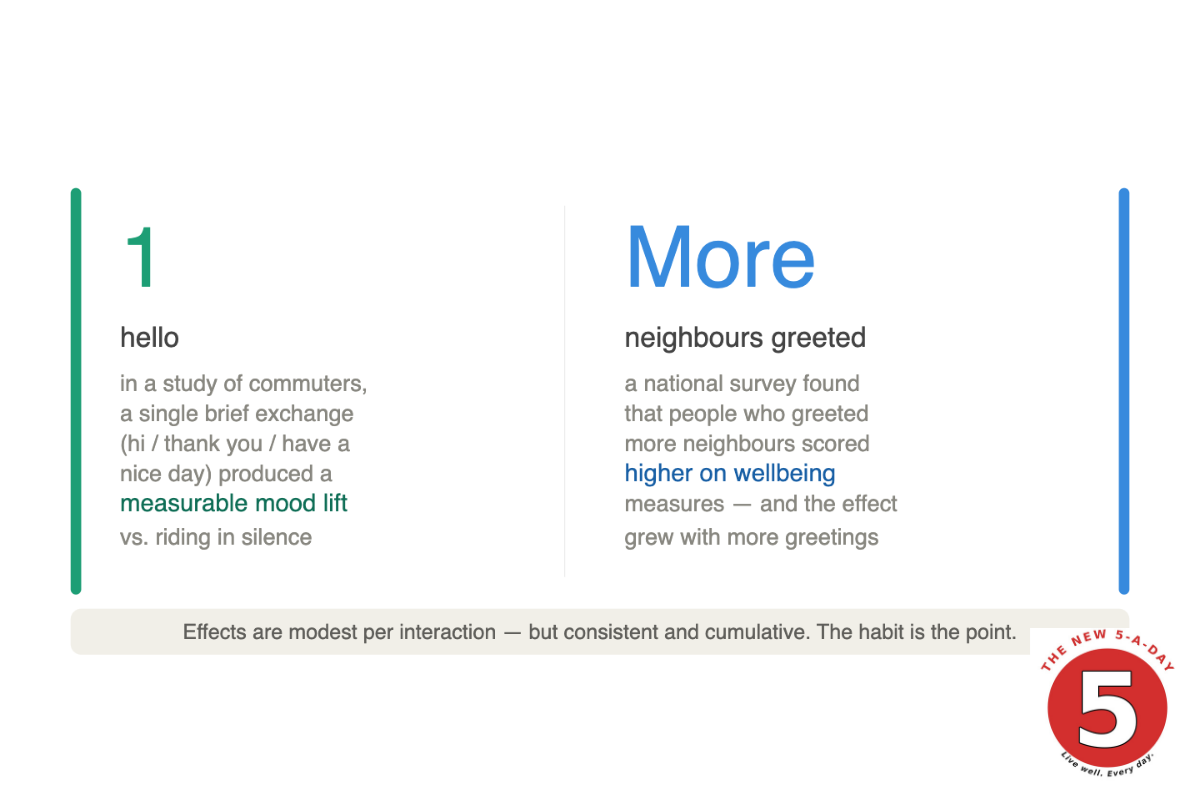
Studies consistently show that people who engage in more frequent minimal interactions — including simple greetings — report higher life satisfaction and more positive mood than those who do not. The effect holds across different countries and cultures. One experiment found that commuters who said something as brief as “hi” or “have a nice day” to a shuttle driver experienced a measurable lift in mood compared to those who said nothing at all.
A Gallup survey tracking neighbourhood social behaviour found that people who greeted more of their neighbours tended to score higher on wellbeing measures, and that the association appeared to grow with the number of greetings — up to a point. The cumulative effect of many small gestures, it turns out, can add up to something genuinely meaningful.
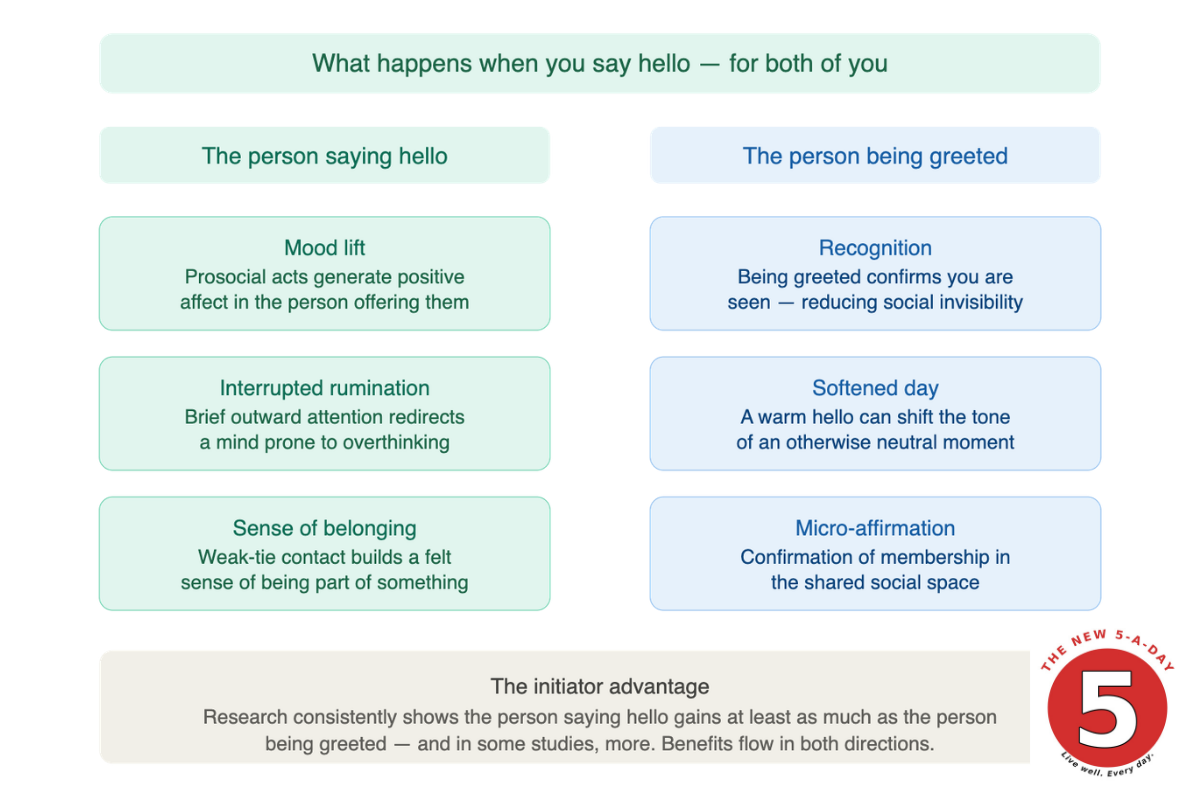
The mechanisms behind this are not mysterious. Greetings work partly because they provide a moment of recognition. They signal: I see you. You are here. You are not invisible. For the person speaking, they create a brief flash of warmth and social connection. For the person being greeted, they reduce the low-level feeling of anonymity that urban and working life can produce in large quantities.
What hello does for you
Here is something the research makes clear and that most people do not expect: the person who says hello often gains as much from the interaction as the person who receives it — sometimes more.
When you greet someone, you create a moment of positive social contact. That contact — even when it is fleeting — can interrupt the internal monologue that runs in the background of a busy, pressured day. It pulls you briefly out of your own head and into shared space. And social warmth, it turns out, tends to be contagious: when you offer it, you typically feel something of it yourself.
There is also an accumulation effect. A single hello changes almost nothing. A consistent habit of greeting — people you pass in the street, the person behind the counter, the colleague you always walk past without speaking — gradually builds a felt sense of being connected to the world around you. Researchers describe these light, easy connections as “weak ties”: relationships that are not close or intimate but that still contribute meaningfully to a sense of belonging. It turns out that belonging does not require depth. It requires contact.
For people who are shy or who find social interaction tiring, this is especially useful. Hello is small. It is brief, predictable, easy to exit from, and unlikely to go wrong. Done regularly, it can quietly build social confidence in a way that does not demand much of you. Each successful greeting is a small piece of evidence that interaction is manageable — and those small pieces, accumulated over time, have a way of shifting how you feel about the social world.
What hello does for the person you greet
A hello is a form of recognition. And recognition — the sense that you have been seen and acknowledged by another person — is something many people experience too rarely.
For the person on the receiving end of a greeting, a warm hello can reduce the subtle feeling of invisibility that is easy to accumulate in public spaces, large workplaces, or neighbourhoods where people rarely speak. It can make a neutral moment pleasant and a difficult day slightly easier to move through. It is a reminder that the people around them are fellow human beings rather than background scenery — and that they, themselves, are worth noticing.
Some of this matters more than it might look. For people who are new to a place, lonely, going through a hard time, or simply having one of those days where the world feels a bit indifferent, a genuine greeting from another person can soften things in a way that is disproportionate to its size. Not solve them — a hello is not a cure for anything. But soften them, yes.
Research on community interventions that actively encouraged people to connect with their neighbours — including through simple greetings — found that participants reported reduced loneliness, stronger feelings of belonging, and a greater sense of community cohesion over time. The individual gesture is small. The collective effect is something more substantial.
The ripple effects
The effects of a greeting do not always stop at the two people involved. In neighbourhoods where people regularly greet each other, research shows higher levels of community cohesion, a greater sense of safety, and more willingness to spend time in shared public spaces. When people feel acknowledged in their local environment, they are more likely to walk, to take part in local life, and to look out for the people around them.
In workplaces, the same logic applies. A culture in which people greet each other — by name, with some warmth, without making it into a performance — tends to be a culture in which people feel more comfortable asking questions, sharing ideas, and offering help. Small social openings make larger collaboration easier. The hello in the corridor lowers the threshold for the conversation that matters.
There is also what you might call a positivity contagion effect. Research consistently shows that positive social behaviour is contagious — not in any mystical sense, but in the ordinary sense that people who are greeted warmly tend to carry a little of that warmth forward into subsequent interactions. A good morning on the way into work does not just affect you and the person you said it to. It is more likely than you might think to continue down the chain of interactions that follow.
A note on realism
It is worth being clear about what hello is not.
Saying hello is not a treatment for loneliness, depression, or social anxiety. It is not going to fix deeper problems in your social life, and it should not be dressed up as something it is not. The research on minimal interactions is consistent and genuine — but the effects are modest at the level of each individual exchange. What the evidence supports is their value accumulated over time, not the idea that a single greeting transforms anything.
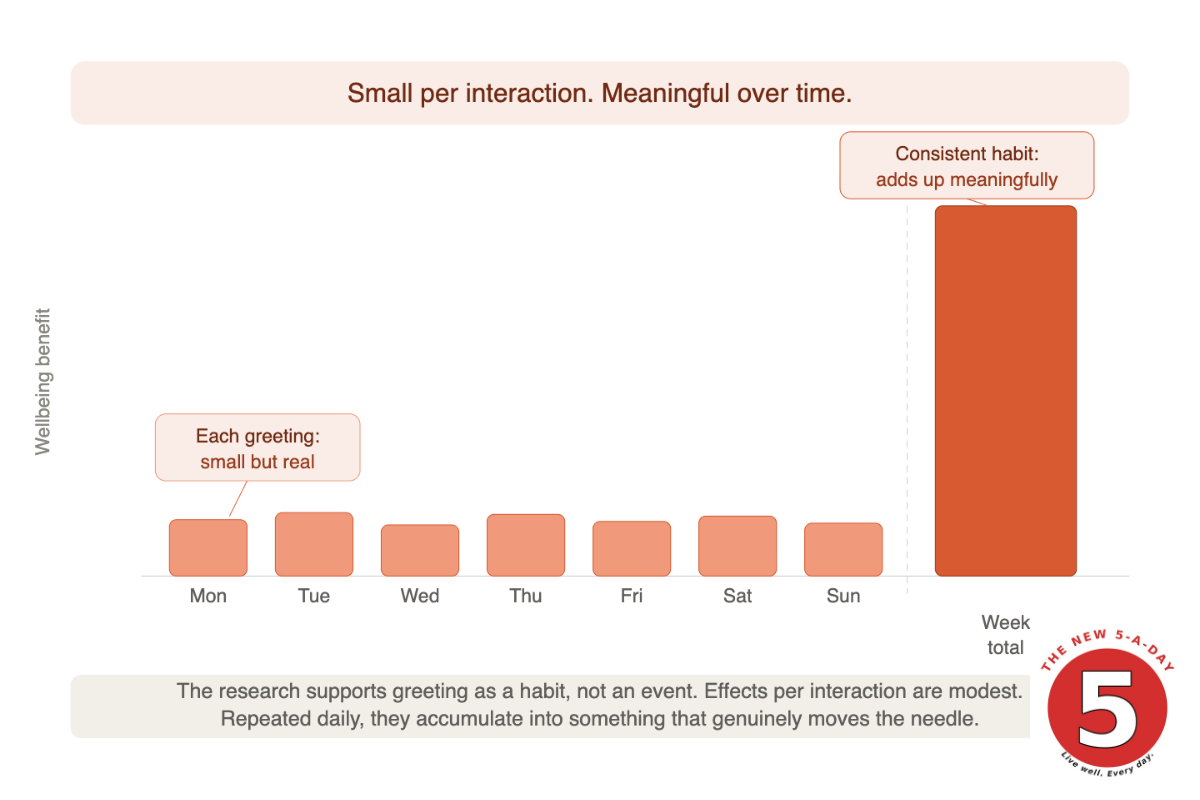
A good hello is also an invitation, not a demand. Some people will not be in the mood to respond. Some situations genuinely call for quiet rather than conversation. If someone does not return your greeting warmly, that is not a failure — and it should not put you off the next one. The value of the habit lies in its consistency, not its success rate.
The goal is not to be performatively cheerful or to turn every passing moment into a social occasion. It is simply to be the kind of person who notices other people — and occasionally says so.
How to build the habit
If saying hello does not come naturally, the best approach is to start smaller than feels necessary and build from there. You do not need a dazzling opener or a warm personality or the ability to make conversation. You need a brief, genuine, low-pressure acknowledgement of another person’s existence. That is the whole thing.
A few practical ways in:
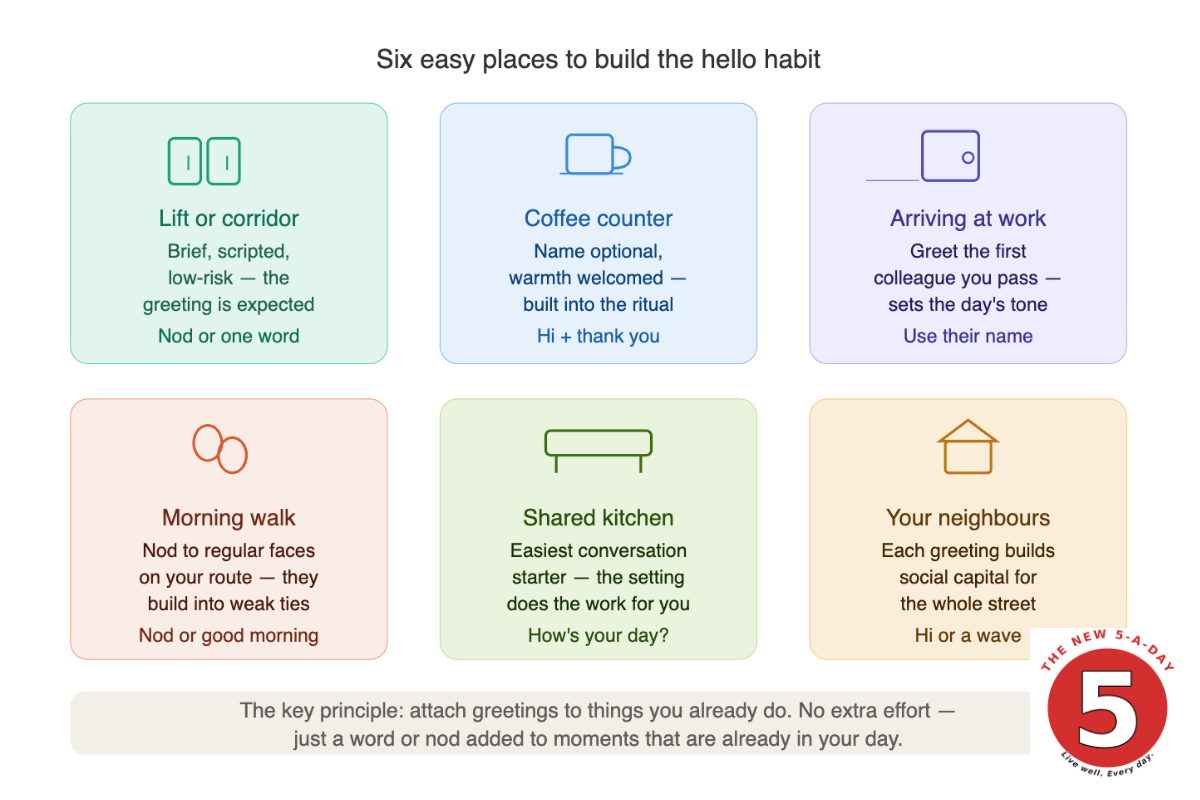
• Start with one setting. Pick a single context — your building, your workplace, your usual café, your commute — and make hello your default there. One environment is easier to establish than a global personality change.
• Tie it to something you already do. Greet the person at the front desk when you arrive at work. Say good morning to whoever you pass first on your walk. Attaching a new behaviour to an existing routine is one of the most reliable ways to make it stick.
• Use names when you have them. Using someone’s name in a greeting signals a level of attention that a generic “hi” does not. It does not require an intimate relationship — just a small extra effort that most people notice.
• Make brief eye contact. A greeting delivered to the floor or the middle distance lands differently from one that includes a moment of actual eye contact. You do not need to hold it. Just briefly, before you speak.
• If speaking feels hard, start with a nod or a smile. These are still greetings. They still signal acknowledgement. Build up to a word or two when it feels easier.
• Add one follow-up question occasionally — but only when it feels comfortable. “How’s your day going?” or “good weekend?” takes a greeting a small step further. It is not a requirement. But when it happens naturally, it deepens the interaction.
• Do not expect every greeting to land. Some people will be distracted, in a hurry, or simply not in the mood. That is fine. The habit is not about the response — it is about the offer.
For people who are shy or introverted, it helps to remember that hello is specifically well-suited to you. It is short. It is predictable. It does not require you to be witty, hold a conversation, or manage someone else’s emotions for an extended period. It is, by design, the form of social contact that costs the least and returns the most relative to its size.
Bringing it back to The New 5-a-Day
Your People is Pillar Five — and it spans everything from your closest relationships to the loose, easy connections that make everyday life feel warmer and more human. Saying hello sits at the lightest end of that spectrum. It is not deep friendship. It is not community in a big, organised sense. It is simply the habit of noticing people and letting them know it.
But that habit has consequences. It shapes how you move through your days. It shapes how the people around you experience their days. And aggregated across a neighbourhood, a workplace, or a community, it shapes something larger: a social environment in which people feel seen rather than invisible, connected rather than isolated, and part of something rather than merely passing through it.
None of that requires courage, charisma, or a particularly outgoing personality. It requires a word. One small word, offered often enough to become a habit.
Hello is a good place to start.
A note on medical advice: The content in this post is intended to inform and inspire, not to replace professional medical guidance. If anything you’ve read raises questions or concerns about your own health, please speak to your GP or another qualified health professional.
Want to explore further? This post is the accessible introduction. A detailed evidence-based Deep Dive, a full Reference List, and a podcast episode are all available on this site.
