From city parks and canal-sides to sweeping countryside — why time in nature is one of the easiest investments you can make in your own wellbeing.
Quick summary: You do not need to drive to a national park or clear your weekend diary to get the benefits of nature. Research consistently shows that time spent in green and blue spaces — parks, canal towpaths, tree-lined streets, community gardens, and yes, the view from your window — is linked with lower stress, better mood, reduced anxiety, improved attention, and meaningful physical health benefits. Even fifteen to thirty minutes makes a measurable difference. This post is about what nature actually does for you, how to find it wherever you live, and how to build it into a life that is already full.
Most of us know, in a vague sense, that getting outside is good for us. The feeling is familiar enough: you’ve been cooped up indoors all day, you step out for a walk, and something shifts. The mental noise quiets a little. You notice the light through the leaves, or the sound of water, or just the simple fact of the sky above you. You come back feeling, somehow, more like yourself.
What the research now tells us is that this is not just a feeling. There is a well-established and growing body of evidence showing that contact with nature — regular, even brief contact — produces real and measurable benefits for mental and physical health. And importantly: you do not need a countryside cottage or a hiking habit to access those benefits. Nature is closer than most of us think.
Getting our into Nature is part of Pillar Four of The New 5-a-Day — Me-Time. This post is your introduction to why it matters, and how to make it work in an ordinary life.
What “nature” actually means
Before anything else, it is worth loosening the definition. When most people picture nature, they picture somewhere remote — mountains, forests, coast, wide open fields. And those places are wonderful. But they are not the only settings that count.
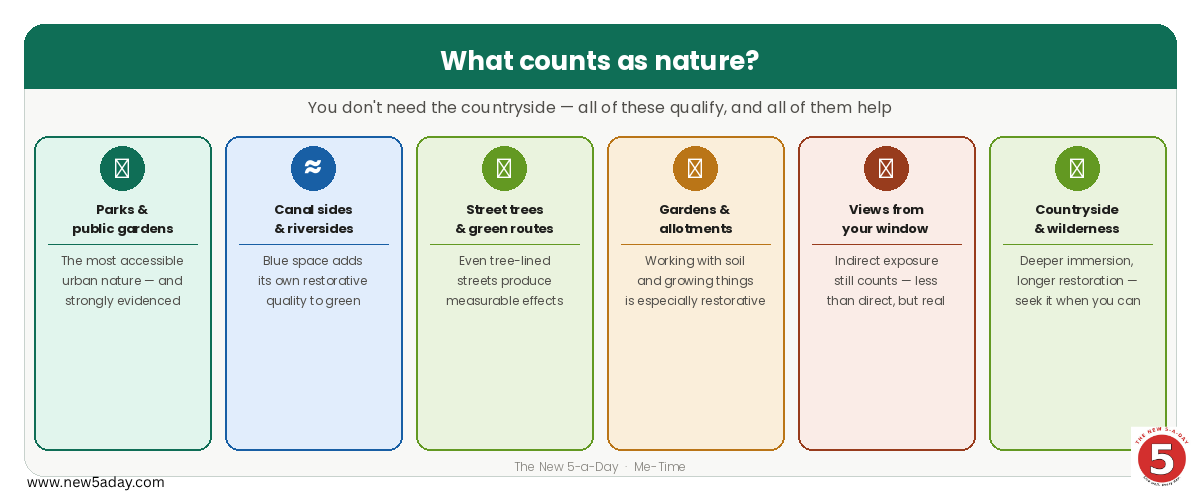
Research consistently treats urban green and blue spaces as meaningful nature. Parks, public gardens, canal towpaths, riversides, street trees, allotments, green roofs, and even a patch of grass between buildings — all of these qualify. What they share is the presence of living things, natural light, fresh air, and a break from the relentless stimulation of the built environment. That combination, even in a modest form, is enough to trigger the benefits.
Studies conducted during the COVID-19 lockdowns made this point unusually clearly. People with access to parks, gardens, and even views of greenery from their windows reported significantly better mental health than those without. The green space did not need to be wild or vast. It just needed to be there.
So: nature does not have to mean the Peak District. It can mean the canal by your commute, the park near your office, or the garden you sit in for ten minutes after dinner. All of it counts.
What being in nature does for your mind
The mental health benefits of spending time in nature are probably the most well-documented — and they show up reliably across different settings, different countries, and different kinds of people.
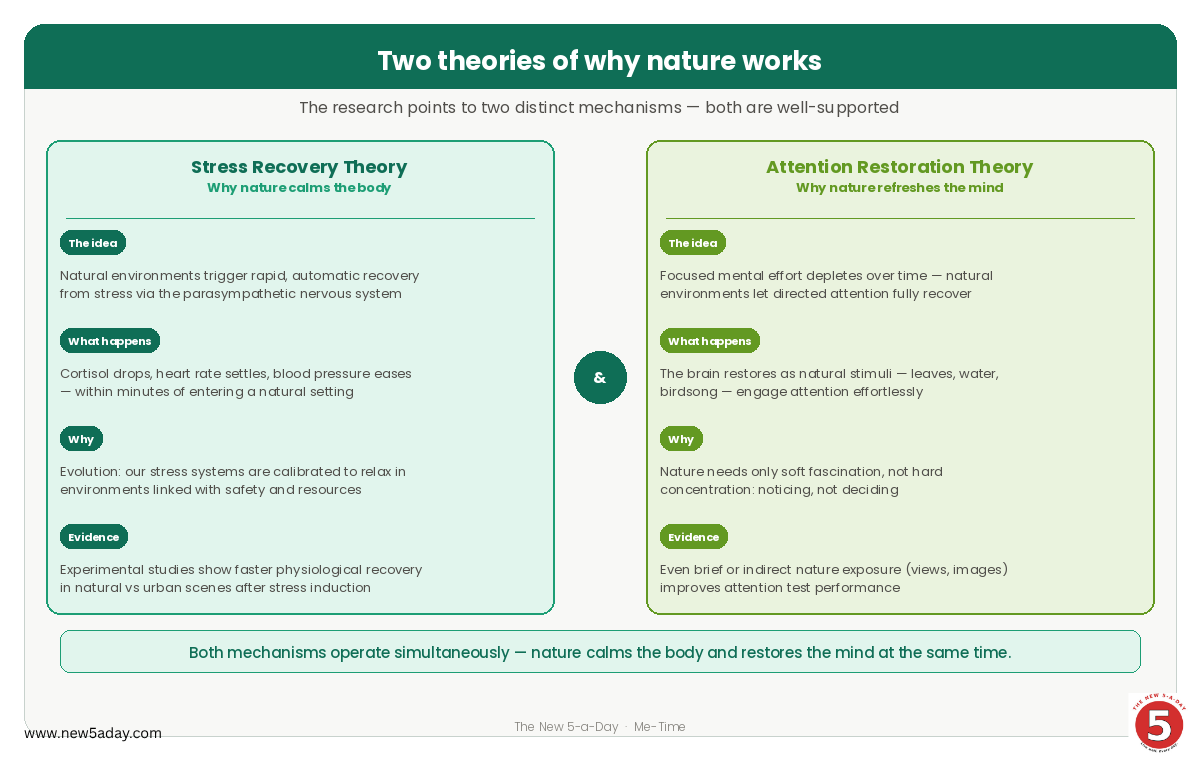
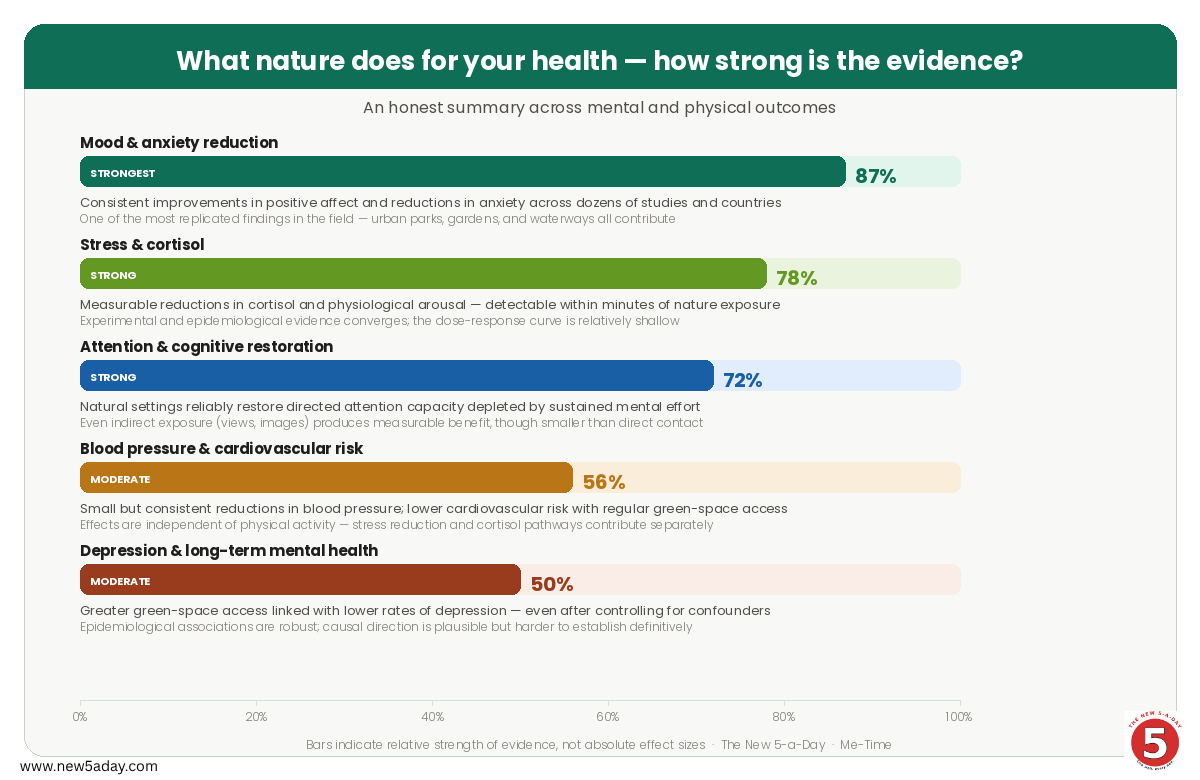
Mood improves fairly quickly. Spending time in green spaces is consistently linked with reductions in anxiety, stress, and low mood, and with increases in positive emotion. The effect is not subtle or marginal — systematic reviews across dozens of studies show it clearly. Something about natural environments shifts the emotional register in most people who spend time in them.
One of the more interesting findings concerns rumination — the tendency to replay worries, regrets, and difficult thoughts in a loop. It is a common feature of anxiety and depression, and it is also just a very familiar part of modern mental life. A study comparing people who walked in an urban park with those who walked on city streets found that the park walkers experienced significantly less negative rumination. The natural setting appeared to interrupt the loop in a way that the city street did not.
There is also a well-established effect on mental fatigue and attention. Natural environments seem to restore the brain’s capacity for focused thought — something that gets depleted by sustained demands, screens, and noise. Even brief or indirect exposure to nature (including views from a window, or time in a quiet courtyard) has been shown to help. If you come back from a lunchtime walk in a park feeling like you can think more clearly, that is a real effect, not imagination.
Over time, people who live near or regularly visit green spaces report lower rates of depression and anxiety compared with those with little access to nature. The relationship holds across many different countries and contexts. It is not a perfect or simple one — access, safety, and quality of green space all matter. But the direction of the evidence is consistent and clear.
What being in nature does for your body
The physical benefits of nature contact are less talked-about than the mental ones, but they are equally real.
Blood pressure is one of the clearest signals. People who live closer to green spaces, or who spend more time in them, tend to have lower blood pressure on average. A review drawing on many studies found small but consistent reductions in both systolic and diastolic blood pressure associated with greater exposure to greenery. This matters because blood pressure is one of the most significant modifiable risk factors for heart disease and stroke.
Green spaces also support physical activity. People move more when they are outside in pleasant natural environments — they walk further, sit still less, and are more likely to return and do it again. This is not a trivial point. One of the biggest obstacles to getting enough movement is motivation. A green space lowers the barrier.
Spending time outdoors also provides natural light exposure, which matters for sleep quality and for the body’s production of vitamin D, important for bone health and immune function. There is also some evidence linking access to green space with lower rates of type 2 diabetes, lower all-cause mortality, and better cardiovascular outcomes over time. The mechanisms are still being explored, but the association is strong enough to take seriously.
City nature vs countryside nature: does it matter?
Yes — and also no, in ways that are worth understanding.
Countryside and wilderness settings tend to offer a deeper sense of immersion. Birdsong without traffic underneath it. Horizon lines that go further than the next building. The quiet that lets you notice things you would otherwise miss. Many people find that longer time in these settings — a full day’s walk, a weekend away somewhere green — produces a more sustained sense of restoration. If you have the opportunity to spend time in sweeping open landscapes, those experiences are worth seeking out.
But city nature is not second-best — it is just different, and for many people it is the nature that is actually available on a Tuesday morning. The research is clear that urban parks, green corridors, waterside paths, and community gardens produce genuine benefits. In some studies, the benefits of green space are actually strongest in urban areas, where the contrast with a stressful built environment is greatest and the need for restoration is most acute.
The honest answer is: wherever you are, work with the nature you have access to. A lunchtime walk along a canal towpath in the middle of a city is genuinely valuable. A weekend in the hills, when you can manage it, adds something extra. Both count. The key is regularity rather than grandeur.
What you can actually do out there
This is one of the more refreshing things about nature as a wellbeing habit: there is no correct way to do it. You do not need equipment, a specific skill, or a plan.
Walking is the most accessible and most well-studied starting point. A brisk walk through a park, along a river, or through a green-lined neighbourhood for twenty or thirty minutes is enough to produce measurable mood and attention benefits. But the walk does not even need to be brisk — a slower, more observational pace has its own value. Some people find it useful to walk without headphones occasionally, simply noticing sounds, textures, and the movement around them.
Gardening is consistently associated with good mental health outcomes — there is something about working with soil, growing things, and the rhythm of tending a living space that seems especially restorative. You do not need a garden to do it: window boxes, balcony planters, and community allotments are all routes in.
Running, cycling, and more vigorous outdoor exercise layer the physical benefits of cardio on top of the nature benefits. Wild swimming — still growing in popularity — adds cold water exposure and a sense of connection with natural water that many people find unusually grounding. Birdwatching, sketching, photography, and simply sitting with a coffee on a bench in a park all work too. The point is contact and presence, not performance.
For those with children, nature provides one of the most straightforward and affordable ways to spend time together. A pond, a woodland path, a patch of grass with enough space to run: children engage with natural environments instinctively, and the benefits of nature access in childhood are well-documented.
How to build it into a life that is already full
The biggest barrier to spending more time in nature is not usually motivation — most people want to do it. The barrier is time, or more precisely, the feeling that time for this kind of thing does not exist.
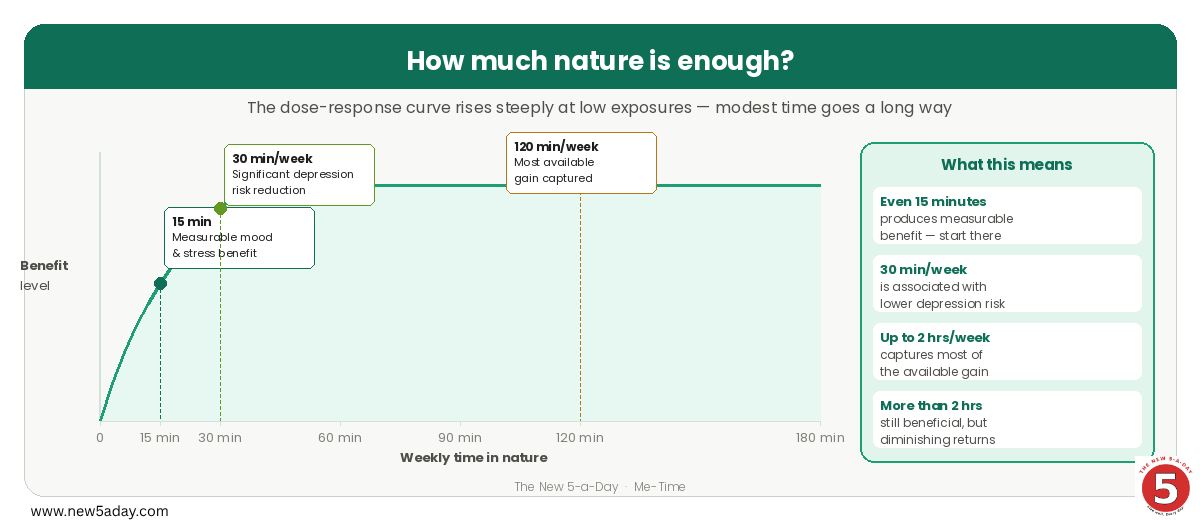
The research on dose is reassuring here. Benefits have been observed with sessions as short as fifteen minutes. You do not need a long walk or a whole afternoon — you need a regular short one. The evidence suggests that weekly green-space time in the range of thirty minutes to two hours produces meaningful effects. That is achievable in most lives, even busy ones, if the habit is built into existing routines rather than bolted on as an extra.
A few practical approaches that tend to work:
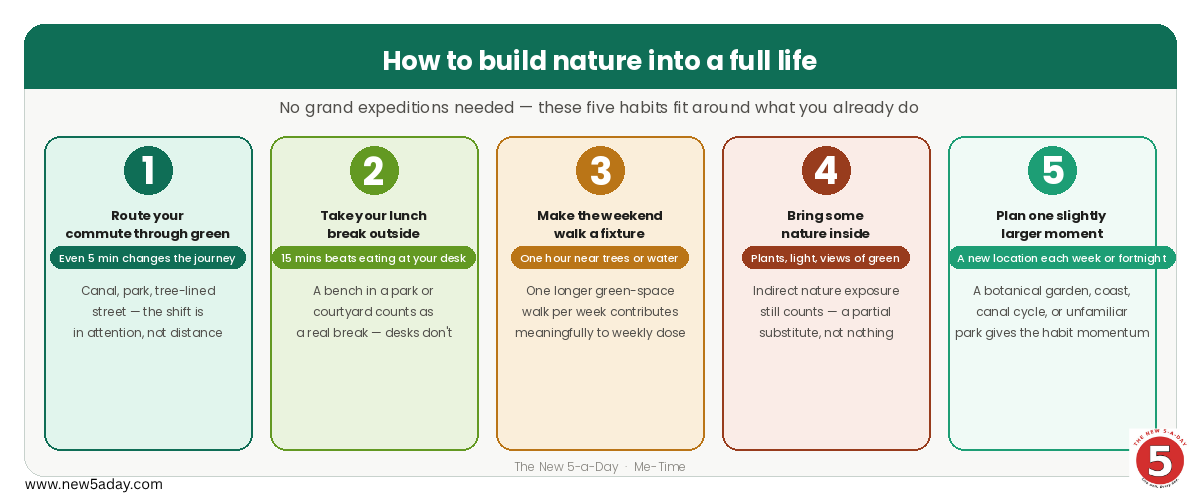
Route your commute through a park or along a waterway if there is one within reach. Even five minutes of green space on the way in or out changes the texture of the journey. If you work from home, a short walk before you start — even around the block past some trees — serves the same function as a commute and gives the day a cleaner start.
Take your lunch break outside. Eating at your desk while checking emails is not a break. Sitting on a bench in a park, or a courtyard with some greenery, for even fifteen minutes is. The distinction matters more than it might look on paper.
Make the weekend walk a fixture rather than an aspiration. One longer green-space walk per week — an hour or so, somewhere with trees or water — contributes meaningfully to the cumulative dose of nature that research links with better health. It does not need to be a major expedition. A local nature reserve, a riverside path, or a park you haven’t been to in a while is more than enough.
If access to outdoor green space is limited where you live, bring some inside. Studies suggest that even indirect nature exposure — houseplants, views of trees from a window, natural light — has some restorative effect, even if it is smaller than the real thing. It is a partial substitute, not a replacement, but it is not nothing either.
Plan one slightly larger nature moment each week or fortnight. This could be a walk in a new location, a visit to a botanical garden, a canal-side cycle, or a trip to the coast. Not every outing needs to be ambitious, but having one that is a little more intentional gives the habit a sense of momentum.
Bringing it back to The New 5-a-Day
Me-Time is Pillar Four of The New 5-a-Day — and nature sits at the heart of what this pillar is about. Not as a grand escape or a bucket-list adventure, but as a quiet, repeatable habit that asks very little of you and gives a great deal back.
What is striking about the evidence on nature is how low the bar actually is. You do not need to climb anything, travel anywhere far, or carve out large blocks of your week. You need to find the green spaces that are accessible to you — and then use them, regularly, in whatever way suits your life.
A city park counts. A canal walk counts. A bench under a tree during your lunch break counts. A back garden counts. Even the view from your window, it turns out, counts a little.
In a life that is full of demands, obligations, and screens, a few minutes in the company of something green and living is not an indulgence. The evidence is clear enough to say it plainly: it is good for you. Meaningfully, measurably, reliably good for you.
So step outside. Notice things. Come back in. Repeat.
A note on medical advice: The content in this post is intended to inform and inspire, not to replace professional medical guidance. If anything you’ve read raises questions or concerns about your own health, please speak to your GP or another qualified health professional.
Want to explore further? This post is the accessible introduction. A detailed evidence-based Deep Dive, a full Reference List, and a podcast episode are all available on this site.
The New 5-a-Day | Me-Time 4-5 | Live well. Every day.
