Reading is so good for you!
There is a particular kind of quiet that comes with reading. Not the absence of sound, exactly, but the presence of something else — a story, an idea, a voice that belongs to someone who is not you. It is one of the oldest forms of entertainment in the world, and also, it turns out, one of the most useful things you can do for your mental and emotional health.
Reading is one of those rare habits that is both completely free and surprisingly powerful. You can do it in five minutes or five hours. You can do it in bed, on a bus, or in a garden. You can read fiction, history, science, poetry, or the kind of feel-good novel you would never admit to enjoying. And every version of it — every genre, every format, every reading pace — offers something back.
This post is about why. And then, just as importantly, how to do more of it.
What reading does to your brain
Reading is a workout for the mind, even when it does not feel like one. Every time you follow a plot, track an argument, or build a picture of a character from the words on a page, your brain is doing real work. It is holding information in memory, making predictions, connecting ideas, and filling in gaps. That is not passive consumption. That is active thinking.
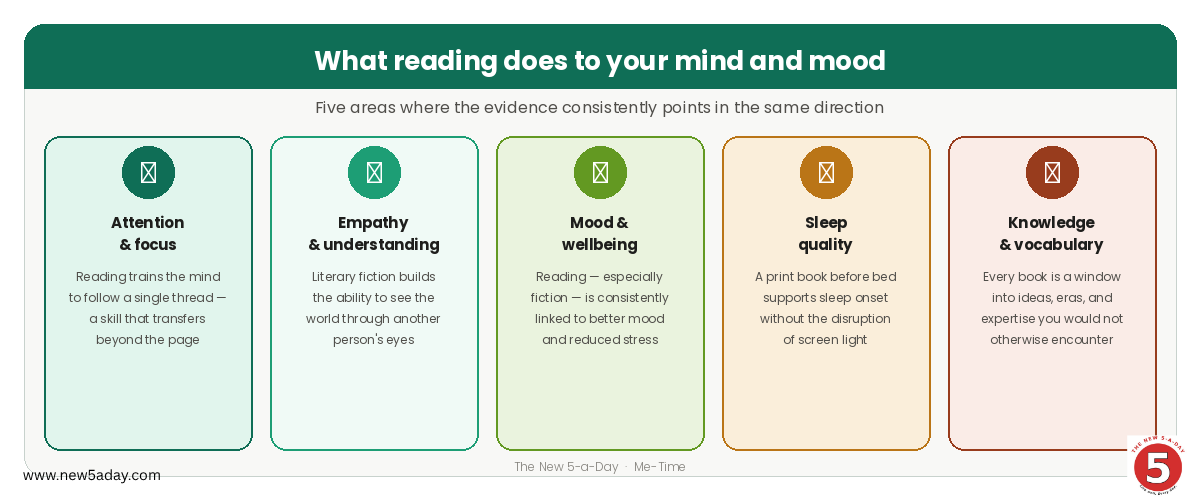
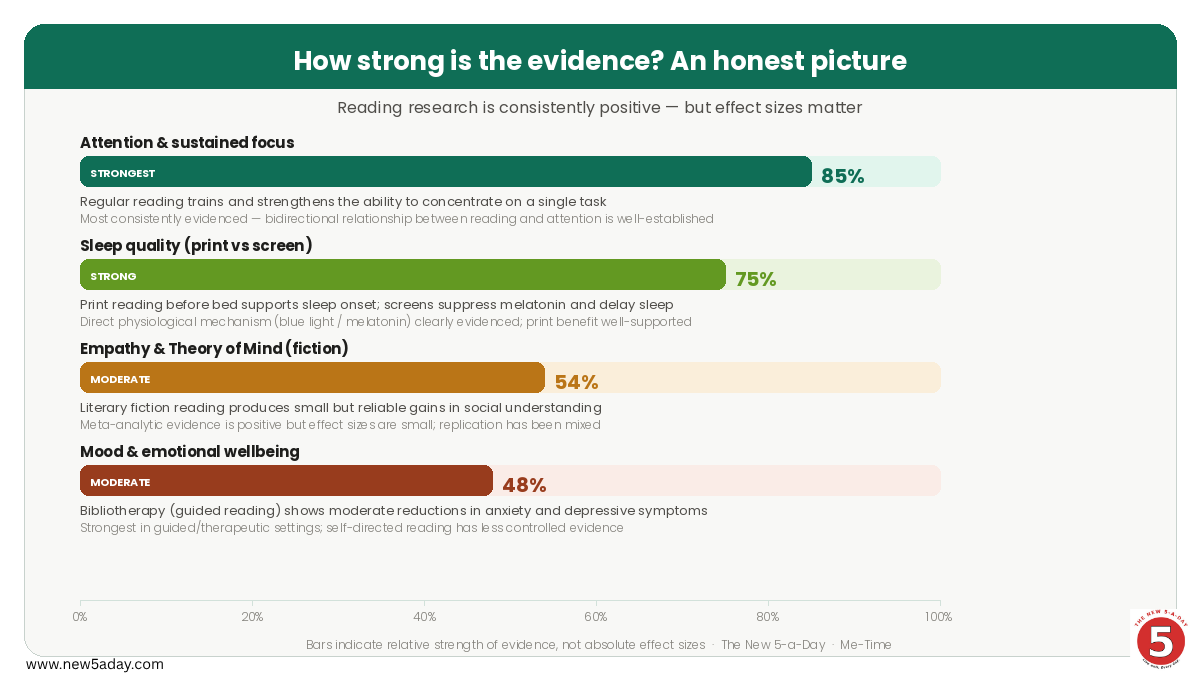
Research confirms that this kind of engagement has real effects. Regular reading is linked to stronger attention and concentration — which matters more than it might sound in a world built to fragment both. Reading trains the mind to follow a thread instead of bouncing between notifications, feeds, and half-finished thoughts. That is not a small thing.
There is also growing evidence that reading supports critical thinking: the ability to assess information carefully, notice when an argument does not add up, and separate evidence from opinion. These are skills that reading builds gradually, almost without you noticing. They show up not just when you read, but when you listen, when you have conversations, and when you make decisions.
Vocabulary, comprehension, and general knowledge all improve with regular reading too. A good book can take you inside a world, a time period, or an area of expertise you would never otherwise encounter. That breadth of knowledge is not just useful — it is one of the most accessible forms of lifelong learning available to anyone with a library card.
The emotional case for reading
The mental benefits of reading are well-established. But some of the most compelling evidence concerns something more personal: how reading makes you feel.
Fiction is particularly powerful here. When you read a novel, you are doing something remarkable — you are inhabiting someone else’s inner life. You experience their fears, their love, their confusion and their courage from the inside. Research has consistently found that this kind of perspective-taking can increase empathy: the ability to understand and share what other people are feeling. Reading stories appears to strengthen the part of us that asks ‘what is this like for them?’
This matters in everyday life. More empathetic people tend to have stronger, more satisfying relationships. They navigate conflict better. They listen more carefully. Reading fiction is not a shortcut to becoming a better person, but it is, over time, a quiet contributor to the skills that help you relate to other people.
Reading also offers something that is harder to quantify but just as real: the sense that you are not alone. Books have an extraordinary ability to name things — experiences, emotions, fears — that you have struggled to put into words yourself. Finding those words on a page can be deeply reassuring. Many readers describe books, especially in harder periods of life, as feeling less like entertainment and more like company.
Reading and stress: a quieter nervous system
If you are looking for a way to reduce stress that does not require equipment, a gym membership, or a great deal of willpower, reading is a strong candidate.
When you settle into a book, your attention narrows. The mental chatter that accompanies a busy day — the to-do lists, the unanswered emails, the low-level anxiety that comes with being switched on all the time — recedes. It does not disappear, but it quiets. The mind has somewhere to go other than the place it has been stuck in all day.
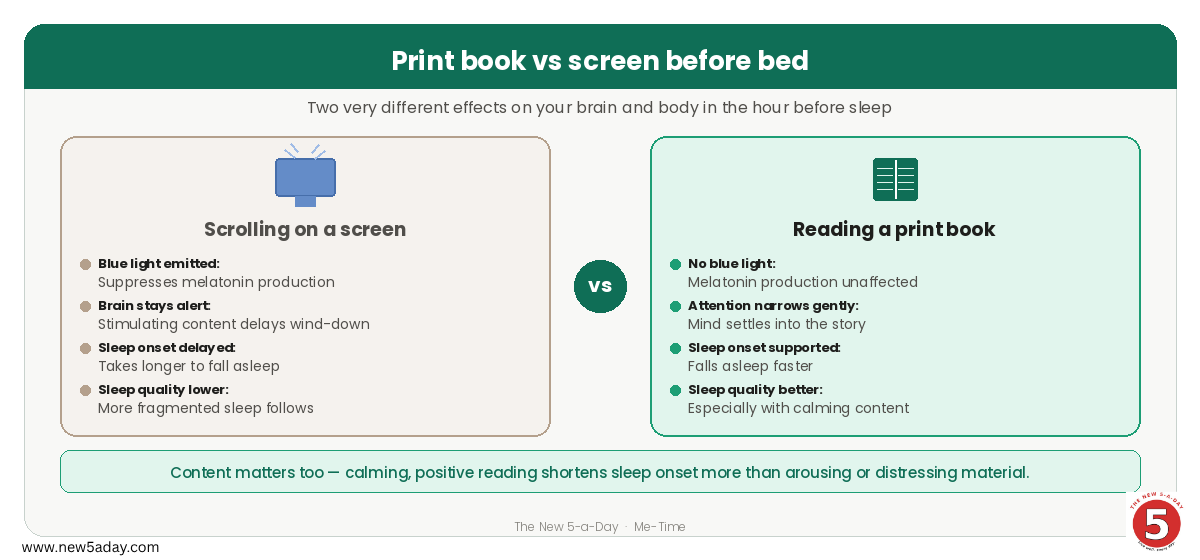
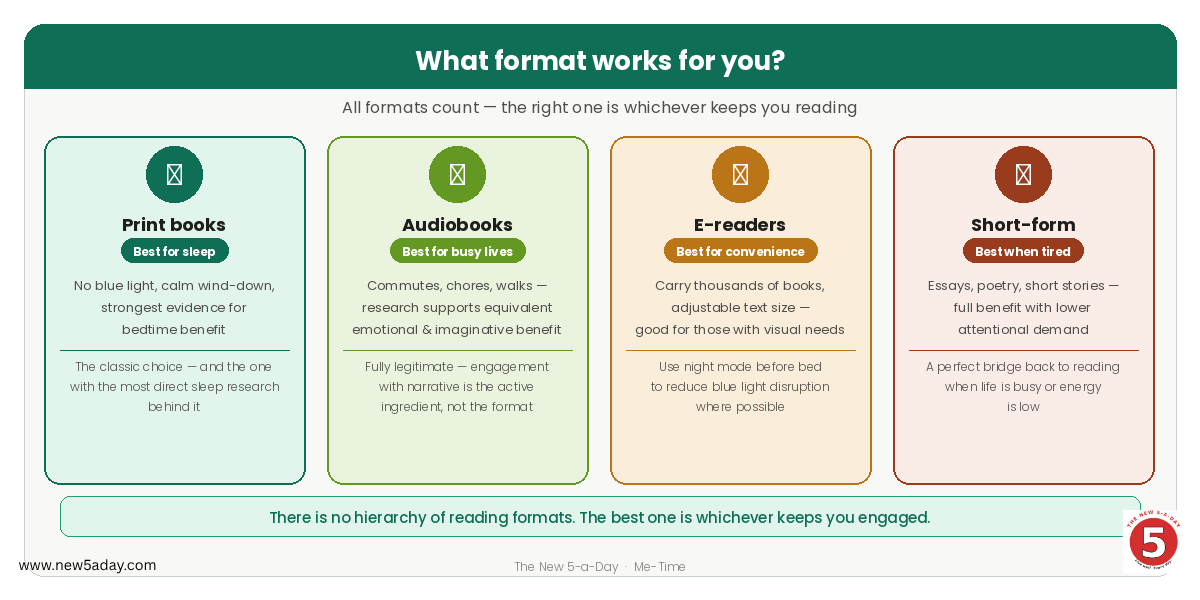
Reading before bed has particular value here. Print books, specifically, appear to support better sleep than scrolling on a phone or tablet. This is partly because screens emit light that can interfere with the body’s natural wind-down process, and partly because reading is simply less stimulating than social media, news feeds, or video content. A few chapters at night can become a reliable signal to the brain that the day is ending — and that it is safe to slow down.
Research on reading with positive emotional content at bedtime suggests it can reduce the time it takes to fall asleep and improve the quality of sleep that follows. That is a significant benefit from a habit that most people would describe as pleasant rather than medicinal.
What kind of reading? Does it matter?
Different kinds of reading offer different things, and there is no wrong answer. Fiction tends to be best for empathy, emotional processing, and what readers often describe as ‘switching off’ in a genuinely restorative way. Nonfiction tends to be stronger for learning, broadening perspective, and the satisfaction of understanding something new. Poetry trains attention to language and feeling in a way that nothing else quite does. Essays and long-form journalism keep you informed and reflective.
Audiobooks count too. Research suggests they can deliver similar emotional and imaginative benefits to reading with your eyes — especially useful for people who find reading difficult because of fatigue, visual problems, or neurodivergent learning styles. If audiobooks are how you most easily access stories and ideas, they are a perfectly good version of the habit.
The most important variable is not format or genre. It is whether you enjoy what you are reading. Engagement is what makes reading work. A thriller you cannot put down is more beneficial than a literary novel you are forcing yourself through because you feel you should. Read what lights you up.
How to read more: practical strategies that actually work
The most common reason people give for not reading more is that they do not have time. This is usually not quite true. What is more accurate is that reading has not become habitual yet — and like any habit, it requires a small amount of deliberate design before it starts taking care of itself.
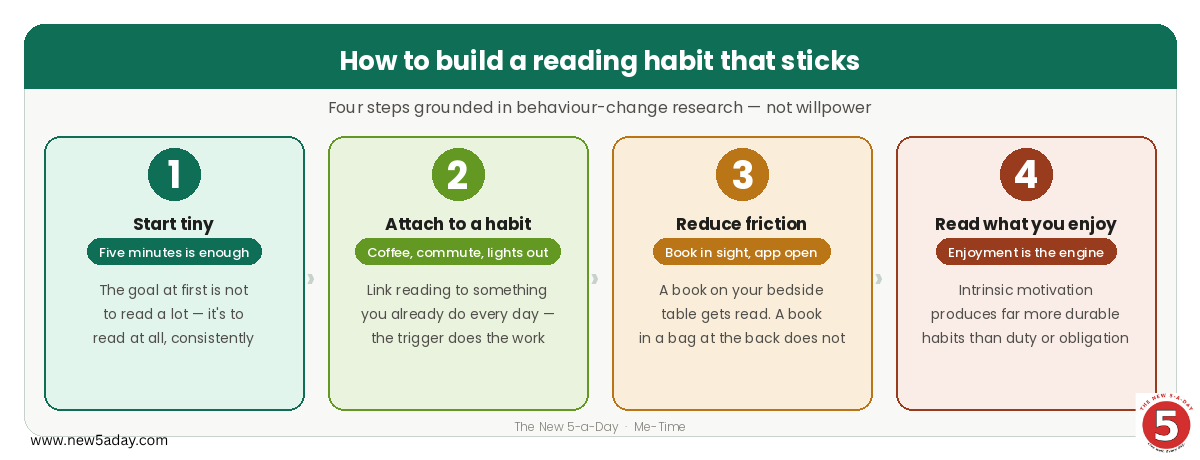
Start small. Really small. The biggest barrier to reading is the sense that it requires a significant block of time. It does not. Five minutes a day is enough to begin. One page before bed. A chapter on the bus. The goal at the start is not to read a lot — it is to read at all, consistently. Small efforts, repeated daily, compound quickly. After a month of five-minute reading sessions, you will have read more than many people manage in a year.
Attach reading to something you already do. Habits stick most easily when they are linked to an existing routine. Reading with your morning coffee, on your commute, during a lunch break, or as the last thing you do before sleep are all good anchors. The trigger — coffee, the bus, lights out — becomes the prompt, and the habit follows almost automatically.
Make books impossible to ignore. Friction kills habits. A book on your bedside table gets read. A book in a bag at the bottom of a wardrobe does not. Keep whatever you are reading visible and within arm’s reach. On your phone, keep an e-reader app open at the page you left off. In the car, have an audiobook queued and ready. The easier reading is to start, the more often you will start it.
Read what you actually enjoy. This sounds obvious but is often overlooked. Many people have a sense that reading should be improving, which leads them to choose books they feel they ought to read rather than books they want to read. This is a reliable way to fall out of the habit. There is no hierarchy of reading that places literary fiction above a good detective novel. If you enjoy it, read it. Enjoyment is the mechanism that makes reading beneficial.
Abandon books that are not working for you. Life is genuinely too short to spend it forcing yourself through a book that has stopped engaging you. Giving yourself permission to put a book down and try something else is not giving up — it is good management of a limited resource. The goal is a reading life, not the completion of specific titles.
Try a light tracking system. Noting what you have read — even just in a notebook or a simple app — provides a mild but genuine sense of progress. Setting a gentle annual goal (twelve books a year is one a month) gives the habit direction without pressure. Seeing a list of books you have read in a year is quietly satisfying in a way that makes you want to keep going.
Be flexible about format. The reading habit you build in one season of life may look different in another. When you are tired, short stories or essays might suit you better than a long novel. When you are busy, audiobooks during commutes or chores might be what makes the habit sustainable. The aim is consistent engagement with ideas and stories in whatever form fits your life right now.
A note on when reading is hard
Reading is not always easy. Fatigue, stress, neurodivergent learning styles, vision problems, or simply a difficult period of life can all make sitting down with a book feel harder than usual. In those moments, the goal should not be discipline — it should be accessibility.
Large print, audiobooks, short-form essays, poetry, or even children’s books can all be routes back to reading when the usual approach is not working. There is no correct version of the habit. The benefit comes from engagement with words and ideas, not from the specific way in which that engagement happens.
Bringing it back to The New 5-a-Day
Me-Time is Pillar Four of The New 5-a-Day — and reading sits right at the heart of what this pillar is about. Not a grand gesture. Not an hour you have to carve out of an impossible schedule. Just a moment that belongs to you: a few minutes with something that interests or moves you, that asks nothing of you except attention.
Reading does that. Quietly, consistently, with almost no cost and very little effort to begin. It is one of those rare habits that works better the more you enjoy it — and that gives something back every time you show up for it.
In a world that rarely stops demanding things from you, a book in your hand feels less like a hobby and more like a small act of self-care. Because that, it turns out, is exactly what it is.
A note on medical advice: The content in this post is intended to inform and inspire, not to replace professional medical guidance. If anything you’ve read raises questions or concerns about your own health, please speak to your GP or another qualified health professional.
Want to explore further? This post is the accessible introduction. A detailed evidence-based Deep Dive, a full Reference List, and a podcast episode are all available on this site.
