How Many Friends Do You Need?

Quality, quantity, and the difference between people who know you and people who actually show up
Quick summary Most of us have been conditioned to think that more friends means a better life. But the science tells a different story. What matters far more than the size of your social circle is the quality of the connections inside it — the friends who actually pick up the phone, remember what you told them last time, and show up when things get hard. Research suggests that a small handful of genuinely close friendships does more for your health and happiness than hundreds of shallow ones. And when it comes to online connections — the question is not whether they count, but whether they really function like friendships at all.
Here is a question that sounds like it should have a quick answer.
How many friends do you need?
We tend to treat friendship a bit like we treat steps on a fitness tracker — the more the better, keep adding, do not stop. Social media has made this instinct worse. Follower counts, friend lists, connection numbers: the whole architecture of modern online life is designed to make us feel that a bigger circle is a better one.
But research on friendship and health paints a much more interesting picture. The number of friends you have turns out to be far less important than what those friendships are actually made of. And some of what passes for friendship in the modern world — especially online — may not be doing the job we think it is.
This post is about what the science actually says — and what it means for how we think about the people in our lives.
First, what do we mean by a friend?
This sounds obvious, but it is worth being precise. The word friend gets stretched to cover an enormous range of relationships: the person you chat to at the school gate, the colleague you grab lunch with occasionally, the hundreds of people you follow online, the handful of people you have known for decades and would call at two in the morning.
These are not the same thing. Researchers who study social connection tend to draw a clear line between close friendships and acquaintances — and the distinction matters enormously when it comes to health.
An acquaintance is someone you know and enjoy, but who does not carry emotional weight in your life. You would be pleased to see them; you might not notice for several weeks if they disappeared. A close friend is different. This is someone with whom there is genuine mutual care, trust, and emotional support. Someone who notices when you go quiet. Someone you can be honest with, who gives their honest attention back. Someone who shows up — not just at the good moments, but at the difficult ones too.
The health benefits that research consistently links to friendship are driven almost entirely by close friendships, not by acquaintances. A full address book of pleasant acquaintances does not, on its own, protect you from loneliness or depression. What does is having people who genuinely know you and care about you — and where that care runs in both directions.
So how many close friends do you actually need?
The short answer from research is: probably fewer than you think — but that number still has to be greater than zero.
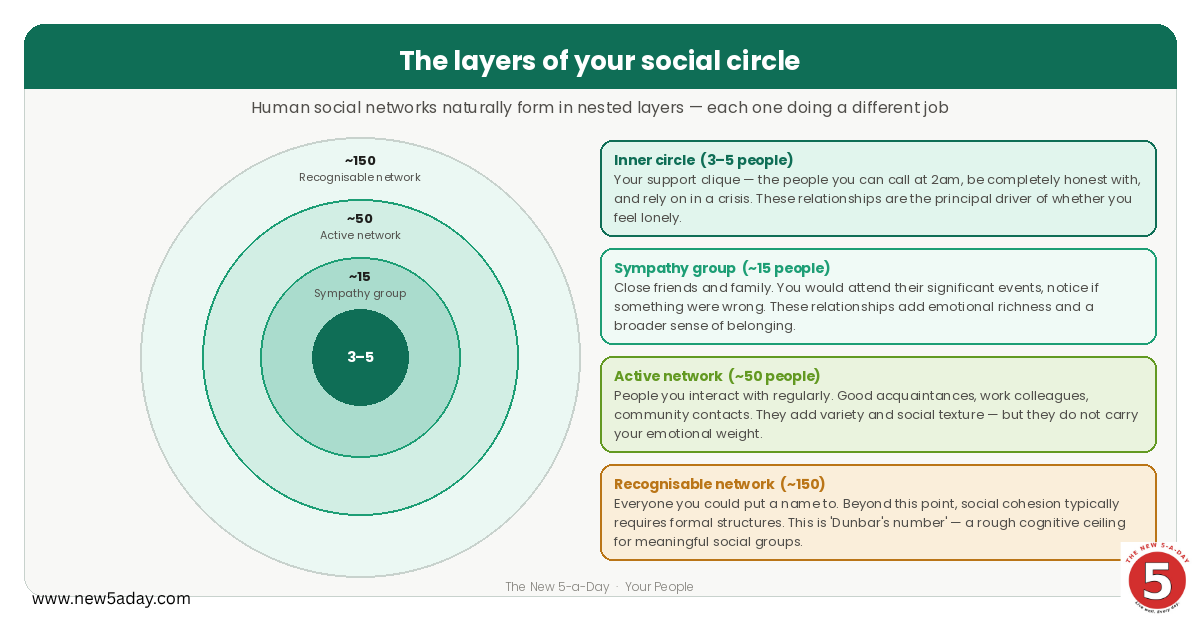
Decades of work in social psychology and anthropology suggests that there is a rough upper limit to how many close friendships the human brain can sustain at one time. Maintaining a genuinely close relationship requires time, emotional investment, and consistent attention. Most of us can realistically manage somewhere between three and five people in our innermost circle — the people we are truly close to — alongside a broader layer of good-but-not-intimate friends, and a wider network of acquaintances beyond that.
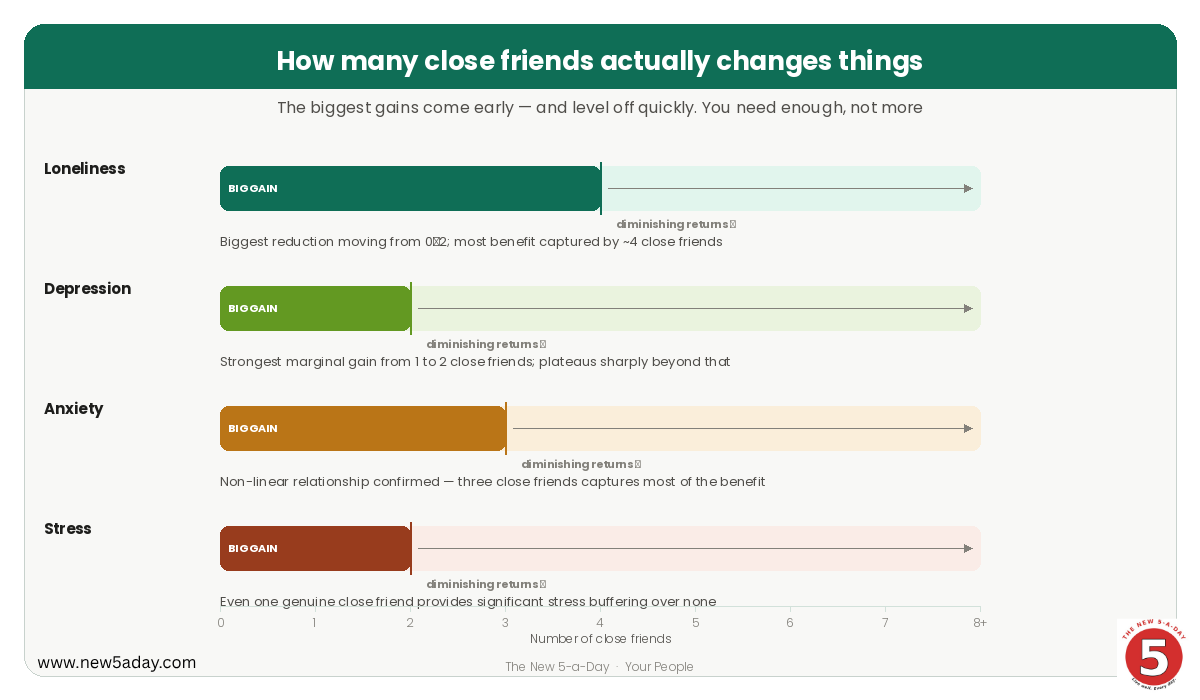
Research on older adults has tried to identify thresholds — the point at which having more close friends stops making a meaningful difference to wellbeing. The numbers vary depending on what you are measuring, but the pattern is consistent: for reducing loneliness, two to four close friends appears to be the range where the biggest benefits kick in. For reducing depression, the threshold is similar. Having more than that adds some further benefit, but the gains level off quickly. What matters is reaching that critical minimum, not maximising your total.
This is genuinely reassuring news for anyone who has ever worried that their social circle is too small. The evidence does not say you need a packed social calendar or a sprawling network of intimates. It says that a modest number of genuinely close, reciprocal relationships is enough — and that chasing more beyond that point may actually stretch your emotional resources thinner without adding much in return.
Quality always wins
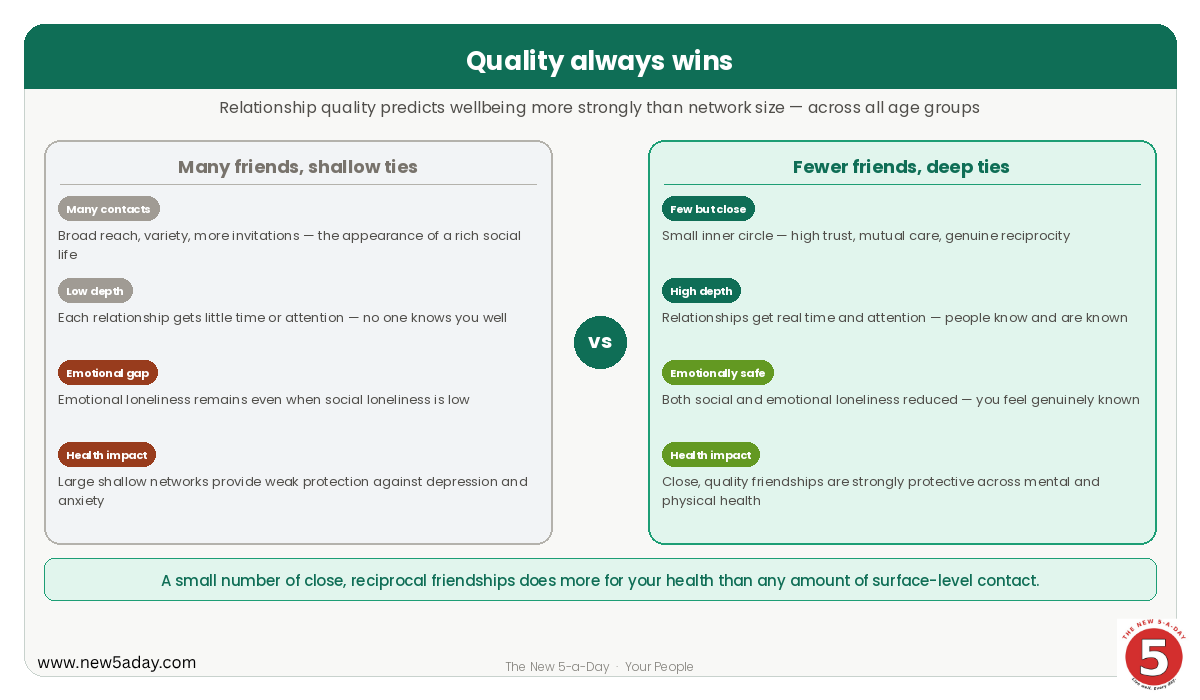
If there is one finding that runs through friendship research more consistently than any other, it is this: quality matters far more than quantity.
Across age groups and study designs, the quality of social relationships — whether friends are supportive, whether relationships feel close, whether there is low conflict and high trust — predicts loneliness, depression, and overall wellbeing far better than simply counting how many friends someone has.
In fact, a large social network can occasionally make things worse, not better. When friendships are maintained at the cost of real depth — spread so thin that no single relationship gets enough time or attention — people can find themselves surrounded by contacts but still profoundly lonely. Emotional loneliness, the specific ache of not feeling truly known or understood, is not prevented by knowing a lot of people. It is prevented by being genuinely close to a few.
A useful question to ask is not 'how many people am I friendly with?' but 'who would I call if things went wrong — and who would actually come?' The answer to that second question is your real inner circle. For most people, it is small. And that is fine. What matters is that it exists.
What about online friends?
This is the question that generates the most debate — and the most confusion.
The honest answer is that online friendships can be real friendships. Geography separates people. Disability, anxiety, or life circumstance can make in-person connection genuinely difficult. For people in these situations, online relationships can provide genuine mutual support, deep trust, and a sense of being known and valued. That is friendship — and the fact that it happens across a screen does not automatically make it less meaningful.
Online communities can also provide something that local life sometimes cannot: a group of people who share a specific interest, experience, or identity. The parent of a child with a rare condition, the person recovering from an unusual illness, the hobbyist whose passion has no local chapter — for these people, the internet may be the only place a close and genuinely supportive community exists. That matters.
But — and this is important — the research draws a sharp distinction between online friendships that function like real friendships and those that merely look like them.
Studies of young people's social media use have found a telling pattern: when online contact with existing friends — people you know in the real world — is measured, it is associated with better wellbeing. But contact with virtual-only acquaintances, strangers, or follower relationships is often associated with worse outcomes, including higher rates of anxiety and loneliness. The likes, comments, and passive scrolling that make up so much of online social life appear to give people very little of what genuine connection actually provides.
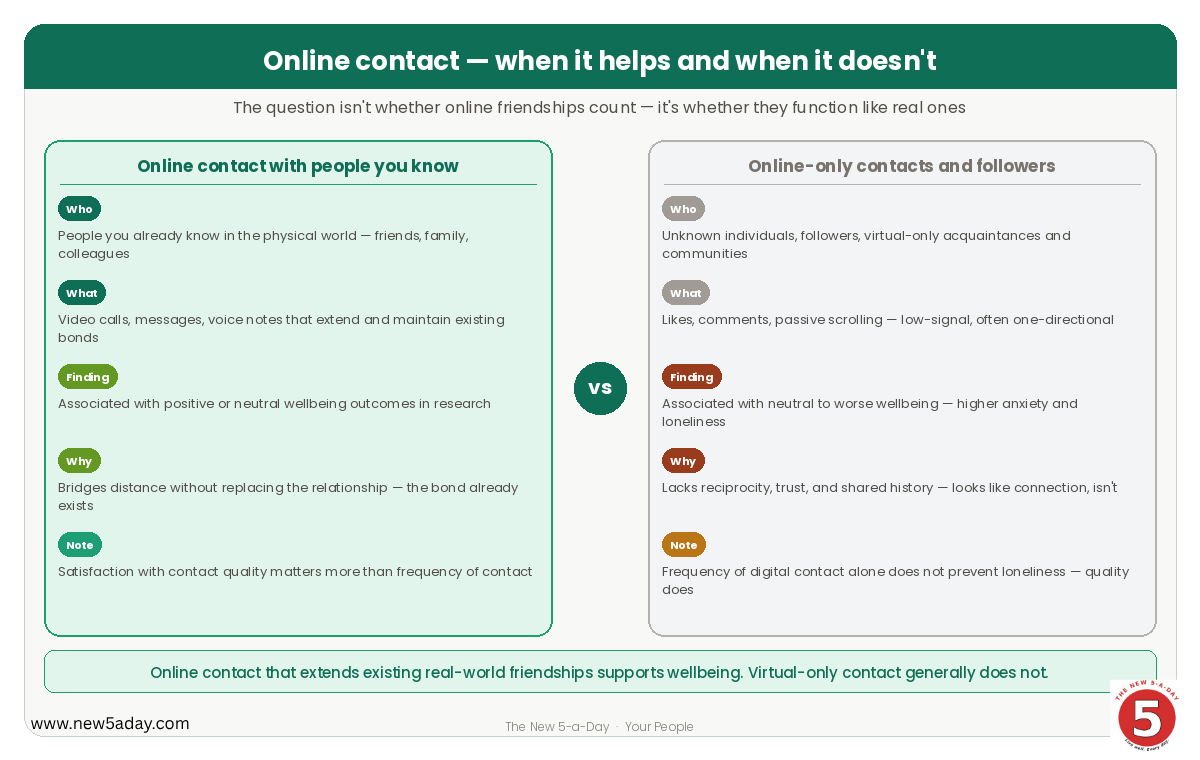
Research during the pandemic reinforced this picture. Digital contact helped — but only when it was satisfying and felt genuinely connective. Frequency alone was not the measure. You could be on your phone for hours and still feel utterly alone.
What in-person connection offers that online often cannot
Face-to-face time does something that text and video calls find hard to replicate. Body language, tone of voice, physical presence — these carry emotional information that the written word and even video compress and lose. Sitting with someone in a difficult moment communicates something that a message, however warm, simply cannot.
There is also the accumulation of shared ordinary experience — the walk, the meal, the errand done together — that builds the texture of a close friendship over time. These moments are small, but they add up. They create the sense of a shared life, which is different from a shared conversation.
Consistently, research finds that face-to-face friendships are more strongly linked to wellbeing than purely digital ones. This does not mean you have to give up online relationships — but it is a reason to be honest about what they can and cannot do. If most of your social connection is happening through a screen, and you are still feeling lonely, the problem may not be the number of connections. It may be the type.
A more useful way to think about it
Rather than asking 'how many friends do I have?' — a question that turns friendship into something to be counted and competed over — the research suggests a more useful set of questions.
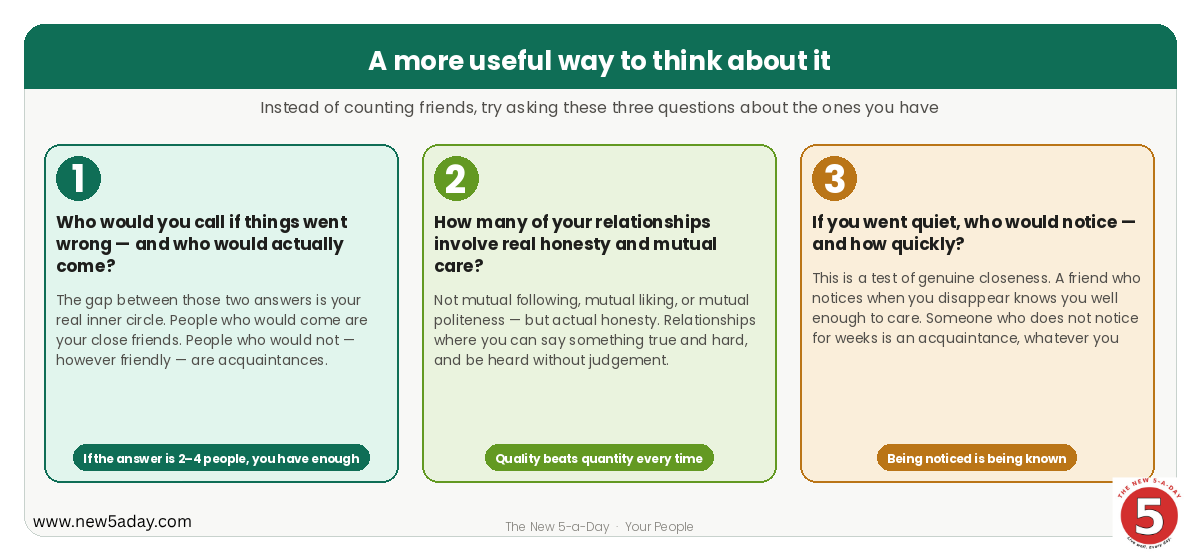
How many of your relationships are genuinely reciprocal?
How many people in your life would notice, and care, if you went quiet?
How many of your connections involve real honesty, shared history, and mutual support — not just mutual following?
It helps to think in layers. At the centre, a very small number of people — two, three, perhaps five — who form your true inner circle: the ones you can be completely honest with, rely on in a crisis, and call without a particular reason. Around that, a broader layer of good friends and warm acquaintances who add variety, enjoyment, and a sense of belonging. Both layers matter, but they do different jobs. The inner circle carries your emotional weight. The outer circle adds richness and texture.
If your inner circle feels thin or absent, that is worth addressing — not by trying to manufacture intimacy with a hundred new people, but by investing more deliberately in the relationships that already have the potential to deepen.
Bringing it back to the New 5-a-Day
Friendship is not a scoreboard. The question has never been how many friends you can accumulate, but whether you have enough of the right kind — people who know you well enough to notice when something is wrong, who you can be genuinely honest with, and where the care goes in both directions.
The research is clear that a small number of close, trusted friendships — maintained with care and consistency — does more for your health and wellbeing than any amount of surface-level social activity. And while online connection can absolutely be part of that picture, the most health-protective relationships tend to be the ones that include real presence, real honesty, and real history.
If you have two or three people in your life who genuinely know you, and you know them the same way, you have something special that many people spend a lifetime looking for.
That is not too few. That is exactly enough.
A note on medical advice: The content in this post is intended to inform and inspire, not to replace professional medical guidance. If anything you've read raises questions or concerns about your own health, please speak to your GP or another qualified health professional.
Want to explore further? This post is the accessible introduction. A detailed evidence-based Deep Dive, a full Reference List, and a podcast episode are all available on this site.
