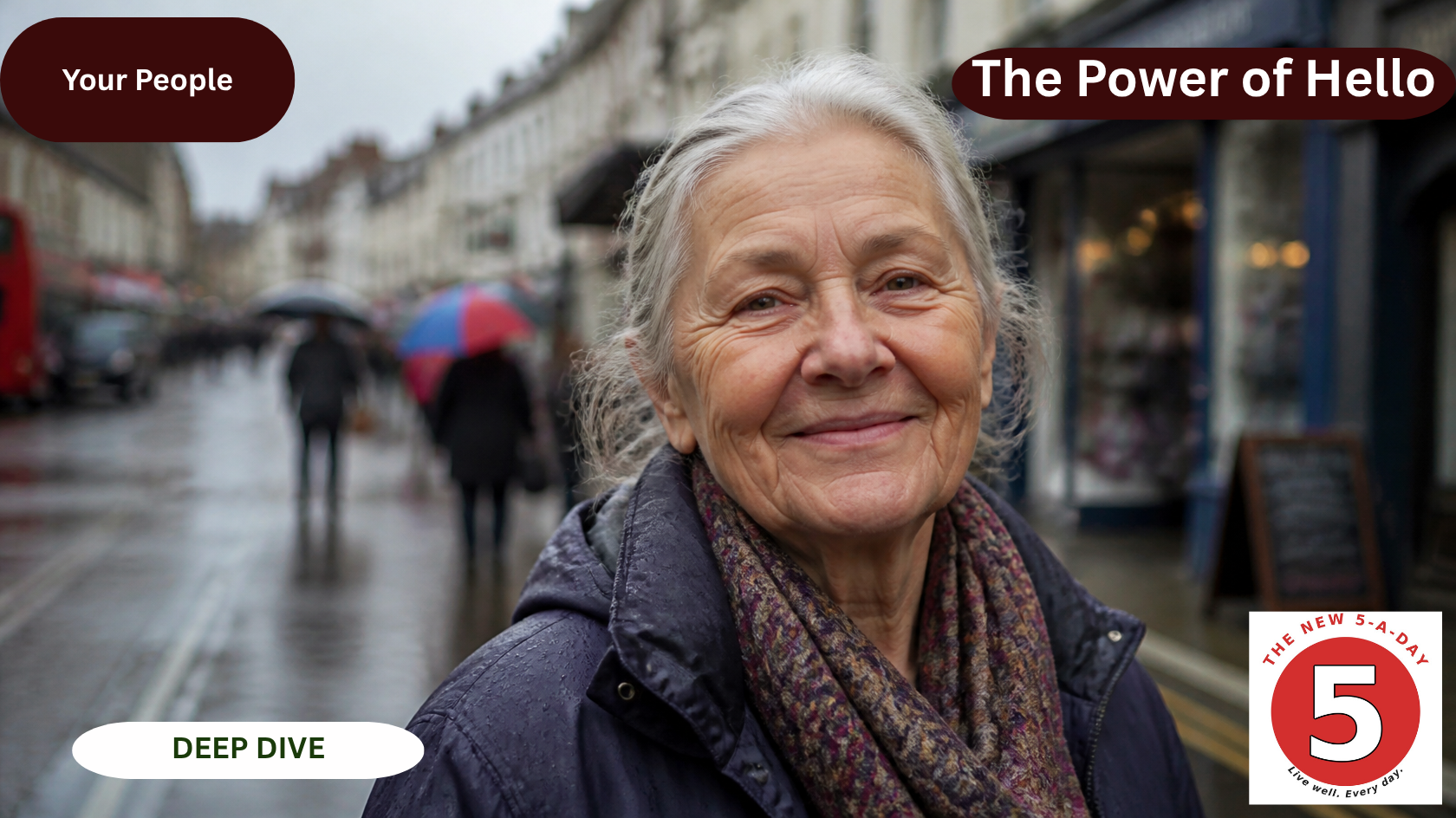
The Power of Hello - What the Science Says
Key takeaways
• Minimal social interactions — including greetings, brief thanks, and good wishes — are robustly associated with higher life satisfaction and positive affect across multiple cultures and study designs.
• Effects are primarily observed in the person initiating the greeting, though recipient benefits are also documented. The initiator advantage is well-replicated and theoretically coherent.
• Weak ties — acquaintances, service workers, neighbours, colleagues — independently predict wellbeing over and above close relationships, partly through mechanisms of belonging and reduced loneliness.
• Neighbourhood-level greeting behaviour is associated with greater social capital, community cohesion, and sense of safety. Community-level interventions that encourage neighbour contact show measurable reductions in loneliness.
• Shy individuals benefit from brief social contact with strangers in terms of mood, and do not show worse outcomes than less-shy counterparts — suggesting that greeting is a low-risk, high-return social behaviour across personality types.
• Effects are modest per interaction but cumulative in nature. The research supports greeting as a health behaviour that accrues value through repetition rather than through isolated episodes of contact.

I’m too shy! Overcoming shyness to reach Your People
Shyness is one of the most common barriers to building the social connections that keep us healthy and happy. It is not a personality flaw, a character weakness, or a life sentence — it is a learned anxiety response, and it can be unlearned. The good news: you do not need to become a social butterfly to benefit. Small, consistent steps are enough to begin opening up your world, building confidence, and finding Your People.

Shyness, Social Anxiety, and the Science of Change
Key takeaways
• Shyness is clinically distinct from introversion and overlaps substantially with social anxiety disorder; both involve fear of negative evaluation rather than a simple preference for solitude.
• Chronic shyness is associated with elevated rates of depression, social anxiety disorder, loneliness, and lower life satisfaction, with longitudinal evidence linking childhood shyness to later psychopathology.
• Acute social stress reliably activates the hypothalamic-pituitary-adrenal (HPA) axis, producing measurable increases in cortisol and autonomic arousal — the physiological basis of shyness symptoms.
• Cognitive behavioural therapy (CBT), particularly exposure-based approaches, has the strongest evidence base for reducing shyness-related difficulties. Digital and VR-delivered formats show effects comparable to in-person therapy.
• Mindfulness and yoga-based interventions demonstrate significant reductions in anxiety and physiological stress markers, offering an accessible complement to CBT-based approaches.