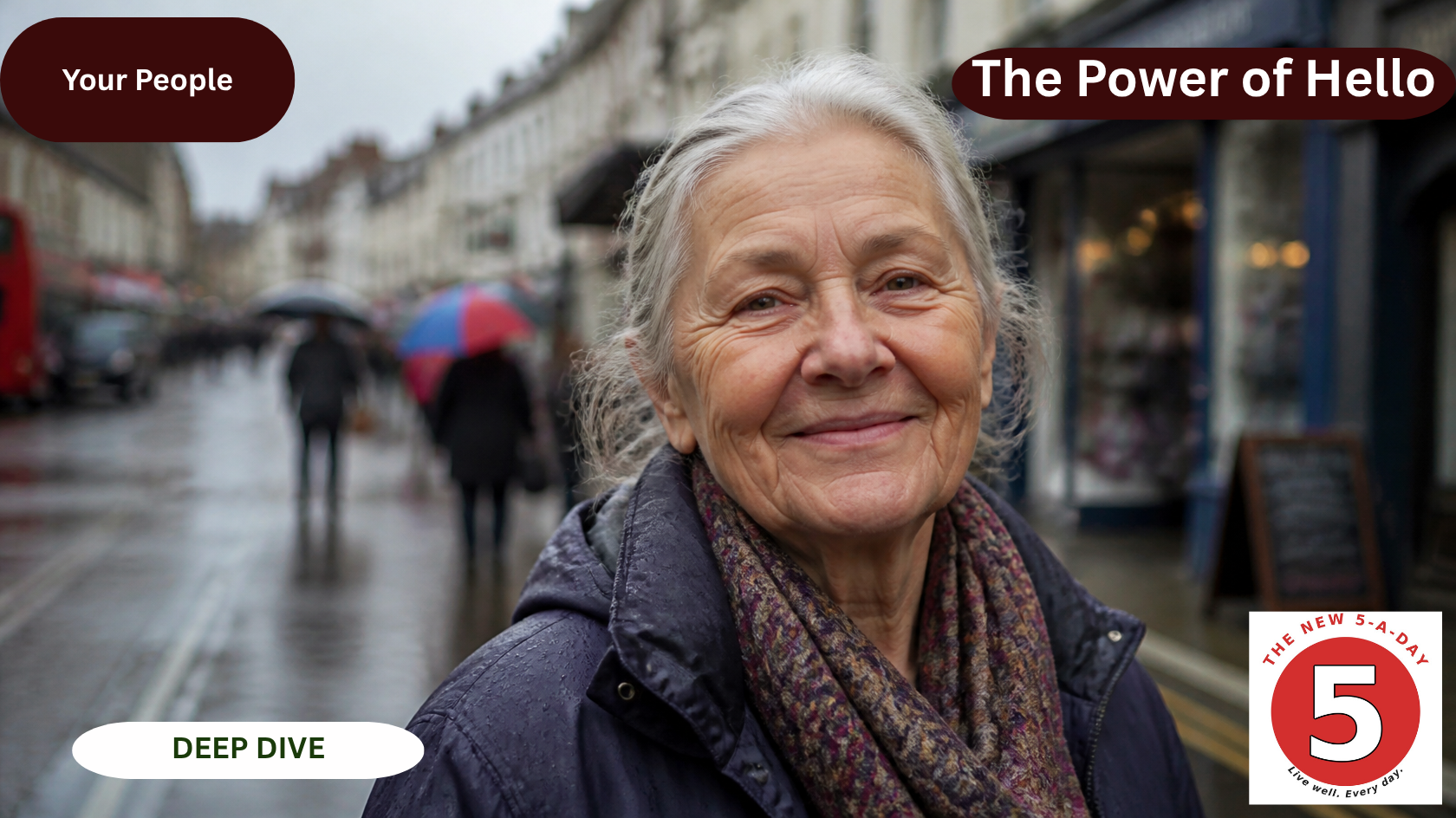
The Power of Hello - What the Science Says
Key takeaways
• Minimal social interactions — including greetings, brief thanks, and good wishes — are robustly associated with higher life satisfaction and positive affect across multiple cultures and study designs.
• Effects are primarily observed in the person initiating the greeting, though recipient benefits are also documented. The initiator advantage is well-replicated and theoretically coherent.
• Weak ties — acquaintances, service workers, neighbours, colleagues — independently predict wellbeing over and above close relationships, partly through mechanisms of belonging and reduced loneliness.
• Neighbourhood-level greeting behaviour is associated with greater social capital, community cohesion, and sense of safety. Community-level interventions that encourage neighbour contact show measurable reductions in loneliness.
• Shy individuals benefit from brief social contact with strangers in terms of mood, and do not show worse outcomes than less-shy counterparts — suggesting that greeting is a low-risk, high-return social behaviour across personality types.
• Effects are modest per interaction but cumulative in nature. The research supports greeting as a health behaviour that accrues value through repetition rather than through isolated episodes of contact.

How Many Friends - What the Science Says…
This Deep Dive examines three interrelated questions that sit at the heart of social connection research: whether there is an empirically supportable answer to how many close friends a person needs; whether friendship quality or friendship quantity is the stronger predictor of wellbeing outcomes; and what the current evidence says about the comparative health value of online versus face-to-face social relationships.

Shyness, Social Anxiety, and the Science of Change
Key takeaways
• Shyness is clinically distinct from introversion and overlaps substantially with social anxiety disorder; both involve fear of negative evaluation rather than a simple preference for solitude.
• Chronic shyness is associated with elevated rates of depression, social anxiety disorder, loneliness, and lower life satisfaction, with longitudinal evidence linking childhood shyness to later psychopathology.
• Acute social stress reliably activates the hypothalamic-pituitary-adrenal (HPA) axis, producing measurable increases in cortisol and autonomic arousal — the physiological basis of shyness symptoms.
• Cognitive behavioural therapy (CBT), particularly exposure-based approaches, has the strongest evidence base for reducing shyness-related difficulties. Digital and VR-delivered formats show effects comparable to in-person therapy.
• Mindfulness and yoga-based interventions demonstrate significant reductions in anxiety and physiological stress markers, offering an accessible complement to CBT-based approaches.