Stronger every day: why strength training matters and how to fit it into a busy life
Quick summary: Strength training — using your muscles against a load — is one of the most powerful and underrated things you can do for your long-term health. It builds stronger bones, improves balance, reduces the risk of serious conditions like heart disease and type 2 diabetes, and helps you stay capable and confident as you age. It does not require a gym, expensive equipment, or hours of your time. As little as 30 to 60 minutes of strength activity spread across the week can make a meaningful difference. This post shows you exactly how to find that time — without overhauling your life.
Here is a question worth sitting with. When did you last do something that made your muscles work hard enough to feel it the next day?
For many of us, the honest answer is: a while ago. Or possibly never. Strength training has an image problem. It conjures images of gyms, barbells, and people who seem to have dedicated their entire existence to their biceps. That image puts a lot of people off — and it is, fortunately, almost entirely wrong.
The reality is that strengthening your muscles is one of the most practical, accessible, and genuinely important things you can do for your health at any age. Strength training is one of the Four Macros of Being Active — Pillar Three of The New 5-a-Day — and it is about far more than how you look. It is about what your body can do, and how confidently and comfortably you move through life for decades to come.
What strength training actually is
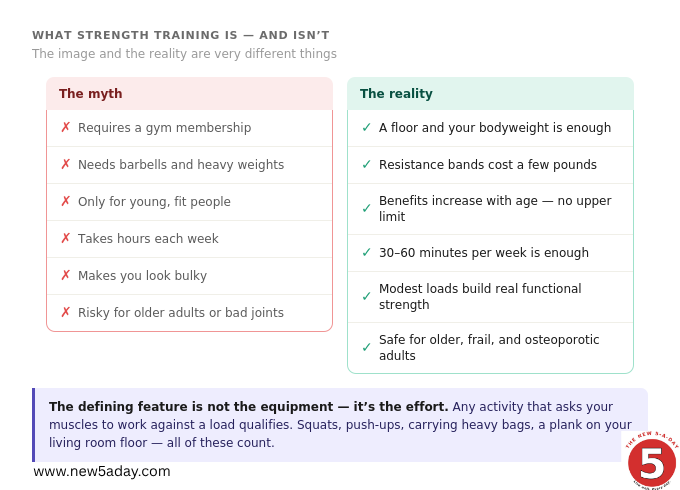
Strength training — also called resistance training — is any activity that asks your muscles to work against a load. That load might be a dumbbell, a resistance band, a full shopping bag, or your own bodyweight. The defining feature is not the equipment. It is the fact that your muscles are being asked to exert effort against something.
Squats count. Push-ups count. Carrying heavy bags up the stairs counts. Holding a plank on your living room floor counts. None of this requires lycra, a gym membership, or a personal trainer — though all of those are fine if they appeal to you.
Why the evidence is so compelling
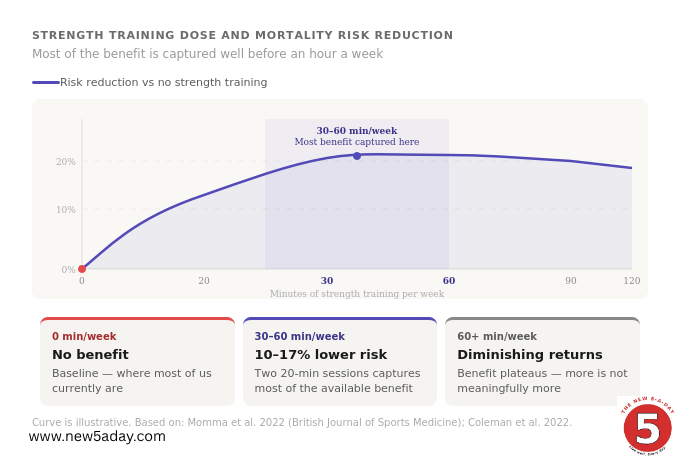
The research on strength training has grown considerably in recent years — and what it shows is striking. Large studies pooling data from hundreds of thousands of people have found that those who do regular strength work have around 10 to 20 per cent lower risk of dying prematurely than those who do none. That includes lower rates of death from heart disease, cancer, and other major conditions — and crucially, these benefits exist on top of those from regular cardio exercise, not instead of them.
But the headline mortality figures are only part of the story. Here is what the research consistently shows strength training can do.
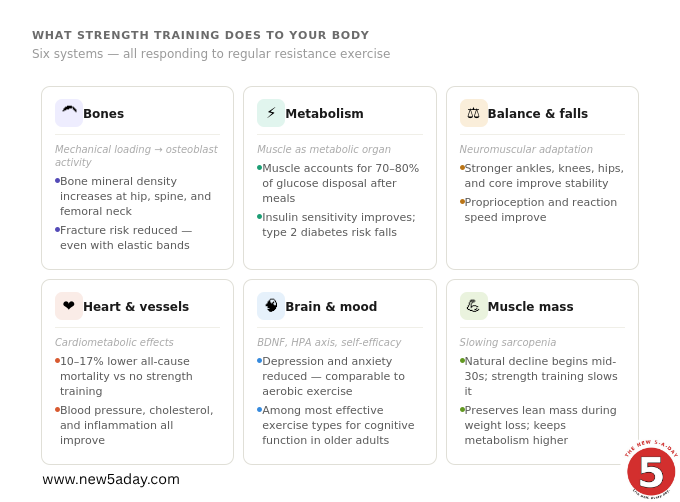
• Stronger bones. When muscles pull on bones during exercise, they become denser and stronger over time. This is one of the most reliable ways to protect against osteoporosis — the thinning of bones that makes fractures more likely as we age.
• Better balance and fewer falls. Stronger muscles around the ankles, knees, hips, and core make you more stable on your feet. Falls are a leading cause of serious injury in older adults, and regular strength training is one of the most effective preventive tools available.
• Healthier weight and metabolism. Muscle tissue uses more energy than fat, even at rest. Building and maintaining muscle helps the body manage weight more effectively over time — particularly when combined with a sensible approach to eating.
• Better blood sugar management. After eating, muscles absorb a significant portion of the glucose released into the bloodstream. Stronger, more active muscles do this more efficiently — reducing the risk of type 2 diabetes and helping manage it in people who already have it.
• Better mood and mental wellbeing. Strength training has a measurable effect on mood and anxiety. Brain chemistry shifts, the body’s stress response settles, and sleep tends to improve. Many people report feeling more capable and confident once they build a regular habit.
How little you actually need to do
This is where most people are surprised. The research on effective dose consistently points to a modest target: around 30 to 60 minutes of strength activity per week, spread across two or three sessions. Two sessions of fifteen to thirty minutes each. That is enough to capture most of the major health benefits, with larger amounts providing diminishing additional returns.
Major health guidelines in the UK, US, and internationally recommend muscle-strengthening activities for all major muscle groups on at least two days a week. Not instead of cardio — alongside it. Both matter. Fortunately, neither demands very much time.
No gym needed: building strength at home
The barrier most people imagine — needing gym access, specialist kit, or a significant budget — is not real. Some of the most effective strength exercises require nothing more than a floor.
A short routine built around squats, lunges, push-ups, planks, and glute bridges covers the major muscle groups of the legs, hips, core, chest, shoulders, and arms. All can be modified for where you are starting from: wall push-ups, partial squats, short plank holds. None requires any equipment.
If you want to add a little resistance, a set of elastic resistance bands costs very little and stores in a drawer. Or use what you already own: a backpack loaded with books, a large bottle of water, a bag of flour. None of this is glamorous. All of it genuinely works.
Building it into a busy life
If 30 to 60 minutes across the whole week is enough to capture most of the benefit, we are talking about finding two fifteen-minute windows across seven days. The question is less about time and more about structure: having a simple plan that makes the action easy to take.
• Anchor it to something you already do. A short session after walking the dog, before your morning shower, or while dinner is in the oven is far easier to maintain than a free-floating intention to exercise. Attaching the habit to an existing routine makes it far stickier.
• Use micro-sessions. Five to ten minutes of bodyweight exercises done two or three times across a day adds up just as effectively as a single longer session. A few squats before breakfast, push-ups at lunchtime, a plank hold in the evening. Small in the moment; cumulative over time.
• Turn ordinary moments into strength work. Carrying heavy shopping bags counts. Taking the stairs at a pace that makes your legs feel it counts. Lifting anything heavy with good form — knees bent, back straight, driven by the legs — turns daily tasks into small training opportunities.
• Set a simple weekly structure. Two named days — Monday and Thursday, say — with a short, repeatable routine removes the need to make a decision each time. Decisions cost energy. A pre-made plan does not.
Strength for your actual life
A useful lens for thinking about strength training is what is sometimes called functional fitness — building strength that makes everyday life easier. Squats and lunges translate directly to getting up from a chair and climbing stairs. Push-ups make pushing and pulling feel less effortful. Core work supports posture and reduces back discomfort. Train these movements, and daily life becomes more comfortable — not just now, but for decades to come.
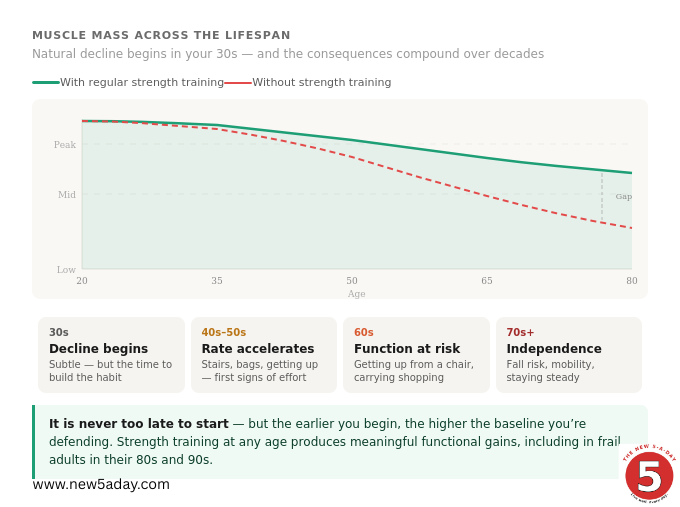
This matters more as we age. Muscle mass naturally declines from our mid-thirties onwards if we do nothing to counteract it. Left unchecked, that gradual loss means previously ordinary tasks — getting up from a low chair, carrying a suitcase, staying steady on uneven ground — become genuinely difficult. Regular strength training is the most effective tool we have to slow that process down. It is not about becoming athletic. It is about not quietly losing the physical capacity that ordinary life requires.
A simple place to start
Start smaller than you think you need to. Most people ignore this advice, which is why most people quit within the first few weeks.
A realistic beginner routine: two sessions a week, ten to fifteen minutes each. A few sets of squats, modified push-ups (against a wall or on the knees if needed), a short plank hold, and glute bridges. Ten repetitions, a minute’s rest between exercises. The goal in the early weeks is not impressive strength — it is the habit of showing up, and letting your body adapt to the demand being placed on it.
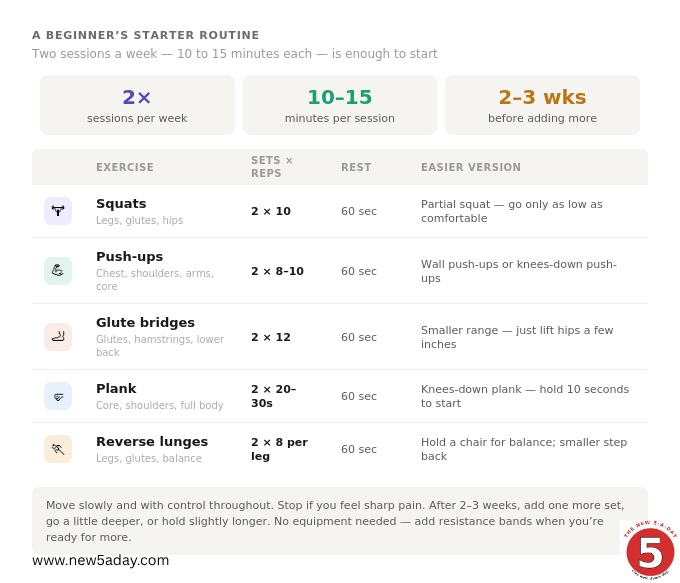
After a few weeks, add a little more: another set, a deeper squat, a slightly longer plank, or a small amount of added resistance. Gradual progression is what drives improvement. It does not have to be dramatic. It just has to keep happening. On safety: go slowly, focus on controlled movement, and stop if you feel sharp pain. Strength training done sensibly is one of the safest forms of exercise available — including for older adults and people with joint concerns.
Bringing it back to The New 5-a-Day
Be Active is Pillar Three — and strength training is one of its four essential components. Not because it is the most glamorous form of movement, but because of what it protects against: fragility, bone loss, falls, and the slow narrowing of what daily life can contain.
Strength training is not about getting bigger or looking different. It is about remaining capable — being the person who can still carry their own bags, get up off the floor, climb a flight of stairs without pausing, and move through daily life with confidence rather than caution. For decades to come.
None of that requires a gym. It requires a floor, a bit of time, and the decision to start. The body, given consistent, modest stimulus, responds. That is not optimism. That is physiology.
A note on medical advice: The content in this post is intended to inform and inspire, not to replace professional medical guidance. If you have joint problems, osteoporosis, a heart condition, or any other health concern that might be relevant to starting a strength training programme, please speak to your GP or a qualified health professional before making significant changes to your activity levels.
Want to explore further? This post is the accessible introduction. A detailed evidence-based Deep Dive, a full Reference List, and a podcast episode are all available on this site.
