Mindful walking: be present with yourself and the world around you
Quick summary: Mindful walking is the simple practice of walking with your attention on what you are actually doing — your breath, your body, the world around you — rather than on the endless stream of thought that usually accompanies you. It costs nothing. It requires no equipment, no special location, and no particular fitness level. The research, while still developing, consistently points to meaningful reductions in stress and anxiety, modest improvements in mood, and a gentler kind of mental reset that most of us could use more of. This post is about what mindful walking is, why it works, and how to fit it into a life that already feels full.
There is a particular kind of tiredness that has nothing to do with how much you have slept. It comes from a day of decisions, notifications, half-finished conversations, and a mind that has not actually stopped since you opened your eyes that morning. Many of us recognise it. Not many of us know what to do about it.
The quiet answer, it turns out, is something almost absurdly simple: go for a walk. But not the kind of walk where you listen to a podcast, plan dinner, or work through an email in your head. A walk where walking is the thing you are doing.
That is mindful walking — and it sits at the heart of what the Me-Time pillar of The New 5-a-Day is really about. Not a grand retreat from life; just a small, deliberate pause inside it.
What mindful walking actually is
Mindful walking is the practice of walking while paying attention to the fact that you are walking. That sounds circular, and in a way it is — but it points at something most of us stopped doing a long time ago.
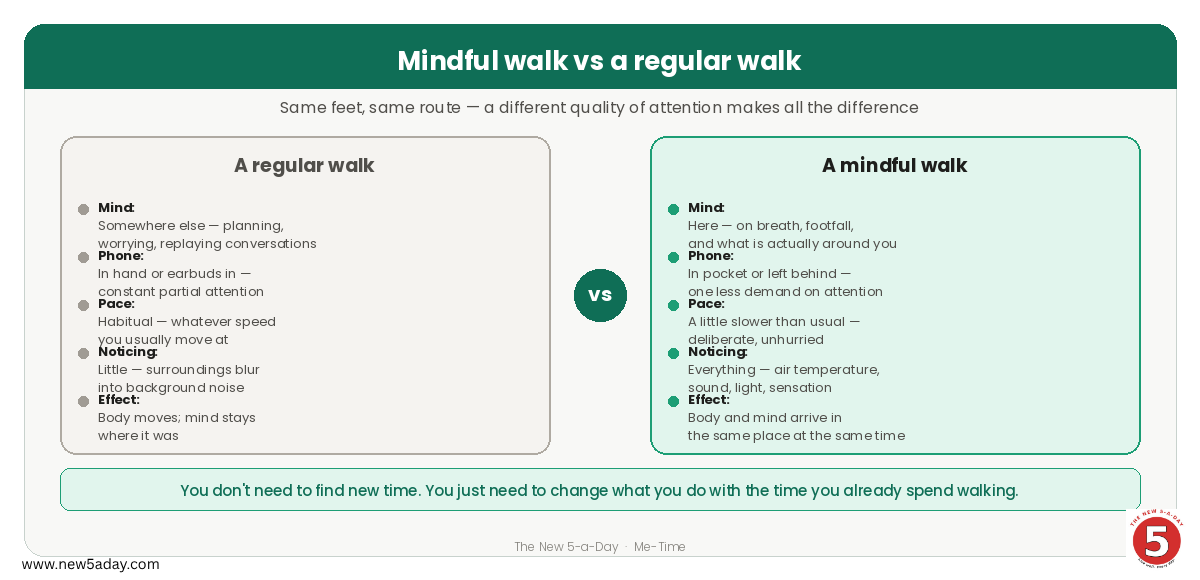
On a normal walk, your body moves and your mind goes somewhere else entirely. You walk to the shops while rehearsing an argument. You walk the dog while scrolling through your phone. You walk to the station while running through the day’s to-do list. The walking itself becomes a kind of background activity — something your legs are doing while the real work happens in your head.
Mindful walking reverses that. You walk a little more slowly than usual. You notice your feet making contact with the ground. You notice the rhythm of your breathing, the movement of your arms, the temperature of the air on your skin. You notice what you can see and hear — without turning any of it into a problem to solve. When your mind wanders off (and it will, constantly), you gently bring your attention back to the next step.
That is it. There is no special breathing technique, no mantra, no app required. Mindful walking is one of the oldest contemplative practices in the world, and one of the least complicated.
Why it seems to work
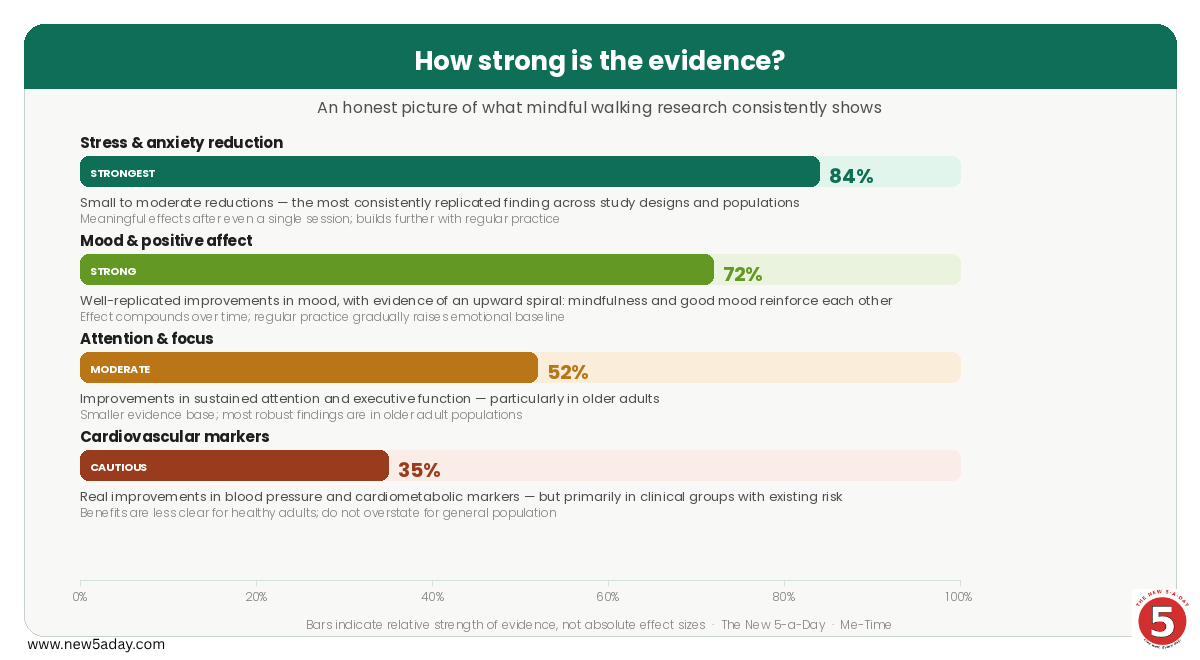
The research on mindful walking is still relatively young, but what there is points in a consistent direction. Across a range of studies mindful walking has been associated with meaningful reductions in stress and anxiety, improvements in mood, and a greater sense of calm and presence. In some studies, even a single guided mindful walk has produced noticeable changes in how people feel.
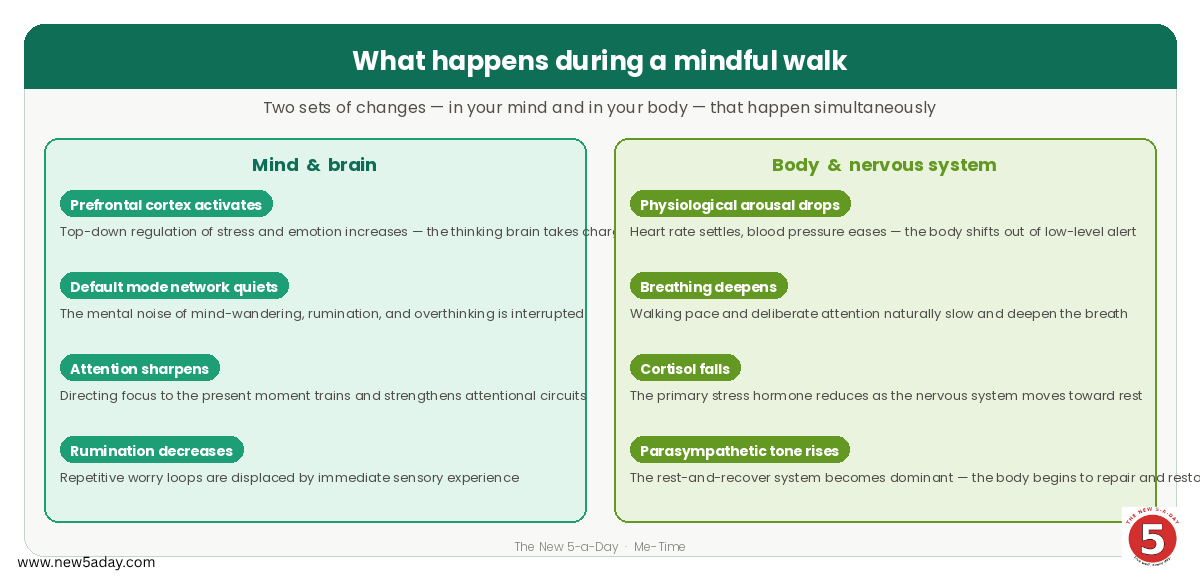
The mechanisms are not mysterious. Walking at a comfortable pace already does useful things to the nervous system: it lowers physiological arousal, encourages deeper breathing, and shifts the body out of whatever low-grade alert state it has been quietly maintaining since the morning. Add a bit of deliberate attention to the body and the surroundings, and you give the mind somewhere specific to be — which turns out to be remarkably restful when the alternative is another loop through the same set of worries.
There is also growing evidence that regular mindful walking may support attention and focus over time, and some research suggests it can help with cardiovascular and cognitive markers, particularly in people who practice it consistently. These findings are encouraging, though still preliminary. The clearest benefits are a calmer nervous system, less anxiety, better mood, and a small but real improvement in how you feel. For a practice that asks nothing from you except a few minutes of your time, that is a very good return.
What makes it different from a regular walk
A brisk walk for cardio is an excellent thing, and you should keep doing those. (Pillar Three of The New 5-a-Day has quite a lot to say about them.) But a mindful walk is a different kind of tool, aimed at a different kind of problem.
Cardio walking is about raising your heart rate and supporting physical health. Mindful walking is about slowing down and actively recovering from the mental load of daily life. One is exercise; the other is closer to meditation. They are not in competition — in fact, a ten-minute mindful walk at the start or end of a longer cardio walk is a sensible combination. The point is simply that if you are looking for mental rest, a mindful walk is probably doing more for you than a phone-scroll on the sofa.
How to build it into a busy day
Starting is simpler than it sounds. Before you set off, pause for a moment and take a breath. Notice how your feet feel on the ground. Then begin walking — a little slower than your usual pace — and let that be your anchor for the first few minutes. You don't need to do anything else. You just need to start there, rather than somewhere in your head.
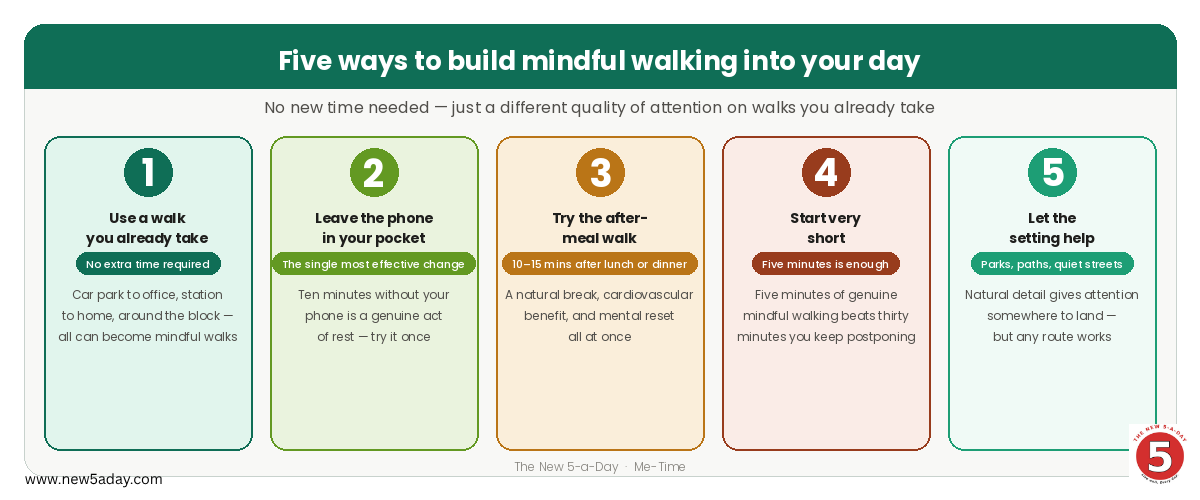
The best thing about mindful walking is that it does not require you to find new time. It asks you to change the quality of time you already spend walking. A few practical ways to do that:
• Use a walk you already take. The short walk from the car park to the office, from the station to home, or around the block after lunch — all of these can become mindful walks without adding a single minute to your day. The shift is in attention, not duration.
• Leave the phone in your pocket. This is the single most effective change most people can make. A mindful walk with a phone buzzing in your hand is just a slightly slower version of a distracted walk. Even ten minutes without your phone is a genuine act of rest.
• Try the after-meal walk. A ten to fifteen-minute walk after lunch or dinner is already one of the best health habits there is. Made mindful — slow pace, attention on the body and surroundings — it becomes a natural break, a cardiovascular benefit, and a mental reset all at once.
• Start very short. Five minutes of genuinely mindful walking is more useful than thirty minutes you keep meaning to do. If you are new to this, try a single five-minute walk a day for a week, and see what you notice.
• Let the setting help. A park, a quiet street, a garden path, a stretch of canal — any environment with a bit of natural detail gives your attention something to land on. A city pavement works too, but gentler surroundings tend to make the early stages easier.
When the mind wanders — because it will
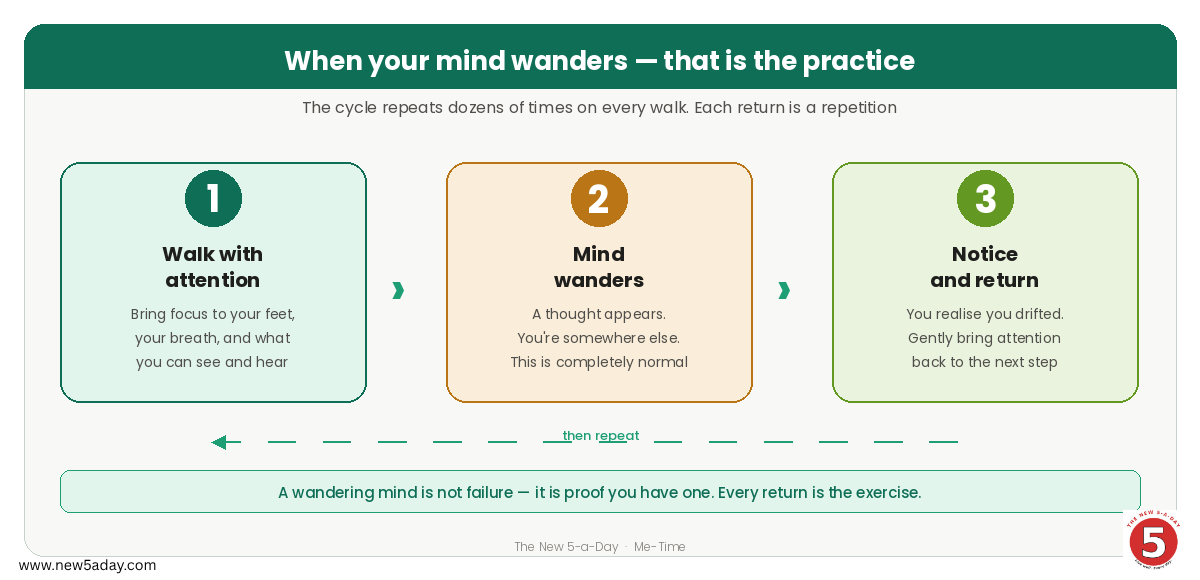
One of the most common reasons people give up on mindful practices is the belief that they are doing it wrong. The mind drifts off within thirty seconds. A random thought appears. Within a minute or two, you realise you have not noticed anything about your walking for ages.
That is not a failure. That is the practice. The whole thing is the noticing that your mind has wandered, and gently returning to the next step. You will do this dozens of times in a short walk — and every return is the exercise. A wandering mind is not a sign that mindful walking is not for you. It is a sign that you have a mind. Welcome to the club.
Bringing it back to The New 5-a-Day
Me-Time is Pillar Four of The New 5-a-Day — and mindful walking sits comfortably at the centre of what this pillar is for. It is accessible. It is free. It takes minutes rather than hours. It pairs with things you are already doing. And the evidence, while still developing, is consistent enough to take seriously.
Most of us are not short of activity. We are short of presence. Mindful walking is one of the simplest ways to put a small amount of genuine presence back into a day that has otherwise been spent somewhere else. You do not need to be good at it. You do not need to believe in it. You just need to walk — and, for a few minutes, to actually be there while you do.
That, it turns out, is enough.
A note on medical advice: The content in this post is intended to inform and inspire, not to replace professional medical guidance. If you have any health conditions that affect your ability to walk safely, or concerns about stress, anxiety, or mental health, please speak to your GP or another qualified health professional.
Want to explore further? This post is the accessible introduction. A detailed evidence-based Deep Dive, a full Reference List, and a podcast episode are all available on this site.
