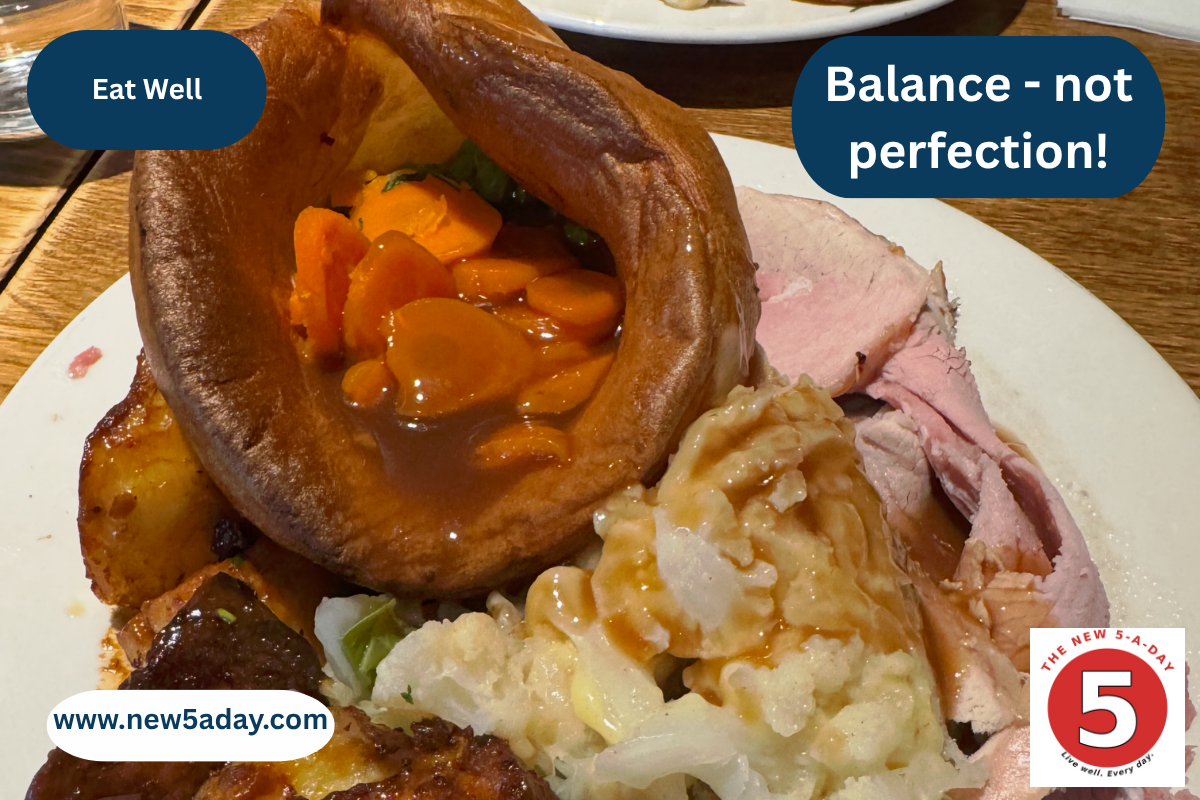
Quick summary: “Eat a balanced diet” sounds like something you are bound to get wrong, but in practice it is far more forgiving than that. It is not about flawless meals or rigid rules — it is about eating a good variety of foods, in roughly sensible proportions, most of the time. There is no single “right” way to do it, and what matters is the overall pattern across days and weeks, not any single meal. The busier your life, the more that built-in flexibility works in your favour.
“Eat a balanced diet” might be the most repeated piece of health advice there is — and one of the least useful as it is usually delivered. Balanced how? Balanced against what? And does it mean every meal has to be a colour-coordinated arrangement of vegetables, photographed for someone’s feed before anyone is allowed to eat?
It does not. The real version is quieter, more flexible, and far more achievable — and it is the one the evidence supports. Balance is not a performance you pass or fail at each sitting; it is a pattern you build gently over time, with room for real life, real budgets, and the occasional slice of cake. This is Post Six in Eat Well — Pillar Two of The New 5-a-Day — and the aim is to move past the slogan: what “balanced” actually means, the different ways to get there, why it is best judged across weeks rather than meals, and how to make it work when your day is already full.
What “balanced” actually means
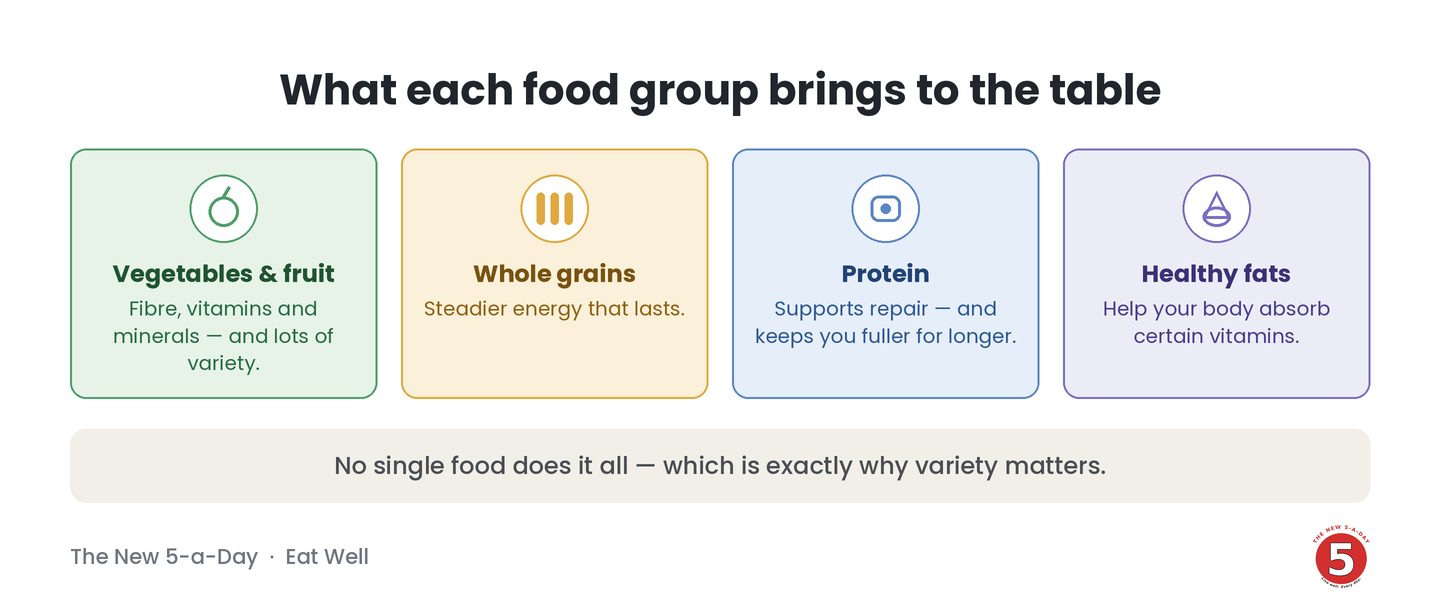
Strip away the noise and a balanced diet comes down to three ideas: variety, proportion, and consistency. Variety, because no single food contains everything your body needs — vegetables and fruit bring fibre and a wide range of vitamins and minerals, whole grains provide steadier energy, protein supports repair and keeps you fuller for longer, and healthy fats help with things like absorbing certain vitamins. Proportion, because the rough balance between those groups is what makes a meal complete and satisfying. And consistency, because it is the overall pattern — not any one plate — that shapes how you feel over time. Notice what is missing: no calorie target, no exact split of grams, no foods banned forever. A wider range of foods is simply associated with a better chance of getting the nutrients you need — a far more encouraging starting point than a list of bans.
There is more than one way to balance a plate
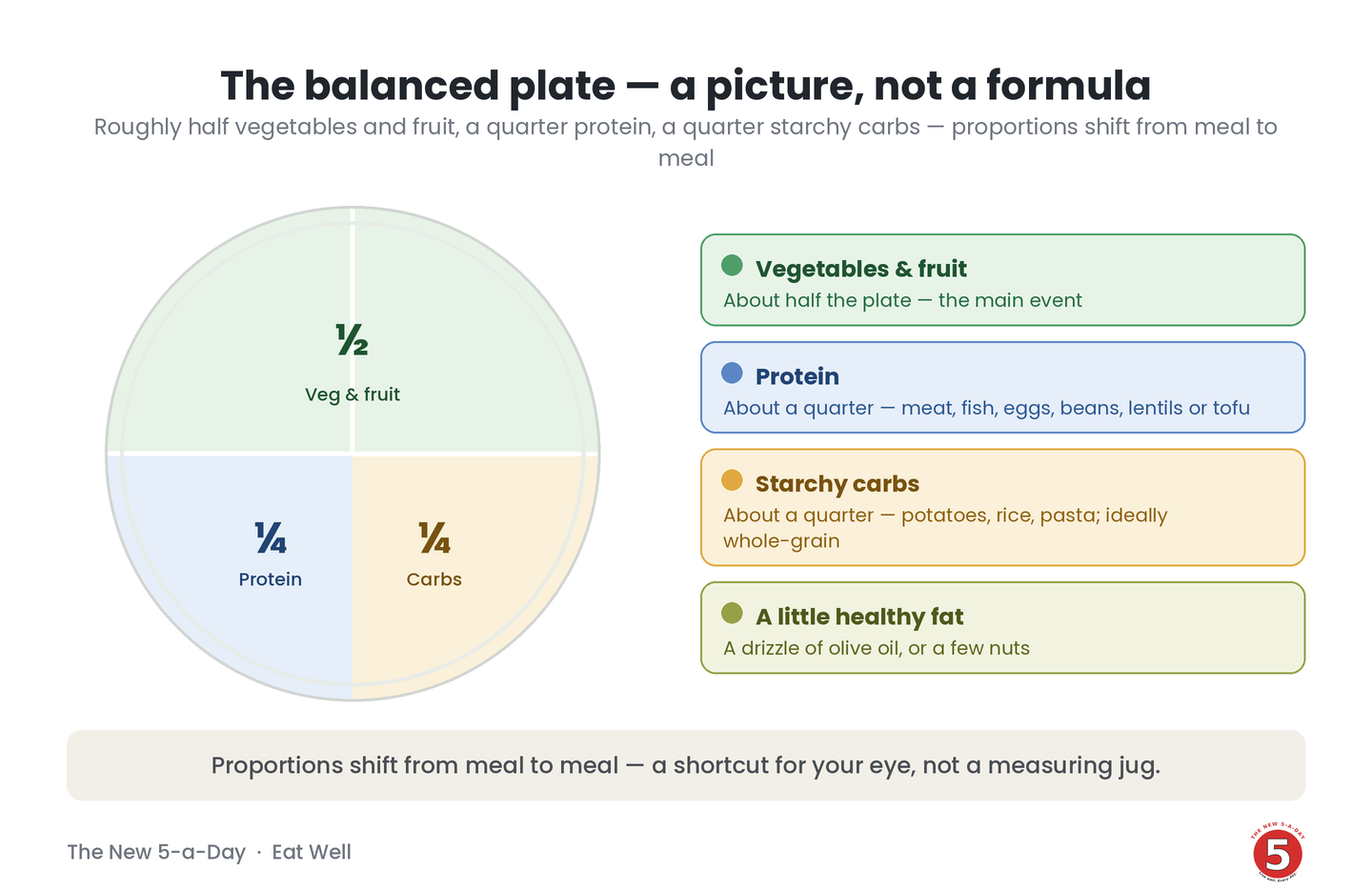
One freeing thing to understand is that “balanced” does not describe a single diet — it is a destination you can reach by several routes. The simplest is the plate model, a visual shortcut rather than a formula. Picture roughly half your plate as vegetables or fruit, about a quarter as a protein of your choosing (meat, fish, eggs, beans, lentils, or tofu), and about a quarter as starchy carbohydrates (potatoes, rice, pasta, ideally whole-grain), with a little healthy fat such as olive oil or a few nuts. The proportions shift with the meal, but it brings every group into view at once — which is most of the work.
A second route is to follow one of the eating patterns researchers have studied for years — the Mediterranean way of eating being the best known. What they share matters more than what separates them: plenty of vegetables, fruit, whole grains, beans and pulses, nuts, and healthy fats, with smaller amounts of red and processed meat and little heavily processed, sugary food. Patterns along these lines are consistently associated with better long-term heart and metabolic health — and they are built as sustainable ways of eating, not short-term regimes.
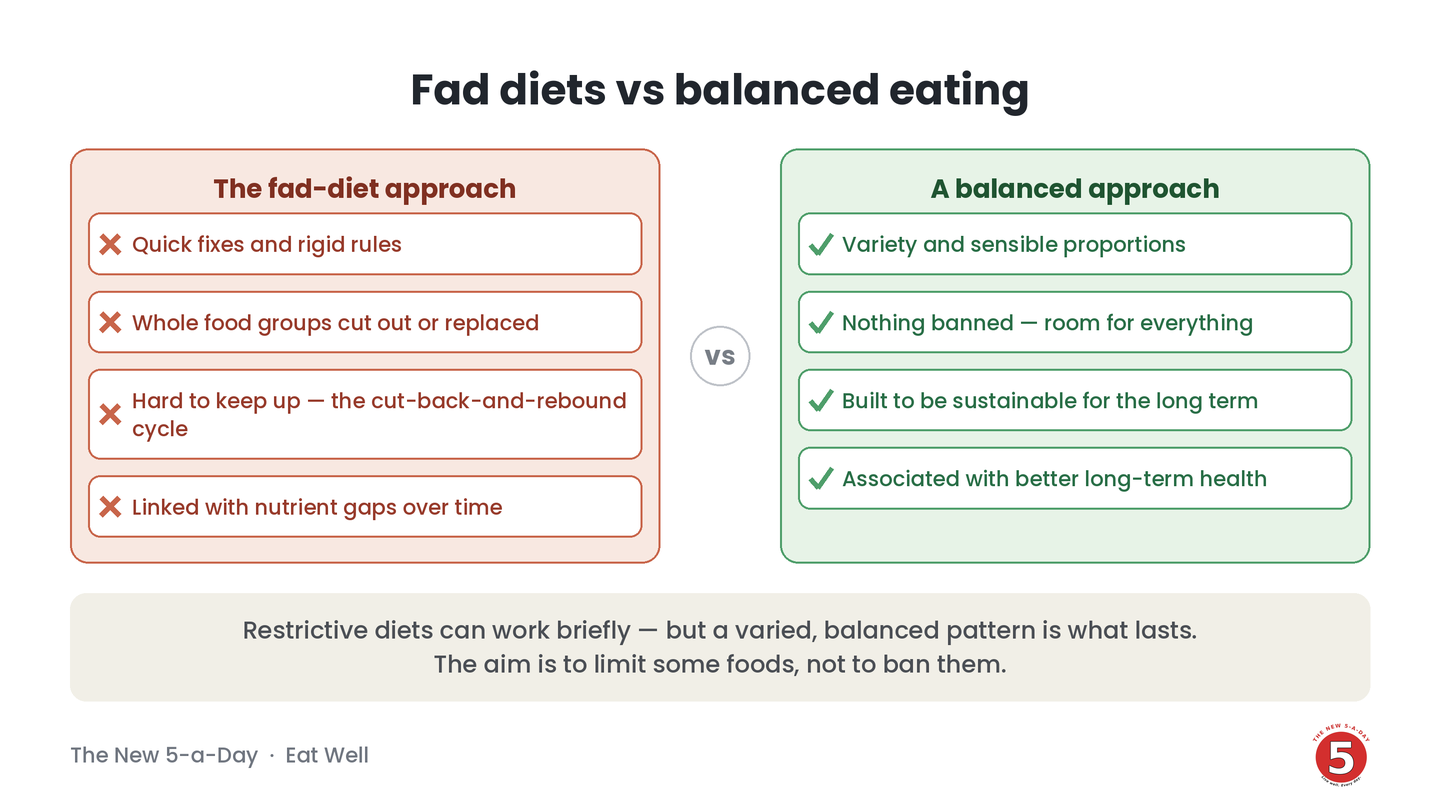
It also helps to see balance by contrast with what it is not. Fad diets take the opposite approach: quick results, rigid rules, whole food groups cut out or replaced with special products. They can work briefly, mostly because narrowing your choices reduces how much you eat — but that narrowness is what makes them hard to live with. Over time, very restrictive approaches are linked with nutrient gaps, a more stressful relationship with food, and the familiar cycle of cutting back and rebounding, and the evidence is fairly consistent that they do not beat a varied, balanced approach in the long run.
The third route is the most important: your own version. A diet that is nutritionally tidy but that you dislike and cannot keep up is not, in any meaningful sense, balanced. Your culture, budget, schedule, and the people you eat with all belong in the picture. The best pattern is the good one you can actually sustain.
Daily, weekly, monthly: balance is a long game
Perhaps the most useful shift is to stop measuring balance meal by meal and start measuring it across longer stretches. It plays out on three timescales at once.
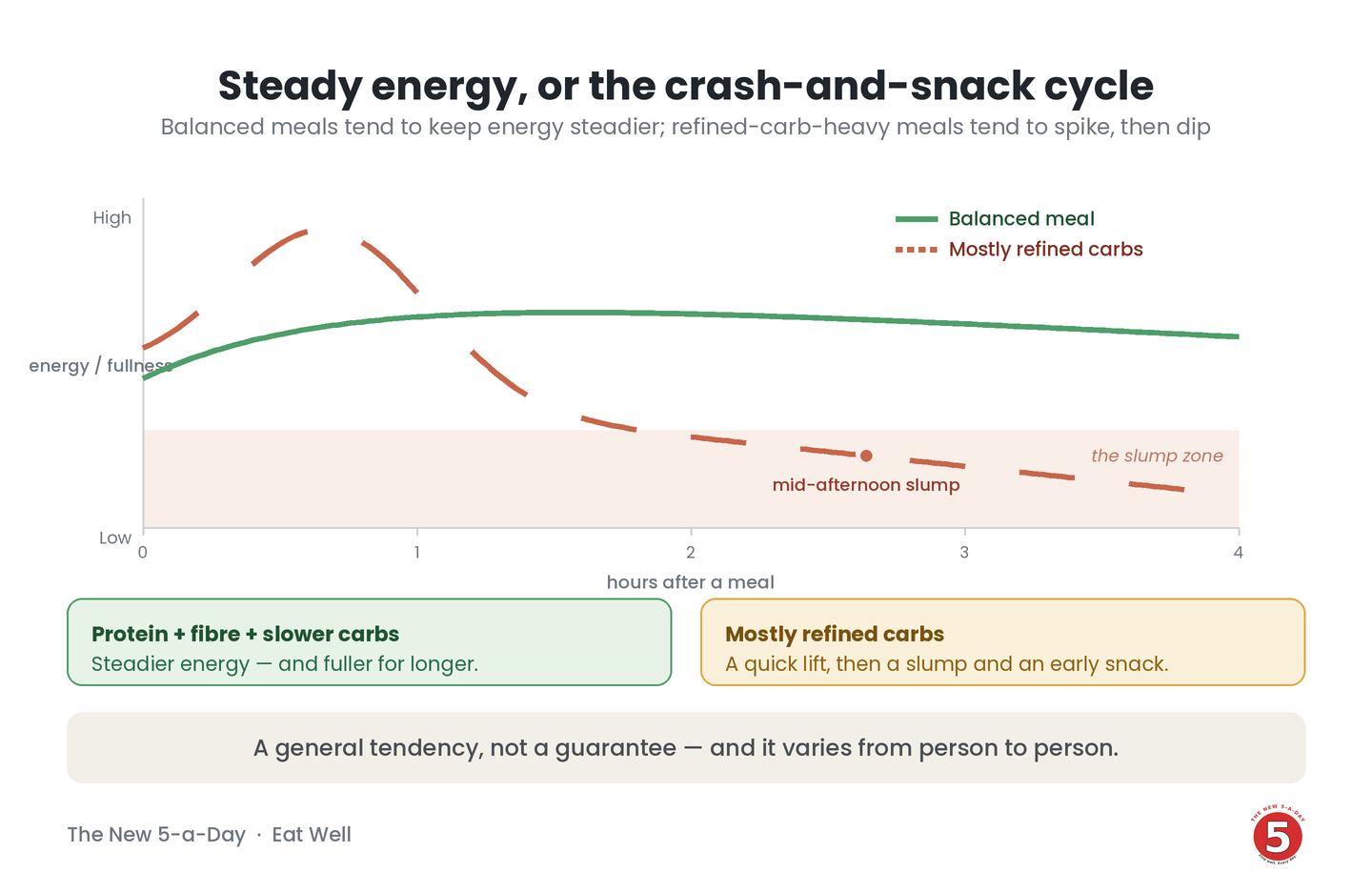
Across a single day, aim for variety and a bit of each group rather than perfection. Meals combining fibre, protein, and slower-digesting carbohydrates tend to give steadier energy and keep you fuller — making the mid-afternoon slump and the “crash and snack” cycle less likely. You are not trying to make every plate flawless; just not to lean on one group all day at the expense of the others.
Across a week, you find the unit that matters most. One takeaway or one freer weekend does not undo seven days of eating reasonably well — and one virtuous salad does not redeem a week built on little else. Zoom out from Monday to Sunday: if you see plenty of vegetables, some fruit, reasonable protein, a mix of whole grains, and most meals home-cooked or minimally processed, you are doing well. That weekly lens is far kinder, and more accurate, than judging yourself one meal at a time.
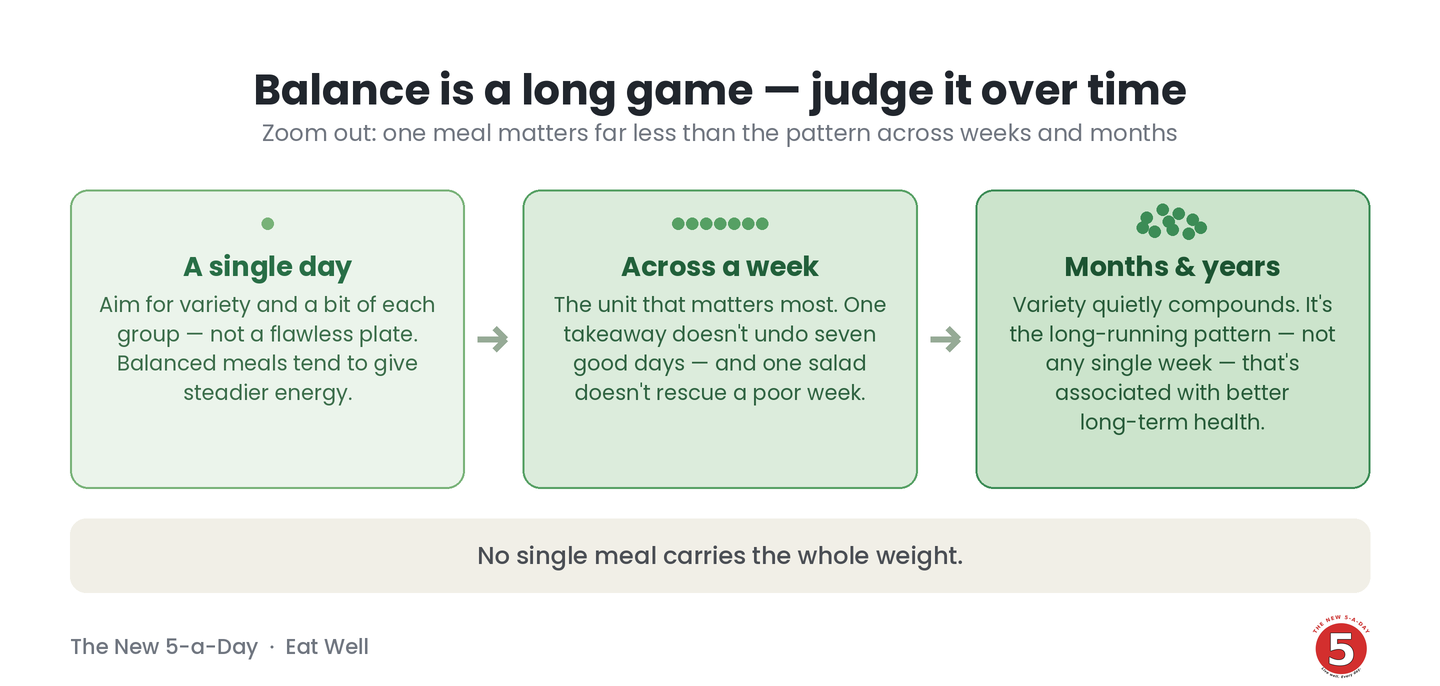
Across months and years, variety quietly compounds. Eating a wide range of foods improves your odds of meeting all your nutrient needs and supports a more diverse gut — and it is the long-running pattern, not any single week, that is associated with lower risk of conditions like heart disease and type 2 diabetes. This is the health-span view: not just how long you live, but how well. And the long game is forgiving by nature — no single meal carries the whole weight.
Optimising balance on a busy day
The challenge is rarely understanding balance — it is putting it into practice when time is short and the easiest option is whatever is nearest. A few habits make balance the path of least resistance. The overall aim is simply better, not perfect: a meal a little more balanced than yesterday’s is a win, and enough small wins stacked together take care of the pattern.
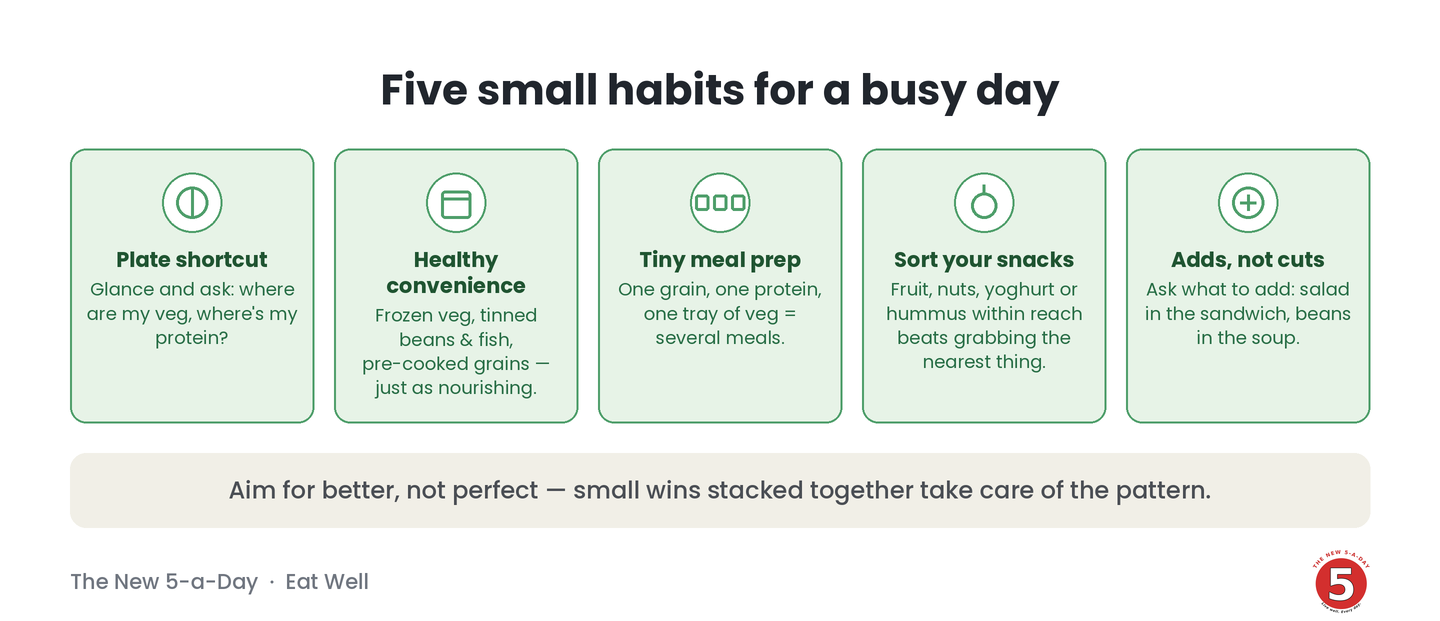
• Use the plate as a mental shortcut. No weighing or counting needed. Glancing at a meal and asking “where are my vegetables, where is my protein” takes a second and quietly improves most plates.
• Let healthy convenience do the work. Frozen vegetables, tinned beans, tinned fish, pre-cooked grains, eggs, yoghurt, and bagged salad are not cheating — they are just as nourishing as fresh and turn a balanced meal into a five-minute job.
• Keep meal prep tiny. You need not batch-cook every lunch. Cooking one grain, one protein, and one tray of vegetables gives several mix-and-match meals — and a small plan that survives to Wednesday beats an ambitious one that collapses by Tuesday.
• Sort out your snacks. Fruit, nuts, yoghurt, hummus, or oatcakes within reach prevent the long hungry gaps that lead to grabbing whatever is nearest. Keep a shelf-stable option in your bag or drawer too.
• Think in adds, not cuts. Rather than asking what to stop eating, ask what you could add: salad in the sandwich, beans in the soup, extra vegetables in the pasta, fruit alongside breakfast. Small additions improve a diet more reliably than strict rules.
Bringing it back to The New 5-a-Day
Eat Well is Pillar Two of The New 5-a-Day — and balance is the idea that ties the whole pillar together. It is not about forbidden foods or a complicated plan, but about seeing your meals clearly enough to nudge them, over time, towards something that supports the rest of your life: the energy to be active, the steadiness that helps you sleep, the even mood that makes everything easier, and the simple pleasure of sharing food with other people.
There is no perfect ratio to hit and no single diet to follow — just variety, sensible proportion, and consistency across weeks rather than meals, reached by whichever route fits your life and forgiving enough to absorb the days that do not go to plan. That is what balanced really means. Not a rule. A relationship with food that works for you, for the long term.
A note on medical advice: The content in this post is intended to inform and inspire, not to replace professional medical guidance. If you have a health condition affected by diet — such as type 2 diabetes, coeliac disease, kidney disease, or a history of disordered eating — or any other concern about your own health, please speak to your GP or a registered dietitian for advice tailored to your situation.
Want to explore further? This post is the accessible introduction. A detailed evidence-based Deep Dive, a full Reference List, and a podcast episode are all available on this site.
