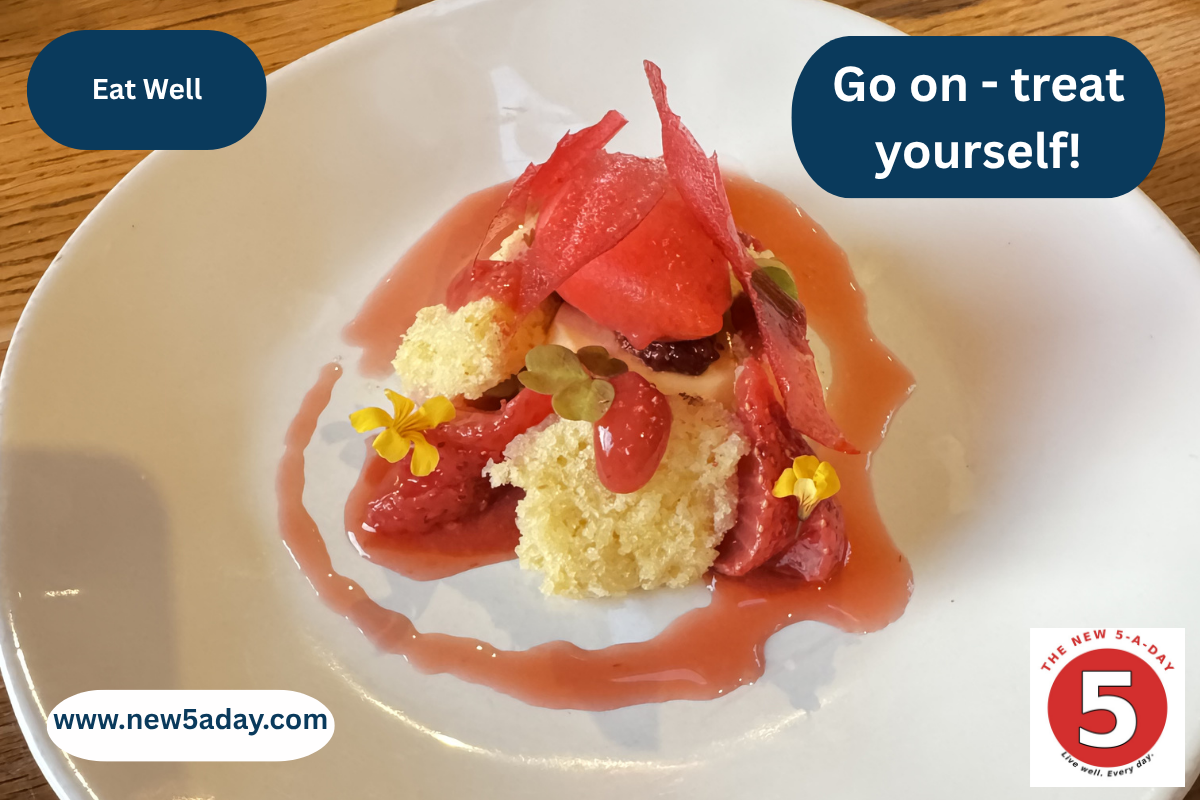
Go on - treat yourself!
Quick summary: A treat is not the enemy of a healthy diet — but it works best as the exception, not the rule. The foods you eat on a typical Tuesday have far more bearing on your health than the cake you had at Saturday's birthday party. When your everyday eating is built around nourishing, satisfying food, occasional treats fit in perfectly well. The problems arise when the treats gradually become the defaults. This post is about finding that line — and making the most of the right side of it.
Here is something most nutrition advice gets badly wrong. It treats the occasional biscuit, the Friday night takeaway, or the dessert shared with friends as a kind of dietary confession — a moment of weakness to be logged, compensated for, or quietly felt guilty about.
That framing is not only unhelpful. There is a reasonable argument that it actively makes things worse.
The truth about treats is rather more interesting, and considerably more forgiving, than the wellness industry would have you believe. Yes, eating too many of them too often is a problem. But the occasional treat? That can be fine. Sometimes it can even be the right call. And learning to tell the difference between those two situations is one of the most useful things you can do for your long-term relationship with food.
Your everyday defaults are doing the heavy lifting
Before we get into treats specifically, it helps to understand one of the most important — and most underappreciated — ideas in nutrition: your health is shaped by your patterns, not your exceptions.
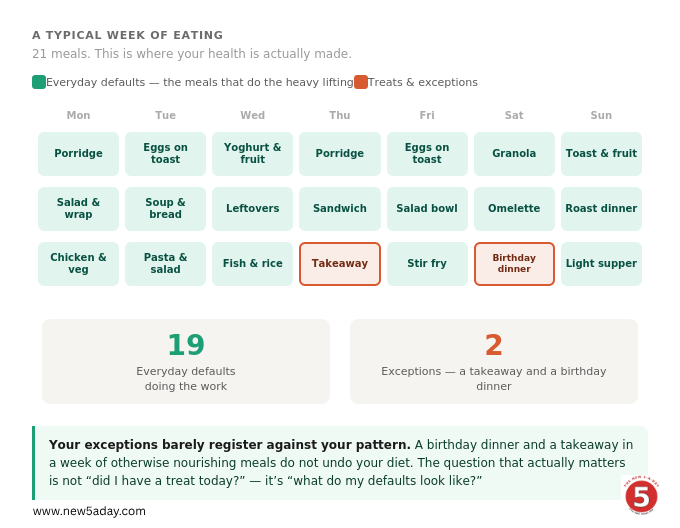
The meal you eat on a typical Monday morning. Your usual lunch at work. The snack you reach for without much thought on a Wednesday afternoon. These are the things that determine the quality of your diet over weeks, months, and years. A birthday cake, a bag of crisps at a friend's house, or a takeaway on a hectic Thursday — these are the exceptions, and exceptions have a far smaller impact than most people assume.
This matters because it completely reframes the way we think about treats. An occasional indulgence does not undo a healthy diet. It barely registers against the backdrop of your regular eating. The question that actually matters is not 'did I eat a treat today?' — it is 'what do my defaults look like?'
Get your everyday eating right, and your occasional indulgences take care of themselves.
When a treat is genuinely fine — or even good
There are plenty of situations where a treat is not just acceptable but actively makes sense. Food is woven into the fabric of human social life, and pretending otherwise is both exhausting and pointless.
Celebrations are the obvious example. A birthday, a wedding, a holiday, the end of a difficult week — these are moments where sharing food is part of the experience. Turning down the cake or the dessert in these situations is not the virtuous choice it might seem. It's just a bit miserable.
Practicality matters too. A busy week where cooking simply isn't going to happen is a perfectly good reason to reach for a takeaway. Given the choice between skipping dinner entirely and ordering something you enjoy, the takeaway wins every time. Food needs to work around real life, not the other way round.
Then there is the psychology of it. Strict approaches to eating — the kind that label certain foods as entirely off-limits — tend to backfire. When people feel deprived, they are more likely to end up in cycles of restriction and overindulgence that leave them feeling worse than if they'd simply allowed themselves the occasional enjoyment. A little flexibility, it turns out, is good for you.
And there is genuine pleasure in a good treat. A piece of excellent chocolate, a pudding you've been looking forward to, a meal at a restaurant you love — these things add real enjoyment to life. That counts. Nutritional science tends to focus on what food does to your body, but food also does things to your mood, your relationships, and your sense of occasion. That is all meaningful.
The difference between a treat and a habit
Here is where things get more nuanced. Because there is a world of difference between enjoying a treat and relying on one.
Enjoyment is intentional. You choose the thing, you eat it, you appreciate it, and you move on. Habit is automatic. It happens without much thought, often every day, and usually without the same level of satisfaction — because when something is always there, it stops feeling special.
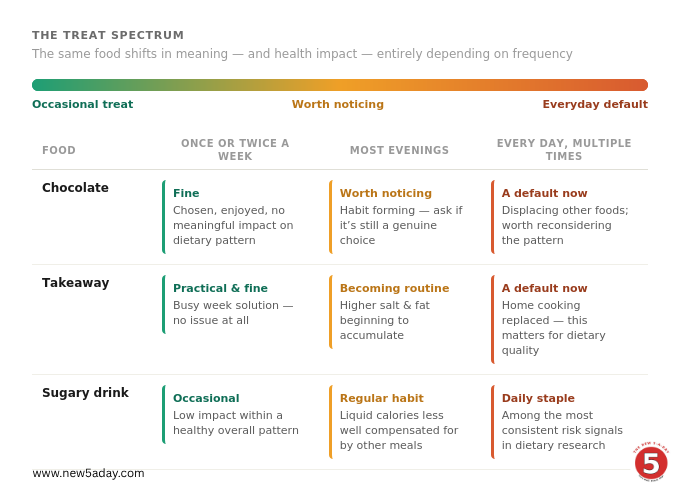
A chocolate bar enjoyed slowly on a Friday afternoon is a treat. A bag of sweets absent-mindedly consumed every evening in front of the television is something else — it is a default, and a nutritionally thin one at that.
The same logic applies to takeaways. One on a busy week is practical and fine. Several nights a week, because cooking never quite happens, means your diet is being built around foods that tend to be higher in salt, saturated fat, and calories than home-cooked alternatives — and that starts to matter.
The question worth asking is simply: is this treat the exception, or has it quietly become the rule?
When treats become a problem
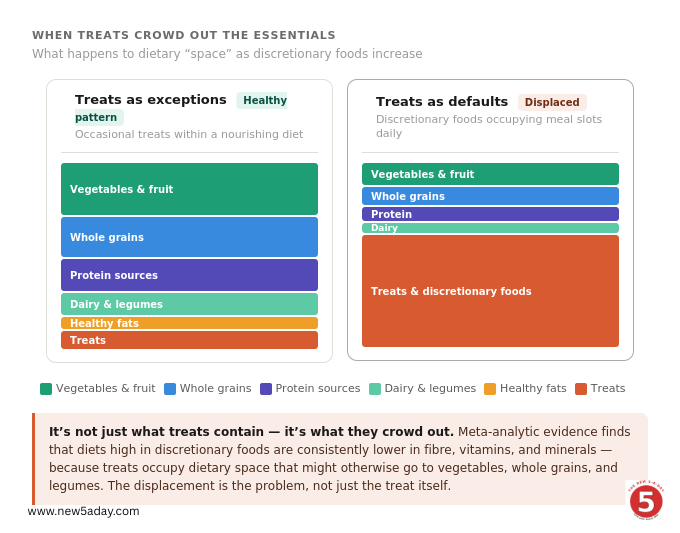
Treats cross a line when they appear often enough to crowd out the things your body actually needs. The issue is not sugar or fat in isolation — it is the pattern they create. A diet built heavily around sweet, rich, heavily processed foods tends to be lower in the things that do most of the work in keeping you healthy: fibre, protein, vitamins, and minerals from vegetables, whole grains, and other everyday staples.
There is also an energy angle. Foods high in sugar can cause your blood sugar to rise and fall quickly, leaving you feeling less satisfied and more likely to reach for more of the same. This is not inevitable — and it is worth being a bit sceptical of dramatic claims about sugar addiction — but for many people, a diet high in sweet, low-fibre snacks does make it harder to feel consistently well-nourished.
It may be worth taking a closer look at your treat habits if any of the following feel familiar: you rarely finish a meal without reaching for something sweet; takeaways are replacing home-cooked food most nights; snacking is driven more by habit or stress than by actual hunger; or you are noticing changes in your energy or weight that you cannot easily explain.
None of these are reasons to panic or ban anything. They are simply signals that the balance between defaults and exceptions may have shifted, and that it might be worth nudging things back.
How to find the balance
The most practical approach is less about policing specific foods and more about making sure your everyday eating is strong enough that treats can stay in their proper place — occasional, enjoyed, and guilt-free.
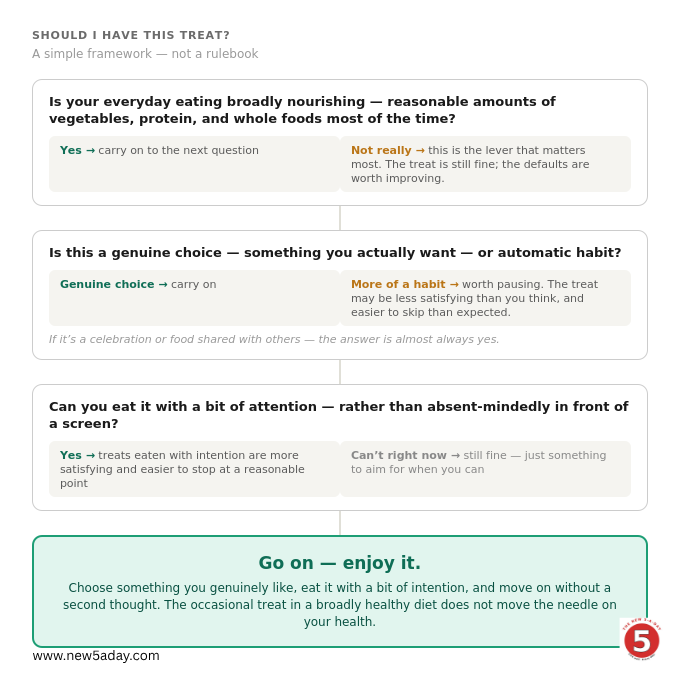
Build your regular meals around foods that actually fill you up and sustain you: protein, fibre, plenty of vegetables, sensible amounts of good fats and carbohydrates. When your standard meals are genuinely satisfying, the urge to reach for something extra tends to diminish on its own. Cravings are often a sign of being underfed or under-nourished, not a personality failing.
When you do have a treat, make it count. Choose something you genuinely enjoy rather than eating something mediocre out of habit. A smaller portion of something excellent is usually more satisfying than a larger portion of something you didn't really want in the first place.
Mindfulness is a somewhat overused word in nutrition circles, but there is something useful in the idea of paying attention. Treats eaten while distracted — scrolling through a phone, watching television, finishing off whatever was left on the counter — tend to provide less satisfaction and are easier to overdo. Treats eaten with a bit of intention tend to be more enjoyable and easier to stop at a reasonable point.
And if you know a treat is coming — a dinner out, a birthday, a celebration — there is absolutely no need to try to 'save up' for it by eating less beforehand. That kind of compensation thinking often leads to arriving at the event already hungry, which is rarely a recipe for enjoyment or moderation.
A healthier relationship with food
The goal is not a life of rigid discipline with occasional permitted exceptions. That is exhausting and, frankly, not a great deal of fun. The goal is a relationship with food that is stable, flexible, and broadly nourishing — where everyday eating does most of the work, treats can be enjoyed without guilt, and the whole thing doesn't require constant monitoring.
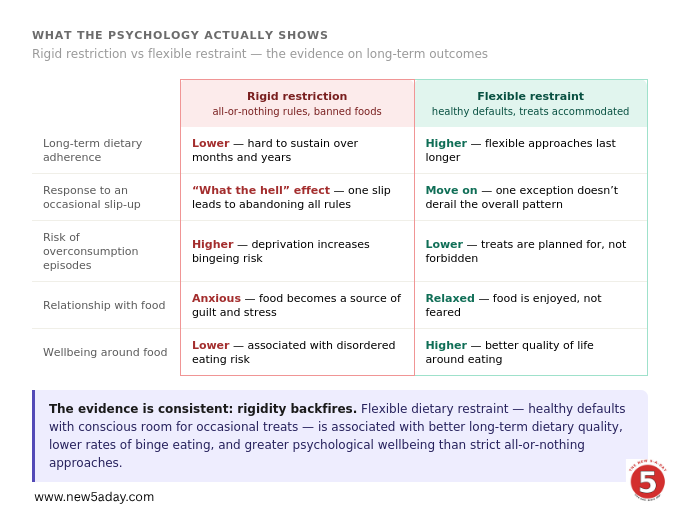
Most nutrition research points in the same direction: overall dietary patterns — what you eat consistently across weeks and months — are what matter most for long-term health. Individual foods, individual meals, and the occasional treat barely feature in that picture. Which means the occasional piece of cake really does not need to carry the weight that diet culture assigns to it.
So: if your everyday eating is reasonable, go on. Treat yourself.
Just do it with a bit of thought, enjoy it properly, and don’t let the exception become the default.
Bringing it back to The New 5-a-Day
Eating well is Pillar Two of The New 5-a-Day — and the question of treats sits right at the heart of what this pillar is really about. Not perfection. Not restriction. Not guilt about the slice of cake you had on Saturday. Just a sustainable, enjoyable pattern of eating that nourishes you most of the time and leaves room for life.
The science is consistent on this: healthy eating is about patterns, not individual choices. Build strong everyday defaults — meals built around vegetables, protein, and whole foods — and the occasional treat takes care of itself. It stays in the right place: the exception, not the rule. Something to look forward to, enjoy properly, and move on from without a second thought.
That is what Eat Well is really asking of you. Not perfection at every meal. Just a pattern worth having — with plenty of room for the good stuff along the way.
A note on medical advice: The content in this post is intended to inform and inspire, not to replace professional medical guidance. If anything you’ve read raises questions or concerns about your own health, please speak to your GP or another qualified health professional.
Want to explore further? This post is the accessible introduction. A detailed evidence-based Deep Dive, a full Reference List, and a podcast episode are all available on this site.
