Hydration without the hype: keeping your fluids up
Quick summary: Water makes up around 60 per cent of your body and supports almost everything that keeps you functioning well — from regulating your temperature to helping your brain stay sharp. Staying properly hydrated is genuinely important. But the advice around it has become cluttered with oversimplified rules, viral challenges, and products that promise more than they deliver. The truth is more straightforward, and more reassuring, than the hype suggests. Most people do not need to track their intake obsessively, force litres of plain water on a rigid schedule, or invest in special hydration products to stay well hydrated. You need to drink regularly, pay attention to a few simple signals your body gives you, and know what actually counts — which is quite a lot more than you might think.
Here is a question worth asking. When you hear the word “hydration,” what comes to mind?
For many people, it is probably a two-litre water bottle with hourly markings. Or a wellness influencer insisting that coffee “doesn’t count” and that anything less than eight glasses a day is quietly destroying your organs. Or perhaps a sports drink with an improbable number of electrolytes and a very confident price tag.
Hydration has somehow become a source of anxiety for something our bodies have been managing rather well for several hundred thousand years. And while staying hydrated really does matter — for your brain, your energy levels, your digestion, your kidneys, and much else besides — the panic-inducing version of hydration advice tends to oversell the problem and overcomplicate the solution.
This is Post Five in Eat Well — Pillar Two of The New 5-a-Day — and the goal here is to cut through the noise. What does the evidence actually say about how much fluid you need? What counts towards that total? How do you know when you are falling short? And what does a sensible, sustainable approach to hydration actually look like?
Why hydration matters — and what it actually does
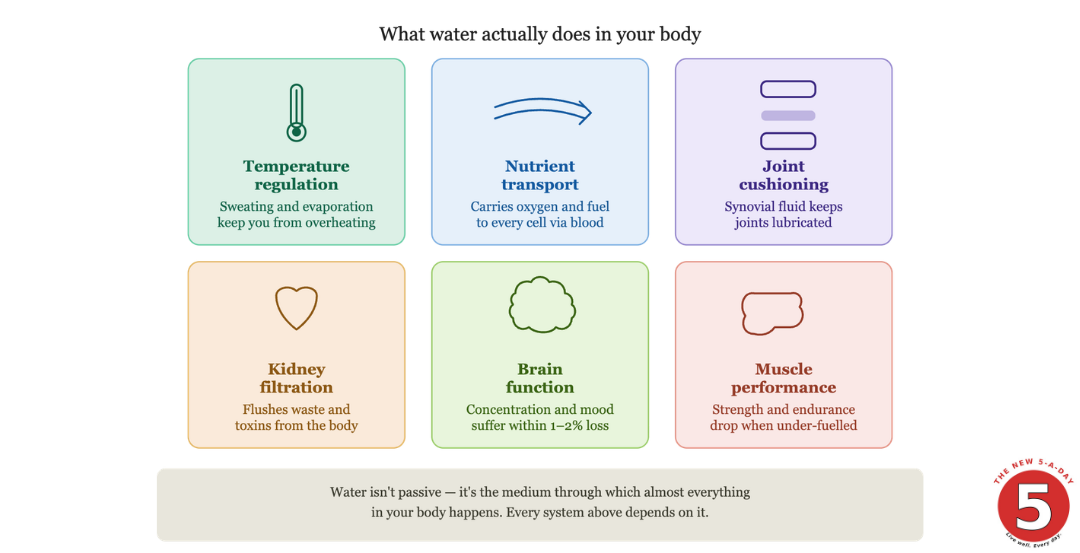
Water is not a minor player in your body’s operations. It is the medium through which almost everything happens. Your body uses water to regulate temperature through sweating, move nutrients and oxygen around the body, support digestion, cushion joints, flush waste products through the kidneys, and keep the brain and muscles working properly.
Even mild dehydration — a fluid loss of around one to two per cent of body weight — can affect concentration, mood, and physical performance. Headaches, fatigue, and difficulty focusing are among the earliest signs that your body is asking for more fluid. None of this is dramatic, but it is real, and it is worth taking seriously.
The encouraging flip side is that staying well hydrated is not complicated. Your body is already doing a great deal of the work for you, using thirst and the kidneys to regulate fluid balance in real time. The goal is to support that system, not override it with a rigid external programme.
How much do you actually need?
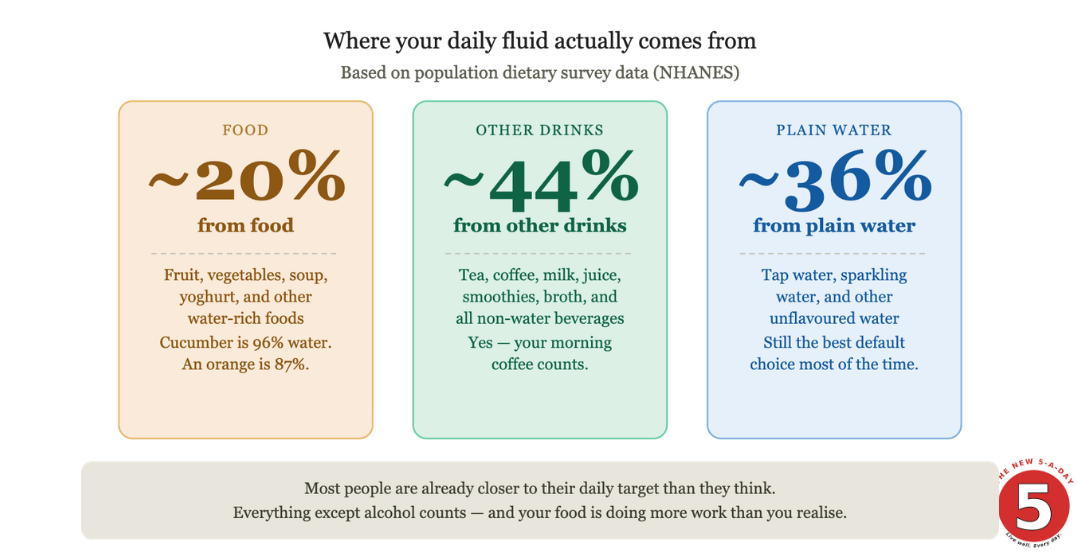
There is no single correct answer, which is one reason so much conflicting advice exists. A widely used reference point from the National Academy of Medicine is a total daily fluid intake of around 2.7 litres for women and 3.7 litres for men. But — and this is important — that figure includes all fluids, including what comes from food, not just glasses of plain water.
Research suggests that food contributes roughly a fifth of total fluid intake for most people, and non-water drinks another substantial share on top of that. So if you eat a reasonably varied diet that includes fruit and vegetables, and you drink a range of beverages across the day, you are probably already meeting a large portion of your needs without tracking a thing.
Those needs also change with circumstances. Heat, physical activity, illness, fever, vomiting, and diarrhoea all increase how much fluid you need. Pregnancy and breastfeeding increase requirements too. Older adults may feel less thirsty than they actually are, and need to be more deliberate about drinking regularly. So any fixed daily target is really a starting point — the context around you matters.
What counts towards hydration — more than you think
One of the most persistent myths in hydration is that only plain water counts. It does not. A wide range of drinks and foods all contribute to your daily fluid intake, and the evidence is clear on this.
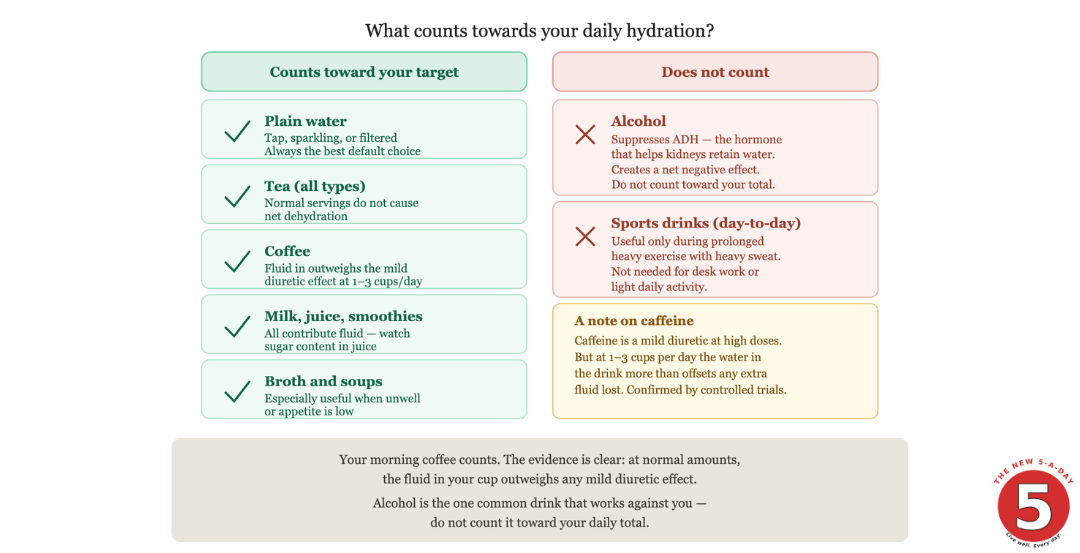
Tea and coffee, in typical daily amounts, count. Caffeine has a mild effect on fluid output in very high doses, but research consistently shows that habitual consumption of coffee and tea at normal levels does not lead to net dehydration. The fluid in the drink outweighs the mild diuretic effect. This is genuinely well established in the research, even if it has been slow to filter through into popular advice.
Milk counts. Juice and smoothies count. Broth counts. Even foods with high water content — cucumber, lettuce, tomatoes, melon, oranges, soups — contribute meaningfully to your daily total. A diet rich in fruit and vegetables provides more fluid than many people realise.
A few exceptions are worth noting. Alcohol is not a useful hydration strategy — it actively increases fluid loss and should not be counted towards your daily target. Sports drinks can genuinely help when you are exercising hard and sweating heavily, as they replace both fluid and the salts lost through sweat. But for desk work, a gentle walk, or everyday life, plain water, tea, or any other unsweetened drink is more than adequate.
The risks of drinking too much
It might seem odd to include a section on over-hydration in an article about staying hydrated, but it is worth a brief mention — partly because it is often left out, and partly because some wellness trends push very high fluid intakes in ways that are not necessarily helpful.
Drinking excessively — particularly very large amounts in a short space of time — can dilute the salts in your blood to dangerous levels. This is known as hyponatraemia, and it is a real medical risk, most commonly seen in endurance athletes who drink beyond their thirst during long events. It is rare in everyday life, but “drink as much as possible” is not sound advice, and the idea that more is always better does not match the evidence.
The body’s own signals — thirst, and to a lesser extent urine colour — are genuinely useful guides for the vast majority of people. For most healthy adults in most circumstances, drinking to thirst and keeping an eye on urine colour is a more sensible strategy than chasing a fixed daily target regardless of how you feel.
How to tell if you are dehydrated
Thirst is the most obvious signal, and it is worth listening to rather than dismissing. But there are others. Dark yellow or amber urine is one of the clearest signs that you need more fluid. The target is pale yellow — not colourless, which can suggest you are drinking too much, but not dark either. Research supports urine colour as a reliable practical marker of hydration in everyday settings.
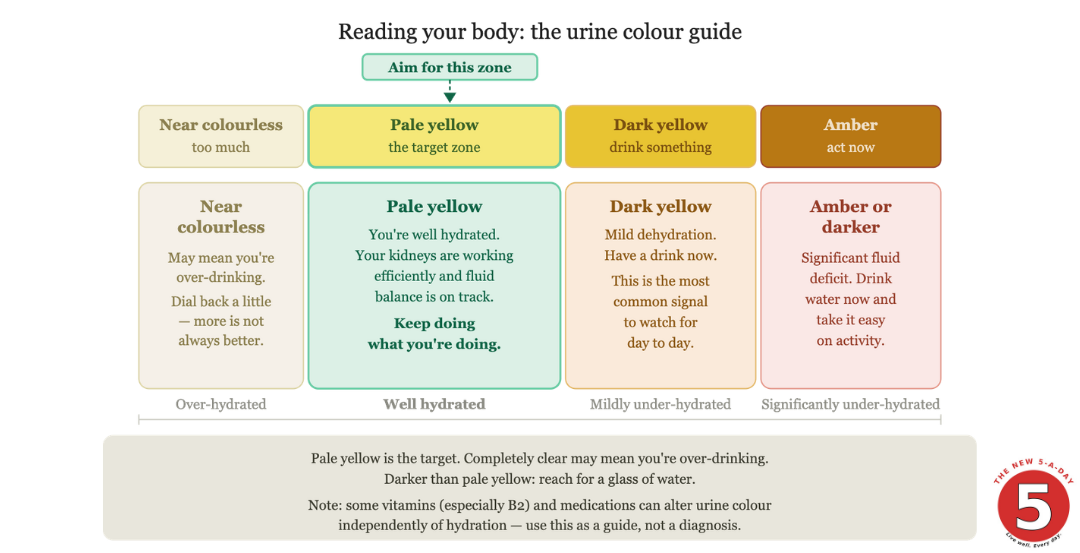
Other common signs of dehydration include headache, tiredness or low energy, difficulty concentrating, dry mouth, dizziness, and going to the loo less frequently than usual. These are not dramatic symptoms in mild cases, but they do affect how you feel and function — often in ways that are easy to attribute to other causes.
Some groups need to be particularly mindful. Older adults may have a blunted sense of thirst, which means they can become dehydrated before they feel particularly thirsty. Young children and infants lose fluid relatively quickly through illness. Anyone experiencing vomiting, diarrhoea, or fever needs to replace fluids actively and consistently rather than waiting until they feel parched.
Practical ways to stay well hydrated
The good news is that sensible hydration does not require a complicated system. It mostly requires making fluids easy to access and building a few simple habits around them.
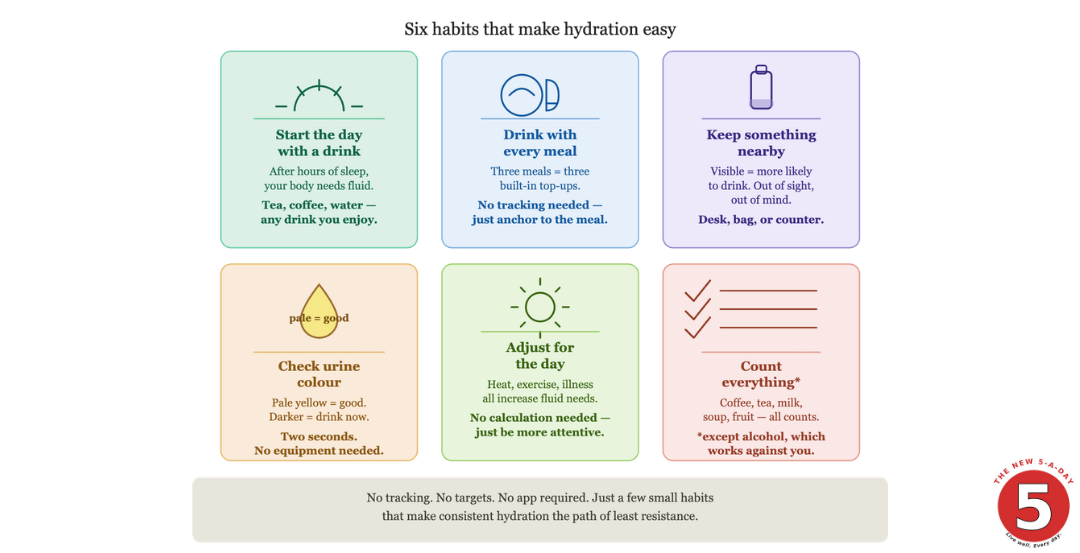
• Start the day with a drink. After several hours of sleep, your body is ready for fluid before almost anything else. A glass of water, a cup of tea, or any drink you enjoy is a simple way to begin well.
• Drink with every meal. Meals are natural anchor points in the day — attaching a drink to each one gives you three reliable top-ups without needing to think about it.
• Keep a drink nearby. Whether it is a glass on your desk, a refillable bottle in your bag, or a mug near the kettle, visible access makes drinking more likely. Out of sight is often out of mind.
• Use urine colour as a quick check. Pale yellow means you are probably doing well. Darker than that is a prompt to drink something. It takes about two seconds and requires no equipment.
• Adjust for the day. Hot weather, exercise, illness, or a particularly sweaty commute are all reasons to drink a little more than usual. You do not need to calculate exactly how much — just be more attentive.
• Count everything (except alcohol). Your morning coffee, your lunchtime soup, the orange you had as a snack, the herbal tea in the evening — all of it counts. A varied, food-rich diet with plenty of drinks across the day is already doing more work than most people realise.
A saner approach to a straightforward need
Hydration has become, somewhat absurdly, a wellness performance. The giant bottle. The hourly reminders. The special drinks. The quiet implication that if you are not tracking every millilitre, you are probably on the road to some slow, dehydration-related catastrophe.
The evidence does not support that level of anxiety. What it supports is something considerably more relaxed: drink regularly across the day, eat a varied diet that includes plenty of fruit and vegetables, pay attention to thirst and urine colour as useful signals, and adjust upwards when circumstances call for it.
That’s it. Your body has been managing fluid balance for considerably longer than the wellness industry has existed, and it is rather good at it. Your job is to give it something to work with — consistently, without drama, across the day.
Good hydration is one of the simplest contributions you can make to how you feel and function. The fact that it has been made to seem complicated is a feature of the content landscape, not the science. The science is reassuring. You are probably closer to the right answer than you think.
Bringing it back to The New 5-a-Day
Eat Well is Pillar Two — and hydration is one of the foundational, unglamorous elements of eating well that tends to get either ignored or over-dramatised. Neither is useful. Staying hydrated does not require a lifestyle overhaul. It requires a steady stream of ordinary drinks, a diet with reasonable amounts of water-rich food, and the wisdom to drink a bit more when your body signals that it needs it.
Put the giant branded bottle down if you want to. Make a cup of tea. Have an orange. Drink a glass of water before bed. All of it counts. All of it helps.
A note on medical advice: The content in this post is intended to inform and inspire, not to replace professional medical guidance. If you have kidney problems, a heart condition, or any other health issue that affects how your body manages fluids, please speak to your GP or a qualified health professional before making significant changes to how much you drink.
Want to explore further? This post is the accessible introduction. A detailed evidence-based Deep Dive, a full Reference List, and a podcast episode are all available on this site.
