Prolonged sitting as a distinct risk factor, the acute physiology of stillness, the evidence for interrupting sitting, and how much activity offsets the risk
Companion to: Be Active Open Post 3-7 — Sitting pretty? The surprising cost of sitting still, and how to undo it. This Deep Dive examines the evidence base in greater technical depth. Readers seeking the accessible introduction should begin with the Open Post.
Key takeaways
High volumes of sedentary time are associated, in a dose-response fashion, with higher risks of cardiovascular disease, type 2 diabetes, metabolic syndrome, and all-cause mortality. These associations persist after adjustment for moderate-to-vigorous physical activity (MVPA). Risk rises more steeply above approximately six to eight hours of sitting per day, particularly among people with low activity levels. The pattern of accumulation also matters: long, unbroken bouts appear more harmful than the same total time broken up regularly. Laboratory trials show that even a few hours of uninterrupted sitting can measurably impair leg vascular function and post-meal glucose control, and that brief bouts of light walking largely prevent these acute changes. Interrupting sitting at least every 30 minutes appears more effective for glucose control than less frequent breaks. High volumes of MVPA — around 60–75 minutes per day — appear to attenuate or eliminate the excess mortality risk associated with high sitting time, though few adults reach this level. The practical prescription is twofold: break up sitting often, and accumulate as much MVPA as is realistic.
This Deep Dive accompanies Open Post 3-6 of Be Active. It examines the research underpinning the claim that prolonged sitting carries health risks of its own, that some of its effects appear within hours, and that frequent movement and regular activity can substantially offset them. Where claims from the Open Post require qualification, those are noted explicitly.
1. Conceptual framework: sedentary behaviour is not the same as inactivity
Sedentary behaviour is formally defined as any waking behaviour characterised by an energy expenditure of 1.5 metabolic equivalents (METs) or less while sitting, reclining, or lying (Tremblay et al., 2017). It is distinct from physical inactivity, which describes failing to meet recommended levels of moderate-to-vigorous activity. The two can co-exist in either combination: a person can meet every activity guideline and still accumulate ten or more hours of sitting a day — the so-called ‘active couch potato’.
Researchers distinguish two dimensions of sedentary exposure. The first is total volume — the number of hours spent sitting across the day. The second is the pattern of accumulation: whether that time is gathered in long, uninterrupted bouts or broken up frequently by standing and movement (Farrahi et al., 2021). Both appear to carry independent information about risk. The World Health Organization’s 2020 guidelines and the UK Chief Medical Officers’ guidelines both advise adults to limit sedentary time and to break up long periods of inactivity, alongside meeting activity targets (Bull et al., 2020; Department of Health and Social Care, 2019).
2. Sedentary time and long-term health outcomes
The association between high sedentary time and adverse health outcomes is among the more consistent findings in modern physical activity epidemiology. Meta-analyses of prospective cohorts link higher sitting time with increased risk of cardiovascular disease, type 2 diabetes, and all-cause and cardiovascular mortality (Bailey et al., 2019; Patterson et al., 2018), and reviews describe effects across metabolic, cardiovascular, and musculoskeletal systems (Dunstan et al., 2021; Owen et al., 2010).
KEY RESEARCH
Ekelund, U., Tarp, J., Steene-Johannessen, J., Hansen, B., Jefferis, B., Fagerland, M., Whincup, P., Diaz, K., Hooker, S., Chernofsky, A., Larson, M., Spartano, N., Vasan, R., Dohrn, I., Hagströmer, M., Edwardson, C., Yates, T., Shiroma, E., Anderssen, S., & Lee, I. (2019). Dose-response associations between accelerometry measured physical activity and sedentary time and all cause mortality: systematic review and harmonised meta-analysis. The BMJ, 366. https://doi.org/10.1136/bmj.l4570
This harmonised meta-analysis used device-measured rather than self-reported sedentary time, removing a major source of measurement error. It found a clear, non-linear dose-response relationship: mortality risk rose progressively with greater sedentary time, with the steepest increases at the highest volumes. The use of accelerometry strengthens confidence that the association is not an artefact of people misreporting how much they sit.
Most dose-response analyses suggest that risk begins to climb more noticeably at around six to eight hours of total daily sitting, with television viewing showing a particularly strong association (Patterson et al., 2018). Analyses of sedentary patterns add a further layer: prolonged, uninterrupted bouts are the accumulation pattern most consistently linked to adverse outcomes (Wu et al., 2023).
One popular claim requires correction. The widely quoted comparison that sitting carries a mortality risk ‘similar to smoking’ is not supported by the primary research reviewed here. It appears to derive from clinical communication rather than from quantified data, and it overstates the magnitude of the risk. Sedentary behaviour is a meaningful, modifiable risk factor; it is not equivalent to tobacco use.
3. The acute physiology of sitting still
Why should sitting carry risks that are partly independent of exercise? The most widely discussed explanation centres on skeletal muscle inactivity. The large postural muscles of the legs are major sites of glucose and lipid uptake from the bloodstream. When they are almost completely unloaded, as in sitting, their contribution to clearing glucose and triglycerides after a meal is markedly reduced. Animal and human work has proposed that suppression of lipoprotein lipase activity in inactive muscle may contribute to this effect (Hamilton et al., 2007), though this mechanism remains a proposed rather than an established pathway in humans.
A second, better-characterised pathway is vascular. Sitting reduces blood flow and therefore the shear stress acting on the walls of the leg arteries. Shear stress is a key stimulus for nitric oxide production and healthy endothelial function — the capacity of blood vessels to dilate in response to demand.
KEY RESEARCH
Thosar, S. S., Bielko, S. L., Mather, K. J., Johnston, J. D., & Wallace, J. P. (2015). Effect of prolonged sitting and breaks in sitting time on endothelial function. Medicine & Science in Sports & Exercise, 47(4), 843–849. https://doi.org/10.1249/MSS.0000000000000479
In this randomised crossover trial, healthy young men sat for three hours with or without brief walking breaks. Flow-mediated dilation of the superficial femoral artery — a standard measure of endothelial function — declined measurably within the first hour of uninterrupted sitting and remained impaired. Five minutes of light walking each hour prevented this decline. Short periods of stillness produce detectable, and readily reversible, vascular changes.
Related work found that small amounts of intermittent leg movement while seated — fidgeting the foot on and off the floor — prevented the fall in popliteal artery function seen in the stationary leg (Morishima et al., 2016). These acute laboratory findings in small samples are not yet of established clinical significance, but they offer a plausible bridge between daily patterns of sitting and the cardiometabolic associations observed in cohort studies.
4. Interrupting sitting: what the experimental evidence shows
A substantial body of randomised crossover trials has tested whether breaking up sitting improves acute cardiometabolic markers. The consistent answer is yes — particularly for post-meal glucose and insulin.
KEY RESEARCH
Buffey, A., Herring, M., Langley, C., Donnelly, A., & Carson, B. (2022). The acute effects of interrupting prolonged sitting time in adults with standing and light-intensity walking on biomarkers of cardiometabolic health in adults: A systematic review and meta-analysis. Sports Medicine, 52, 1765–1787. https://doi.org/10.1007/s40279-022-01649-4
This meta-analysis pooled crossover trials comparing uninterrupted sitting with sitting broken up by standing or light walking. Both strategies improved post-meal glucose relative to continuous sitting, but light-intensity walking produced larger and more consistent improvements in glucose and insulin than standing alone. The finding supports a central practical message: the goal is to move, not simply to stand.
Frequency matters as well as type. A meta-analysis of randomised crossover trials concluded that interrupting sitting at least every 30 minutes was more effective for glucose control than less frequent interruptions (Yin et al., 2024).
KEY RESEARCH
Duran, A. T., Friel, C. P., Serafini, M. A., Ensari, I., Cheung, Y. K., & Diaz, K. M. (2023). Breaking up prolonged sitting to improve cardiometabolic risk: Dose–response analysis of a randomized crossover trial. Medicine & Science in Sports & Exercise, 55(5), 847–855. https://doi.org/10.1249/MSS.0000000000003109
This dose-finding trial compared five different walking ‘doses’ during eight hours of sitting. Five minutes of light walking every 30 minutes produced the largest reductions in post-meal glucose and lowered blood pressure relative to uninterrupted sitting. One minute every hour did not meaningfully improve glucose, suggesting that very infrequent, very brief breaks may be insufficient for metabolic benefit.
The limits of this literature should be stated clearly. Most trials are short, conducted in laboratory conditions, and measure surrogate markers rather than clinical outcomes. Real-world interventions show that frequent interruptions are feasible, but long-term health effects remain modest or uncertain, including in older adults (Swartz et al., 2024). Larger dose-finding trials are under way (Diaz et al., 2025).
5. Can physical activity offset the risks of sitting?
This is the question with the most practical consequence, and one where popular messaging has been more absolute than the evidence allows.
KEY RESEARCH
Ekelund, U., Steene-Johannessen, J., Brown, W. J., Fagerland, M. W., Owen, N., Powell, K. E., Bauman, A., & Lee, I.-M. (2016). Does physical activity attenuate, or even eliminate, the detrimental association of sitting time with mortality? A harmonised meta-analysis of data from more than 1 million men and women. The Lancet, 388(10051), 1302–1310. https://doi.org/10.1016/S0140-6736(16)30370-1
Pooling data from over one million adults, this analysis found that high levels of moderate-intensity activity — approximately 60–75 minutes per day — appeared to eliminate the increased mortality risk associated with high sitting time. The association with high television viewing time was attenuated but not fully eliminated at these activity levels. Crucially, only a minority of participants reached this volume of activity.
Subsequent device-based analyses broadly support this picture, showing that higher MVPA attenuates the sedentary–mortality association (Rezende et al., 2024; Sagelv et al., 2023). Occupational data point the same way: in a large Taiwanese cohort, those who mostly sat at work had higher mortality, but an additional 15–30 minutes of daily leisure activity was associated with mortality risk similar to that of inactive workers who did not mostly sit (Gao et al., 2024).
The Open Post’s framing reflects this evidence. It would be inaccurate to say that exercise ‘does not cancel out’ sitting; at sufficiently high volumes, it appears to. But most adults do not reach those volumes, and for them both strategies — less sitting and more activity — carry independent value. Isotemporal substitution studies, which model replacing sitting with other behaviours, find that swapping 30–60 minutes of sitting for light activity or MVPA is associated with lower mortality, especially among the least active (Chang et al., 2024; Rees-Punia et al., 2019; Stamatakis et al., 2019).
An emerging line of evidence concerns very short bursts of vigorous activity embedded in daily life — hurrying up stairs or walking briskly between tasks. Device-measured data from the UK Biobank found that a few one-minute bursts of such activity per day were associated with lower mortality among adults who reported no structured exercise (Stamatakis et al., 2022). This is observational evidence and should be treated as promising rather than established.
6. Workplace interventions and sit–stand desks
Sit–stand desks and workplace programmes reliably reduce sitting time at work in the short term, though the certainty of evidence is generally low and effects on health outcomes remain unproven (Shrestha et al., 2018). Computer-based prompts to take breaks produce modest increases in break frequency (Leppe-Zamora et al., 2025). Standing still for long periods carries its own drawbacks, and the experimental evidence favours light walking over standing. A standing desk is best understood as one tool for introducing variety, not as a solution in itself.
7. Methodological notes and limitations
Much of the long-term evidence is observational. Despite adjustment for activity, diet, and socioeconomic factors, residual confounding and reverse causation — people in poorer health sitting more — cannot be fully excluded. Self-reported sitting is prone to substantial error, which is one reason device-measured studies are given particular weight here. Conversely, the experimental literature offers strong causal inference but over hours rather than years, and in samples that are typically small, young, and healthy. Claims about musculoskeletal effects such as back pain and stiffness rest largely on occupational and narrative reviews rather than population meta-analyses, and are presented in the Open Post as commonly reported experiences rather than established outcomes.
Summary of the evidence
The evidence supports the following conclusions:
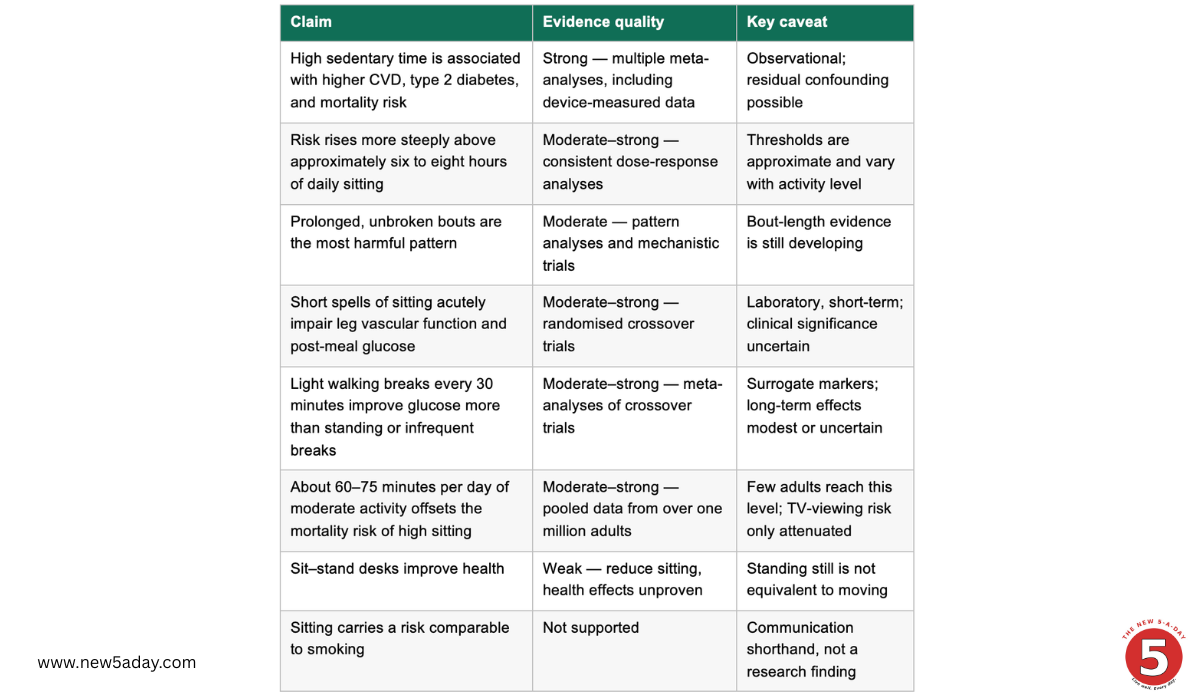
Taken together, prolonged sitting is a real and modifiable risk, some of its effects appear within hours, and both frequent movement breaks and regular activity work in the body’s favour. The most robust guidance is the simplest: get up and move often, and be as active as your life allows.
A note on medical advice: This Deep Dive is intended for readers who want to engage with the evidence in more depth. It does not replace professional medical advice. If you have a heart condition, diabetes, circulatory problems, or any other health concern that affects how active you can be, please speak to your GP or a qualified health professional.
Want to read further? Full citations for all research referenced in this post are available in the accompanying Reference List.
