Quick summary: Most of us sit for far more of the day than we realise. Long hours of sitting are linked with a higher risk of heart disease, type 2 diabetes, and dying earlier — and even an hour or so of unbroken stillness seems to leave your body working less well than it should. The fix is unusually simple. Moving for a few minutes every half hour to an hour, walking after meals, and building brisk activity into your week all appear to blunt the effects of sitting, and can largely cancel them out. This post explains why, and shows you how.
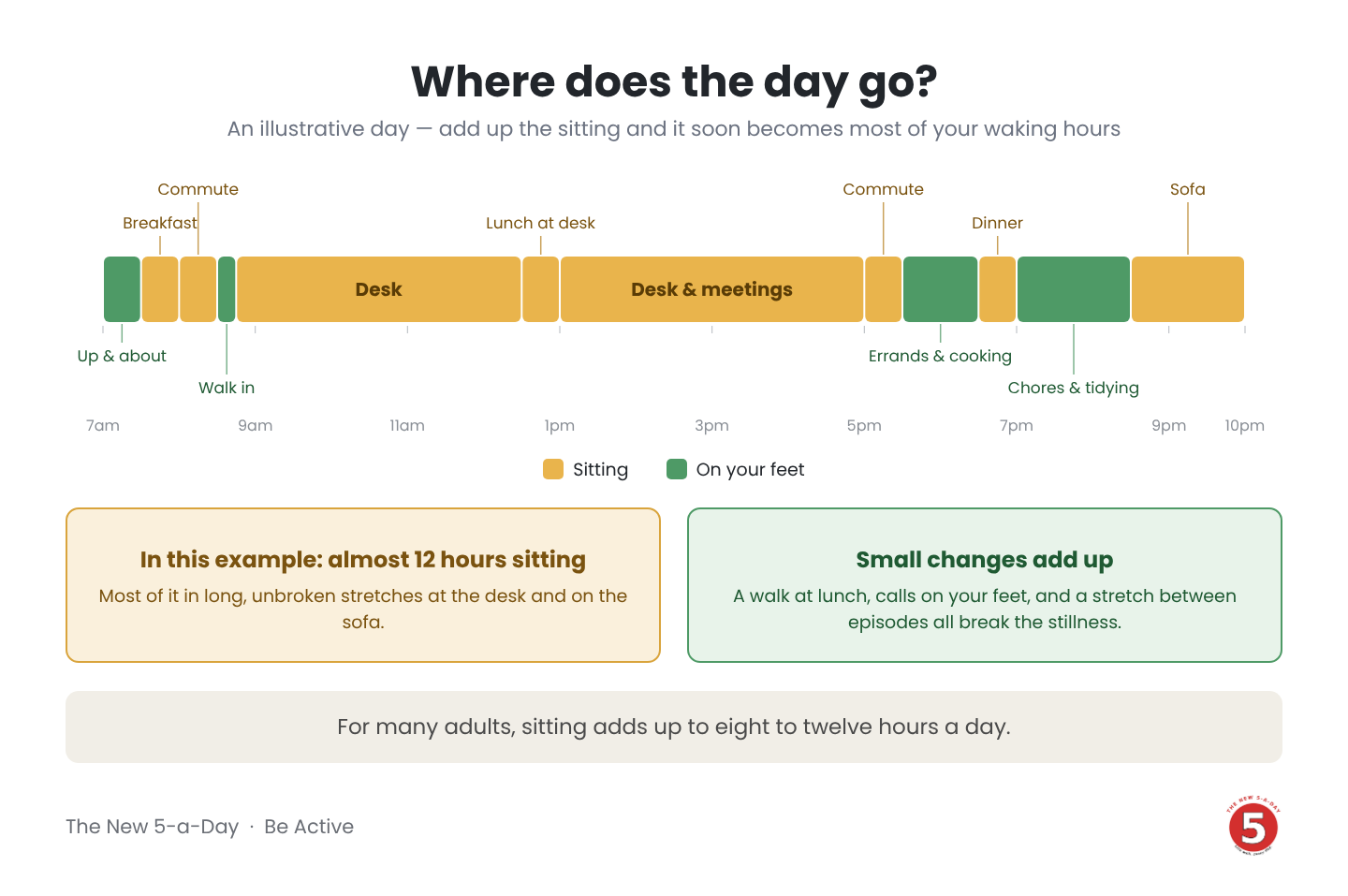
Try a quick bit of arithmetic. Think back over yesterday and add up the time you spent sitting down.
Breakfast. The commute. A morning at a desk. Lunch — quite possibly at the same desk. An afternoon of meetings and screens. The journey home. Dinner. And then, finally, a well-earned evening on the sofa.
For many adults, that total lands somewhere between eight and twelve hours a day. And if you are reading this sitting down — which, let’s be fair, you probably are — you are in very good company.
Nobody is suggesting you give up chairs. The problem is sitting for long, unbroken stretches, day after day, with too little movement in between. This is Post Six in Be Active — Pillar Three of The New 5-a-Day — and it is about why that matters, and the simple things that put it right.
Sitting still is not the same as not exercising
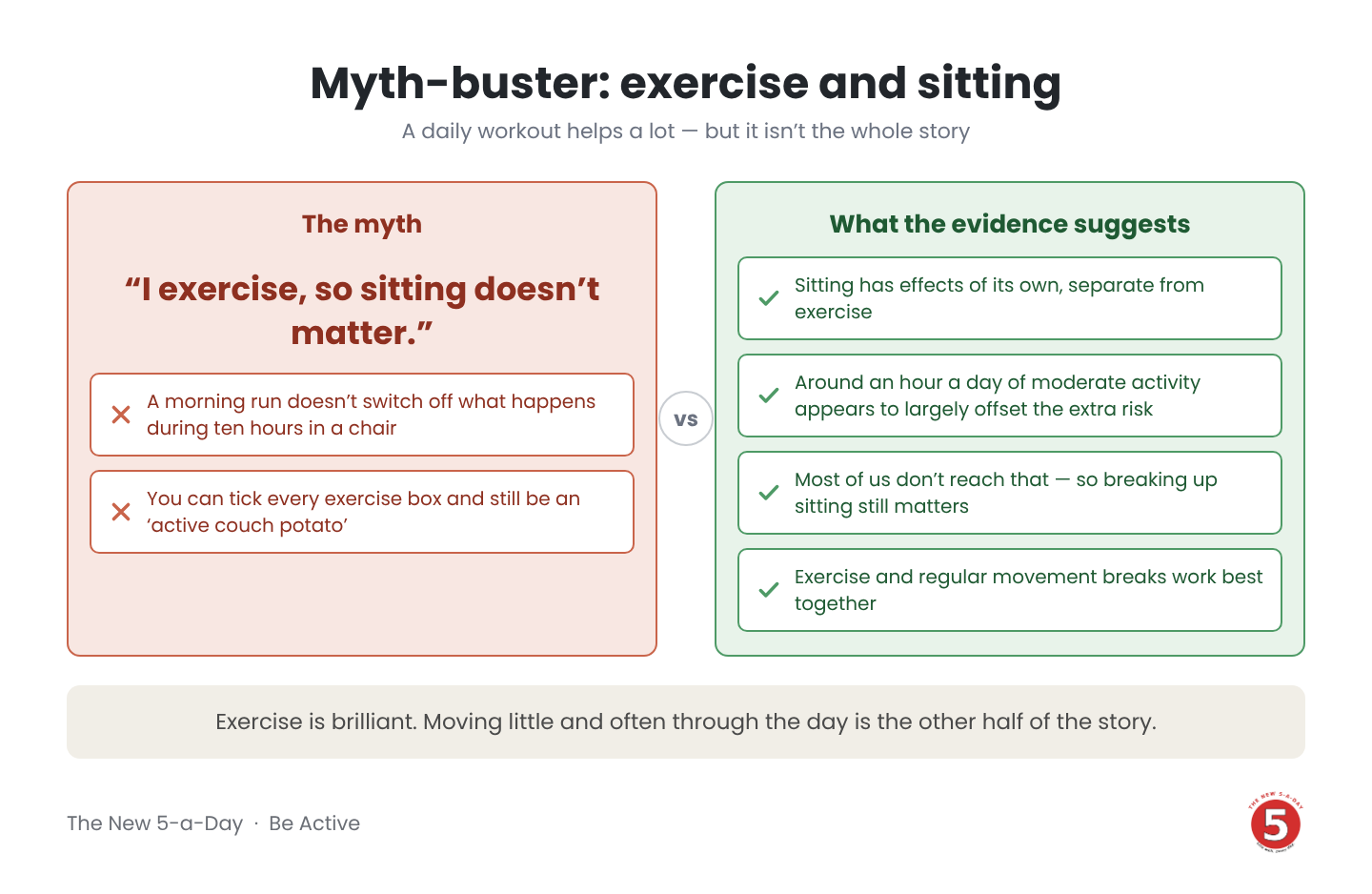
Sitting is not simply the absence of exercise. Long periods of sitting — what scientists call sedentary behaviour — appear to carry their own risks, separate from whether or not you exercise. You can meet every activity guideline and still spend ten hours a day in a chair.
Part of the explanation seems to lie in your legs. The large muscles of your thighs, bottom, and calves are among the body’s biggest users of sugar and fat from the bloodstream. Working — even gently — they help keep both in check. When you sit, they go almost completely quiet. Circulation in the lower body slows, and the body appears to handle sugar and fats less efficiently. Researchers think this is a big part of why long hours of sitting take their toll.
The surprising damage
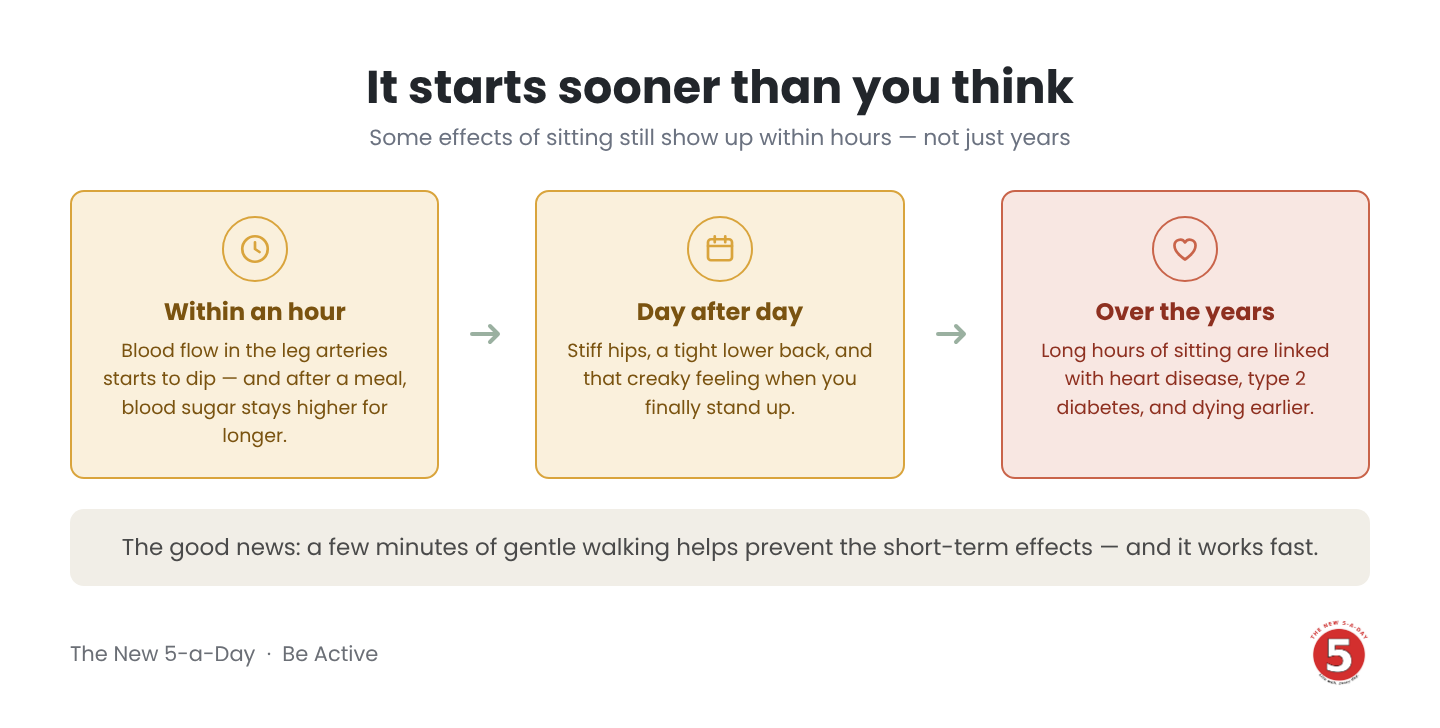
Over the years, the pattern adds up. Large studies have found that those who sit the most are more likely to develop heart disease, type 2 diabetes, and metabolic syndrome — the cluster of raised blood pressure, high blood sugar, unhealthy cholesterol, and extra fat around the waist. And they are more likely to die earlier. The risks tend to climb more steeply once daily sitting goes beyond around six to eight hours, especially in people who are not otherwise very active.
Many people also notice the more immediate effects: stiff hips, a tight lower back, and that creaky feeling when you finally stand up after a long meeting. Sitting keeps the front of the hips shortened and leaves the bottom and back muscles underworked — as we explored in our post on flexibility.
You may have heard the slogan “sitting is the new smoking”. It is a catchy line, but it overstates things. Smoking is in a league of its own. Too much sitting is a real risk — just not that kind of risk. And unlike smoking, it is unusually easy to fix.
Even short spells add up
Here is the part that surprises most people: some effects of sitting show up within hours, not years.
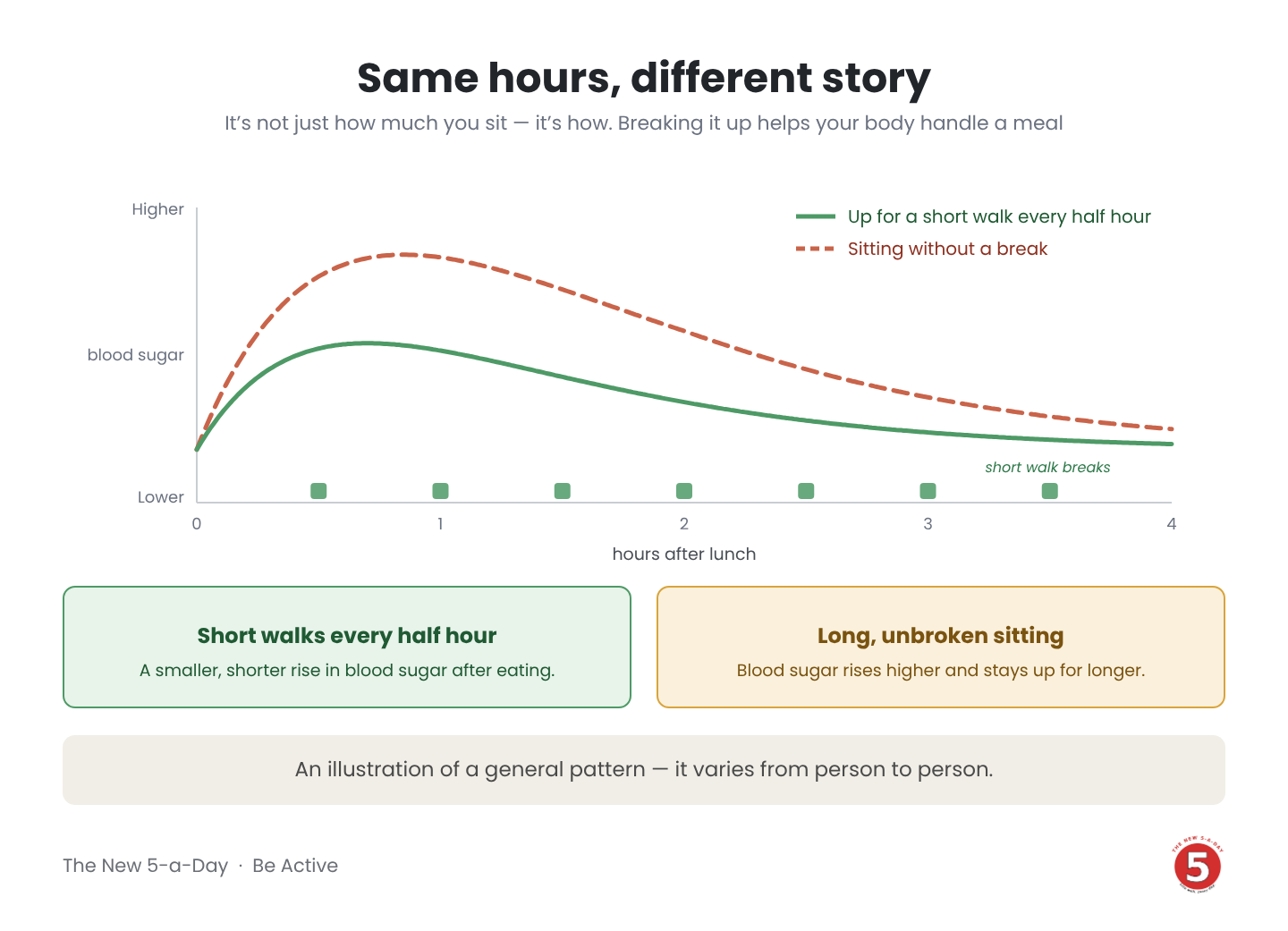
In laboratory studies, healthy volunteers who sat still for as little as an hour or so showed a measurable dip in how well the arteries in their legs widened and relaxed. After a meal, blood sugar tends to stay higher for longer when people sit still than when they get up and move. None of this is dangerous on a single afternoon, but repeated day after day, these small changes are thought to be part of how longer-term problems take root.
The reassuring flip side is just as striking: short bursts of movement largely prevented these changes. A few minutes of gentle walking was enough to restore healthy blood flow. In one well-known trial, five minutes of light walking every half hour noticeably flattened the rise in blood sugar after meals and nudged blood pressure down.
So it is not just how much you sit, but how. Long, unbroken stretches — longer than thirty to sixty minutes at a time — appear to be the pattern most linked to harm. Someone who sits for much of the day but gets up often may be considerably better off than someone who sits for the same total time without moving.
Breaking the stillness
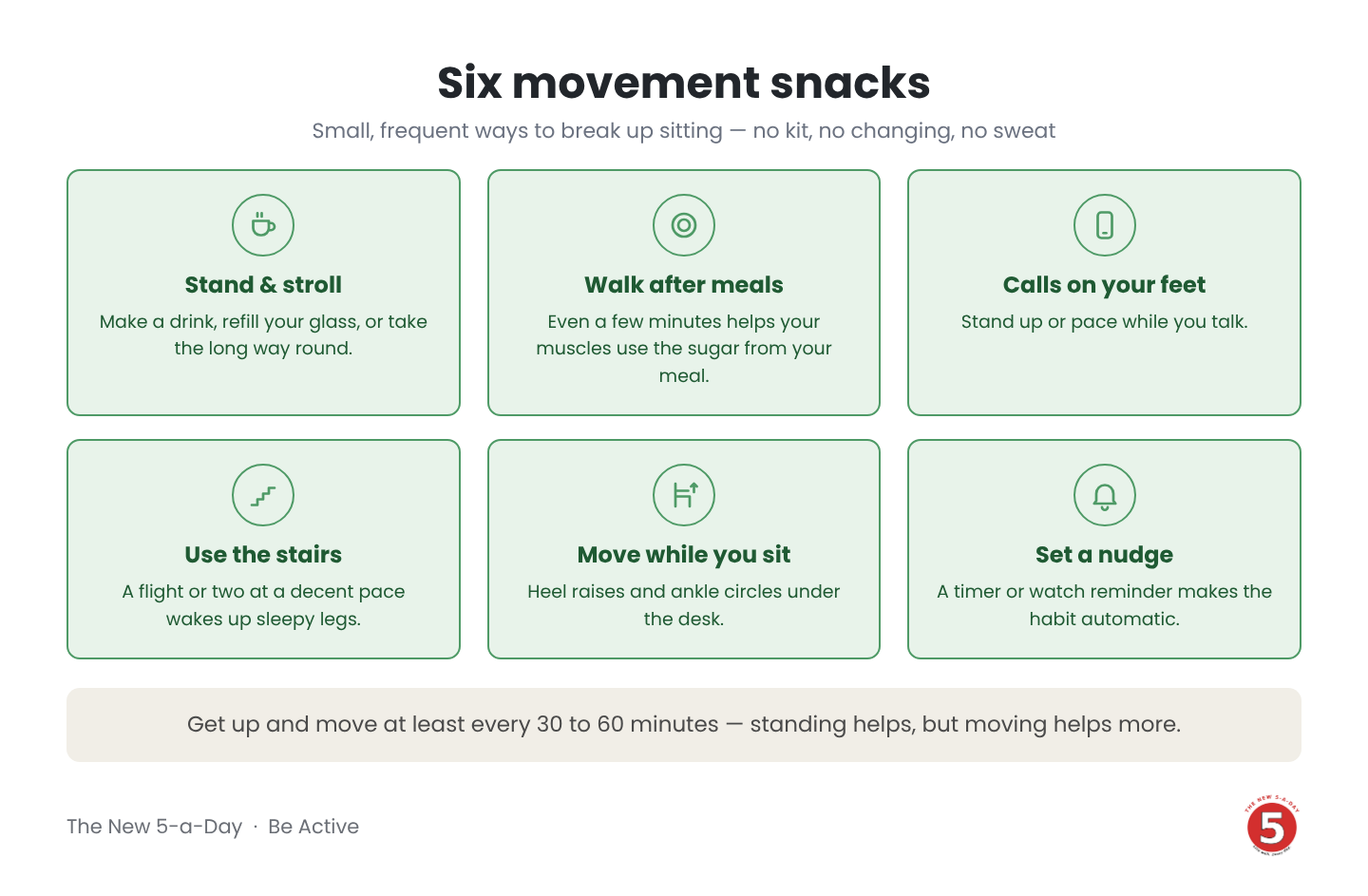
The single most useful habit is also the simplest: get up and move at least every thirty to sixty minutes. It does not need to be exercise. It just needs to interrupt the stillness. Think of these as movement snacks — small, frequent, and easy to fit into a day.
• Stand and stroll. Walk to make a drink, refill your water glass, or take the long way to the loo.
• Walk after meals. A short, gentle walk after eating helps your muscles use up the sugar from your meal. Even a few minutes helps.
• Take calls on your feet. Stand or pace while you talk.
• Use the stairs. A flight or two at a decent pace quickly wakes up sleepy leg muscles.
• Move while you sit. If you really cannot get up, heel raises under the desk, ankle circles, and a bit of fidgeting all keep your calf muscles working.
• Set a nudge. A timer, a watch reminder, or a simple rule — stand up every time you finish a task — makes the habit automatic.
A standing desk is a useful tool, not a cure — standing still for hours brings problems of its own. The real goal is variety: sit, stand, and above all, move.
Undoing the damage: what counts most
Breaking up your sitting is the first line of defence. The second is some proper activity — the kind that raises your heart rate and leaves you slightly out of breath.
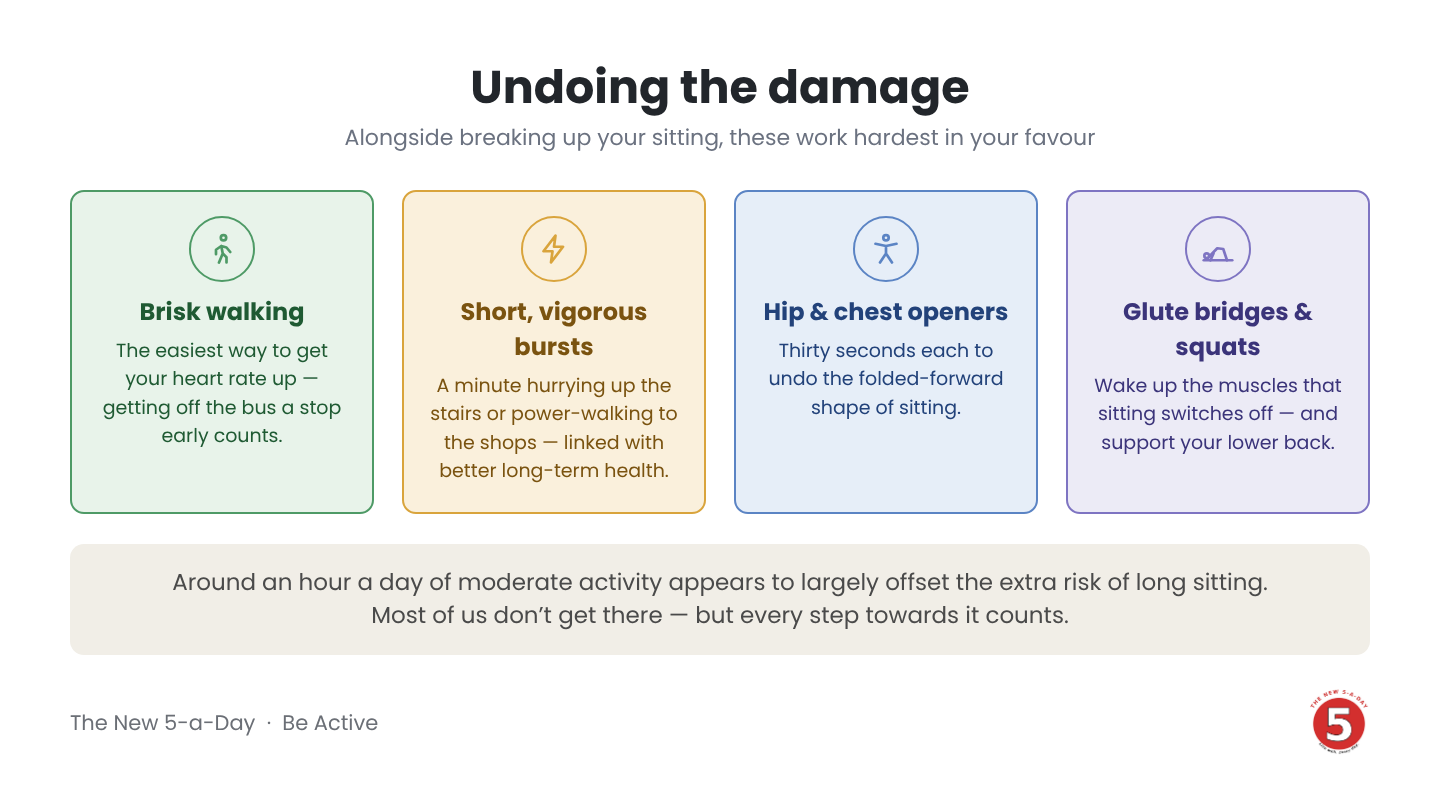
Here the evidence is encouraging. Large studies suggest that people who do around an hour a day of moderate activity — brisk walking, cycling, swimming, active gardening — appear to largely offset the extra risk that comes with long hours of sitting. That is more than most of us manage, so it is not a licence to sit all day — but it shows how powerfully movement works in your favour, and every step towards it counts.
A few types of activity are particularly good at undoing what sitting does:
• Brisk walking. The most accessible way to get your heart rate up. Getting off the bus a stop early or walking part of the school run all adds up.
• Short, vigorous bursts. A few one-minute bursts a day — hurrying up the stairs, power-walking to the shops, playing chase with the children — are linked with better long-term health, even in people who do no formal exercise.
• Hip and chest openers. A lunging hip flexor stretch and a simple chest stretch counter the folded-forward shape of sitting. Thirty seconds each, a couple of times a day.
• Glute bridges and squats. Sitting leaves your bottom muscles switched off. Waking them up supports your lower back and makes standing up and climbing stairs easier.
Making it work in a busy day
The trick is to tie movement to things you already do. At work, walk over to a colleague rather than sending a message, and take lunch away from your desk. At home, stand up between episodes or during the adverts, and potter around the kitchen while dinner cooks. On long drives, plan short stops to stretch your legs. None of this needs to be heroic. It just needs to happen often.
Bringing it back to The New 5-a-Day
Be Active is Pillar Three of The New 5-a-Day — and this may be its most quietly important habit. Not because it involves gyms or training plans, but because it doesn’t. It is about the hours in between, and the small, frequent moments of movement that break them up.
You do not need to give up your chair. You just need to get out of it more often.
So: when you finish reading this, stand up. Stretch. Walk somewhere, even if it is only to the kettle. Then do it again in half an hour. That is how it starts.
A note on medical advice: The content in this post is intended to inform and inspire, not to replace professional medical guidance. If you have a heart condition, diabetes, joint problems, or any other health concern that affects how active you can be, please speak to your GP or a qualified health professional before making significant changes to your activity levels.
