Flexibility across the lifespan: what the evidence actually shows
Age-related loss of range of motion, the neuromuscular and connective-tissue mechanisms of stretching, dose-response evidence, and the limits of current claims
Companion to: Be Active Open Post 3-5 — Keep stretching! The life-long benefits of being flexible. This Deep Dive examines the evidence base in greater technical depth. Readers seeking the accessible introduction should begin with the Open Post.
Key takeaways
Flexibility — the capacity of joints and their associated soft tissues to move freely through a full range of motion — declines measurably with age, with hip and shoulder flexibility falling by approximately six degrees per decade from the mid-fifties onwards. This decline is joint-specific and is accelerated by sedentary behaviour, particularly prolonged sitting.
The evidence that regular stretching improves range of motion (ROM) is robust and among the best-established in exercise science. Multiple meta-analyses confirm meaningful chronic ROM gains from programmes lasting two weeks or more. Static stretching and proprioceptive neuromuscular facilitation (PNF) produce the largest long-term improvements; dynamic stretching is better suited to pre-activity warm-up.
A large 2024 dose-response meta-analysis found that flexibility gains are maximised at approximately four minutes of static stretching per muscle group per session and approximately ten minutes per week in total. Additional volume beyond this threshold yields diminishing returns.
Stretching reduces passive muscle stiffness in older adults to a degree comparable to younger populations, and programmes targeting flexibility in older adults improve gait speed and balance — outcomes with direct implications for fall prevention and functional independence.
A 2025 international Delphi consensus statement confirmed that stretching does not reliably prevent all injuries and is not an all-purpose injury-prevention strategy. Claims that flexibility training corrects posture, reliably prevents injury, or directly improves overall health are only partially supported or remain uncertain.
Emerging evidence suggests chronic stretching programmes may reduce arterial stiffness and improve vascular endothelial function, though this evidence base is still developing and these effects require sustained practice over months.
The practical prescription is well-supported: consistent flexibility work targeting the major joints two to three times per week, using static holds of 30–120 seconds, with sessions of approximately ten minutes. Benefits are cumulative and responsive to modest, regular investment at any age.
This Deep Dive accompanies Open Post 3-5 of Be Active. It examines the research underpinning the claim that maintaining and improving flexibility is a meaningful and lifelong health behaviour — one whose benefits compound over years and decades of consistent practice. The post draws on exercise physiology, musculoskeletal gerontology, and the emerging literature on vascular effects of stretching. Where claims from the Open Post require qualification, those are noted explicitly.
1. Conceptual framework: what flexibility is, and how it is measured
Flexibility refers to the capacity of a joint or series of joints to move through its complete range of motion. It is determined by the mechanical properties of the structures surrounding a joint — muscles, tendons, ligaments, joint capsules, and the connective tissue framework that integrates them — as well as by neurological factors governing muscle tension and stretch tolerance.
In research settings, flexibility is typically quantified through goniometry (measuring joint angles with a calibrated instrument) or by validated field tests such as the sit-and-reach, which assesses composite hamstring, lumbar, and hip flexibility. Range of motion (ROM) — the arc through which a joint can move — is the most widely used outcome variable in the stretching literature, and most claims about the benefits of stretching refer to improvements in ROM.
Passive versus active flexibility
A distinction frequently drawn in the clinical and research literature is between passive flexibility — the ROM achievable when an external force (gravity, a partner, or a therapist) moves the limb without active muscular contribution — and active flexibility, which is the ROM achievable through the individual’s own muscular effort alone. Passive ROM consistently exceeds active ROM for any given joint. Most stretching research measures passive ROM, which should be borne in mind when interpreting effect size estimates.
Passive muscle stiffness — the resistance a muscle offers to being elongated without active contraction — is a related but distinct construct. High passive stiffness corresponds to a feeling of tightness and resistance when a limb is moved, and is independently associated with reduced ROM. A significant part of what stretching achieves is a reduction in passive stiffness, as measured by instruments that quantify the torque required to move a joint through a given arc.
Musculotendinous structures and connective tissue
The soft tissues that govern flexibility are composed primarily of collagen and elastin fibres arranged within a proteoglycan matrix. Collagen provides tensile strength and relative stiffness; elastin confers the capacity to return to resting length after deformation. The ratio of collagen to elastin, the organisation of collagen fibrils, and the degree of cross-linking between fibres all influence the mechanical behaviour of the tissue.
With age, collagen cross-linking increases, the proportion of type I collagen relative to more elastic subtypes rises, and proteoglycan content in the extracellular matrix decreases. These changes collectively increase tissue stiffness and reduce the capacity for deformation — which is the biomechanical basis for the age-related decline in ROM documented across numerous large cohort studies.
2. Age-related decline in flexibility: what the evidence shows
The proposition that flexibility declines with age is not simply folk wisdom. It is one of the more reliably documented findings in musculoskeletal gerontology, with large-sample studies providing quantitative estimates of the rate of decline.
KEY RESEARCH
Stathokostas, L., McDonald, M., Little, R., & Paterson, D. (2013). Flexibility of Older Adults Aged 55–86 Years and the Influence of Physical Activity. Journal of Aging Research, 2013. https://doi.org/10.1155/2013/743843
This large study tracked hip and shoulder ROM across adults aged 55–86 years, finding that flexibility in these major joints declined by approximately six degrees per decade. Crucially, physically active older adults showed substantially attenuated decline compared with their sedentary counterparts, providing direct evidence that regular activity — including flexibility training — modifies the trajectory of age-related ROM loss.
KEY RESEARCH
De Oliveira Medeiros, H., Araújo, D., & Araujo, C. (2013). Age-related mobility loss is joint-specific: an analysis from 6,000 Flexitest results. AGE, 35, 2399–2407. https://doi.org/10.1007/s11357-013-9525-z
Drawing on 6,000 Flexitest assessments across a wide age range, this study demonstrated that flexibility loss with age is not uniform across joints. The shoulder and trunk lose mobility more rapidly than the knee and elbow. This joint-specificity has practical implications: a comprehensive flexibility programme should target the joints most vulnerable to age-related restriction, which for most adults means the shoulder girdle, hip flexors, hamstrings, and thoracic spine.
A consistent finding across this literature is that sedentary behaviour substantially accelerates flexibility loss. Prolonged sitting — which places the hip flexors in a chronically shortened position and reduces thoracic extension — is associated with particularly rapid loss of hip and spinal mobility. This is not merely a consequence of inactivity in general: the specific postural demands of seated work create a reproducible pattern of tightening in identifiable muscle groups.
3. How stretching improves range of motion: mechanisms
Understanding why stretching improves ROM requires distinguishing between two classes of mechanism: structural adaptations within the musculotendinous unit, and neurological changes in stretch tolerance.
Structural mechanisms
Regular stretching over sustained periods produces measurable changes in the mechanical properties of soft tissue. These include increased compliance of the muscle-tendon unit (meaning greater length change per unit of applied force), reduced passive stiffness, and — in some studies — the addition of sarcomeres in series within muscle fibres, which increases the functional length of the contractile apparatus.
Sarcomere addition is a specific and well-documented adaptation to chronic muscle elongation. When a muscle is regularly placed near its end range, the contractile proteins reorganise to shift the optimal length for force production to a longer position, which corresponds to an increased functional range. This adaptation is not immediate — it accumulates over weeks and months of consistent practice — but it represents a genuine structural change in the tissue rather than simply a change in sensation.
Neurological mechanisms: stretch tolerance
The second class of mechanism operates at the level of sensory processing. The sensation of discomfort encountered at the end range of a stretch — and the reflex resistance that follows — is mediated by mechanoreceptors within muscle and connective tissue, principally muscle spindles and Golgi tendon organs. Regular stretching appears to increase the threshold at which these structures signal discomfort, allowing a greater ROM to be accessed before the limiting sensation is encountered.
This increased stretch tolerance is thought to operate primarily through central nervous system habituation: with repeated exposure to end-range stimuli, the subjective perception of discomfort at a given degree of elongation diminishes. Evidence suggests this neurological mechanism may operate over shorter timeframes than structural adaptation, which is why short-duration stretching programmes often produce ROM improvements that initially seem disproportionate to the amount of training completed.
KEY RESEARCH
Konrad, A., Alizadeh, S., Daneshjoo, A., Anvar, S., Graham, A., Zahiri, A., Goudini, R., Edwards, C., Scharf, C., & Behm, D. (2023). Chronic effects of stretching on range of motion with consideration of potential moderating variables: A systematic review with meta-analysis. Journal of Sport and Health Science, 13, 186–194. https://doi.org/10.1016/j.jshs.2023.06.002
This systematic review with meta-analysis examined chronic ROM improvements from stretching programmes of two weeks or more across multiple study designs and populations. It found consistent, meaningful gains from regular stretching, with effects present across age groups, stretching modalities, and muscle groups. The review identified stretch duration, frequency, and total weekly volume as significant moderators of the magnitude of effect.
4. Dose-response evidence: how much stretching is needed
One of the more practically useful developments in recent stretching research is the identification of a dose-response relationship for flexibility gains — specifically, the finding that there appears to be a point of diminishing returns beyond which additional stretching volume does not produce proportionate further gains.
KEY RESEARCH
Ingram, L., Tomkinson, G., d’Unienville, N., Gower, B., Gleadhill, S., Boyle, T., & Bennett, H. (2024). Optimising the Dose of Static Stretching to Improve Flexibility: A Systematic Review, Meta-analysis and Multivariate Meta-regression. Sports Medicine, 55, 597–617. https://doi.org/10.1007/s40279-024-02143-9
This large systematic review and meta-analysis with multivariate meta-regression is the most comprehensive examination to date of dose-response relationships in static stretching. It found that flexibility gains were maximised at approximately four minutes of static stretching per muscle group per session, and approximately ten minutes of total stretching per week. Beyond these thresholds, additional stretching time yielded diminishing marginal returns. The practical implication is both encouraging and precise: a modest, regular commitment — rather than prolonged or intensive sessions — captures the majority of the available benefit.
This dose-response finding has important implications for programme design. The conventional wisdom that ‘more is better’ does not appear to apply to flexibility training beyond relatively modest volumes. A ten-minute weekly commitment to static stretching, distributed across two or three sessions, is sufficient to produce meaningful and sustained ROM improvements when maintained consistently over time.
Stretch duration per hold
KEY RESEARCH
Warneke, K., Thomas, E., Blazevich, A., Afonso, J., Behm, D., Marchetti, P., Trajano, G., Nakamura, M., Ayala, F., Longo, S., Babault, N., Freitas, S., Costa, P., Konrad, A., Nordez, A., Nelson, A., Zech, A., Kay, A., Donti, O., & Wilke, J. (2025). Practical recommendations on stretching exercise: A Delphi consensus statement of international research experts. Journal of Sport and Health Science, 14. https://doi.org/10.1016/j.jshs.2025.101067
A Delphi consensus statement is produced by systematically surveying international experts through multiple rounds until a pre-specified level of agreement is achieved. This 2025 statement — the most authoritative expert synthesis currently available on stretching practice — recommended two to three sets per muscle group, with each hold lasting 30 to 120 seconds, on a daily basis when flexibility improvement is the primary goal. It also confirmed that static stretching and proprioceptive neuromuscular facilitation (PNF) produce the largest ROM gains, and that dynamic stretching is more appropriate for pre-activity preparation.
PNF stretching — which involves a cycle of voluntary contraction of the target muscle followed by relaxation and assisted elongation, typically with a partner or resistance band — consistently achieves among the largest ROM improvements of any technique. The contract-relax mechanism exploits autogenic inhibition: the contraction activates Golgi tendon organs, which reflexively reduce spindle-mediated tension in the same muscle, allowing a greater elongation during the subsequent passive phase. PNF is appropriate for individuals seeking accelerated flexibility gains, though its partner-assisted form may not always be practicable in everyday settings.
5. Stretching in older adults: stiffness, balance, and functional movement
The case for flexibility training is particularly well-supported in older adult populations, where the functional consequences of declining ROM become most clinically significant. Two outcomes are especially relevant: the impact on balance and gait, and the responsiveness of ageing musculoskeletal tissue to stretching.
KEY RESEARCH
Nakamura, M., Takeuchi, K., Fukaya, T., Nakao, G., Konrad, A., & Mizuno, T. (2023). Acute effects of static stretching on passive stiffness in older adults: A systematic review and meta-analysis. Archives of Gerontology and Geriatrics, 117, 105256. https://doi.org/10.1016/j.archger.2023.105256
This systematic review and meta-analysis examined whether static stretching reduces passive muscle stiffness in older adults. It found that acute static stretching produces reductions in passive stiffness in this population that are comparable in magnitude to those observed in younger adults. This is a significant finding: it demonstrates that the musculoskeletal system in older age retains meaningful responsiveness to flexibility training, and that age is not a barrier to achieving stiffness-reduction benefits from a stretching programme.
KEY RESEARCH
Salse-Batán, J., González-Devesa, D., Duñabeitia, I., Bidaurrazaga-Letona, I., Ayán-Pérez, C., & Sánchez-Lastra, M. (2024). Effects of stretching exercise on walking performance and balance in older adults: A systematic review and meta-analysis. Geriatric Nursing, 61, 479–490. https://doi.org/10.1016/j.gerinurse.2024.12.018
This meta-analysis found that stretching programmes improved both gait speed and balance in older adults, with effects reaching statistical and clinical significance. Gait speed is a well-validated predictor of overall health and longevity in older adults, used routinely in clinical settings as a marker of functional status. Balance improvement is directly implicated in fall prevention. Both are among the most clinically meaningful functional benefits available from any low-intensity exercise modality in this age group.
These findings are particularly noteworthy because they concern functional outcomes — how people actually move through their day — rather than laboratory measures of ROM alone. The ability to walk at a healthy pace and maintain balance during tasks of daily living is directly coupled to the maintenance of flexibility in the lower limb and hip musculature. A stretching habit, sustained over years, represents an investment in the functional independence that most people do not think seriously about until they begin to lose it.
6. What the evidence does and does not support: injury prevention, posture, and broader health claims
A degree of exaggeration surrounds stretching in popular health content. Several claims made on its behalf are only partially supported by the research or remain genuinely uncertain. The Delphi consensus statement (Warneke et al., 2025) is explicit on this point: the evidence base should be accurately characterised rather than overstated.
Injury prevention
The claim that stretching reliably prevents injury is one of the most widely repeated in recreational fitness — and one of the least securely supported. The evidence is mixed, sport-specific, and highly dependent on injury type and mechanism. For sports where muscle-tendon units are subjected to rapid eccentric loading — sprinting, jumping, rapid changes of direction — there is some evidence that greater muscle compliance may reduce the probability of strain injuries. For other injury categories, including joint injuries and overuse conditions, the evidence for stretching as a preventive measure is limited.
KEY RESEARCH
McHugh, M., & Cosgrave, C. (2009). To stretch or not to stretch: the role of stretching in injury prevention and performance. Scandinavian Journal of Medicine & Science in Sports, 20. https://doi.org/10.1111/j.1600-0838.2009.01058.x
This influential review examined the evidence for stretching in injury prevention across multiple study designs and sport types. It found that the relationship between stretching and injury risk is complex and sport-specific, with meaningful preventive effects identified primarily for activities involving rapid muscle elongation (such as sprint events), and limited evidence for generalised injury prevention in recreational exercise. The authors concluded that blanket recommendations for pre-exercise stretching as injury prevention are not supported by the evidence.
Posture correction
Claims that flexibility training corrects posture — specifically that stretching tight hip flexors and chest muscles will restore an upright stance — are theoretically plausible but empirically underdeveloped. The relationship between muscle length, passive tension, and habitual postural position involves multiple interacting factors, including neuromotor control patterns and load distribution during movement, that stretching alone does not address. Postural improvement from flexibility training has not been convincingly demonstrated in controlled trials with objective outcome measures.
Broader health and vitality claims
Claims that improved flexibility directly produces better overall health, vitality, or wellbeing are not firmly established in the peer-reviewed literature. Reviews note limited or conflicting evidence for such broad benefit claims. The review of the research base for this topic was explicit: direct links between improved ROM and better daily function or health are not robustly demonstrated and should be communicated with appropriate hedging.
This does not undermine the case for flexibility training. The benefits that are well-supported — improved ROM, reduced passive stiffness, improved gait and balance in older adults, and potential vascular effects — are themselves meaningful outcomes. The argument for a regular stretching habit does not require overclaiming.
7. Emerging evidence: vascular effects of chronic stretching
A less familiar branch of stretching research concerns its potential effects on vascular health — specifically, the findings that regular flexibility training may reduce arterial stiffness and improve the function of the endothelium (the inner cellular lining of blood vessels).
The mechanistic basis for this is plausible: regular mechanical loading of blood vessels through sustained muscular elongation may stimulate endothelial shear stress responses that promote vascular remodelling and improved nitric oxide production. The effect has been observed in both single-session (acute) and multi-month (chronic) stretching protocols, with chronic programmes typically producing larger and more sustained changes.
KEY RESEARCH
Kato, M., Green, F., Hotta, K., Tsukamoto, T., Kurita, Y., Kubo, A., & Takagi, H. (2020). The Efficacy of Stretching Exercises on Arterial Stiffness in Middle-Aged and Older Adults: A Meta-Analysis of Randomized and Non-Randomized Controlled Trials. International Journal of Environmental Research and Public Health, 17. https://doi.org/10.3390/ijerph17165643
This meta-analysis examined the effect of stretching programmes on arterial stiffness in middle-aged and older adults. It found that multi-week stretching programmes were associated with significant reductions in arterial stiffness measures, including pulse wave velocity — a validated marker of cardiovascular risk. Effects were observed in programmes of eight weeks or more. The authors noted that the effect sizes, while statistically significant, were modest, and that these vascular benefits should be understood as complementary to, not a substitute for, aerobic exercise.
The Delphi consensus statement (Warneke et al., 2025) acknowledges that chronic stretching may improve vascular health but characterises the evidence as still limited. This is an accurate summary of the current state: the signal is real, but the evidence base is not yet as extensive or consistently replicated as for ROM improvement. It should be communicated as promising rather than established.
8. Methodology: how researchers study flexibility
Flexibility research draws on a hierarchy of methodologies, each with distinct strengths and limitations that bear on how findings should be interpreted.
Randomised controlled trials (RCTs) assign participants to stretching or control conditions and measure outcomes — ROM, passive stiffness, gait speed, balance — at defined intervals. These are the strongest design for establishing causation. The stretching literature contains many well-powered RCTs, particularly for ROM outcomes, making the evidence on that specific claim unusually robust for exercise science.
Systematic reviews and meta-analyses pool data from multiple RCTs and other study designs to produce more precise estimates of effect size and to identify sources of between-study variation. The dose-response analyses described above (Ingram et al., 2024; Konrad et al., 2023) are meta-analytic in design. A limitation is that meta-analyses inherit the limitations of the studies they include: if primary studies used heterogeneous measurement protocols or populations, pooled estimates may not apply uniformly to all readers.
Delphi consensus processes, such as the Warneke et al. (2025) statement, aggregate expert judgement through structured, iterative rounds of survey and feedback. They are particularly useful for translating a complex evidence base into practical recommendations and for flagging areas of genuine scientific uncertainty. They are not equivalent to meta-analytic evidence but provide valuable guidance where primary research is incomplete or conflicting.
Observational and longitudinal studies — such as the Stathokostas et al. (2013) cohort study on flexibility decline across decades — provide valuable data on population-level trends but cannot rule out confounding. People who maintain flexibility into older age may differ from those who do not in ways beyond their stretching habits, including general activity level, diet, and health status.
9. Summary of the evidence
The evidence supports the following conclusions:
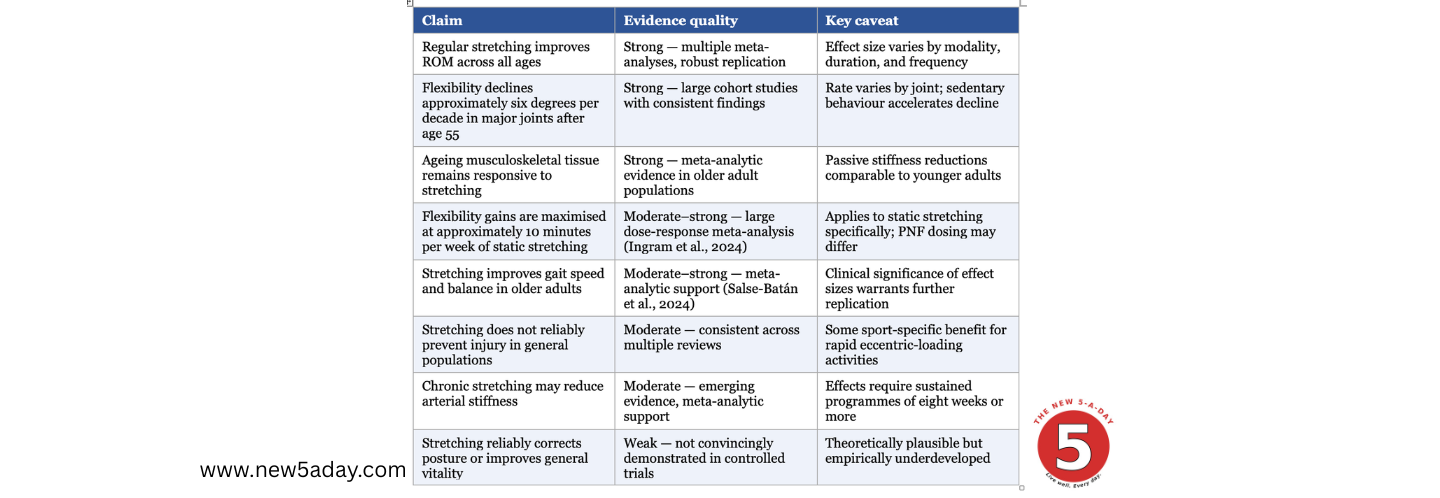
Taken together, the research on flexibility supports a straightforward practical position: a consistent, modest stretching habit — targeted at the joints most vulnerable to age-related restriction, using static or PNF techniques, sustained across years rather than weeks — produces meaningful and cumulative benefit. The returns that are most robustly evidenced — preserved range of motion, reduced passive stiffness, improved gait and balance in later life — are precisely the returns that preserve functional independence and ease of movement through daily life.
The argument for building flexibility into a regular movement routine does not require overstating what the evidence shows. The case that is well-supported is, by any reasonable assessment, sufficient.
A note on medical advice: This Deep Dive is intended for readers who want to engage with the evidence in more depth. It does not replace professional medical or physiotherapy advice. If you have specific concerns about joint pain, mobility limitations, or health conditions affecting your ability to exercise, please speak to your GP or a qualified health professional.
The New 5-a-Day | Be Active 3-5 | Live well. Every day.
