Keep stretching! The life-benefits of Flexibility
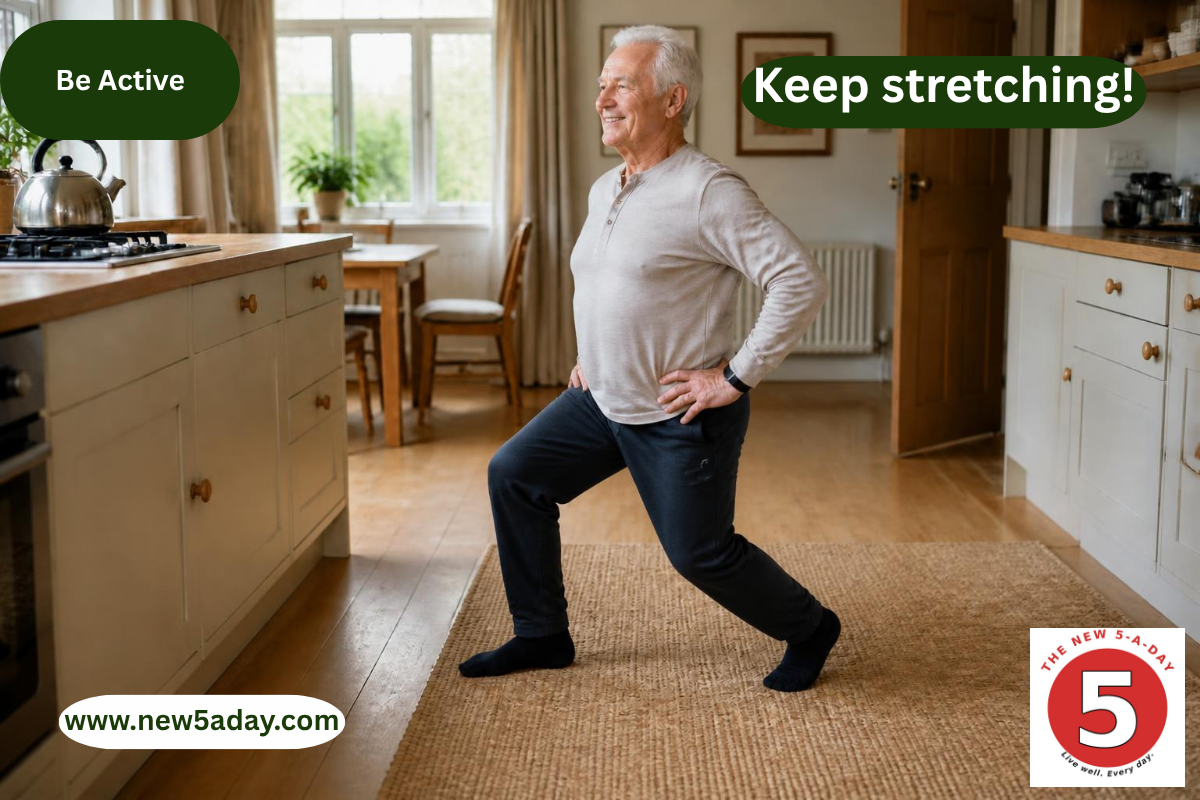
Quick summary: Flexibility — the ability of your muscles and joints to move freely through their full range — is one of those aspects of fitness that most of us take for granted until we notice it slipping away. Research consistently shows that flexibility declines with age, but the good news is that it responds remarkably well to regular, modest effort. Just five to ten minutes of stretching a day, done consistently, can meaningfully preserve and even restore range of motion. This post explains why flexibility matters so much as we get older, what the warning signs of stiffness look like, and how to build simple stretching habits into even the busiest day — without gym membership, special kit, or large blocks of time.
Here is a small test. Stand up, reach down, and try to touch your toes.
How did that go? If you made it easily, congratulations — you are in a minority. If you hovered somewhere around your shins, or felt a sharp protest from your hamstrings and lower back, you are in very good company. And if the thought of trying at all seemed faintly alarming, this post is especially for you.
Flexibility — the ability of your muscles, tendons, and joints to move freely through their natural range — is one of the Four Macros of being physically active, alongside cardio fitness, strength, and balance. Of the four, it is probably the most underrated. People talk about getting fit. They sign up for gym memberships, buy trainers, download running apps. Flexibility tends to get a brief mention at the end of an exercise class and then forgotten. That is a shame, because the evidence for what it does — and what happens when we lose it — is more compelling than most people realise.
Why flexibility matters more than you might think
Good flexibility is about more than being able to reach things on high shelves. It is the quality that allows you to move through daily life with ease — bending, twisting, reaching, turning — without strain or stiffness. When joints move freely and muscles are pliable, the whole body works more efficiently. Posture tends to be better. Balance is improved. Movements that require coordination between muscle groups — getting out of a car, picking something up from the floor, carrying bags without hunching — feel less effortful.
Flexibility also supports the other things we do to stay healthy. Strength training and cardio both go better when your body can move through its full range. Muscles that are chronically tight limit movement before they have even been properly challenged, and they are more prone to discomfort when asked to work hard. Think of flexibility as the foundation on which other physical activity sits. Without it, everything else is slightly constrained.
What happens as we age
This is where the picture becomes important, because flexibility does not stay put. It declines steadily with age — and the research is quite specific about this. Large studies tracking adults from their mid-fifties into their eighties have found that flexibility in the hips and shoulders drops by around six degrees per decade. That might sound abstract, but it translates into real, tangible changes: the reach that was effortless at forty feels slightly laboured at fifty, and noticeably restricted by sixty. By the time most people start to notice, the loss has often been accumulating for years.
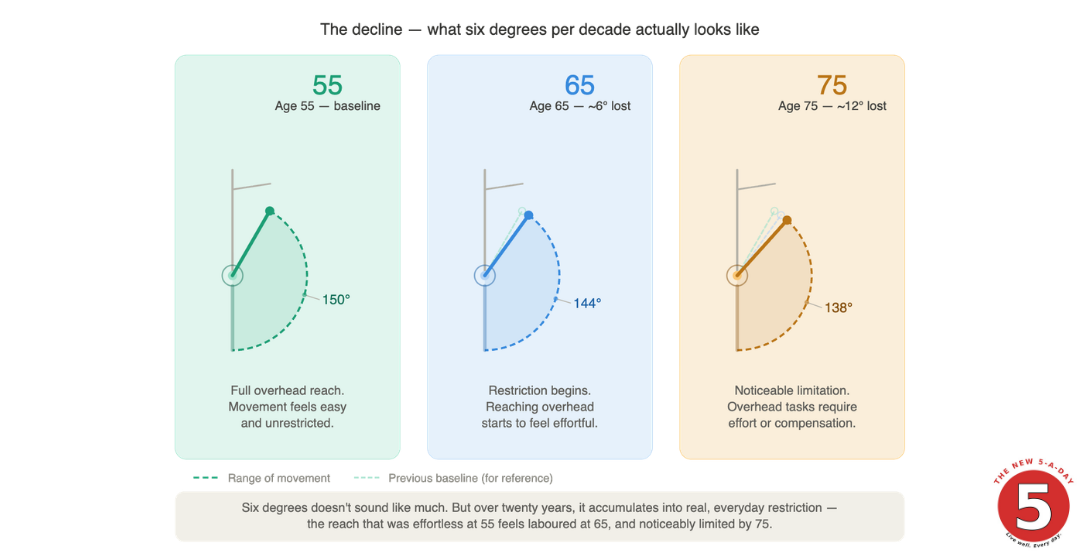
The decline is not uniform across the body. Shoulders and the trunk lose mobility faster than knees and elbows. And it is not only age at work: a sedentary lifestyle accelerates the process considerably. Prolonged sitting — which describes much of modern working life — shortens the muscles at the front of the hips and tightens the back. Connective tissue that is not regularly moved through its range becomes stiffer over time. The body, in its pragmatic way, adapts to what you ask of it. If you mostly sit, it will optimise for sitting.
The consequences of this go beyond mild discomfort. Reduced flexibility affects balance, which in turn increases the risk of falls — a significant and serious concern for older adults. It can make everyday tasks feel arduous. It often contributes to the kind of persistent low-level back and neck discomfort that many people simply learn to live with, without ever connecting it to their declining range of movement. The good news — and there is very good news here — is that flexibility is one of the most responsive aspects of fitness to targeted effort. It improves with practice, at any age.
The signs worth paying attention to
Reduced flexibility tends to arrive gradually, which means it often goes unnoticed until it has become quite significant. Some of the more common signals:
• Stiffness after sitting for an hour or so, particularly in the hips, lower back, or neck.
• Difficulty reaching overhead without your lower back arching to compensate.
• Trouble turning your head fully when reversing the car.
• Needing to hold something for balance when putting on shoes or trousers.
• Feeling noticeably tight in your hamstrings, hip flexors, or shoulders — the areas most affected by desk-based work.
• Morning stiffness that takes longer than a few minutes to ease off.
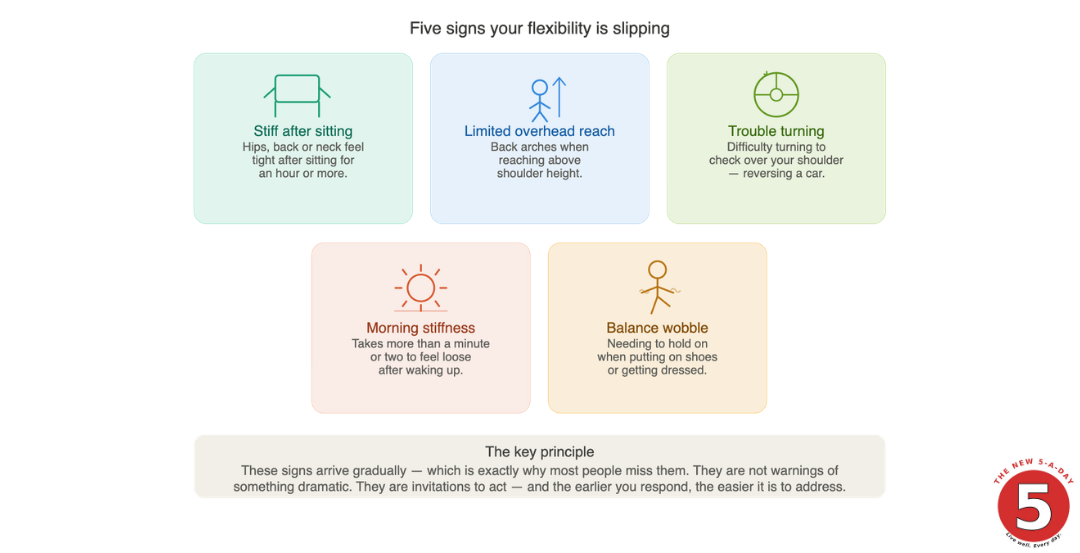
None of these are alarming in isolation. But they are useful information, because they are telling you something your body needs. The earlier you respond, the easier it is to address.
What the evidence actually shows
It is worth being clear about what stretching will and will not do, because the evidence is more nuanced than it is sometimes presented. The research is very consistent on one thing: regular stretching genuinely improves range of motion. This is one of the better-established findings in exercise science. It is true for people of all ages, and it is true even when the stretching is relatively modest in duration.
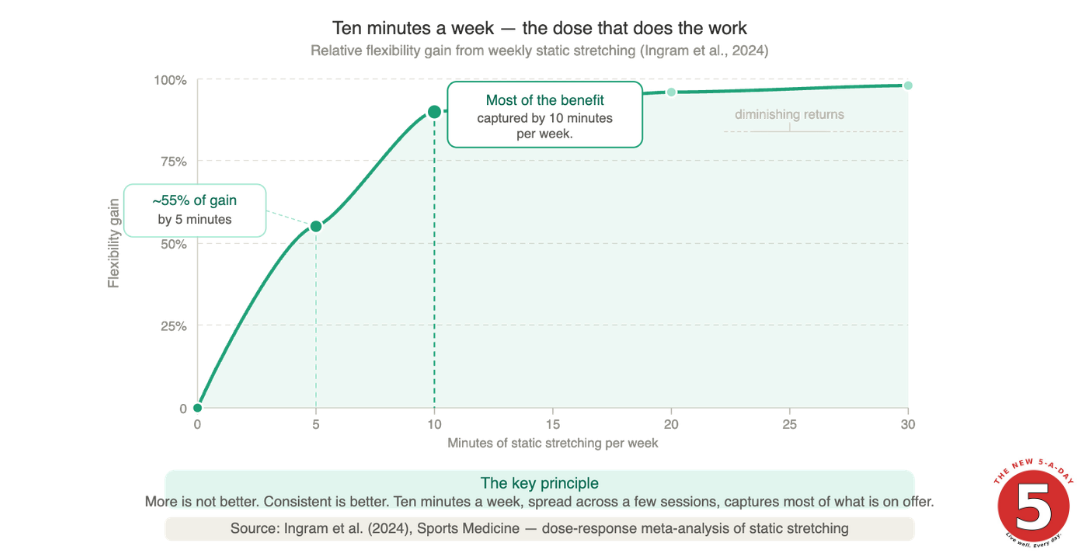
A large analysis of the research on static stretching — the kind where you hold a position for a period of time — found that flexibility gains are maximised by around four minutes of stretching per muscle group per session, and roughly ten minutes total per week. That is a remarkably small investment for a measurable, reliable return. Beyond that threshold, additional time brings diminishing returns; more is not necessarily better. The implication is that even a modest daily routine, done consistently, delivers most of the benefit.
What is less firmly established — and worth being honest about — is the idea that stretching reliably prevents injuries. The evidence here is mixed and sport-specific. Stretching before certain types of activity seems helpful for some people in some contexts; it is not a guarantee. Similarly, claims that flexibility training corrects posture or directly improves overall health in measurable ways are only partly supported. The core benefit — improved range of motion, reduced muscle stiffness, and more comfortable everyday movement — is solid. That is worth emphasising, because it is quite enough.
What actually works — and how to fit it in
The most important practical insight from the research is also the most encouraging: you do not need long sessions, specialist classes, or any equipment to improve your flexibility. What you need is regularity. Short and consistent beats long and occasional, every time.
A simple approach is to anchor stretching to something you already do. Five minutes after your morning shower, while the kettle boils, or during a break from your desk — these are all enough. The habit does not need to feel like an event. It just needs to happen most days.
For a basic daily routine, it helps to think about the areas most likely to have tightened up — and for most adults, especially those who spend significant time sitting, this means the hips, hamstrings, lower back, and shoulders. A handful of straightforward movements covers this ground well:
• Hip flexor stretch: Step one foot forward into a lunge position, lower the back knee gently towards the floor, and hold. This directly counters the tightening that comes from prolonged sitting. Switch sides and hold for 30 seconds each.
• Hamstring stretch: Stand with feet hip-width apart and hinge forward from the hips, letting your arms hang towards the floor. Bend your knees slightly if needed. Hold for 30 seconds, breathing steadily.
• Seated spinal twist: Sit upright on a chair, place one hand on the opposite knee, and gently rotate your upper body to look behind you. This works the thoracic spine and helps restore rotational range. Switch sides.
• Chest opener: Clasp your hands behind your back, straighten your arms gently, and lift slightly while drawing your shoulder blades together. This counters the rounded-shoulder posture that desk work encourages.
• Neck rolls: Slowly drop one ear towards the shoulder, hold briefly, then move to the other side. Avoid rolling the neck in full circles; side-to-side and chin-to-chest movements are gentler and just as effective.
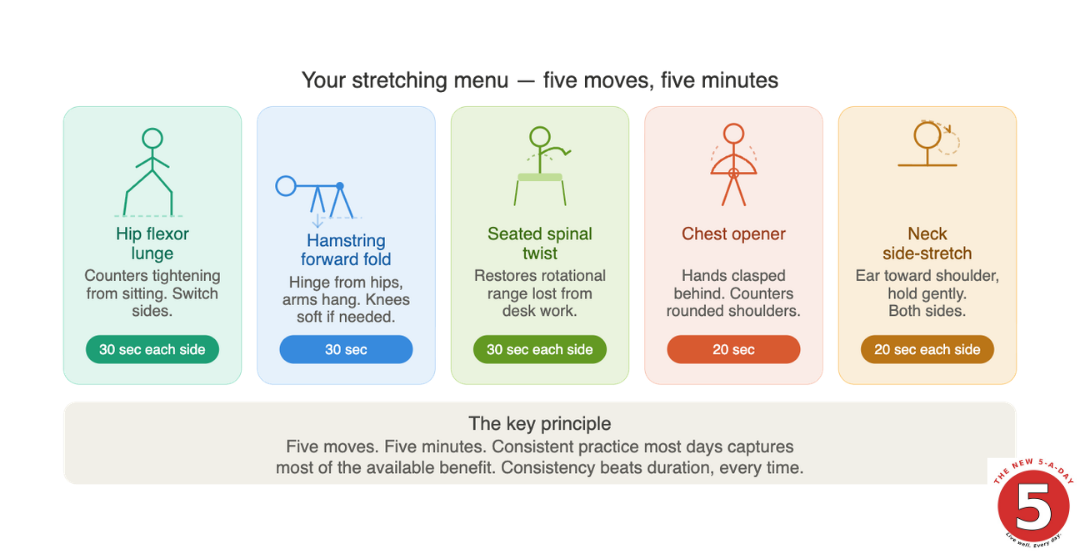
The principle for holding stretches is simple: aim for 30 seconds per position, working towards two or three repetitions of each. You should feel a gentle pull — a sensation of mild tension — but not pain. Do not bounce. Breathe steadily throughout. If something hurts, ease back.
Fitting it into a busy life
One of the most useful reframes here is to stop thinking of stretching as something that requires a dedicated slot. Like all the habits in The New 5-a-Day, it works best when it is woven into life rather than bolted on to the side of it.
Micro-stretches work. Thirty seconds of a hip flexor stretch while waiting for the kettle. A chest opener between back-to-back meetings. Slow neck stretches on the commute home. These small moments accumulate. The body does not require a single uninterrupted session — it just needs the movement to happen.
There are also some easy wins from activities you may already be doing. Yoga and Pilates both prioritise flexibility as a core component, and even a short beginner class — there is a generous library of free content online — covers a lot of ground. Swimming is excellent for shoulder and hip mobility. Even walking with a full, purposeful stride, rather than the slightly shuffled gait that tight hips can produce, actively works your range of movement.
If you work at a desk, a particularly useful habit is to set a reminder to stand up and move every hour. Even a brief two-minute walk to make a drink, combined with a couple of simple stretches on returning to your desk, breaks the pattern of sustained static sitting that tightens everything so efficiently.
A note on warming up first
One practical point worth knowing: static stretching works better on warm muscles. Stretching cold — first thing in the morning before moving around, or immediately after getting up from a desk — is fine in terms of not causing harm, but you will find your range is more limited and the sensation less comfortable. A short walk, a few minutes of gentle movement, or simply doing it after a warm shower means your muscles are more receptive and the stretch more effective.
Dynamic stretching — movement-based rather than held — is particularly good before activity: arm swings, leg swings, torso rotations. Static holds are better saved for after exercise or as a standalone session. Both improve flexibility; the choice of which to use when makes the experience more comfortable and the outcome slightly better.
Start where you are
The research on flexibility has one reassuring consistent message: it is never too late to start, and the returns from modest effort are real. Adults well into their seventies and eighties show meaningful improvements from regular stretching. The body’s capacity to adapt does not disappear with age — it slows, but it persists. What you do today genuinely matters for how you move tomorrow.
The aspiration here is not to become someone who can fold themselves in half. It is simply to preserve and gradually extend the range of movement that makes daily life comfortable — to be able to reach, bend, turn, and move without wincing. To get in and out of a car without planning it. To pick things up from the floor without bracing. To sit at a desk for hours and stand up without feeling like the Tin Man.
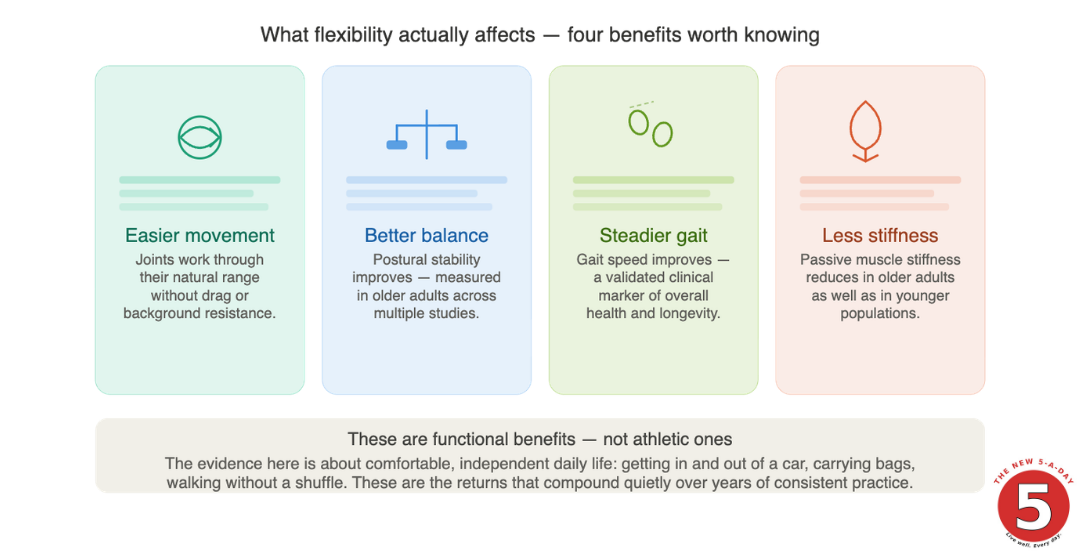
Flexibility is one of the quieter contributors to quality of life. You notice it most when you have lost it. The argument for building it into your routine now is simply that prevention is considerably easier than recovery — and the investment required is smaller than almost anyone expects.
So: pick one stretch. Do it today. And then tomorrow. That is all it takes to begin.
A note on medical advice: This post is intended for general information purposes. It does not replace professional medical or physiotherapy advice. If you have specific concerns about joint pain, mobility limitations, or health conditions that affect your ability to exercise, please speak to your GP or a qualified health professional.
The New 5-a-Day | Be Active 3-5 | Live well. Every day.
