
The neuroscience of rapid eye movement sleep, its roles in memory consolidation and emotional regulation, the evidence on lifestyle factors affecting REM architecture, and the clinical significance of REM disruption
Companion to: Sleep Well Open Post 1-6 — The night shift your brain never tells you about. This Deep Dive examines the evidence base in greater technical depth. Readers seeking the accessible introduction should begin with the Open Post.
Key takeaways
REM sleep is a physiologically distinct state characterised by desynchronised, wake-like cortical activity, rapid conjugate eye movements, and near-complete skeletal muscle atonia — the last of which is actively generated by brainstem circuits and serves to prevent the physical enactment of dreams. In healthy adults, REM comprises approximately 20–25% of total sleep time, equivalent to roughly 90–120 minutes per night on a full seven-to-nine-hour sleep episode. REM is heavily concentrated in the final third of the sleep period, with successive episodes lengthening across the night — meaning that even modest curtailment of total sleep time disproportionately reduces REM. The functional roles of REM are well evidenced, though its contributions often work in concert with non-REM sleep rather than in isolation. REM is particularly implicated in the consolidation of procedural, associative, and emotionally significant memories, and in the processing and regulation of emotional experience. The contribution of REM to creativity reflects its capacity to form novel associative links between memories during a period of markedly reduced noradrenergic activity. Alcohol consumed before sleep suppresses REM in a dose-dependent fashion, confirmed by systematic review and meta-analysis. Late caffeine intake delays REM onset and reduces total REM duration. Sleep apnea, in its REM-predominant form, fragments and reduces REM with documented downstream effects on neurocognitive and cardiometabolic outcomes. The most reliable levers for protecting REM are also the foundations of good sleep hygiene: adequate and consistent total sleep duration, a stable schedule, a cool and dark sleep environment, and mindful management of alcohol and caffeine.
Overview and scope
This Deep Dive examines the scientific evidence underpinning the claims made in Sleep Well Open Post 1-6 about REM sleep: its definition and physiological characteristics, its functional roles in memory, emotional regulation, and cognition, the mechanisms through which lifestyle factors affect REM architecture, and the clinical significance of REM disruption. It draws on the Consensus AI literature review commissioned for this post and the supporting Perplexity research synthesis.
Where findings from the Open Post require qualification or nuance — particularly regarding the relative contributions of REM versus non-REM sleep to specific outcomes — these are addressed explicitly. Key methodological limitations in the REM literature are noted where they affect the interpretation of findings.
How researchers study REM sleep
The evidence base for REM sleep draws on a hierarchy of study designs, each with distinct strengths and limitations that bear on how findings should be interpreted.
Polysomnography (PSG) — the simultaneous measurement of brain electrical activity (EEG), eye movements (EOG), and muscle tone (EMG) in a sleep laboratory — is the gold-standard method for identifying and characterising sleep stages, including REM. PSG studies have established the defining physiological features of REM and provided the normative data on REM duration and distribution that underpin current clinical and research benchmarks. Their limitation is ecological validity: sleep in a laboratory differs in important ways from sleep at home, and single-night recordings may not capture the full variability of an individual’s sleep architecture.
Selective REM deprivation studies represent a key methodology for establishing what REM actually does. Participants are monitored continuously and awakened specifically when EEG signatures indicate REM onset, preventing entry into the stage while preserving most NREM sleep. This approach has produced some of the most direct evidence on REM function. Its limitation is the inevitable co-occurrence of general sleep disruption and arousal stress alongside the specific REM loss, making it difficult to attribute observed effects cleanly to the absence of REM rather than to the disruption itself.
Randomised controlled trials (RCTs) and observational cohort studies are used to examine the effects of lifestyle factors on sleep architecture and downstream outcomes. RCTs examining the effects of alcohol, caffeine, and sleep restriction on REM — assessed via polysomnography — provide the strongest causal evidence in this domain. Systematic reviews and meta-analyses pool data from multiple studies to produce the most reliable overall estimates of effect size and consistency. Several such analyses are central to this post.
Consumer wearable devices, which increasingly report REM estimates to the public, do not measure brain activity directly. Their accuracy relative to concurrent PSG is the subject of active validation research and is addressed in a dedicated section below.
REM sleep: physiological characteristics and architecture
Sleep is not a passive, uniform state. Polysomnographic recording reveals a highly organised, cyclical structure alternating between non-REM (NREM) and REM sleep in roughly 90-minute cycles across the night.
The defining features of REM
REM sleep is distinguished from NREM by three cardinal features. First, cortical EEG activity shifts from the high-amplitude, low-frequency waves characteristic of slow-wave sleep to a low-voltage, high-frequency, ‘desynchronised’ pattern that closely resembles waking. This wake-like cortical activation is what makes REM physiologically unusual: the brain is, in many respects, as active as during alertness. Second, the stage is characterised by bursts of rapid, conjugate eye movements — the phenomenon that gives the stage its name. Third, and critically, skeletal muscle tone is actively suppressed to near-complete atonia, generated by brainstem circuits that inhibit motor neurons via glycinergic and GABAergic pathways. The functional purpose is to prevent the physical enactment of dream content.
KEY RESEARCH
Elliott, J., Metha, J., Hoyer, D., & Jacobson, L. (2025). Rapid eye movement sleep: Who needs it? Creativity mechanisms and psychiatric applications of REM sleep enhancement. Journal of Psychopharmacology, 39, 1245–1257. https://doi.org/10.1177/02698811251365179
This review provides a comprehensive account of REM physiology and its functional roles, with particular attention to creative and associative memory functions. The authors note that phasic REM — characterised by eye movements and pontine-geniculate-occipital (PGO) waves — and tonic REM — the quieter inter-burst intervals — may have distinct functional profiles, a distinction increasingly recognised in the research literature.
REM distribution across the night
REM episodes are not evenly distributed. The first REM episode of the night is typically brief — often only ten to twenty minutes — and occurs roughly 90 minutes after sleep onset. Subsequent episodes lengthen progressively, with the final REM period potentially lasting 45–60 minutes or more. The majority of an adult’s REM sleep is therefore concentrated in the final two hours of a full eight-hour sleep episode.
This architectural fact carries a direct practical implication: truncating sleep — even by a single hour at the end of the night, as occurs with early alarms — disproportionately reduces REM. A person sleeping six rather than eight hours may lose a third or more of their REM time while losing only a quarter of their total sleep. This asymmetry helps explain why chronically short sleepers often report cognitive and emotional difficulties not simply proportional to the hours lost.
KEY RESEARCH
Carskadon, M., & Dement, W. (2005). Chapter 2 — Normal Human Sleep: An Overview. In M. Kryger, T. Roth, & W. Dement (Eds.), Principles and Practice of Sleep Medicine (pp. 13–23). https://doi.org/10.1016/b0-72-160797-7/50009-4
REM proportion in healthy adults
In healthy adults, REM comprises approximately 20–25% of total sleep time. A systematic review and meta-analysis by Boulos et al. (2019) of 5,273 healthy adults confirmed this figure and found that REM percentage does not significantly decline across adulthood — distinguishing REM from slow-wave sleep, which does reduce meaningfully with age. In contrast, newborns spend approximately 50% of their considerably longer sleep episodes in active sleep, the developmental precursor to adult REM — a proportion that decreases to adult levels by around age two, consistent with theories that early-life REM plays a central role in synaptic maturation and brain development.
KEY RESEARCH
Boulos, M., Jairam, T., Kendzerska, T., Im, J., Mekhael, A., & Murray, B. (2019). Normal polysomnography parameters in healthy adults: a systematic review and meta-analysis. The Lancet. Respiratory Medicine, 7(6), 533–543. https://doi.org/10.1016/s2213-2600(19)30057-8
Functional roles of REM sleep
The functions of REM sleep have been studied across decades of research. The evidence points to several well-supported roles, with a consistent finding that REM and NREM sleep interact and often work complementarily rather than in isolation.
Memory consolidation and associative processing
The consolidation of memories during sleep — the process by which newly acquired information is stabilised and integrated into long-term networks — is among the most replicated findings in sleep science. REM’s contribution is particularly strong for procedural memories, emotional memories, and the formation of novel associative connections between previously unrelated information.
The neural mechanism appears to involve the replay of activity patterns from waking experience during REM. Crucially, the markedly reduced noradrenergic activity that characterises REM — the locus coeruleus, the brain’s primary source of noradrenaline, is nearly silent during REM — is thought to create a neuromodulatory environment that favours the formation of weak associative links between distantly related memories, rather than simple strengthening of existing associations. This is mechanistically distinct from the consolidation role of slow-wave sleep, which appears better suited to the strengthening and transfer of strongly encoded memories.
KEY RESEARCH
Ferrara, M., D’Atri, A., & Salfi, F. (2023). Novel insights into the role of eye movements during REM sleep in memory consolidation. Sleep, 46. https://doi.org/10.1093/sleep/zsad178
This paper focuses on the role of phasic eye movements during REM in the consolidation process, proposing that pontine-geniculate-occipital (PGO) waves — which trigger eye movements and are associated with hippocampal activity — may be mechanistically involved in memory replay and consolidation during REM.
An important qualification: the relationship between REM and emotional memory is more nuanced than a simple ‘REM strengthens emotional memories’ formulation. A 2025 study by Yuksel et al. in Communications Biology, directly comparing the contributions of slow-wave sleep and REM to emotional memory consolidation, found that both stages contributed but in potentially complementary ways — with REM possibly involved in transforming or modulating the emotional valence of memories rather than uniformly strengthening them. REM does not simply replay and amplify emotional experience; it appears to process and regulate it.
KEY RESEARCH
Yuksel, C., Denis, D., Coleman, J., Ren, B., Oh, A., Cox, R., Morgan, A., Sato, E., & Stickgold, R. (2025). Both slow wave and rapid eye movement sleep contribute to emotional memory consolidation. Communications Biology, 8. https://doi.org/10.1038/s42003-025-07868-5
Emotional regulation
Sleep, and REM in particular, plays a documented role in emotional homeostasis. The amygdala — the brain region most closely associated with processing emotionally salient information — is among the most active structures during REM. This activity is thought to underlie the processing of emotionally significant experiences accumulated during the preceding waking period.
Research using experimental REM deprivation paradigms consistently shows that participants deprived specifically of REM demonstrate impaired emotional regulation: increased emotional reactivity, heightened response to aversive stimuli, and reduced positive affect. These effects emerge relatively quickly, with meaningful changes apparent after two to three nights of selective REM restriction. Clinical populations provide convergent evidence: REM sleep is consistently abnormal in depression, anxiety disorders, PTSD, and mood disorders, with characteristic alterations in REM latency, episode duration, and density.
KEY RESEARCH
Tempesta, D., Socci, V., De Gennaro, L., & Ferrara, M. (2017). Sleep and emotional processing. Sleep Medicine Reviews, 40, 183–195. https://doi.org/10.1016/j.smrv.2017.12.005
Creativity and novel problem-solving
The hypothesis that REM sleep supports creativity has received growing empirical support. The mechanism most frequently proposed is that the hyper-associative state of REM, combined with low noradrenergic tone, facilitates the formation of weak associative links that are less accessible during focused waking cognition. Experimental studies have shown that REM-rich sleep improves performance on tasks requiring creative or lateral thinking — including remote associates tests and insight problems — more than equivalent amounts of NREM sleep or equivalent waking periods.
KEY RESEARCH
Lewis, P., Knoblich, G., & Poe, G. (2018). How Memory Replay in Sleep Boosts Creative Problem-Solving. Trends in Cognitive Sciences, 22(6), 491–503. https://doi.org/10.1016/j.tics.2018.03.009
Lifestyle factors affecting REM architecture
A number of common lifestyle behaviours have well-documented effects on REM architecture. The evidence is strongest for alcohol, caffeine, and total sleep curtailment.
Alcohol
Alcohol is one of the most reliably documented suppressors of REM sleep. The mechanism involves alcohol’s GABAergic and glutamatergic effects on brainstem circuits that generate REM — in particular, suppression of REM-promoting neurons in the sublaterodorsal nucleus. This effect is dose-dependent: larger doses produce greater REM suppression, most pronounced in the first half of the night when alcohol concentrations are highest.
A systematic review and meta-analysis by Gardiner et al. (2024) confirmed dose-dependent REM suppression alongside a rebound effect in the second half of the night as alcohol is metabolised — characterised by increased awakenings and lighter sleep. Early-night REM suppression is not fully compensated by this late-night rebound; the net effect on memory consolidation, emotional processing, and next-day cognitive function is consistently negative.
KEY RESEARCH
Gardiner, C., Weakley, J., Burke, L., Roach, G., Sargent, C., Maniar, N., Huynh, M., Miller, D., Townshend, A., & Halson, S. (2024). The effect of alcohol on subsequent sleep in healthy adults: A systematic review and meta-analysis. Sleep Medicine Reviews, 80, 102030. https://doi.org/10.1016/j.smrv.2024.102030
Caffeine
Caffeine operates as an adenosine receptor antagonist, reducing the perception of sleepiness that would otherwise accumulate during wakefulness. In the context of REM sleep, caffeine consumed in the afternoon or evening has two relevant effects: it delays sleep onset, compressing the total sleep window and therefore reducing late-night REM; and it appears to directly delay the timing of REM promotion — the circadian and homeostatic signal that increases REM propensity in the second half of the night.
KEY RESEARCH
Weibel, J., Lin, Y., Landolt, H., Berthomier, C., Brandewinder, M., Kistler, J., Rehm, S., Rentsch, K., Meyer, M., Borgwardt, S., Cajochen, C., & Reichert, C. (2021). Regular Caffeine Intake Delays REM Sleep Promotion and Attenuates Sleep Quality in Healthy Men. Journal of Biological Rhythms, 36, 384–394. https://doi.org/10.1177/07487304211013995
This study is notable for distinguishing the effects of regular caffeine intake from acute single-dose effects, finding that habitual caffeine consumption specifically delayed the circadian drive for REM promotion — not merely sleep onset. The implication is that chronic caffeine use may produce a systematic shift in REM timing even among individuals who believe their sleep is unaffected by caffeine.
A systematic review and meta-analysis by Gardiner et al. (2023) confirmed that caffeine intake significantly shortens total sleep time, reduces REM duration, and worsens sleep efficiency in a dose-dependent fashion. These effects are present even when caffeine is consumed in the afternoon, reflecting caffeine’s extended half-life of five to seven hours in most adults.
KEY RESEARCH
Gardiner, C., Weakley, J., Burke, L., Roach, G., Sargent, C., Maniar, N., Townshend, A., & Halson, S. (2023). The effect of caffeine on subsequent sleep: A systematic review and meta-analysis. Sleep Medicine Reviews, 69, 101764. https://doi.org/10.1016/j.smrv.2023.101764
Sleep duration and schedule consistency
The single most impactful determinant of REM quantity is total sleep duration. Because REM episodes lengthen across the night, a reduction in total sleep time produces a disproportionate reduction in REM. A person consistently sleeping six rather than eight hours may reduce their REM time by thirty to forty percent while reducing total sleep by only twenty-five percent.
Schedule consistency matters for a related reason: the circadian system governs the timing of REM, not merely its total quantity. A stable wake time anchors the circadian clock and ensures that the REM-promoting signal — which rises across the night in coordination with the circadian system — occurs at the appropriate phase. Irregular sleep timing disrupts this coordination, potentially producing nights in which REM is either delayed or compressed even when total sleep duration appears adequate.
REM disruption and sleep disorders
Beyond lifestyle factors, several sleep disorders specifically disrupt REM architecture with clinically significant consequences.
REM-predominant obstructive sleep apnea
Obstructive sleep apnea (OSA) is characterised by repeated upper airway obstruction during sleep, producing arousals, oxygen desaturation, and sleep fragmentation. A recognised phenotype — REM-predominant OSA — involves breathing events that cluster specifically during REM, when upper airway muscle tone is further reduced by the motor atonia characteristic of the stage. This selective vulnerability means that REM is disproportionately fragmented or eliminated in affected individuals.
KEY RESEARCH
Karuga, F., Kaczmarski, P., Białasiewicz, P., Szmyd, B., Jaromirska, J., Grzybowski, F., Gebuza, P., Sochal, M., & Gabryelska, A. (2023). REM-OSA as a Tool to Understand Both the Architecture of Sleep and Pathogenesis of Sleep Apnea — Literature Review. Journal of Clinical Medicine, 12. https://doi.org/10.3390/jcm12185907
This review documents that REM-predominant OSA is associated with worse neurocognitive outcomes, greater mood disturbance, and higher cardiometabolic risk than non-REM-predominant apnea, consistent with the functions REM serves. Treatment with CPAP, which maintains airway patency across all sleep stages, restores more normal REM architecture and is associated with improvements in cognitive performance and emotional functioning.
REM sleep behaviour disorder
REM sleep behaviour disorder (RBD) is a condition in which the normal muscle atonia of REM sleep fails, allowing individuals to physically enact dream content. Unlike OSA (which reduces REM), RBD reflects a failure of the brainstem circuits responsible for generating atonia during REM. It is strongly associated with synucleinopathies — including Parkinson’s disease, Lewy body dementia, and multiple system atrophy — and may precede the motor and cognitive symptoms of these conditions by years or decades. RBD requires specialist assessment and should not be self-diagnosed from consumer tracker data.
Evidence-based approaches to protecting REM sleep
The evidence does not support any intervention that selectively and meaningfully increases REM percentage beyond what is achieved by good sleep hygiene and adequate total sleep. The practical levers for optimising REM are therefore the same as those for optimising sleep overall, with particular attention to the factors most likely to disrupt late-night sleep and REM specifically.
Total sleep duration. Protecting the final two hours of a full sleep episode — where the longest REM periods occur — is the most powerful available lever. The evidence consistently supports seven to nine hours for most adults. For individuals currently sleeping less than seven hours, even modest extensions achieved by advancing bedtime can produce meaningful increases in REM.
Schedule consistency. A stable wake time is particularly important for circadian entrainment. Research on sleep regularity — including a 2025 systematic review by Kalkanis et al. in Sleep Medicine Reviews — confirms that sleep regularity is an independently important health variable, associated with better metabolic, mental health, and mortality outcomes beyond sleep duration alone. For REM specifically, a consistent wake time helps ensure that the REM-promoting circadian signal is appropriately timed.
Alcohol management. Given the dose-dependent suppression of REM by alcohol, even modest reductions in evening alcohol intake can produce measurable improvements in REM architecture. The timing of intake matters alongside quantity: alcohol consumed earlier in the evening is metabolised before the second half of the night when most REM occurs, reducing the impact on late-night sleep.
Caffeine cutoff. The evidence supports avoiding caffeine from the mid-afternoon onwards for most adults. Individuals with slower caffeine metabolism — a genetically determined trait — may benefit from an earlier cutoff. The practical test is whether sleep onset feels disrupted after afternoon caffeine; if so, bringing the cutoff one to two hours earlier is a reasonable first step.
Sleep environment. A cool, dark, and quiet bedroom makes it easier to stay asleep through the second half of the night, protecting the longer REM episodes that occur in that period. Core body temperature drops during the transition to sleep and remains lower during NREM, with a modest rise during REM; a cool room supports this natural thermoregulatory pattern.
Exercise. Regular physical activity is associated with improved sleep architecture in a broad sense, including more consolidated sleep and — in some studies — modest increases in slow-wave sleep. Its effects specifically on REM are less consistently reported, but overall improvements in sleep consolidation and duration are likely to benefit REM indirectly by reducing nighttime awakenings that fragment the second half of sleep.
Consumer sleep trackers and REM measurement
Consumer wearable devices increasingly report REM sleep estimates. It is important to understand what these estimates represent and their limitations. Polysomnography identifies REM sleep using simultaneous EEG, EOG, and EMG. Consumer devices instead rely primarily on heart rate variability, accelerometry, and sometimes skin temperature to infer sleep stages. They do not directly measure brain activity.
Validation studies comparing consumer device estimates with concurrent polysomnography have generally found moderate accuracy at the group level, with significant individual-level variability. Devices tend to perform reasonably well at distinguishing sleep from wakefulness, but are less reliable at accurately classifying individual sleep stages — particularly in distinguishing light NREM from REM. Single-night REM estimates from consumer devices should be interpreted with caution; trends over many nights, and the relationship between tracker-estimated REM and subjective sleep quality, are more informative than individual readings.
For individuals concerned about REM specifically — particularly those with symptoms suggestive of a sleep disorder — clinical polysomnography remains the appropriate diagnostic tool. Consumer trackers are not a substitute for clinical assessment.
Evidence limitations and methodological considerations
Several methodological features of the REM research literature deserve acknowledgement.
Difficulty of selective REM deprivation. Much foundational evidence on REM function comes from selective deprivation studies in which participants are awakened when EEG signatures indicate REM onset. This inevitably causes general sleep disruption and arousal stress alongside specific REM loss, making it difficult to attribute observed effects cleanly to the absence of REM rather than to the disruption itself.
REM versus NREM interaction. The increasing recognition that REM and NREM work in coordinated sequences — rather than independently — complicates simple attribution of functions to one stage. Memory consolidation, emotional processing, and synaptic homeostasis all appear to involve both stages in complementary roles. The ‘tagged for consolidation during NREM, processed during REM’ model, while useful, is an oversimplification of a more dynamic interaction.
Population generalisability. Much human REM research is conducted in healthy young adults under controlled laboratory conditions. Generalisability to older adults, clinical populations, and individuals with comorbidities requires caution. The effects of REM disruption on longer-term outcomes such as dementia risk and immune function are areas of active research where the evidence base is still developing.
REM and next-day refreshment. The claim that REM is specifically responsible for the subjective feeling of being refreshed is less directly supported than its roles in memory and emotional processing. Subjective sleep quality and next-day alertness are influenced by NREM sleep, sleep continuity, total sleep duration, and circadian alignment, as well as by REM. The Open Post treats REM as an important contributor rather than the sole determinant.
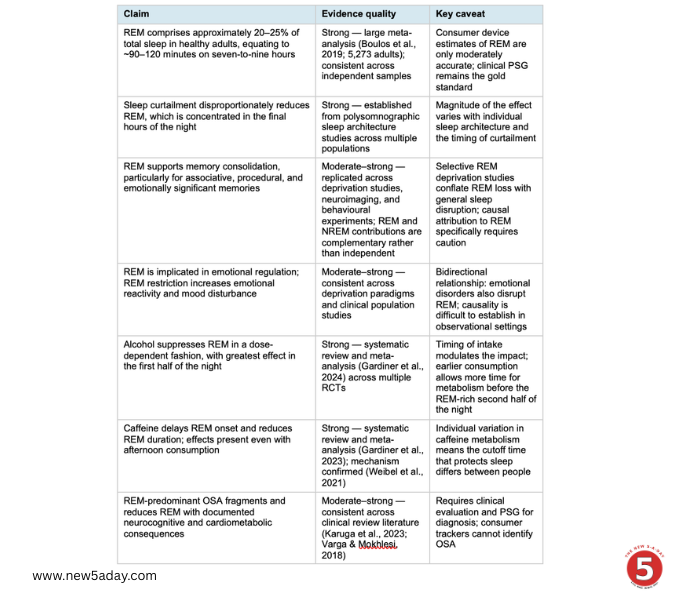
Summary of the evidence
The evidence supports the following conclusions:
Bringing it back to The New 5-a-Day
Sleep is Pillar One of The New 5-a-Day. The evidence reviewed in this post supports its place there with some precision: REM sleep is not an incidental feature of the night, but an active and functionally significant stage whose benefits touch cognition, emotion, creativity, and resilience in ways that compound over time. It is also the stage most readily undermined by the habits — late alcohol, late caffeine, inconsistent schedules, and truncated sleep windows — that characterise many modern lives.
The practical message that emerges from the research is a reassuring one. There is no specialist intervention required to protect REM, and no supplement or device that meaningfully adds to it. What the evidence supports is consistent with what the whole of the sleep science literature supports: give sleep enough time, give it a stable schedule, give it an environment that does not work against it, and manage the specific behaviours — alcohol and caffeine in particular — that most reliably suppress the stage where so much of the brain’s essential maintenance work gets done.
The physiology is compelling, but the practical prescription does not need to be. Protect the hours. Keep the schedule. Mind the nightcap and the late coffee. The REM sleep will follow.
A note on medical advice: This Deep Dive is intended for readers who want to engage with the evidence in greater depth. It does not replace professional medical or psychological advice. If you regularly wake unrefreshed despite adequate time in bed, snore loudly, suspect you may have a sleep disorder, or have concerns about mood, memory, or cognitive function linked to poor sleep, please speak to your GP or a qualified health professional.
Want to read further? Full citations for all research referenced in this post are available in the accompanying Reference List.
[Return to Open Post →] [View the References →] [Listen to the Episode →]
The New 5-a-Day | Sleep Well 1-6 | Deep Dive | Live well. Every day.
