Mindful walking and health: what the evidence actually shows
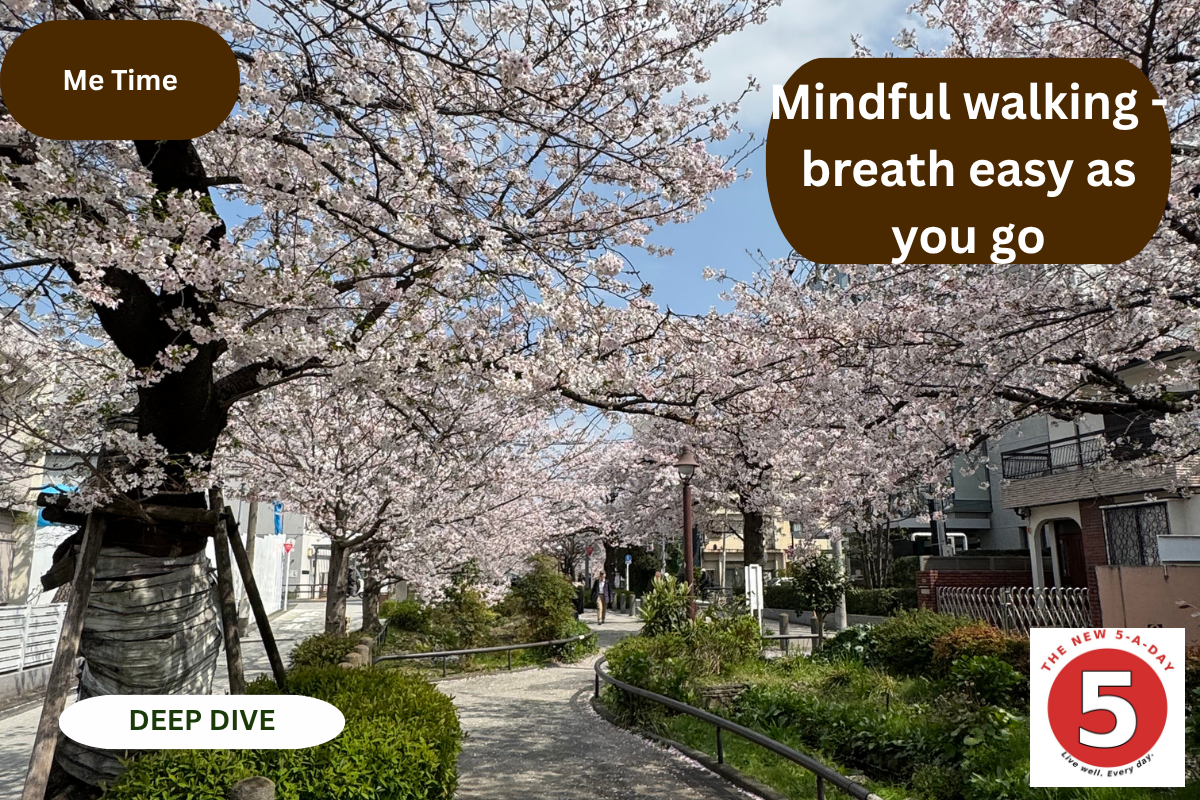
The science of stress reduction, mood, attention, cardiovascular health, and the neuroscience of present-moment awareness
Key takeaways Across multiple systematic reviews and randomised controlled trials, mindful walking is consistently associated with small to moderate reductions in anxiety and perceived stress, and improvements in mood and state mindfulness. The neurological mechanisms are well-characterised: deliberate attentional focus during walking modulates activity in the prefrontal cortex and reduces amygdala reactivity, supporting a genuine physiological shift toward relaxation. Some evidence supports modest improvements in cardiovascular markers — including blood pressure in clinical samples — and cognitive function in older adults, but these findings come from smaller, methodologically limited studies and should not be overstated. Evidence for sleep and general-population blood pressure benefits, while biologically plausible, is not yet firmly established for mindful walking specifically. The practice is safe, low-impact, and well-suited to adults across the fitness and age spectrum, including sedentary and clinically vulnerable groups. No specialist equipment, location, or experience is required.
Companion to: Me-Time Open Post 4-4 — Mindful walking: be present with yourself and the world around you. This Deep Dive examines the evidence base in greater technical depth. Readers seeking the accessible introduction should begin with the Open Post.
The Open Post frames mindful walking as a simple, accessible practice with real but modest benefits for stress, mood, and mental recovery. This Deep Dive examines the research behind those claims in greater depth: the neurological and physiological mechanisms, the study designs and effect sizes, the cardiometabolic and cognitive evidence, and the limits of what the current literature can confidently support.
How researchers study mindful walking and health
The evidence base for mindful walking draws on several methodological traditions, each with distinct strengths and limitations. Understanding them is important for calibrating confidence in the conclusions.
Randomised controlled trials (RCTs) assign participants to mindful walking or control conditions — typically conventional walking, seated rest, or no intervention — and measure outcomes at defined points. These are the strongest design for establishing causation. In the mindful walking literature, RCTs have examined outcomes including anxiety scores, mood ratings, physiological arousal measures (heart rate, blood pressure), and markers of state mindfulness — the degree to which someone is currently experiencing present-moment awareness without judgement.
Systematic reviews and meta-analyses pool data from multiple studies to generate more precise effect size estimates and assess the consistency of findings across populations and settings. Several systematic reviews now exist specifically examining meditative or mindful walking, providing a reasonable degree of confidence in the core psychological findings, though the evidence base remains smaller and more heterogeneous than that for conventional exercise or broader mindfulness meditation.
A key methodological challenge in this area is active control design: it is difficult to construct a convincing placebo for a mindful walking intervention. Most control conditions involve conventional walking without attentional instruction, which itself may have beneficial effects, potentially underestimating the additional benefit of the mindful component. This matters when interpreting effect sizes: the benefit of mindful walking over doing nothing may be larger than what trial comparisons suggest.
Important caveat on heterogeneity: studies in this area vary considerably in the type and duration of mindful walking protocol used, the population studied (healthy adults, older adults, clinical populations), the outcome measures employed, and the presence or absence of prior mindfulness training in participants. This limits the degree to which findings can be directly compared, and cautions against assuming that effects seen in one population will transfer uniformly to another.
The neuroscience of mindful walking: what happens in the brain
Mindful walking combines two independently well-studied phenomena — rhythmic aerobic movement and deliberate attentional focus — and the neuroscience suggests these interact in ways that are meaningfully different from either alone.
Prefrontal regulation and amygdala reactivity
Mindfulness practice in general — including walking-based practice — has been associated with increased activation of the prefrontal cortex (PFC) and reduced reactivity of the amygdala, the brain region most closely associated with threat detection and the initiation of the stress response. The PFC-amygdala relationship is well-characterised: stronger top-down prefrontal regulation of amygdala activity is associated with better emotional regulation, lower trait anxiety, and more flexible responses to stressors.
KEY RESEARCH
Sumantry, D., & Stewart, K. (2021). Meditation, Mindfulness, and Attention: a Meta-analysis. Mindfulness, 12, 1332–1349. https://doi.org/10.1007/s12671-021-01593-w
This meta-analysis of mindfulness meditation and attention found small but reliable improvements in sustained attention and executive control — cognitive functions associated with prefrontal activity. While not specific to walking, the attentional training component of mindful walking engages the same prefrontal circuits, providing mechanistic plausibility for cognitive benefits observed in walking-specific studies.
The default mode network and rumination
The default mode network (DMN) is a set of brain regions that become active during mind-wandering, self-referential thought, and mental time travel — the neural substrate of what is colloquially described as overthinking or rumination. Rumination — repetitive, passive focus on distress — is a well-established risk factor for anxiety and depression. Mindfulness practice has been shown to reduce DMN activity and the tendency toward rumination, substituting present-moment awareness for self-referential looping.
The relevance for mindful walking is direct: the instruction to attend to sensory experience — breath, footfall, surroundings — actively occupies attentional resources that would otherwise default to DMN-mediated thought. This is not merely a pleasant distraction; it represents a trained shift in the baseline allocation of attentional resources that, with practice, may become more automatic.
Psychological effects: stress, anxiety, and mood
The most consistently supported benefits of mindful walking are psychological: reductions in perceived stress and anxiety, improvements in mood and positive affect, and increases in state mindfulness — the momentary experience of present-moment awareness.
KEY RESEARCH
Davis, D., Carrier, B., Cruz, K., Barrios, B., Landers, M., & Navalta, J. (2022). A Systematic Review of the Effects of Meditative and Mindful Walking on Mental and Cardiovascular Health. International Journal of Exercise Science. https://doi.org/10.70252/ltna9604
This systematic review — the most comprehensive on the topic — examined 14 studies and found that 13 reported significant improvements in at least one mental or cardiovascular outcome following meditative or mindful walking, including reductions in anxiety, stress, and depression, and improvements in positive affect and state mindfulness. The breadth of positive findings across different study designs, populations, and outcome measures strengthens confidence in the core psychological claim, even accounting for methodological variability and moderate risk of bias in individual studies.
KEY RESEARCH
Burdick, A., & Camhi, S. (2024). The Effects of a Guided Mindful Walk on Mental Health in University Students. International Journal of Exercise Science, 17, 590–601. https://doi.org/10.70252/xxrm5481
This RCT found significant improvements in anxiety, stress, and state mindfulness following a single 20-minute guided mindful walk in university students, compared with a control condition. The finding that meaningful psychological benefits can occur after a single session is clinically and practically important: it supports the Open Post’s claim that even brief, one-off practice produces noticeable effects, and suggests that regular practice would accumulate benefit over time.
KEY RESEARCH
Bigliassi, M., Galano, B., Lima-Silva, A., & Bertuzzi, R. (2020). Effects of mindfulness on psychological and psychophysiological responses during self-paced walking. Psychophysiology, e13529. https://doi.org/10.1111/psyp.13529
This study examined both psychological and physiological responses during self-paced mindful walking and found reductions in perceived effort and negative affect alongside improvements in attentional focus. The psychophysiological dimension — the interaction between subjective experience and measurable physiological change — adds mechanistic depth to the self-report evidence.
The upward spiral: mindfulness and mood reinforcing each other
KEY RESEARCH
Gotink, R., Hermans, K., Geschwind, N., De Nooij, R., De Groot, W., & Speckens, A. (2016). Mindfulness and mood stimulate each other in an upward spiral: a mindful walking intervention using experience sampling. Mindfulness, 7, 1114–1122. https://doi.org/10.1007/s12671-016-0550-8
This study used experience sampling methodology — repeated real-time measurements across multiple days — and found that in participants with prior mindfulness experience, mindful walking in nature generated a reciprocal relationship between momentary mindfulness and positive affect: increases in one predicted increases in the other across time. This ‘upward spiral’ dynamic suggests that regular practice may compound its own benefits — not just producing isolated mood improvements, but gradually shifting the baseline emotional tone across the day.
Cardiovascular and cardiometabolic effects
A more cautious evidence base exists for the cardiovascular effects of mindful walking. The findings are genuinely encouraging, but the limitations of the research are important to understand before making strong claims.
KEY RESEARCH
Montalva-Valenzuela, F., Guzmán-Muñoz, E., Ferrari, G., Adsuar, J., Ruiz, N., & Castillo-Paredes, A. (2025). Effects of Buddhist Walking Meditation, Walking Meditation or Mindful Walking on the Health of Adults and Older Adults: A Systematic Review. Psychiatry International. https://doi.org/10.3390/psychiatryint6040122
This 2025 systematic review examined the effects of various forms of mindful and meditative walking on health outcomes in adults and older adults. It found improvements in blood pressure, functional walking capacity, and some cardiometabolic markers in specific clinical groups — particularly those with diabetes, COPD, and hypertension. Importantly, these benefits sometimes exceeded those seen with conventional walking programmes matched for duration and intensity, suggesting that the mindful component adds value beyond the exercise itself.
KEY RESEARCH
Tanaka, H., & Suksom, D. (2024). Impact of Religion-Based Mindful Walking Meditation on Cardiometabolic and Mental Health. Exercise and Sport Sciences Reviews, 52, 126–131. https://doi.org/10.1249/jes.0000000000000341
This review of Buddhist walking meditation programmes found meaningful improvements in cardiometabolic markers — including blood pressure, blood glucose, and body composition — and in mental health outcomes. In some comparisons, mindful walking produced larger cardiometabolic improvements than conventional walking programmes of equivalent duration. The proposed mechanism is that mindfulness enhances parasympathetic tone during exercise, supporting cardiovascular recovery and reducing the sympathetically-mediated components of vascular resistance.
An important caution on blood pressure claims
KEY RESEARCH
Blodgett, J., Ahmadi, M., Atkin, A., Pulsford, R., Rangul, V., Chastin, S., Chan, H., et al. (2024). Device-Measured 24-Hour Movement Behaviors and Blood Pressure: A 6-Part Compositional Individual Participant Data Analysis in the ProPASS Consortium. Circulation, 151, 159–170. https://doi.org/10.1161/circulationaha.124.069820
This large accelerometer-based study of free-living behaviour found that walking per se had minimal independent impact on blood pressure in the general population, while more vigorous exercise-like activity and less sitting time mattered considerably more. This finding cautions against strong claims that gentle walking — mindful or otherwise — substantially regulates blood pressure on its own in healthy adults without cardiovascular risk factors. The cardiovascular benefits seen in clinical trials of mindful walking are most credible in populations with established risk, and should not be generalised indiscriminately to the general adult population.
The appropriate summary: cardiovascular benefits from mindful walking are real and promising, particularly in clinical populations. For healthy adults, the psychological benefits are more firmly established; cardiovascular improvement is a plausible secondary gain rather than a primary mechanism.
Cognitive effects: attention, processing speed, and executive function
A smaller but growing body of evidence addresses the cognitive effects of mindful walking, with the most robust findings coming from older adult populations where cognitive change is most measurable over practical timeframes.
KEY RESEARCH
Yang, C., Hakun, J., Roque, N., Sliwinski, M., & Conroy, D. (2021). Mindful walking and cognition in older adults: A proof of concept study using in-lab and ambulatory cognitive measures. Preventive Medicine Reports, 23. https://doi.org/10.1016/j.pmedr.2021.101490
This proof-of-concept study found that a month-long supervised slow mindful walking programme in older adults produced improvements in processing speed and executive function with moderate to large effect sizes — larger than those typically seen in conventional walking programmes of similar duration. The ambulatory cognitive testing methodology — assessing cognition in everyday contexts rather than only in laboratory conditions — strengthens the ecological validity of the findings. These are preliminary results from a single small study and should be treated as hypothesis-generating rather than definitive, but the direction and magnitude of effect are notable.
The proposed mechanism involves both the attentional training component of mindfulness (repeatedly redirecting attention develops executive control circuits) and the aerobic component of walking (which increases cerebral blood flow and supports neuroplasticity). The combination may be synergistic: mindful walking trains attentional networks while simultaneously providing the vascular and neurochemical benefits of aerobic exercise.
For younger, cognitively healthy adults, the cognitive evidence is more limited. The general mindfulness meditation literature supports small improvements in sustained attention and working memory, and these mechanisms are plausibly engaged by mindful walking, but direct evidence in non-elderly populations remains early-stage.
Nature settings and the environmental dimension
KEY RESEARCH
Simpattanawong, D., Li, Q., & McEwan, K. (2024). A controlled trial comparing the impact of guided forest bathing or a mindful urban walk on heart rate, blood pressure, and mood in young Thai adults. People and Nature. https://doi.org/10.1002/pan3.10744
This controlled trial compared guided forest bathing — a form of mindful immersion in natural woodland — with a mindful urban walk, measuring heart rate, blood pressure, and mood outcomes. Both conditions produced beneficial effects; mood improvements were somewhat larger in the forest setting, while cardiovascular effects were comparable. The finding supports a nuanced conclusion: natural environments appear to add value to mindful walking, likely through the additional stress-reducing properties of natural sensory stimuli (what is sometimes termed the ‘restorative’ quality of nature), but urban mindful walking is not ineffective.
The restorative environment literature — which predates the mindful walking evidence base — has established that exposure to natural settings reduces physiological arousal, lowers cortisol, and improves attentional fatigue, via a combination of reduced cognitive demand (nature does not require the directed attention that urban environments do) and direct sensory engagement. Mindful walking in nature may therefore combine three beneficial elements simultaneously: aerobic movement, present-moment attentional practice, and restorative environmental exposure.
The practical implication for the general reader is that green spaces, parks, canal paths, and quiet streets with trees are worth seeking out when possible — but that urban routes should not be dismissed. The mindful attention itself is the active ingredient; the setting modulates the effect rather than determining it.
What the evidence does not clearly support
Honesty about the limits of the evidence is, in the spirit of our community, as important as presenting what is well-supported. Several claims associated with mindful walking require careful qualification.
Sleep. Direct evidence for mindful walking improving sleep quality is limited. The broader mindfulness meditation literature — primarily non-walking practices — shows benefits for heart rate variability and some sleep parameters, and it is plausible that regular mindful walking could support better sleep through reductions in pre-sleep anxiety and improved parasympathetic tone. However, these are inferences from adjacent literatures rather than demonstrated effects of mindful walking specifically. The Open Post does not make strong claims about sleep; that caution reflects the evidence.
General-population blood pressure regulation. As noted above, the ProPASS Consortium data suggest that gentle walking does not substantially move blood pressure in healthy adults without cardiovascular risk. The positive blood pressure findings from mindful walking trials are predominantly from clinical samples with pre-existing hypertension or metabolic disease, where baseline blood pressure is elevated and the treatment effect has more room to operate. Presenting these findings as applicable to the general healthy population would be an overreach.
Digestion. Walking in general supports gastrointestinal motility and may reduce post-meal blood glucose excursions. These are walking benefits rather than mindful walking benefits specifically — no robust evidence compares mindful and conventional walking on digestive outcomes. The Open Post avoids this claim for this reason.
Healthier decision-making and long-term cognitive transformation. While preliminary evidence supports acute attention improvements and some longer-term cognitive benefits in older adults, causal claims about mindful walking producing better decision-making, preventing cognitive decline, or producing substantial cognitive change in younger healthy adults are not supported by the current evidence.
What the evidence is clear about
It is worth stating explicitly what the evidence does clearly and consistently support, to avoid the impression that the caveats above undermine the core case.
Meaningful, reliable reductions in perceived stress and anxiety — including after a single session — are among the most consistently replicated findings in this literature. Multiple study designs, populations, and measurement approaches converge on this conclusion. The effect sizes are small to moderate rather than large, but they are real and they are meaningful: for a practice that costs nothing and can be embedded in existing daily routines, a reliable reduction in anxiety is a substantial return.
Improvements in mood and positive affect are similarly well-supported. The upward spiral dynamic documented by Gotink et al. suggests that these improvements may compound over time with regular practice, gradually raising the baseline emotional register rather than merely producing isolated better days.
State mindfulness — the momentary quality of present-moment awareness — increases reliably with practice. This is both an outcome in itself and a mechanism: higher state mindfulness is associated with reduced rumination, better emotional regulation, and more flexible responses to stressors.
Safety and accessibility. Systematic reviews consistently conclude that mindful and Buddhist-style walking is safe and low-impact across adult populations, including sedentary, older, and clinically vulnerable individuals. This is an important practical finding: it is one of the few evidence-based wellbeing practices with essentially no contraindications for the general adult population.
Bringing it back to The New 5-a-Day
Me-Time is Pillar Four of The New 5-a-Day — and the evidence for mindful walking sits comfortably within what this pillar is designed to support: low-effort, evidence-grounded practices that create genuine moments of psychological recovery in a demanding day.
The research portrait of mindful walking is not one of dramatic transformation but of reliable, cumulative, accessible benefit. Its most evidenced effects — on perceived stress and anxiety, mood, and state mindfulness — are meaningful and consistent. The evidence that these benefits can emerge after a single brief session makes it unusual among wellbeing interventions: most require sustained engagement before any return is felt. The finding that benefits compound over time — through the upward spiral of mindfulness and positive affect — suggests that regular practice builds something real, even if individual sessions feel modest.
The honest qualification is that this is a younger and smaller evidence base than exists for conventional aerobic exercise or established mindfulness-based clinical programmes. The claims that can be made confidently are narrower than enthusiasts sometimes suggest. But within those narrower claims — less anxiety, better mood, a genuine shift in the quality of attention — the evidence is solid. And for something that requires nothing more than a pair of shoes and ten minutes, solid is more than enough.
A note on medical advice: This Deep Dive is intended for readers who want to engage with the evidence in more depth. It does not replace professional medical or psychological advice. If you are managing anxiety, depression, cardiovascular disease, or other health conditions, please speak to your GP or a qualified health professional.
Want to read further? Full citations for all research referenced in this post are available in the accompanying Reference List.
