No cushions, no chanting, no emptying your mind — just a simple, ordinary practice that almost anyone can start today.
Quick summary: Meditation has a reputation for being complicated, a little mystical, and reserved for people with unusual reserves of patience. In reality, it is simply the practice of paying attention on purpose — usually to your breath — and gently bringing your attention back each time it wanders off. Research across many studies links regular meditation with lower stress, less anxiety, steadier mood, and better sleep. The effects tend to be modest rather than dramatic, and they build with practice. You do not need special clothes, a silent house, or a clear mind. A few minutes most days is a perfectly good place to start. This post is about what meditation actually is, the myths that put people off, and how to fit a simple practice into a busy life.
Say the word “meditation” and a particular picture tends to appear. Someone sitting cross-legged on a mountaintop, eyes closed, perfectly serene. Incense. Total silence. A mind as still as a pond. And, for most of us, a quiet thought follows close behind: that is not me.
It is an understandable reaction, and it rests almost entirely on a misunderstanding. Meditation is not a talent, a belief system, or a state of blissful calm you have to achieve. You sit, you notice what is happening right now, and when your mind drifts off you bring it back. That is the whole technique. Everything else is detail.
This is Post Six in Me-Time — Pillar Four of The New 5-a-Day. Earlier posts looked at mindful walking and time in nature. This one goes to the source: a few minutes spent sitting quietly with yourself, and why that small act can make the rest of the day feel calmer.
What meditation actually is
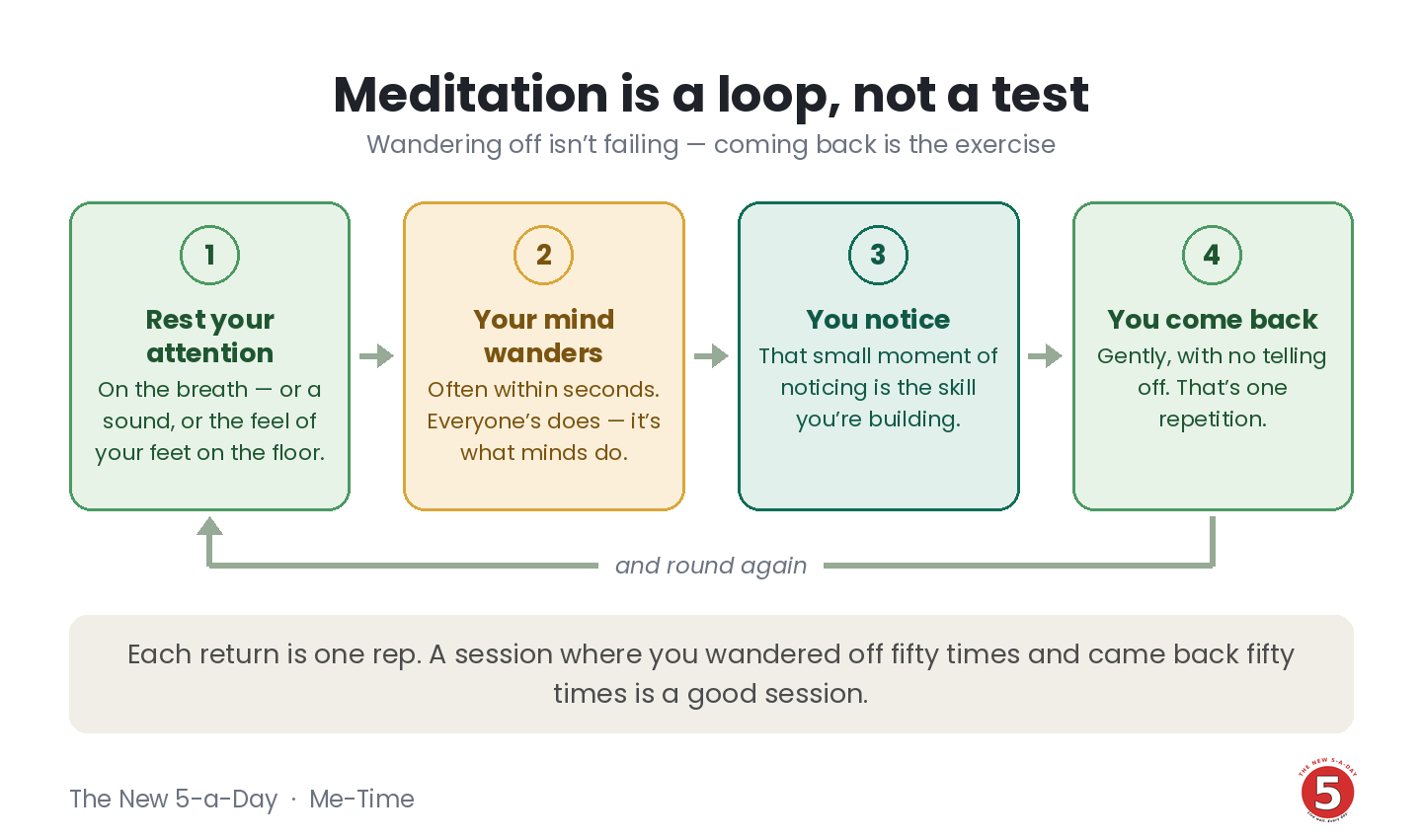
At its simplest, meditation is paying attention on purpose. You choose something to focus on — most often the feeling of your breath, though it could be a word you repeat, the sensations in your body, the sounds around you, or a recorded voice guiding you. You rest your attention there. Your mind wanders. You notice. You come back.
That last part is the important one. Beginners often assume the mind wandering and coming back is a sign of failure. It is actually the exercise itself — like one rep at the gym. A session in which your mind wandered off fifty times and came back fifty times is a good session.
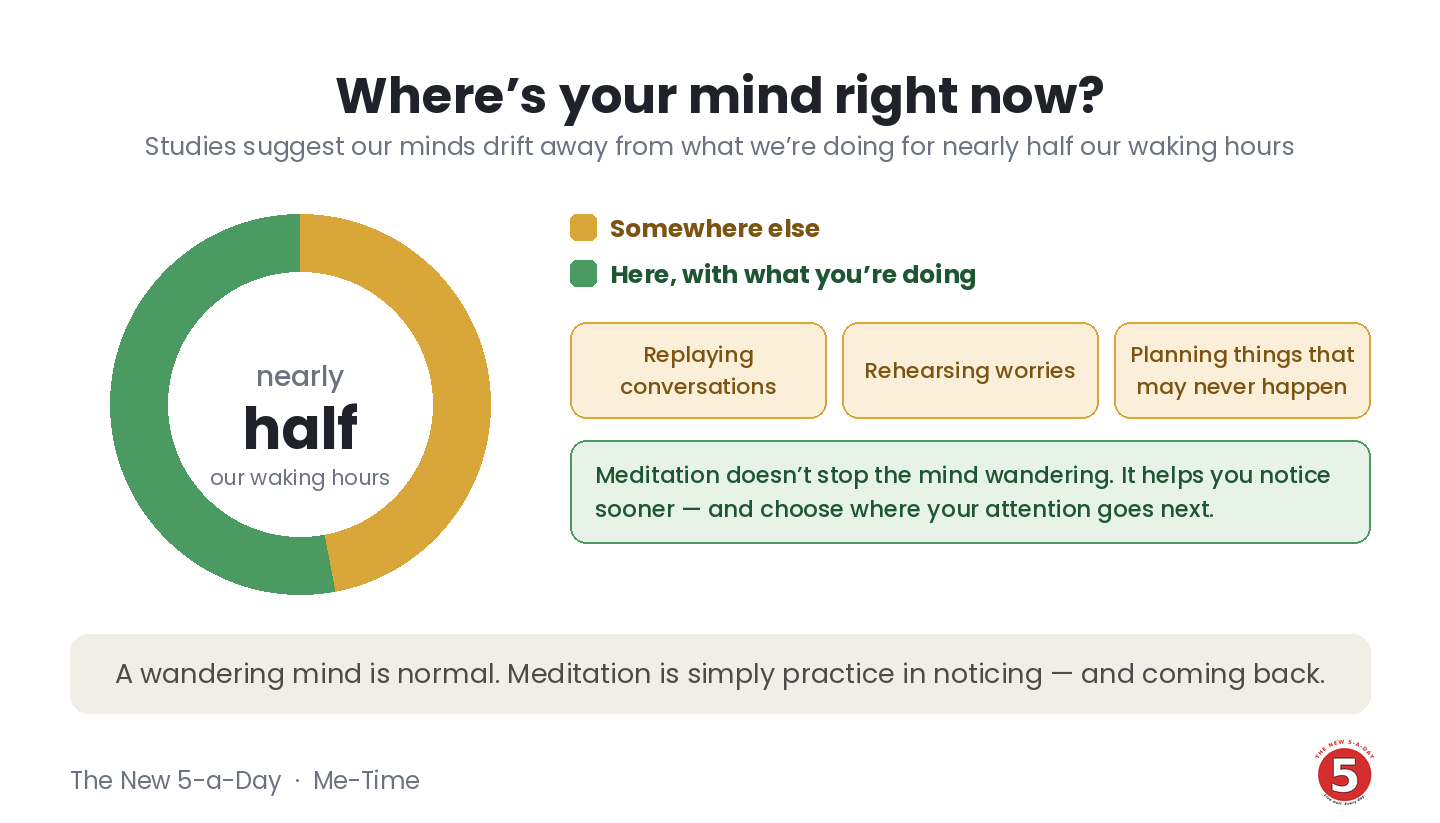
There is a reason this skill is worth building. Studies that track people through their ordinary days suggest our minds spend nearly half our waking hours somewhere other than what we are actually doing — replaying conversations, rehearsing worries, planning things that may never happen. People also tend to report feeling less happy when their mind is wandering than when it is settled on the present. Meditation does not stop the mind from wandering. It makes you a little quicker to notice when it has, and a little better at choosing where to put your attention next.
There is also no single correct way to do it. Breath-focused mindfulness is the best-known style, but there are many others: guided meditations, body scans, repeating a calming word or phrase, loving-kindness practice (quietly wishing yourself and others well), prayer-based meditation, and moving practices such as mindful walking. Benefits have been seen across many different styles. The best one is simply the one you are likely to do again tomorrow.
The myths that put people off
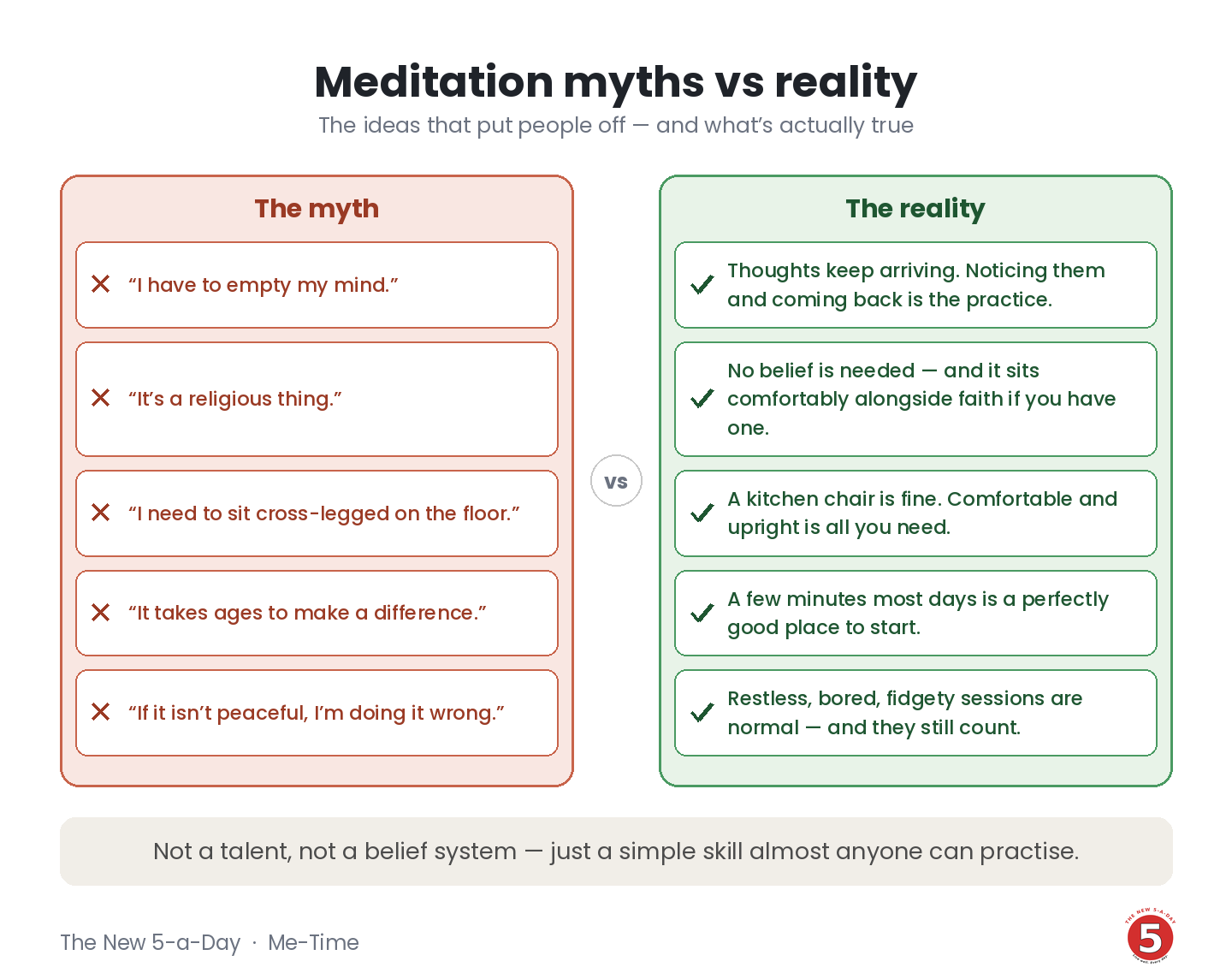
• “I have to empty my mind.” You do not, and you could not if you tried. Thoughts will keep arriving. The practice is noticing them and returning to your focus, not making them stop.
• “It’s a religious thing.” Meditation has roots in ancient contemplative traditions and sits comfortably alongside faith if you have one. But no belief is required.
• “I need to sit cross-legged on the floor.” A kitchen chair is fine. Comfortable and upright is all you need.
• “It takes ages to make a difference.” Research has looked at sessions as short as a few minutes, and even brief daily practice over a week or two has been linked with improvements in wellbeing. In the early weeks, longer sessions do not seem to offer a clear advantage over shorter ones.
• “If it doesn’t feel peaceful, I’m doing it wrong.” Some sessions will feel calm; others restless, boring or faintly ridiculous. All normal. Doubting whether you are “doing it right” is one of the most common experiences new meditators report.
What it can do for you
Meditation is one of the most widely studied wellbeing practices there is, and the overall picture is encouraging. Across many studies in workplaces, universities and the general population, regular practice is consistently linked with reductions in stress, anxiety and low mood, and with a greater sense of wellbeing.
Sleep is another area where the evidence looks promising, particularly for older adults who struggle to sleep well. Many people also find meditation gives them a little more space between something happening and how they react to it. Worries loop less tightly. Irritation passes more quickly.
It is worth being honest about the size of these effects. On average they are small to moderate — real and worthwhile, but not life-transforming overnight. Meditation is not a cure for anything. The larger and more lasting changes tend to come to people who keep practising over weeks and months, and the research suggests that regularity matters more than the length of each session. That is good news for anyone with a busy life.
Your first five minutes
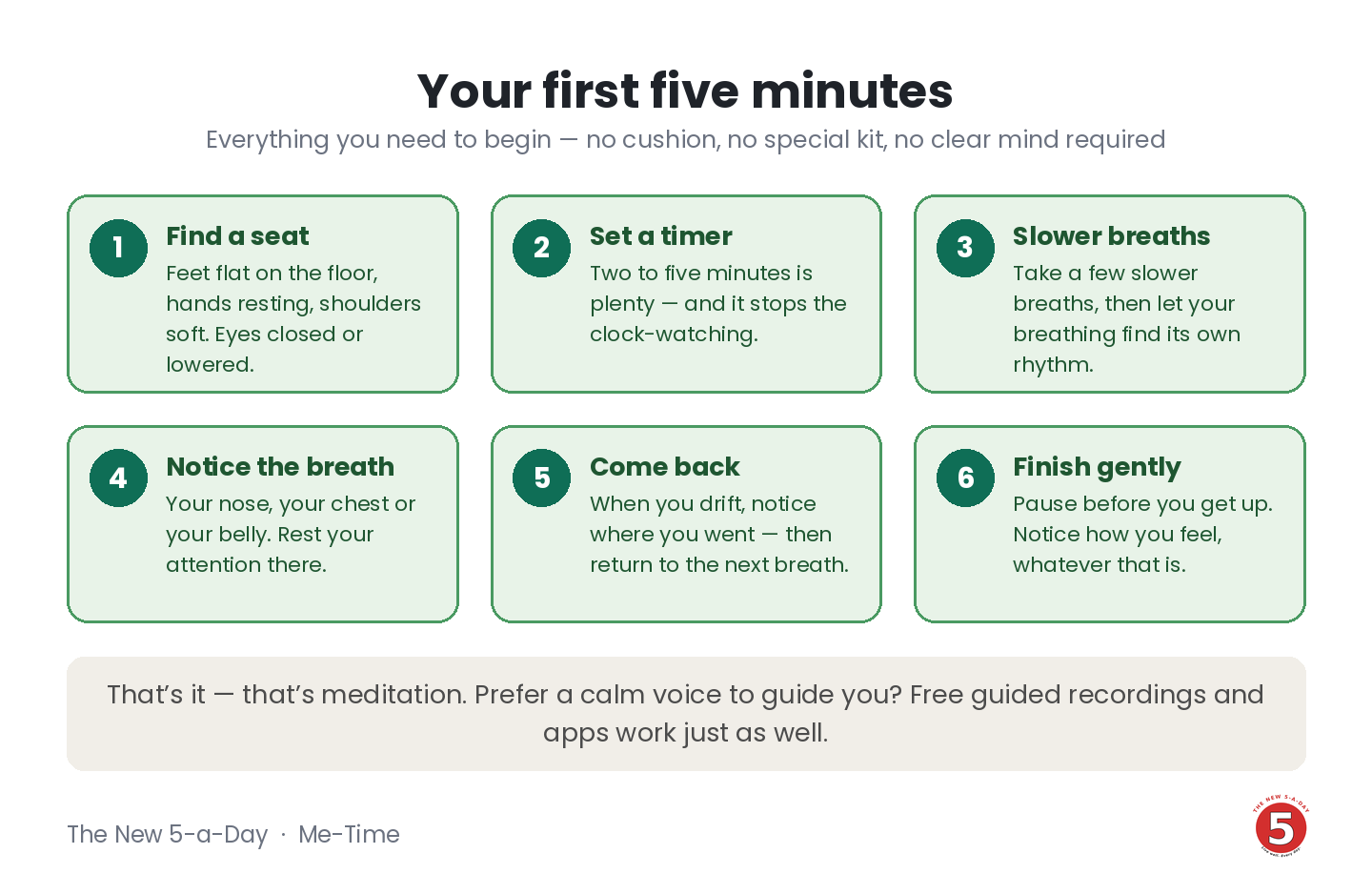
1. Find a seat. Feet flat on the floor, hands in your lap, shoulders soft. Close your eyes or lower your gaze.
2. Set a timer. Two to five minutes is plenty. A timer means you can stop checking the clock.
3. Take a few slower breaths. Then let your breathing settle back into its own natural rhythm. There is no need to control it.
4. Notice where you feel the breath. The tip of your nose, your chest, or your belly. Rest your attention there. Counting breaths from one to ten, then starting again, can help.
5. When your mind wanders, come back. It will, often within seconds. Notice where you went — “planning”, “worrying” — and return to the breath. No telling off required.
6. Finish gently. When the timer sounds, take a moment before you get up. Notice how you feel, without needing it to be anything in particular.
That is it. If silence feels awkward, plenty of free guided recordings and apps will talk you through each step.
Building it into a busy day
The hardest part of meditation is not doing it. It is remembering to do it, day after day, in a life that is already full. A few approaches make that much easier.
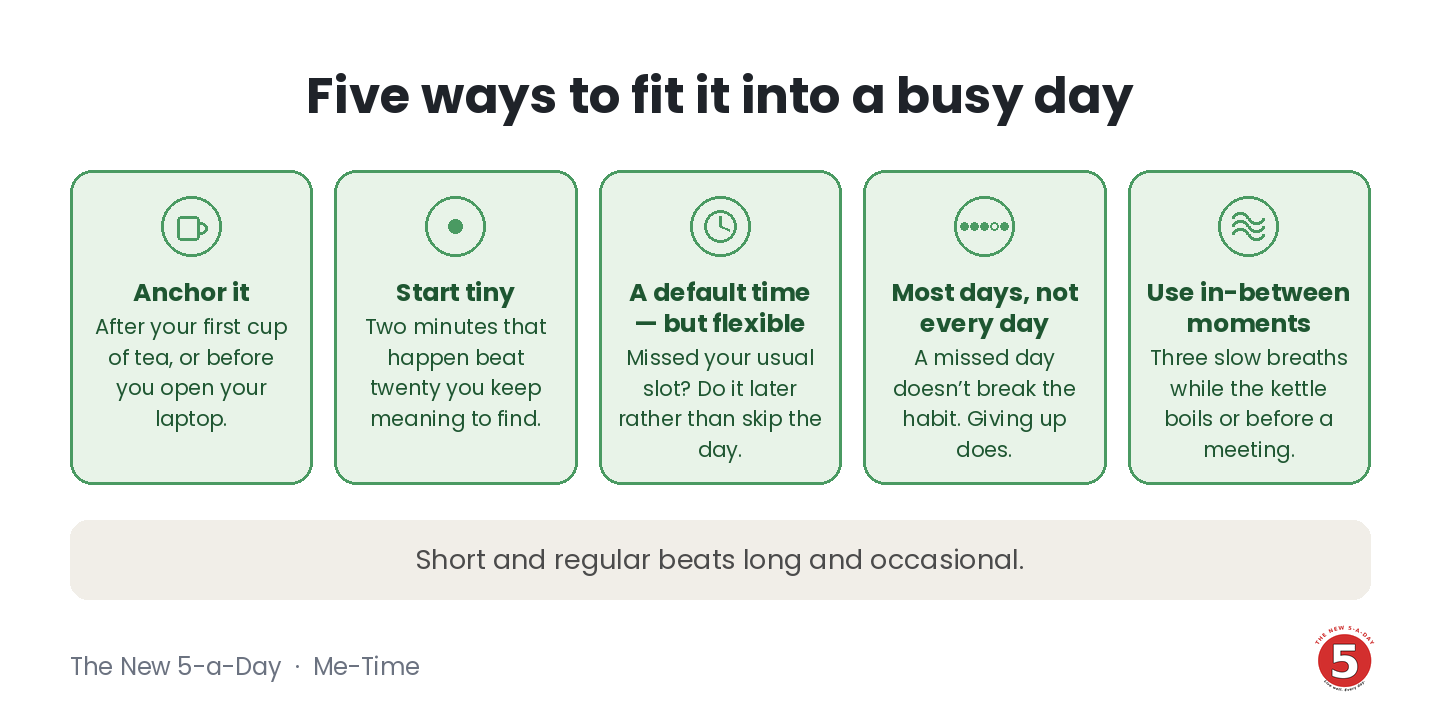
• Attach it to something you already do. After your first cup of tea, after brushing your teeth, or before you open your laptop. Linking a new habit to an existing one is one of the most reliable ways to make it stick.
• Start smaller than you think you need to. Two minutes a day that actually happen are worth far more than twenty minutes you keep meaning to find. Add a minute when it starts to feel easier.
• Have a default time, but stay flexible. A regular slot — mornings work well for many people — makes the habit easier to keep. But if you miss it, do it later rather than writing the day off. People who are flexible about exactly when they practise often find it easier to keep going over the long run.
• Aim for most days, not every day. Missing a day does not break the habit. Missing a day and deciding you have “failed” is what breaks it.
• Use the in-between moments. Three slow, attentive breaths while the kettle boils, at a red traffic light, or before a difficult meeting is a mini-meditation. On the busiest days, it keeps the thread alive.
• If sitting still is a struggle, move. A mindful walk is meditation too.
A note of realism
For most people, meditation is a safe and helpful habit. But it is not right for everyone. A minority of people find that it stirs up uncomfortable feelings — anxiety, difficult memories, or a sense of unease — particularly if they have experienced trauma or have a history of significant mental health difficulties. If that happens, there is no need to push through. Open your eyes, shorten the session, switch to a guided practice or a mindful walk, or simply stop.
Meditation can sit happily alongside professional support, but it is not a replacement for it. If you are struggling with your mental health, please talk to your GP.
Bringing it back to The New 5-a-Day
Me-Time is Pillar Four of The New 5-a-Day, and meditation may be its purest form: a few minutes that ask nothing of you except to be present. No equipment. No cost. No special skill. No need to be calm before you start — calm is something the practice gradually helps you find, not a ticket you need to get in.
Its value is not that it is impressive. It is that it is small enough to fit into almost any day — and small, repeated moments of attention add up.
So sit down. Breathe. Notice when your mind wanders. Come back. Do it again tomorrow.
That is meditation. You already know how.
A note on medical advice: The content in this post is intended to inform and inspire, not to replace professional medical guidance. If you have experienced trauma, or have concerns about anxiety, depression or other mental health difficulties, please speak to your GP or another qualified health professional before starting a meditation practice.
Want to explore further? This post is the accessible introduction. A detailed evidence-based Deep Dive, a full Reference List, and a podcast episode are all available on this site.
