Attention and the wandering mind, effects on stress and mood, how much practice is enough, how habits form, and the evidence on adverse effects
Key takeaways: Meditation is the deliberate training of attention, most often by resting it on the breath and bringing it back when the mind wanders. It is one of the most widely studied wellbeing practices. Systematic reviews and meta-analyses consistently find small-to-moderate improvements in anxiety, depression, psychological distress and wellbeing across non-clinical, workplace and online populations, and these benefits appear across several styles of practice. Brief practice is a valid starting point: interventions as short as five minutes have been linked with at least one positive health-related outcome, and in a two-week trial ten-minute daily sessions performed as well as thirty-minute sessions. Larger and more durable changes tend to come with sustained, regular practice, and consistency appears to matter more than session length. The proposed mechanisms include less mind-wandering and changes in activity in the brain’s default mode network, though much of this evidence is correlational. A minority of practitioners report unpleasant or distressing experiences, particularly people with a history of trauma or significant mental health difficulties. Meditation complements professional care; it does not replace it.
Companion to: Me-Time Open Post 4-6 — Meditation without the mystery: a few quiet minutes, a calmer day. This Deep Dive examines the evidence base in greater technical depth. Readers seeking the accessible introduction should begin with the Open Post.
The Open Post argues that meditation is simpler than its reputation suggests, that its benefits for calm and wellbeing are real but modest, and that a few minutes most days is a reasonable place to begin. This Deep Dive examines the evidence behind those claims: how researchers define and study meditation, the proposed mechanisms, the evidence on mental health and everyday functioning, what is known about dose and habit formation, and the evidence on adverse effects.
1. What meditation is, and how researchers study it
“Meditation” is an umbrella term for practices that train attention and awareness. Researchers commonly distinguish three families. In focused-attention practices, attention is held on a single object, such as the breath or a repeated word. In open-monitoring practices, the meditator observes whatever arises without reacting to it. Constructive or compassion-based practices, such as loving-kindness, deliberately cultivate warmth towards oneself and others. Most contemporary research concerns mindfulness, meaning present-moment, non-judgemental attention, which is often delivered through structured eight-week programmes such as Mindfulness-Based Stress Reduction (MBSR) and Mindfulness-Based Cognitive Therapy (MBCT). Reviews covering mindfulness, mantra, compassion, body-scan and movement-based styles describe broadly similar pathways to better emotional regulation and stress resilience. This supports the Open Post’s position that no single style is uniquely effective.
The evidence comes from randomised controlled trials (RCTs), meta-analyses that pool those trials, large observational datasets from meditation apps, and neuroimaging studies. Each design has limitations. Participants cannot be blinded to whether they are meditating, so expectation effects are hard to exclude. Most outcomes are self-reported. Programmes vary widely in content and length, and attrition is often high. Comparisons with waiting-list controls tend to produce larger effects than comparisons with active alternatives such as exercise or relaxation training. These limitations matter when interpreting the effect sizes reported below.
2. The wandering mind: attention and the default mode network
The core instruction in most meditation is to notice when attention has drifted and to return it. There is good reason to think this is a worthwhile skill to train.
KEY RESEARCH
Killingsworth, M. A., & Gilbert, D. T. (2010). A wandering mind is an unhappy mind. Science, 330(6006), 932. https://doi.org/10.1126/science.1192439
This experience-sampling study used a smartphone app to contact around 2,250 adults at random moments in their daily lives, collecting roughly 250,000 reports. Participants’ minds were wandering from the task in hand in close to half of all samples, and people reported being less happy while their minds were wandering than when they were attending to their current activity. Time-lagged analyses suggested that mind-wandering was more likely to precede unhappiness than to follow it, although the design cannot establish causation conclusively.
Mind-wandering is associated with a set of brain regions known as the default mode network (DMN), which is active during self-referential thought, rumination and “mental time travel” into the past or future.
KEY RESEARCH
Brewer, J. A., Worhunsky, P. D., Gray, J. R., Tang, Y.-Y., Weber, J., & Kober, H. (2011). Meditation experience is associated with differences in default mode network activity and connectivity. Proceedings of the National Academy of Sciences, 108(50), 20254–20259. https://doi.org/10.1073/pnas.1112029108
In this functional MRI study, experienced meditators showed relatively lower activity than meditation-naive controls in the main nodes of the DMN (the medial prefrontal and posterior cingulate cortices) across three different meditation types. They also showed stronger coupling between the posterior cingulate and regions involved in self-monitoring and cognitive control. The design is cross-sectional, so it cannot show that practice caused these differences, but the findings provide a plausible neural account of reduced mind-wandering.
Experimental studies of brief training point in the same direction. Four sessions of mindfulness training improved working memory, executive functioning and visuospatial processing, and reduced fatigue and anxiety, compared with an active control (Zeidan et al., 2010). Fifteen minutes a day for seven days reduced attentional bias towards negative stimuli without worsening mood (Wu et al., 2019). A 2024 systematic review of neurobiological studies describes changes in attention, emotion-regulation and self-referential networks, while noting that the methods vary widely (Calderone et al., 2024). These mechanisms are best understood as proposed rather than established.
3. Stress, anxiety and mood: the outcome evidence
KEY RESEARCH
Goyal, M., Singh, S., Sibinga, E. M. S., Gould, N. F., Rowland-Seymour, A., Sharma, R., Berger, Z., Sleicher, D., Maron, D. D., Shihab, H. M., Ranasinghe, P. D., Linn, S., Saha, S., Bass, E. B., & Haythornthwaite, J. A. (2014). Meditation programs for psychological stress and well-being: A systematic review and meta-analysis. JAMA Internal Medicine, 174(3), 357–368. https://doi.org/10.1001/jamainternmed.2013.13018
This review of 47 trials with 3,515 participants, commissioned by the US Agency for Healthcare Research and Quality, found moderate-strength evidence that mindfulness programmes improve anxiety, depression and pain, with small-to-moderate effect sizes. Evidence for stress and distress was weaker. Meditation programmes were not shown to be better than active treatments such as exercise or other behavioural therapies. The review found insufficient evidence for mantra meditation. A later meta-analysis focused on mantra-based practice did find small-to-moderate reductions in anxiety, depression and stress (Álvarez-Pérez et al., 2022).
KEY RESEARCH
Galante, J., Friedrich, C., Dawson, A. F., Modrego-Alarcón, M., Gebbing, P., Delgado-Suárez, I., Gupta, R., Dean, L., Dalgleish, T., White, I. R., & Jones, P. B. (2021). Mindfulness-based programmes for mental health promotion in adults in nonclinical settings: A systematic review and meta-analysis of randomised controlled trials. PLoS Medicine, 18(1), e1003481. https://doi.org/10.1371/journal.pmed.1003481
This pre-registered review of 136 trials with 11,605 participants is the largest synthesis of mindfulness programmes in community, workplace and university settings. Compared with no intervention, the programmes reduced anxiety, depression and distress and improved wellbeing, with small-to-moderate effects. Against active comparators the advantage was smaller and less consistent. The authors rated the certainty of the evidence as moderate to very low, and the prediction intervals suggest that some settings may see little or no benefit. Their conclusion is that mindfulness helps many people on average but is unlikely to work for everyone.
Meta-analyses of workplace programmes (Bartlett et al., 2019), online programmes (Sommers-Spijkerman et al., 2021) and medical students (Da Silva et al., 2023) report comparable small-to-moderate effects, while effects in children and adolescents tend to be smaller (Dunning et al., 2019). In clinical practice, MBCT has the strongest track record: an individual-participant meta-analysis found it reduced the risk of depressive relapse (Kuyken et al., 2016), and NICE guidance lists group MBCT among the options for adults at higher risk of relapse (NICE, 2022). These structured, therapist-led programmes are distinct from the self-guided everyday practice described in the Open Post.
4. Emotion regulation, sleep and the body
In a randomised trial, the standard eight-week MBSR course improved emotion regulation and reduced worry and rumination (Robins et al., 2012). A 2025 meta-analysis of meditation-based mind–body interventions in older adults with poor sleep found improvements in sleep quality alongside reductions in depression and anxiety (Li et al., 2025). Because that analysis combined seated meditation with tai chi, yoga and qigong, the specific contribution of seated practice cannot be isolated.
Claims about physical health are more tentative. A scientific statement from the American Heart Association concluded that meditation may offer a possible benefit for cardiovascular risk but that the quality and quantity of the data are modest, and that it may be considered an adjunct to, not a replacement for, guideline-based care (Levine et al., 2017). For this reason, the Open Post makes no cardiovascular claims.
5. Dose: how much practice is enough?
KEY RESEARCH
Howarth, A., Smith, J. G., Perkins-Porras, L., & Ussher, M. (2019). Effects of brief mindfulness-based interventions on health-related outcomes: A systematic review. Mindfulness, 10(10), 1957–1968. https://doi.org/10.1007/s12671-019-01163-1
Of 85 randomised trials of brief mindfulness interventions, 79 reported a significant positive effect on at least one health-related outcome, sometimes after a single session and with interventions lasting as little as five minutes. Outcomes varied widely, which limits pooled conclusions, but the review supports brief practice as a legitimate entry point.
KEY RESEARCH
Fincham, G. W., Mavor, K., & Dritschel, B. (2023). Effects of mindfulness meditation duration and type on well-being: An online dose-ranging randomized controlled trial. Mindfulness, 14(5), 1171–1182. https://doi.org/10.1007/s12671-023-02119-2
Participants were randomised to practise for about ten or about thirty minutes a day, using either sitting or movement meditation, for two weeks. Wellbeing and mindfulness rose, and distress fell, in all four conditions, with no significant differences by dose or type. Movement meditation had a higher dropout rate. The sample was small (161 completers) and the follow-up short, but the trial directly supports the Open Post’s advice to start with short sessions.
KEY RESEARCH
Cearns, M., & Clark, S. R. (2023). The effects of dose, practice habits, and objects of focus on digital meditation effectiveness and adherence: Longitudinal study of 280,000 digital meditation sessions across 103 countries. Journal of Medical Internet Research, 25, e43358. https://doi.org/10.2196/43358
In this naturalistic analysis of app users, practising consistently (four to seven days a week) was associated with the largest improvements in mood. Longer sessions were associated with greater benefit from roughly the twentieth session onwards. In other words, session length becomes more relevant as experience grows, while consistency matters from the start. A prospective study of experienced meditators similarly found that more practice was associated with better mental health and wellbeing, with the relationship moderated by lifetime experience and personality (Bowles & Van Dam, 2025). Taken together, short and regular practice is a sound way to begin, and benefits appear to grow as practice accumulates.
6. Building and keeping the habit
Dropout from meditation programmes and apps is common, which makes habit formation a practical question rather than a secondary one.
KEY RESEARCH
Berardi, V., Fowers, R., Rubin, G., & Stecher, C. (2023). Time of day preferences and daily temporal consistency for predicting the sustained use of a commercial meditation app: Longitudinal observational study. Journal of Medical Internet Research, 25, e42482. https://doi.org/10.2196/42482
Using data from 14,879 users and nearly 900,000 sessions, this study tested the common advice to meditate at the same time every day, preferably in the morning. Morning meditators were more likely to keep practising. Strict consistency of timing predicted better short-term engagement but worse long-term use, which suggests that a degree of flexibility helps people persist. The authors also note earlier work linking “anchoring” meditation to existing daily habits with more persistent practice. These findings underpin the Open Post’s advice to have a default slot, attach it to an existing routine, and practise later rather than skip a day.
7. Adverse effects: who should take care
KEY RESEARCH
Goldberg, S. B., Lam, S. U., Britton, W. B., & Davidson, R. J. (2022). Prevalence of meditation-related adverse effects in a population-based sample in the United States. Psychotherapy Research, 32(3), 291–305. https://doi.org/10.1080/10503307.2021.1933646
In this population-based survey of 434 people who meditated, unpleasant meditation-related experiences were common when defined broadly. The most frequent were anxiety, traumatic re-experiencing and emotional sensitivity. A minority reported some functional impairment, and lasting impairment was rare. Childhood adversity was associated with higher risk. Notably, participants who reported adverse effects were as glad to have practised as those who did not.
Systematic reviews report prevalence estimates ranging from roughly 8 to 33 per cent, depending heavily on how adverse effects are defined and measured (Farias et al., 2020; Lambert et al., 2023). Recent reviews recommend informed consent, screening and trauma-sensitive approaches, particularly for people with previous mental health difficulties or intensive retreat experience (Matko & Van Dam, 2025). In practice, this means that shorter sessions, keeping the eyes open, using external anchors such as sounds or the feet, and switching to movement-based practice are reasonable adjustments, and that anyone experiencing persistent distress should stop and seek support.
8. Limitations of the evidence
Several caveats apply across this literature. Blinding is not possible, and expectation effects are likely to inflate self-reported benefits. Publication bias is a recognised concern. Effects shrink when meditation is compared with credible active alternatives. App-based datasets are large but observational and self-selected, so people who benefit are more likely to keep using the app. Neuroimaging findings are mostly cross-sectional, and most research has been conducted in Western, educated and relatively affluent populations. None of this undermines the core conclusion, but it supports describing the benefits as modest and associated with practice rather than guaranteed.
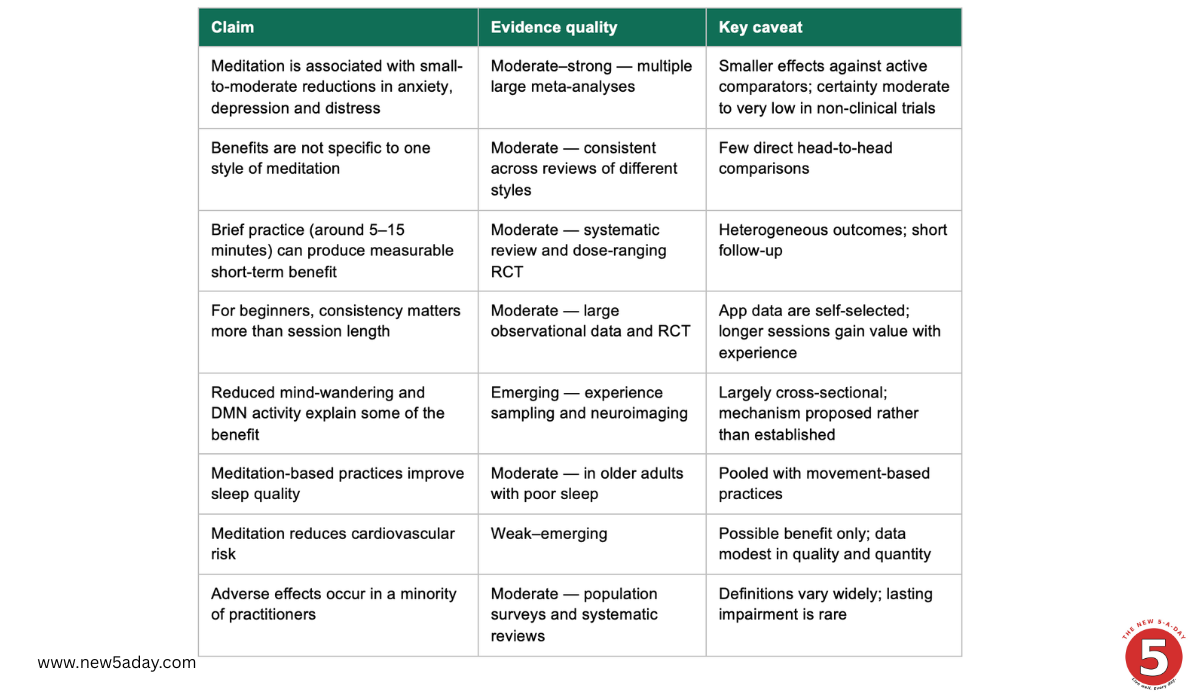
Summary of the evidence
The evidence supports the following conclusions:
Bringing it back to The New 5-a-Day
Me-Time is Pillar Four of The New 5-a-Day. Meditation belongs there because it is the most direct form of the pillar’s aim: a short, deliberate pause in which nothing is asked of you except attention. The evidence does not support grand claims, but it does support a consistent, modest one. Regular practice of almost any style is linked with lower stress, less anxiety and better mood, and those benefits are available to beginners from short sessions.
The practical implications match the Open Post closely. Start with a few minutes. Anchor the practice to an existing routine, ideally a morning one, but stay flexible about timing. Aim for most days rather than perfection. Allow the practice to lengthen naturally as experience grows. Take care, and seek support, if meditation brings up more distress than calm. For a practice that costs nothing and needs no equipment, that is a well-supported and worthwhile return.
A note on medical advice: This Deep Dive is intended for readers who want to engage with the evidence in more depth. It does not replace professional medical or psychological advice. If you have experienced trauma, or are managing anxiety, depression or another mental health condition, please speak to your GP or a qualified health professional before starting a meditation practice.
Want to read further? Full citations for all research referenced in this post are available in the accompanying Reference List.
