Why human connection matters more than we think…
Quick summary
Human connection — with friends, family, colleagues, neighbours, and community — is not a lifestyle bonus. The research is unambiguous: strong social ties reduce the risk of depression, cardiovascular disease, cognitive decline, and early death. Loneliness, by contrast, carries health risks comparable to smoking 15 cigarettes a day. The quality of our relationships is one of the most powerful — and most overlooked — determinants of how well and how long we live.
There is a question buried inside Pillar Five of The New 5-a-Day — a question that sounds almost embarrassingly simple: do you have people?
Not an enormous social circle. Not a packed calendar. Just people who know you, who you can turn to, who you'd notice if they went quiet for a while — and who'd notice the same about you.
The research on what that kind of connection does to the body and mind is, at this point, overwhelming. Social connection is not a soft extra. It is a biological need, shaped by millions of years of evolution, and when it is chronically absent the consequences are measurable, serious, and cumulative.
This is the opening post for Find Your People — and it starts, as all the best health conversations do, with something that seems obvious but turns out to be anything but.
What we mean by human connection
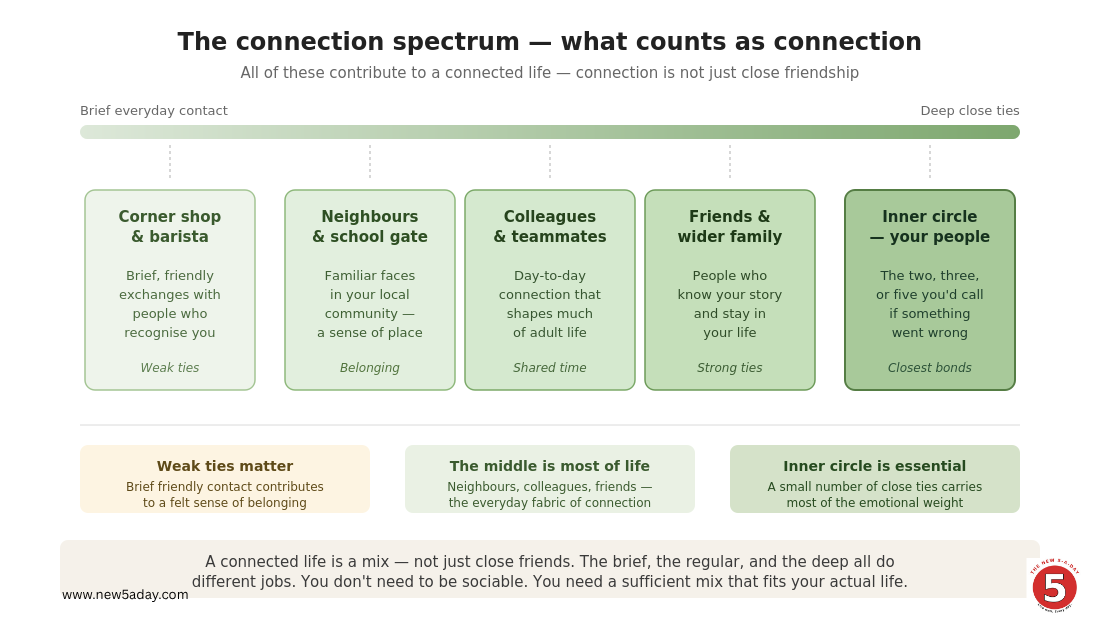
Human connection is not just about having friends. It encompasses the full range of bonds that make us feel we belong: close friendships and family relationships, yes, but also neighbours, colleagues, acquaintances, community groups, faith communities, and even the brief but genuine exchanges that happen at the school gate or the corner shop.
What matters is not the number of people in your life, but the sense that you matter to others — and that others matter to you. That you are seen. That you are not alone in navigating the world.
This distinction between quantity and quality is important, and we will come back to it. For now, the key point is this: connection is not about being extroverted or sociable in the conventional sense. It is about having a sufficient number of meaningful, reciprocal relationships that give life a sense of warmth, purpose, and support.
The case for connection — what the science actually shows
The evidence base for social connection as a health determinant has grown substantially over the past two decades. It is no longer a fringe idea in behavioural science. It is, as one major 2024 review in World Psychiatry describes it, a critical factor for both mental and physical health — one that deserves to sit alongside diet, exercise, and sleep as a core pillar of wellbeing.
Here is what that evidence consistently shows.
Connection protects mental health
People with strong social ties report lower rates of depression and anxiety. Loneliness and social isolation, by contrast, are among the most consistent predictors of poor mental health outcomes — not just as correlates, but as contributing causes. When social support is present, it acts as a buffer: life's difficulties do not disappear, but they become more manageable. The emotional load is shared, and the sense of being understood and valued in itself has measurable protective effects.
Connection affects the body
The physical effects of social connection — and its absence — are not metaphorical. Chronic loneliness keeps the body in a state of low-grade stress. Cortisol levels rise. Inflammation increases. Cardiovascular and immune function are affected. Over time, these effects add up.
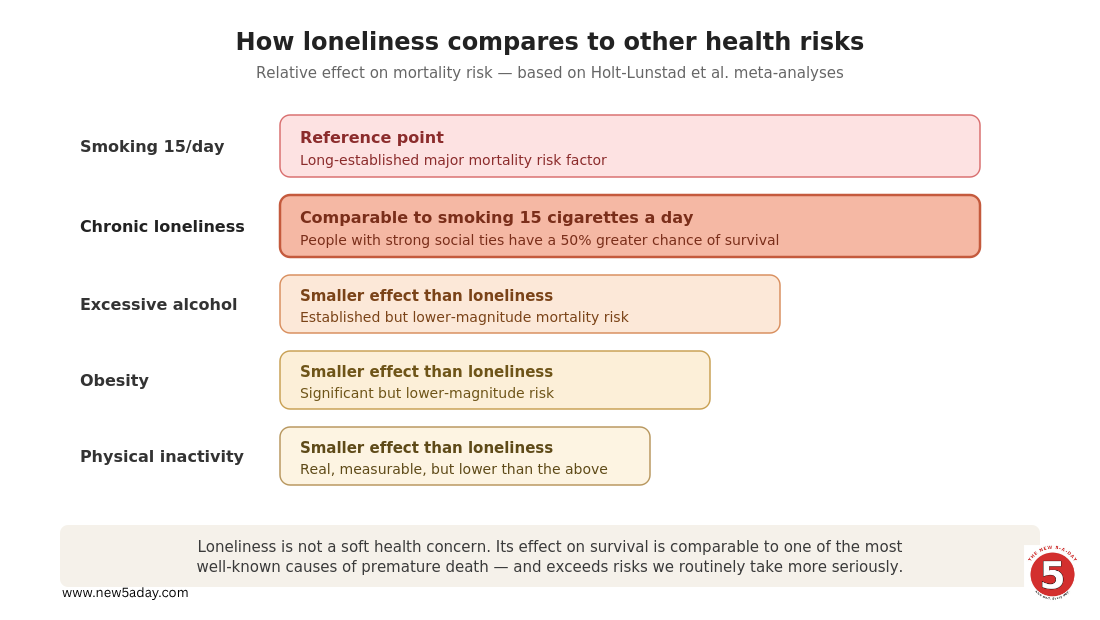
A landmark meta-analysis found that people with stronger social relationships had a 50% greater likelihood of survival over a given period than those with weaker or absent ties. The researchers concluded that the health risk of social isolation is comparable to smoking 15 cigarettes a day — and exceeds that of physical inactivity, obesity, and excessive alcohol use.
The health risk of chronic loneliness is comparable to smoking 15 cigarettes a day — and exceeds the risk of physical inactivity.
Connection shapes how we live
Social relationships also influence health indirectly, by shaping the habits and behaviours that determine long-term health. When the people around us exercise, eat well, sleep enough, and attend to their health, those behaviours become more normal — more achievable — for us too. We are social creatures, and we calibrate our behaviour partly against those closest to us.
Conversely, social isolation tends to be associated with poorer health behaviours: less physical activity, less consistent sleep, worse diet, and less engagement with healthcare. Connection is not just emotionally important — it is practically important, as a context in which healthier choices become easier.
Connection supports the brain
Staying socially engaged appears to keep our brains healthy over time. Conversation, cooperation, and the act of sustaining relationships all require and exercise the brain in ways that matter — listening, interpreting, remembering, responding. Long term studies link stronger social ties with slower cognitive decline and better mental sharpness in later life. For older adults in particular, social engagement is one of the most accessible forms of cognitive maintenance available.
The loneliness problem — and why it matters now
In the UK and across the developed world, loneliness has been described as a public health epidemic. Former Surgeon General of the United States Vivek Murthy dedicated a major advisory to the topic in 2023, describing loneliness and isolation as having reached "epidemic levels" with "devastating health consequences." The UK has had a dedicated Minister for Loneliness since 2018.
These are not overreactions. The data on the prevalence of social isolation — and its concentration in particular groups, including older adults, young people, people with disabilities, and those who have recently moved or experienced significant life transitions — reflects a genuine and growing problem.
The causes are not mysterious: increasing physical mobility, declining participation in community institutions, the restructuring of work and family life, and the rise of digital interaction as a partial substitute for in-person contact have all played a role. Technology connects us in some ways while subtly displacing the deeper forms of connection that health depends on.
Understanding this context matters because it reframes the personal: if you feel less connected than you would like, you are not failing at something others find easy. You are experiencing something that is structurally common, socially reinforced, and genuinely worth taking seriously.
Quality over quantity
Not all relationships are equally beneficial — and this is worth saying plainly. High-conflict, coercive, or consistently draining relationships can create stress rather than relieve it. Research consistently shows that it is the quality of social ties — their warmth, reciprocity, and reliability — that predicts health outcomes, more than the sheer number of connections.
A small number of genuinely supportive relationships can offer more health benefit than a large but superficial social network. And relationships characterised by conflict or strain are associated with worse health outcomes than social isolation in some studies.
This is not a reason to be pessimistic. It is a reason to be intentional. The goal is not to accumulate contacts — it is to cultivate connection. And even modest improvements in the quality and depth of a few key relationships can make a meaningful difference.
Finding your own version of connected
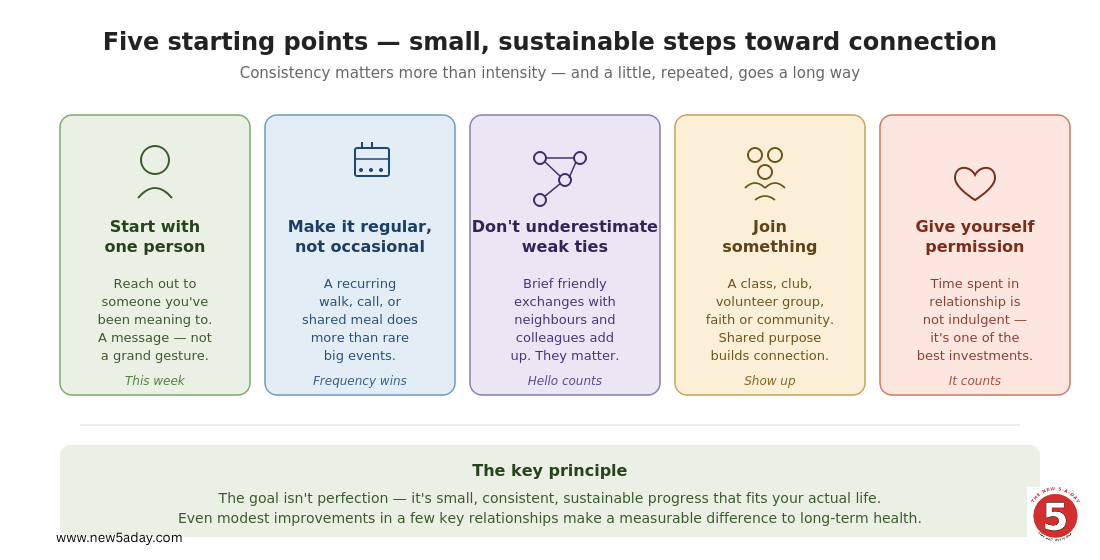
As with every pillar in The New 5-a-Day, the goal here is not perfection — it is sustainable, realistic progress that fits your actual life. Five starting points.
• Start with one person. Think of someone you have been meaning to contact — a friend you have lost touch with, a family member you don't speak to as often as you'd like — and reach out this week. Not a grand gesture. A message.
• Make it regular, not occasional. Connection is built through consistency more than intensity. A recurring walk, phone call, or shared meal once a fortnight does more for a relationship than occasional significant events.
• Don't underestimate weak ties. Regular brief interactions — with a neighbour, a barista, a colleague — contribute to a sense of social presence and belonging even without deep friendship. Weak ties matter.
• Join something. A class, a volunteer group, a community activity, a faith community, a club. Shared purpose is one of the most reliable routes to new connection, especially for adults whose natural social infrastructure has changed.
• Give yourself permission to invest time here. In a culture that prizes productivity, time spent in relationship can feel indulgent. It is not. It is one of the most evidence-backed investments in long-term health and wellbeing you can make.
Connection as a pillar, not an afterthought
Find Your People is Pillar Five of The New 5-a-Day — and it connects to all four of the others. Sleep quality is influenced by social stress and support. Physical activity is more likely when it is shared. Eating well happens more easily in the context of people we care about. Even the quiet of Me-Time is more restorative when it is freely chosen against a backdrop of connection, rather than the default of isolation.
Relationships are not separate from health. They are woven into almost every dimension of it. The science is clearer on this than on almost any other behavioural determinant of health-span — and the good news is that even small, consistent steps in the direction of connection can make a genuine and measurable difference.
You don't need more people. You need enough of the right ones — people you can be honest with, rely on, and show up for. That, it turns out, is one of the most powerful things you can do for your health.
A note on medical advice: The content in this post is intended to inform and inspire, not to replace professional medical guidance. If anything you've read raises questions or concerns about your own health, please speak to your GP or another qualified health professional.
Want to explore further? This post is the accessible introduction. A detailed evidence-based Deep Dive, a full Reference List, and a podcast episode are all available on this site.
