A moment of calm: the psychological sigh
Quick summary: The psychological sigh — two short inhales through the nose, followed by one long exhale through the mouth — is one of the simplest and most accessible tools for real-time stress regulation. It works by activating the body's parasympathetic nervous system, and the evidence behind slow, exhale-focused breathing is genuinely compelling. It takes under a minute, requires nothing, and your body already knows how to do it.
You already know how to do this. You've been doing it your whole life, without thinking about it.
That quiet exhale when you finally sit down. The breath that escapes when a worry passes. The long, slow release after something difficult is over. These aren't just emotional responses — they're your body doing something purposeful. Something useful. Something you can learn to use intentionally.
It's called the psychological sigh. And it might be the smallest, most accessible piece of genuine self-care there is.
What is the psychological sigh?
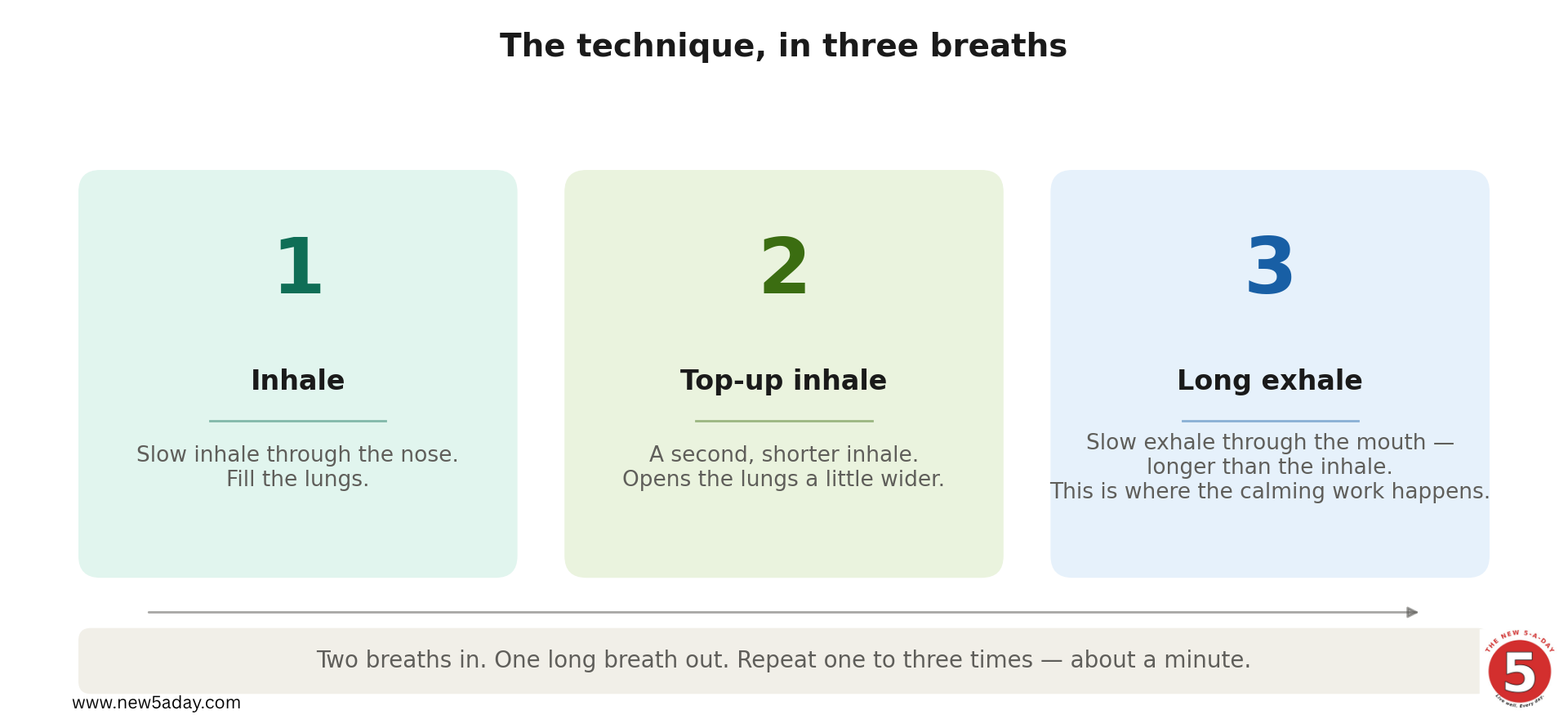
The psychological sigh — sometimes called the physiological sigh — is a specific breathing pattern: two short inhales through the nose, followed by one long, slow exhale through the mouth. The first inhale fills the lungs. The second, shorter inhale tops them up a little further. And then the exhale does the work.
It sounds almost embarrassingly simple. But there's a reason your body does this automatically, several times an hour, without being asked.
Those tiny air sacs in your lungs — the alveoli — can start to partially deflate when you're stressed and breathing shallowly. A sigh reinflates them, opening up your lungs and keeping the respiratory system working properly. It's a built-in biological reset — not just an emotional one. The fact that we can trigger it deliberately is what makes it interesting.
Why the exhale is the point
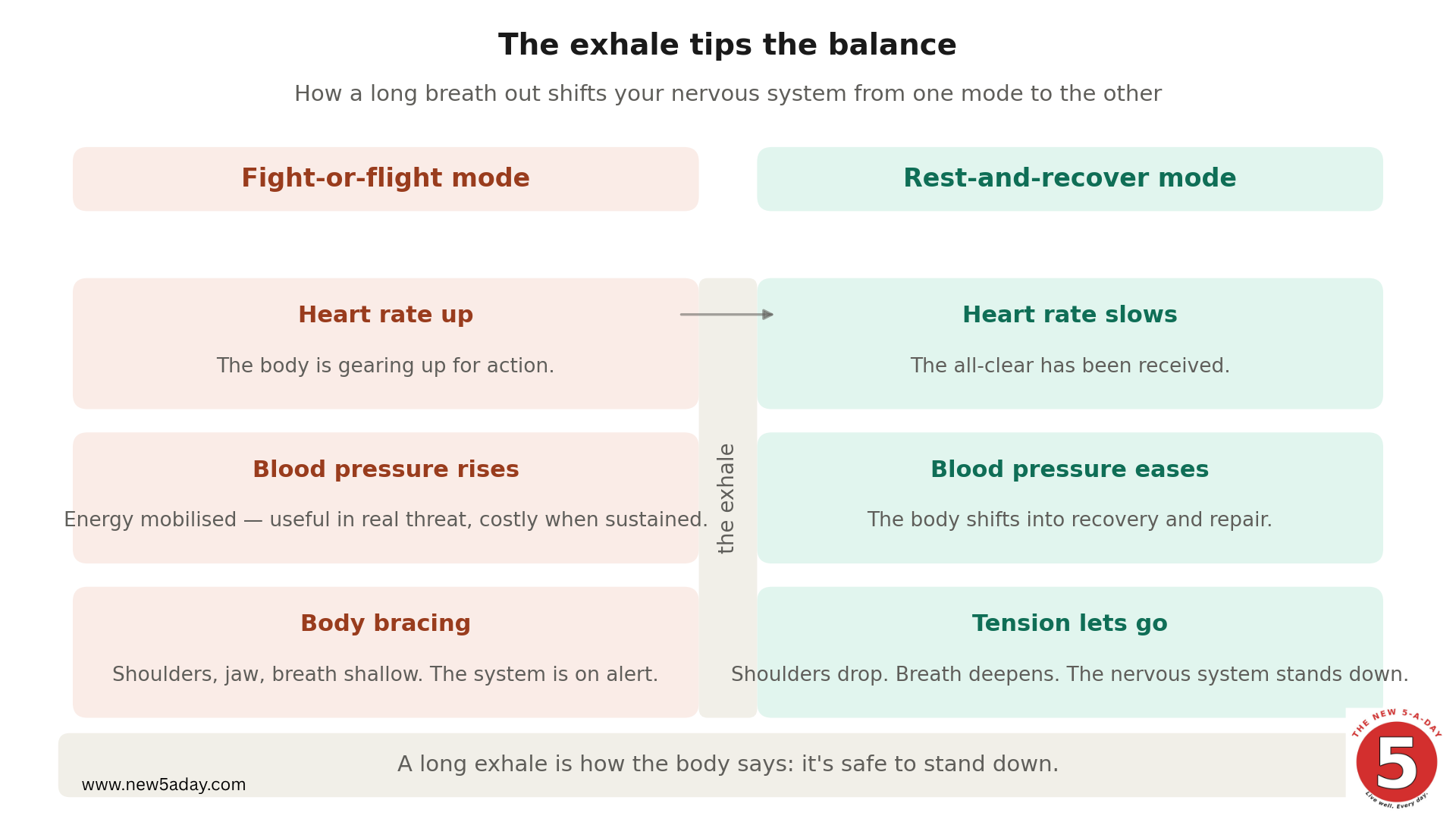
Here's what happens when you exhale slowly. The parasympathetic nervous system — your body's “rest and recover” mode, the opposite of fight-or-flight — becomes more active. Heart rate comes down. Blood pressure eases. The body receives a quiet signal: the threat has passed. It's safe to stand down.
Research consistently shows that slow, exhale-focused breathing reduces heart rate and blood pressure, and lowers feelings of anxiety and stress. Multiple reviews have confirmed this across healthy adults in a range of settings. The exhale is where the calming work happens — and the psychological sigh is designed to make that exhale as full and effective as possible.
What the research actually shows
A 2023 study compared several five-minute daily breathing practices — including cyclic sighing, which uses this exact double-inhale, long-exhale pattern — with mindfulness meditation over one month. Cyclic sighing produced greater improvements in positive mood than mindfulness meditation, alongside meaningful reductions in breathing rate, suggesting a genuine lowering of stress.
That's a striking result. Not because breathing is better than meditation — they're different tools — but because something this simple and brief produced a measurable, sustained effect on mood and arousal.
Wider research on slow, controlled breathing reinforces the picture. Deep and slow-paced breathing practices have been shown to reduce levels of cortisol — the “stress hormone,” lower heart rate, and ease anxiety. And spontaneous sighing has long been associated with a sense of relief — researchers describe it as a “resetter” for both breathing regulation and emotional state.
It's worth being honest about what the evidence does and doesn't say. The 2023 trial studied five minutes of daily practice — not one or two on-demand sighs in the middle of a difficult moment. The evidence for instant, single-use relief is less robustly established. Researchers also note that instructed sighing isn't universally beneficial: in some conditions, being told to sigh during stress can actually slow emotional recovery rather than speed it up. Individual responses vary.
But the overall direction is clear and consistent: slow, deliberate, exhale-led breathing helps the nervous system settle. The psychological sigh is one of the simplest, lowest-barrier ways to practise that — and the evidence behind the underlying mechanism is solid.
What it actually feels like
If you haven't tried this deliberately before, it's worth pausing here and doing it once before reading on.
Inhale slowly through your nose. Before you exhale, take one more short inhale — just a top-up. Now breathe out, slowly and fully, through your mouth. Long and steady, until the lungs feel empty.
Most people notice something shift. Not dramatically — this isn't a theatrical wellness moment. But there's often a quiet settling. A slight drop in the shoulders. A sense that the background hum of tension has come down a notch.
That's the parasympathetic nervous system doing its job. You just gave it the right prompt.
The myth of the perfect calm
A lot of self-care advice suffers from the same problem as a lot of diet advice: it presents calm as a binary state. Either you're meditating for twenty minutes in a serene room, or you've failed at looking after yourself.
The psychological sigh resists this framing. It's not a practice you have to do perfectly, consistently, at a scheduled time. It's a tool. You pick it up when you need it. You put it down when you don't.
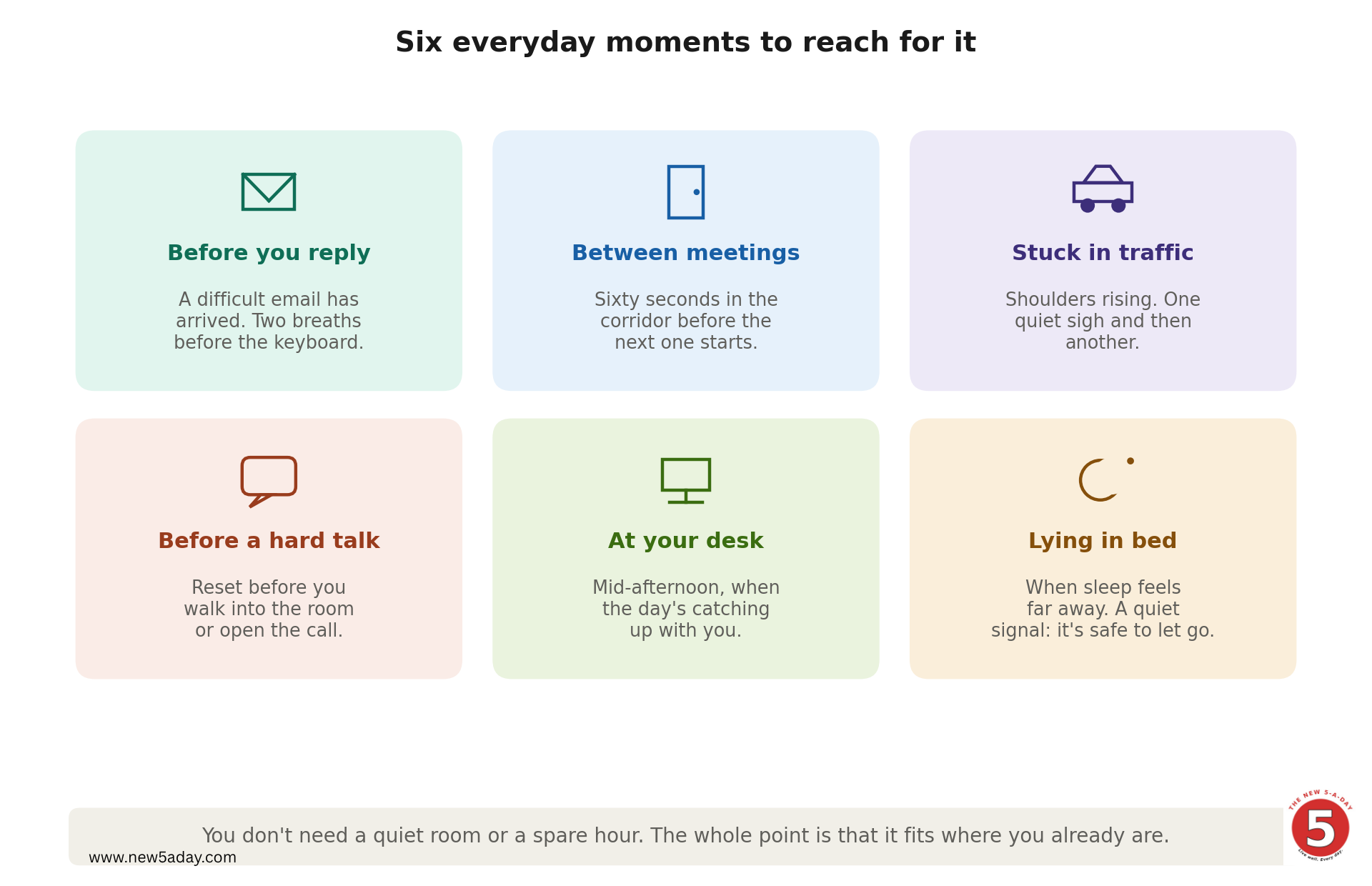
A difficult email arrives. You take two breaths in and one long exhale before you reply. A meeting runs over and you feel your shoulders tighten. You step into the corridor for sixty seconds. You're stuck in traffic and the tension is building. A quiet breath, and then another.
These are not grand acts of self-care. They are small, repeated signals to a nervous system that is working hard — signals that say: I see you, and I'm helping.
Does this mean I have to do it every day?
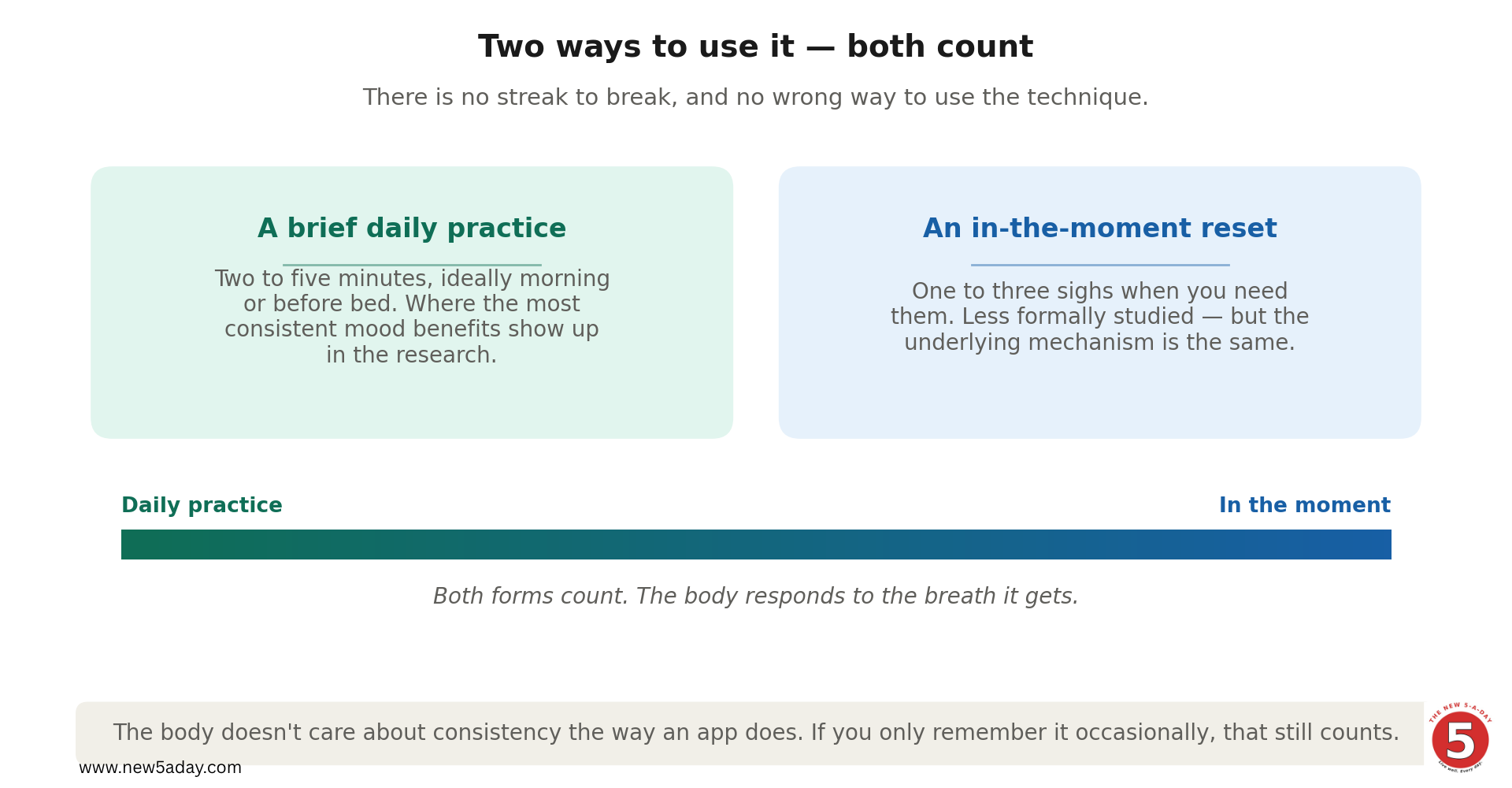
No. Though if you do build it into a brief daily practice — even two or three minutes in the morning or before bed — the evidence suggests that's where the mood benefits are most consistently found.
But even if you only remember it occasionally — in moments of acute stress, before difficult conversations, when sleep feels far away — that's still worth something. The body doesn't care about your streak. It responds to the breath it gets.
How to do it
The method is straightforward:
• Inhale slowly through your nose, filling the lungs.
• Take a second, shorter inhale to top up the breath.
• Exhale slowly and fully through the mouth — longer than the inhale.
• Repeat one to three times, or for about a minute.
A few things to keep in mind: keep the inhales gentle rather than forceful; let the exhale be long and unhurried; if you feel dizzy or lightheaded, return to normal breathing. This should feel like a release, not an effort.
You can do it sitting at your desk, standing in a corridor, lying in bed at night, or walking between meetings. Because it's quiet and takes no equipment, it fits into almost any moment in the day.
What about all the other breathing techniques?
Box breathing. 4-7-8. Diaphragmatic breathing. Alternate nostril breathing. The world of breathwork can start to feel as confusing as the world of nutrition advice — too many options, not enough clarity about which one to pick.
Here's a useful way to think about it. All of these techniques are drawing on the same underlying mechanism: slow, controlled breathing, with attention to the exhale, activates the parasympathetic nervous system and helps the body regulate itself. The differences between them are mostly about structure and preference.
The psychological sigh has one advantage over many of the others: it's the shortest. You can do it in the middle of a conversation without anyone noticing. You don't need to count to eight or memorise a pattern. It's one extra inhale and then a long breath out. That simplicity is its strength.
When talking to a professional helps
If you're managing anxiety, panic disorder, or other mental health conditions, breathing exercises can be a useful complement to professional support — but they're not a replacement for it. Some research notes that certain breathing techniques aren't universally helpful and may not suit everyone in every context. If you find that controlled breathing increases anxiety or brings on uncomfortable sensations, stop and speak with your GP or a mental health professional.
Bringing it back to The New 5-a-Day
Me-Time is Pillar Four of The New 5-a-Day — and the psychological sigh is perhaps the most minimal expression of what this pillar means. Not an hour of uninterrupted time to yourself. Not a retreat or a spa day. Just a moment. Sixty seconds that belong to you and your nervous system, in the middle of whatever else is happening.
The science is clear enough to take seriously, and the technique is simple enough to actually use. That combination — accessible, low-cost, evidence-grounded — is exactly what this series is built around.
Two inhales. One exhale. That's your moment of calm.
A note on medical advice: The content in this post is intended to inform and inspire, not to replace professional medical guidance. If anything you've read raises questions or concerns about your own health, please speak to your GP or another qualified health professional.
Want to explore further? This post is the accessible introduction. A detailed evidence-based Deep Dive, a full Reference List, and a podcast episode are all available on this site.
