How to live well in a world full of Ultra-Processed Food

Quick summary: Ultra-processed foods (UPFs) make up more than half of what most people in the UK eat — and the evidence linking high consumption to health problems is now substantial. But the goal isn’t to be afraid of every ingredient label. It’s to understand the overall pattern, make a few smart shifts, and give yourself permission to eat imperfectly in a world that wasn’t designed to make healthy eating easy.
Here’s the honest truth about ultra-processed foods: you probably can’t avoid them entirely. The good news is - you don’t need to.
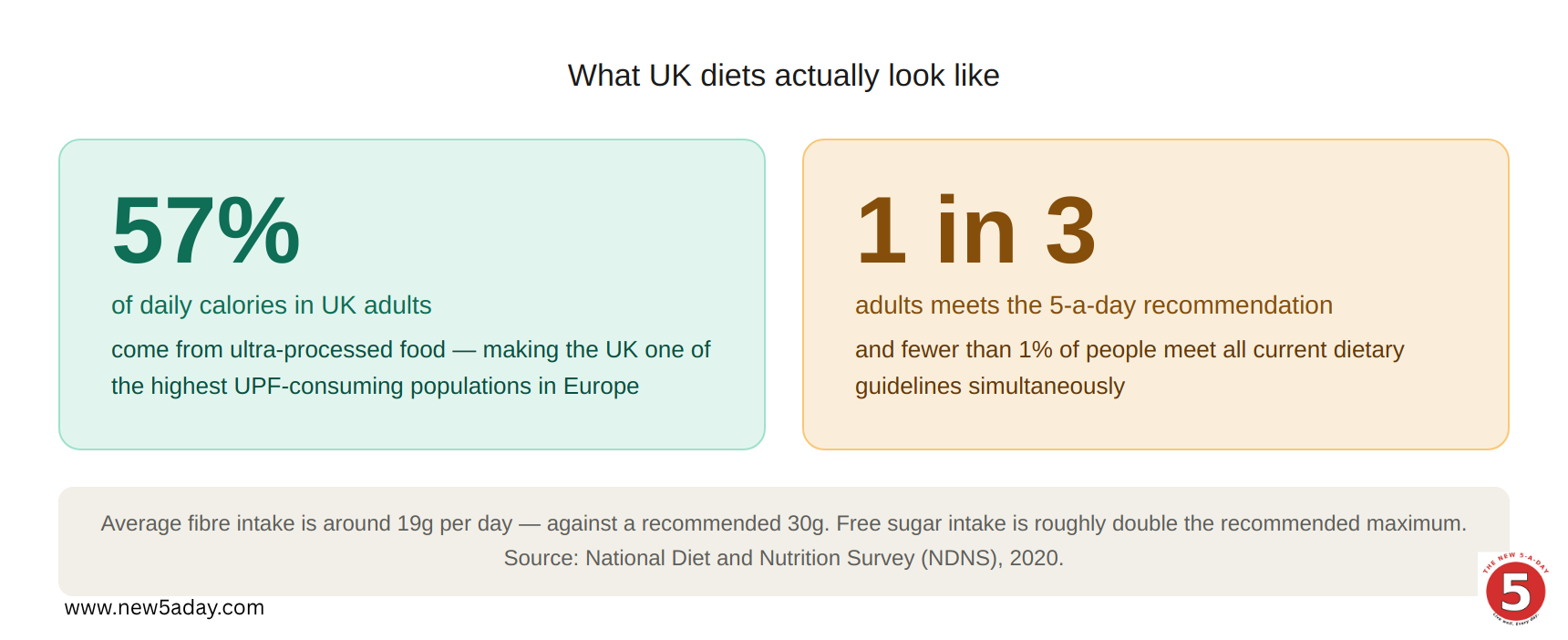
They are in the bread you grab at the supermarket. They are in the cereal your kids eat before school. They are in the ready meal that saves you on a Wednesday evening when cooking from scratch is simply not going to happen. They are on every service station shelf, in every vending machine, at every meal deal counter in the country.
The science on ultra-processed foods has moved quickly over the past few years, and some of what it shows is genuinely concerning. But the response to that science shouldn’t be guilt, or paranoia, or an impossibly restrictive approach to eating. It should be awareness — and a few practical ideas for nudging your diet in a better direction without making food feel like a minefield.
So what actually counts as ultra-processed?
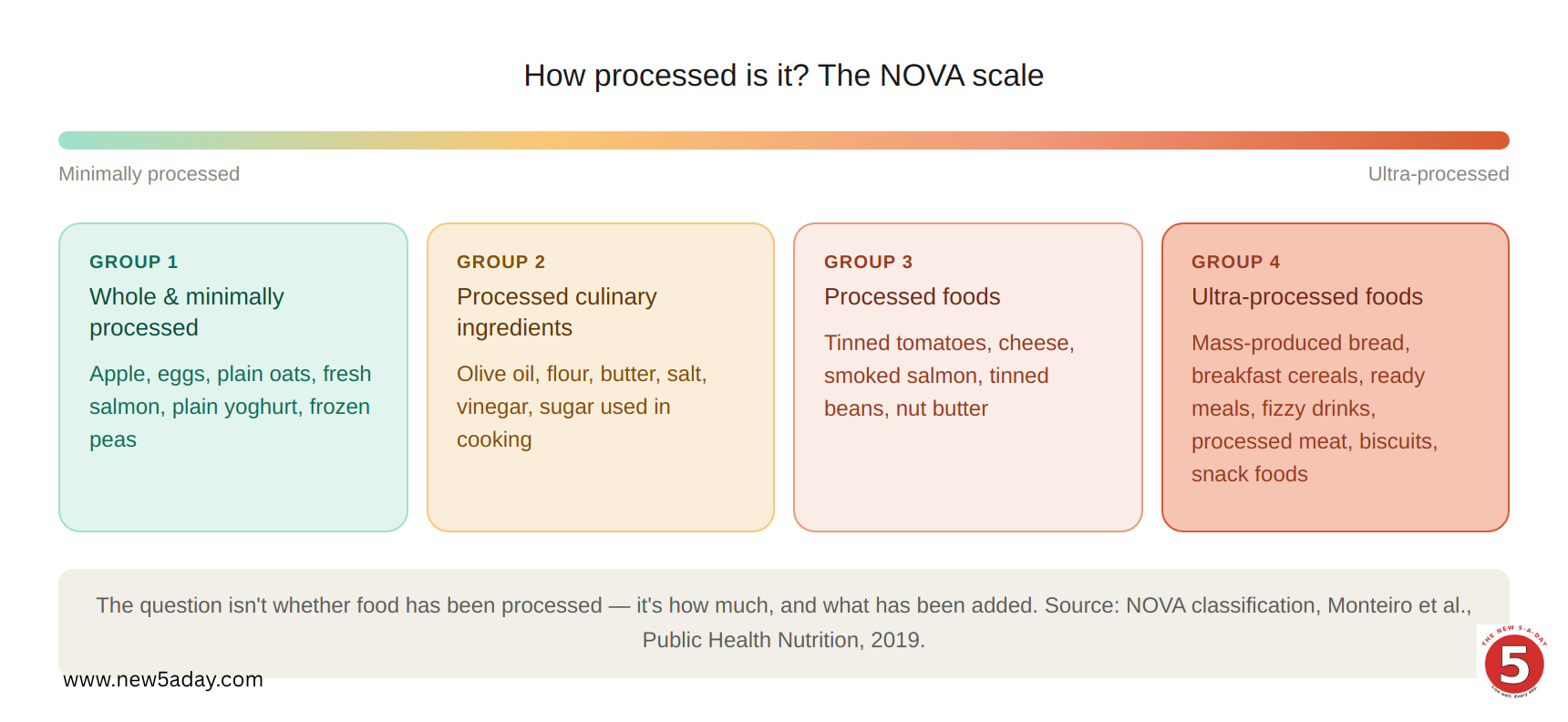
Ultra-processed foods — sometimes called UPFs — are products that have been significantly transformed from their original state. They typically contain ingredients you would not find in a home kitchen: emulsifiers, stabilisers, artificial flavourings, preservatives, added sugars and fats in combinations that make them highly palatable, very convenient, and engineered to last on a shelf.
The classic examples are mass-produced bread, most breakfast cereals, ready meals, biscuits, fizzy drinks, processed meats like sausages and ham, and most snack foods. But the category is broad — and that breadth is part of what makes the conversation complicated.
A useful rule of thumb: the more a product resembles a factory creation rather than a recognisable ingredient, the more likely it falls into this category. That doesn’t make it automatically harmful — but it does raise the odds that it is high in sugar, salt, saturated fat, and low in fibre and nutrients your body can use.
Importantly, not every processed food is ultra-processed. A tin of tomatoes is minimally processed and extremely useful. Frozen peas are frozen at harvest and retain most of their nutrition. A tub of plain yoghurt, a packet of smoked salmon, a jar of nut butter — these are all processed to some degree, and all fine as part of a balanced diet. The distinction that matters is between light processing that preserves food, and heavy industrial processing that fundamentally changes it.
What does the evidence actually say?
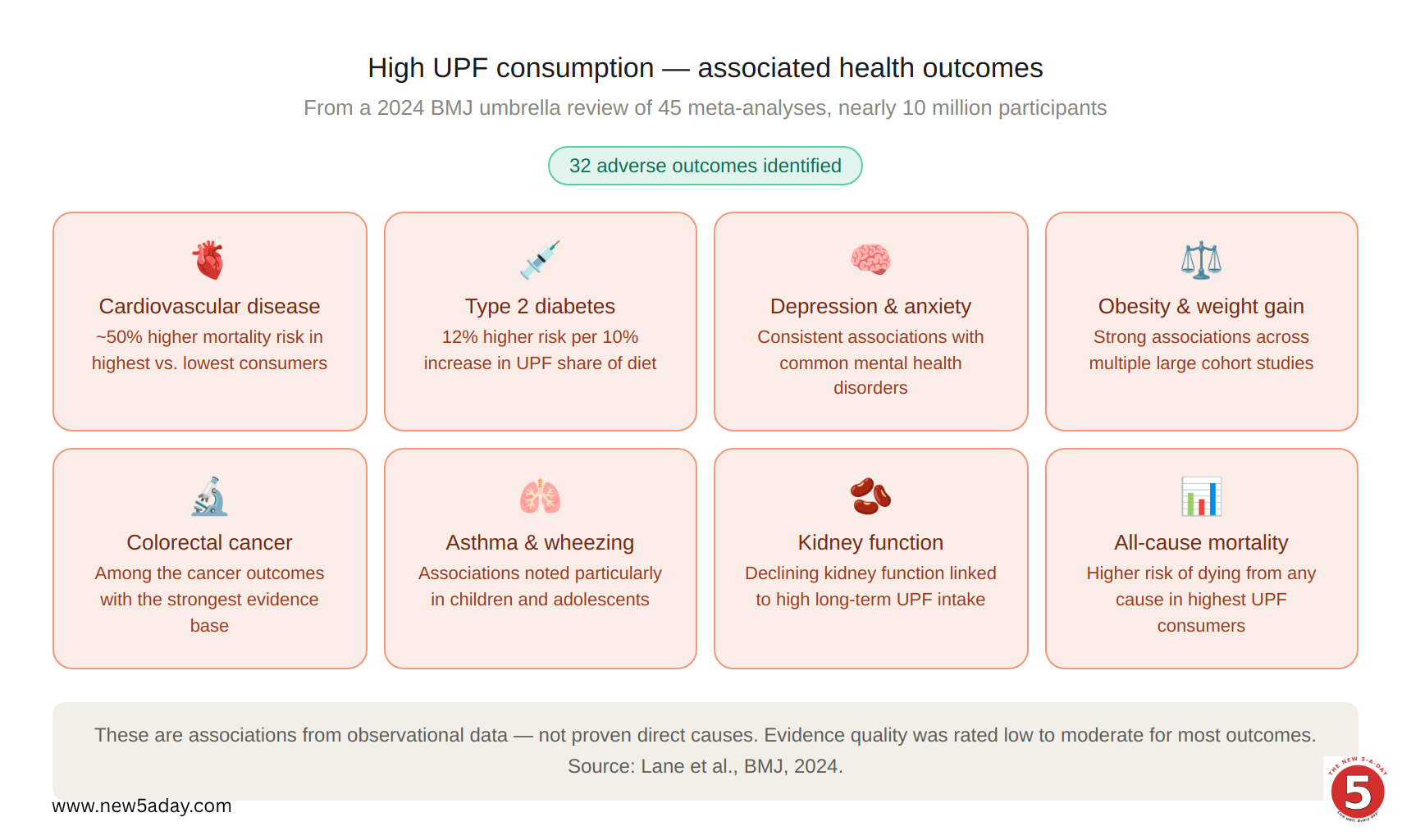
The research on ultra-processed foods has grown rapidly, and the direction of travel is consistent. A landmark review published in the BMJ in 2024 — the most comprehensive analysis of its kind, drawing on data from nearly 10 million people across dozens of studies — found associations between high UPF consumption and 32 different adverse health outcomes. These included cardiovascular disease, type 2 diabetes, depression and anxiety, several cancers, and a higher risk of dying from any cause.
In early 2026, the UK Parliament’s own scientific advisory body reviewed the evidence and concluded that regular high consumption of UPFs is linked to worse health outcomes across multiple body systems.
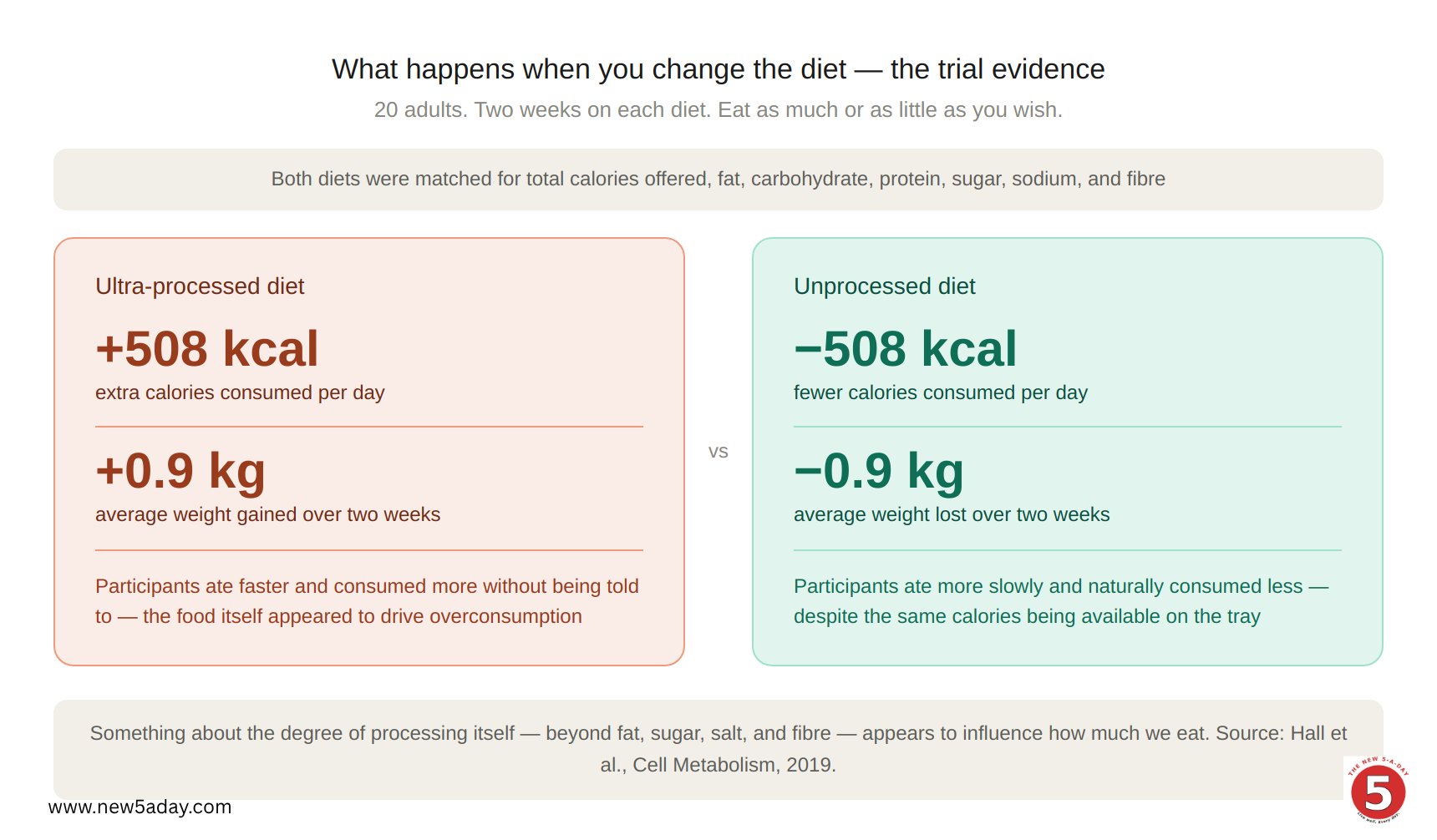
One of the more striking findings comes from a controlled trial in which participants were fed either an ultra-processed diet or an unprocessed diet for a month, with both diets matched for calories, protein, sugar, fat, and fibre. The people on the ultra-processed diet ended up consuming around 500 extra calories per day and gained weight — not because they were told to eat more, but because the food itself seemed to drive overconsumption.
The honest caveat is that most of this research is observational — it shows associations, not definitive proof that UPFs cause these outcomes directly. Separating the effects of heavy processing itself from the effects of high fat, sugar, and salt content is genuinely complicated. And individuals vary. But the breadth, consistency, and size of the evidence is now significant enough to take seriously.
Why are they so easy to overeat?
This is worth understanding, because it explains a lot. Ultra-processed foods are specifically engineered to be highly appealing — the combination of salt, sugar, fat, and texture is designed in ways that natural foods rarely achieve accidentally. They tend to be low in protein and fibre, the two nutrients most responsible for making you feel full. And they are often eaten quickly, which means your brain’s “I’m satisfied” signal arrives after you’ve already had more than you needed.
This isn’t a character flaw. It’s the product working as designed. Understanding this can take some of the shame out of it: if you find it difficult to eat just a few crisps or stop after one biscuit, the food itself is partly responsible for that experience.
The longer-term issue is displacement. Diets heavy in ultra-processed foods tend to crowd out the things that support good health — vegetables, fruit, legumes, whole grains, nuts, fish, plain dairy. When a significant proportion of your calories comes from heavily manufactured products, there is simply less room for the foods associated with lower disease risk and better long-term wellbeing.
This isn’t about perfection — or shame
Here is something worth saying clearly before we get to practical suggestions: the way ultra-processed foods dominate modern diets is not primarily a story of individual failure. It is a story of environment.
These foods are cheap, convenient, heavily marketed, and often the most available option — particularly for people on tight budgets, long hours, or without easy access to well-stocked supermarkets. The idea that everyone can and should cook everything from scratch misunderstands the reality of most people’s lives. It is also, frankly, not supported by the science — which consistently points to overall pattern rather than individual food purity as the thing that matters.
A person who eats a ready meal on Tuesday but otherwise has plenty of vegetables, some whole grains, reasonable protein, and a varied diet across the week is in a genuinely different position from someone whose diet is dominated by heavily processed foods at every meal. The pattern is what matters — not the Tuesday ready meal.
Practical ways to shift the balance
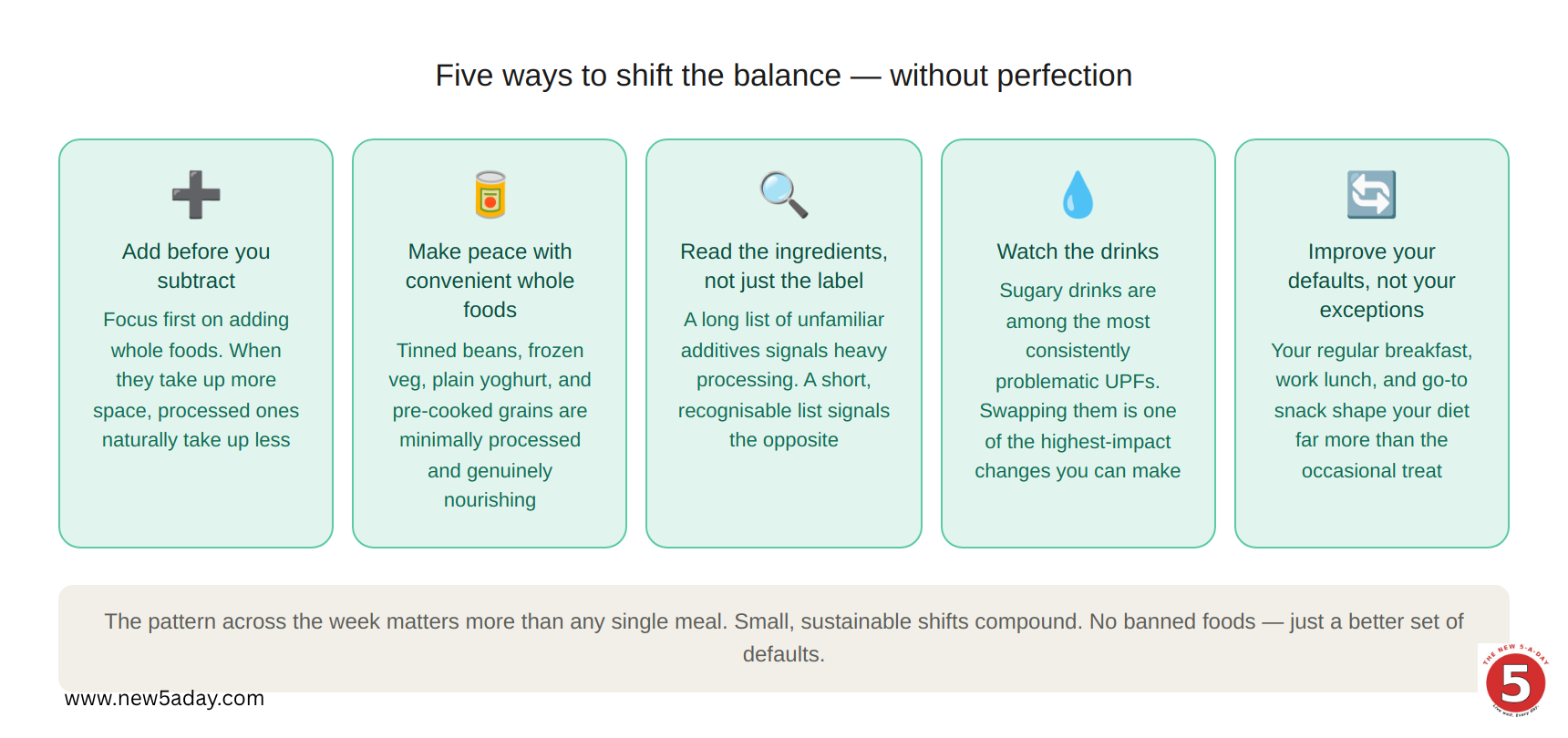
The goal here is not zero ultra-processed foods. It is a diet where whole and minimally processed foods make up a larger share of what you eat, and heavily manufactured products a smaller one. Even modest shifts in that direction are associated with meaningful improvements in health markers.
A few approaches that tend to work:
• Add before you subtract. Rather than trying to cut out processed foods, focus first on adding more whole ones. An extra handful of nuts as a snack, an extra portion of vegetables at dinner, a piece of fruit in the morning. When whole foods take up more space, processed ones naturally take up less — without requiring willpower or restriction.
• Make peace with convenient whole foods. Frozen vegetables, tinned fish, tinned beans, plain yoghurt, and pre-cooked grains are all minimally processed, affordable, and quick. Building a few of these into your regular routine means you have something genuinely nourishing to reach for when time is short — without defaulting to a heavily processed alternative.
• Read the ingredient list, not just the label. A long list of unfamiliar additives is a reasonable signal that something is heavily processed. A short list of recognisable ingredients — oats, fruit, milk, nuts — is a reasonable signal that it isn’t. Traffic light labels on the front tell you about fat, sugar, and salt, which is useful — but they won’t tell you about the degree of processing.
• Watch the drinks as much as the food. Sugary soft drinks and energy drinks are among the most consistently problematic UPFs in the evidence. Swapping sweetened drinks for water, sparkling water, tea, or coffee — without added sugar — is one of the highest-impact single changes you can make, and it often goes underestimated.
• Think about your defaults, not your exceptions. The foods you eat habitually — your standard breakfast, your usual work lunch, your go-to snack — have far more impact on your overall diet than the occasional treat. Improving your defaults is more effective than trying to police every exception.
A note on food access and cost
It would be dishonest not to acknowledge that eating fewer ultra-processed foods is easier for some people than others. In areas with limited access to affordable fresh food, and in households where time and budget are stretched, UPFs are often the most realistic option. That’s not a moral failing — it’s a structural reality.
If that’s your situation, a few lower-cost staples can make a significant difference: oats, tinned beans and lentils, frozen vegetables, eggs, plain yoghurt, and supermarket own-brand whole grains are all relatively affordable, minimally processed, and nutritionally valuable. You don’t need a perfect diet. You need a pattern that works for your actual life.
Bringing it back to The New 5-a-Day
Eating well is Pillar Two of The New 5-a-Day — and ultra-processed foods sit at the intersection of almost everything this pillar is about. They affect energy, mood, sleep quality, and the overall pattern of nourishment that shapes how well we feel across years, not just days.
The science is clear enough to take seriously. But the response it calls for is not anxiety about individual foods — it is a gentle, sustained shift toward a diet that includes more of the things associated with good health and a little less of the things associated with harm.
More whole foods. More variety. Fewer defaults to the heavily manufactured. That’s all. No banned foods. No perfect plates. Just a pattern that works for you, most of the time — because that is what the evidence actually supports.
A note on medical advice: The content in this post is intended to inform and inspire, not to replace professional medical guidance. If anything you’ve read raises questions or concerns about your own health, please speak to your GP or another qualified health professional.
Want to explore further? This post is the accessible introduction. A detailed evidence-based Deep Dive, a full Reference List, and a podcast episode are all available on this site.
