Good night! When is the best time to go to bed..?

Quick summary: There is no single perfect bedtime — but there is a right approach for you. Your ideal bedtime is the one that gives you seven to nine hours of sleep, fits your natural body clock, and stays roughly consistent from night to night. Work backwards from when you need to wake up, pay attention to when you naturally feel sleepy, and prioritise keeping your schedule steady. The specific hour matters far less than whether you can actually stick to it.
Here is a question that sounds like it should have a simple answer. What time should I go to bed? Ten o’clock? Half past ten? Maybe ‘early’, in some vague, virtuous way that involves drinking chamomile tea and turning off your phone before the evening news?
The honest answer is: it depends. But before your eyes glaze over at that classic non-answer, here is the more useful version: it depends on you — your wake-up time, your natural body clock, and whether your bedtime is consistent enough for your body to actually trust it. Get those things roughly right, and the specific hour matters much less than you might think.
This post is about how to find your own best bedtime — not someone else’s, and not some idealised number plucked from a sleep study. Let’s get into it.
There is no magic hour (but there is a right approach)
Sleep researchers are fairly united on one thing: there is no single universal bedtime that suits everyone. What matters far more is that your bedtime allows you to get enough sleep, fits your natural rhythm, and — crucially — stays roughly consistent from one night to the next.
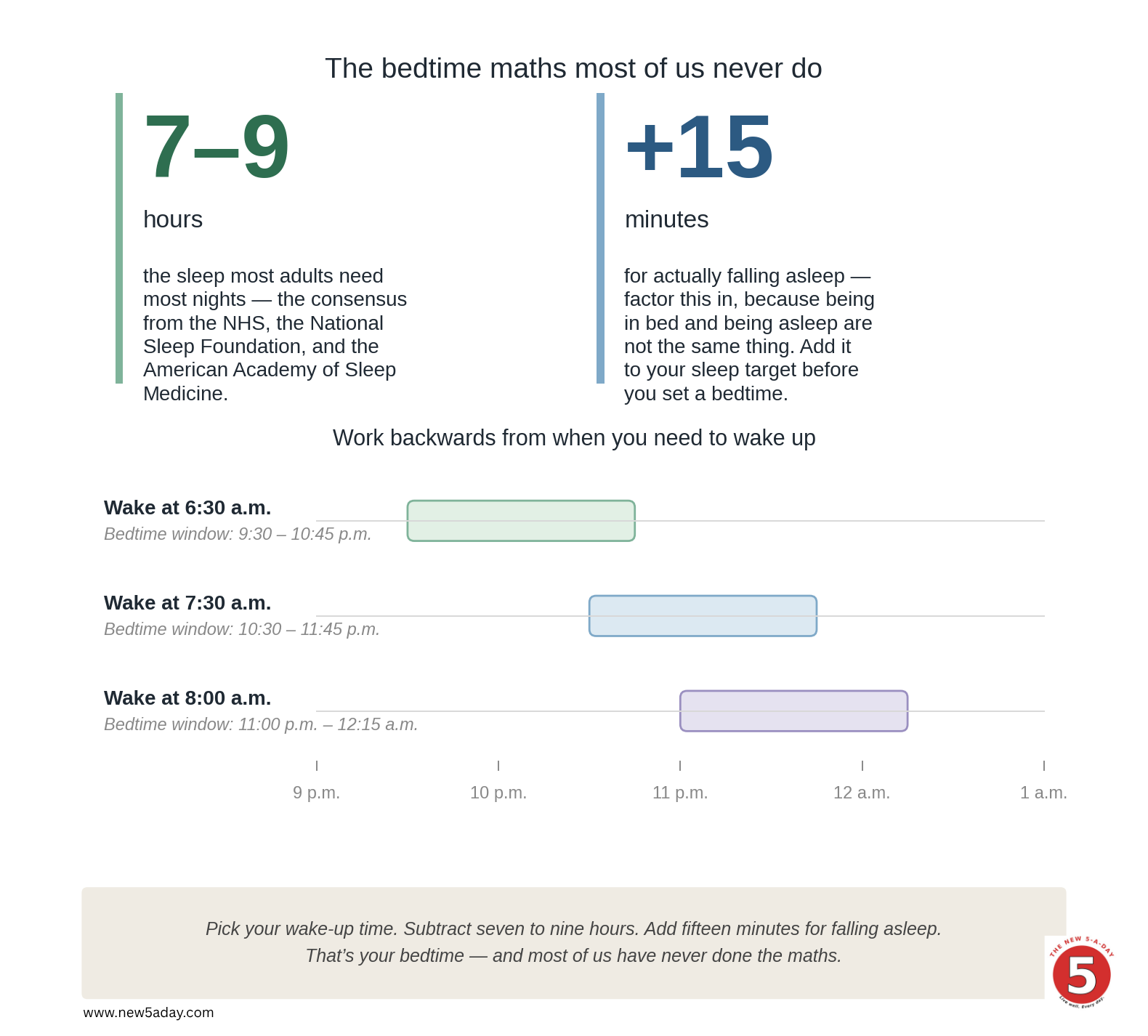
Think of it this way. If you need to be up at 6:30 a.m. and you function best on around eight hours of sleep, then a bedtime somewhere between 10:00 and 10:30 p.m. is probably in the right ballpark. If you’re a 5 a.m. riser, you’re looking at 9:00 to 9:30 p.m. And if you regularly stay up until 1 a.m. and wake at 9 a.m. — well, that could work too, as long as you’re actually getting those hours and your lifestyle allows it.
The simplest starting point: work backwards from when you need to get up. Allow for seven to nine hours of sleep, add fifteen to thirty minutes for actually falling asleep, and you have your target bedtime. It’s not rocket science — it’s just maths most of us never bother to do.
Your body clock is real — and it matters
Your body runs on an internal clock — a biological timing system that runs on roughly a 24-hour cycle. This clock regulates when you feel sleepy, when you feel alert, when your body temperature dips, and when hormones like melatonin (the ‘it’s getting dark, wind down’ hormone) are released.
Going to bed when your body clock says ‘now’ makes falling asleep easier, and makes the sleep you get more restorative. Going to bed significantly before or after that window is like arriving at the airport three hours early or twenty minutes late — either frustrating or chaotic, and neither feels great.
Most people have experienced the ‘second wind’ effect: you feel tired at 10 p.m., push through it to finish something on your phone or TV, and by 11:30 p.m. you’re suddenly wide awake. That’s your body clock at work. You missed your natural sleep window and your brain has switched back into alertness mode. It doesn’t mean you can’t sleep — it just means it’ll take longer, and the sleep you get may be lighter than it could have been.
The practical takeaway: pay attention to when you naturally start to feel drowsy in the evening. That sleepiness is a real signal, and it’s worth acting on rather than overriding.
Are you a lark or an owl? (And why it’s not just laziness)
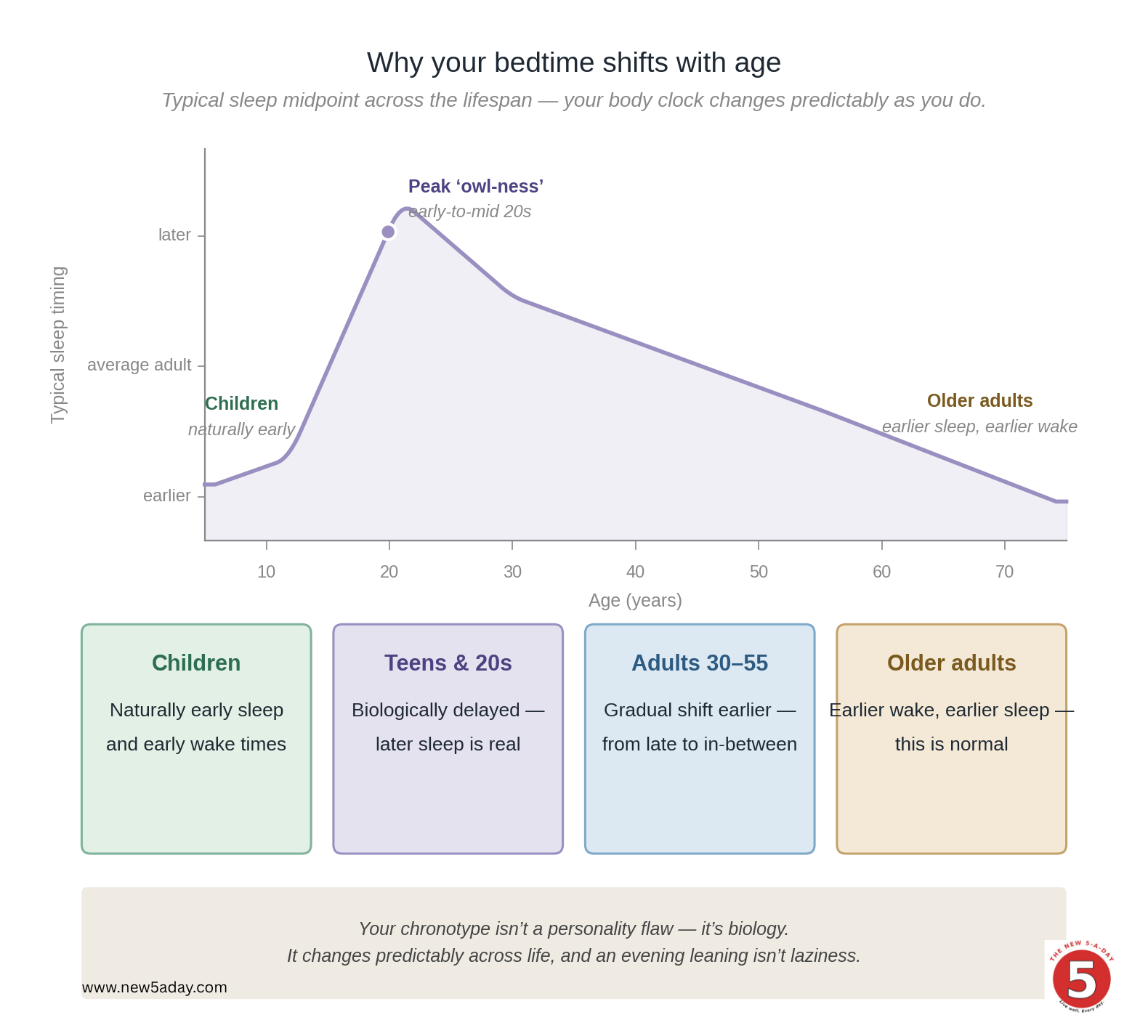
Some people genuinely come alive in the morning. Others are at their sharpest after 10 p.m. These tendencies — sometimes called your ‘chronotype’ — are partly genetic and partly shaped by age and lifestyle. They’re not personality flaws or signs of poor discipline.
Children tend to go to sleep earlier and wake earlier. Teenagers experience a genuine biological shift towards later sleep — which is why asking a 16-year-old to be sharp at 8:30 a.m. is, from a sleep science perspective, a fairly unreasonable request. Adults in their twenties and thirties often lean later than they will in middle age. And many older adults find themselves naturally getting sleepy earlier in the evening and waking earlier in the morning — which is simply a normal change in the body clock, not a sign that anything is wrong.
None of this means your chronotype is fixed forever. Light exposure, meal timing, exercise, and screen habits can all nudge your body clock earlier or later over time. But it does mean that the ‘ideal’ bedtime for a night owl is legitimately different from that of an early riser — and both are fine, as long as enough sleep is actually happening.
Consistency is the underrated superpower
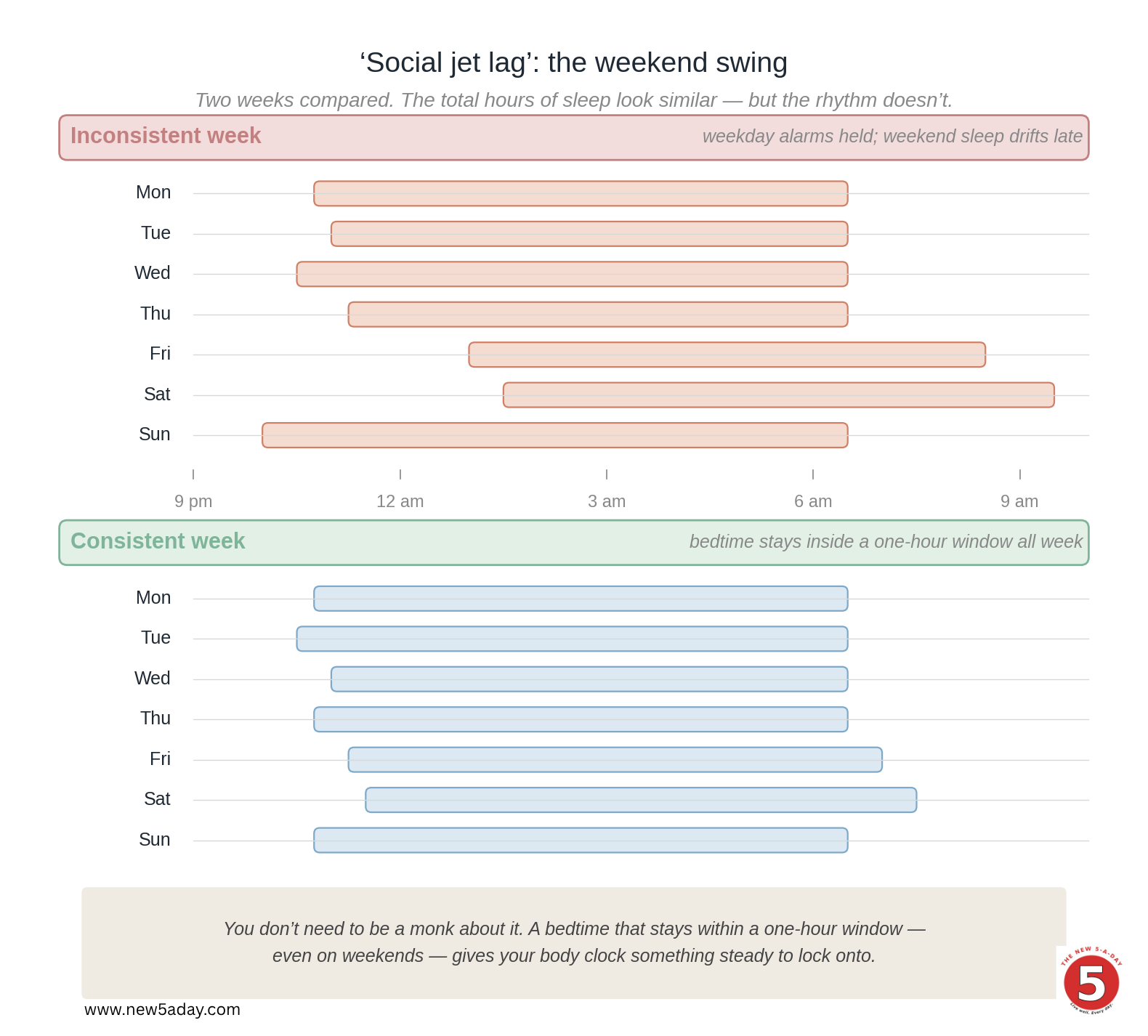
Here is where many people quietly undermine their own sleep without realising it. It’s not just the hour you go to bed — it’s whether you go to bed at roughly the same hour most nights.
Your body clock is surprisingly literal. It sets itself based on patterns — light, darkness, mealtimes, activity. If you go to bed at 10:30 p.m. on weekdays and 1:30 a.m. on weekends, your body is essentially being asked to cross two time zones every Friday night and again every Sunday. Researchers sometimes call this ‘social jet lag’, and it can have real effects: grogginess, poorer concentration, and a body that never quite settles into a reliable rhythm.
Studies consistently show that people with irregular sleep schedules tend to have worse sleep quality, more depressive symptoms, and greater risk of cardiometabolic problems — even when total sleep time looks adequate on paper.
The good news: you don’t need to be a monk about it. Aiming for a bedtime window of about an hour — say, any time between 10:30 and 11:30 p.m. — rather than a precise minute, is much more realistic and still provides most of the benefits. Consistency, not rigidity.
Is earlier always better?
There’s a persistent idea that early bedtimes are inherently virtuous. ‘Early to bed, early to rise’ and all that. The research tells a more nuanced story.
Going to bed earlier is only useful if you can actually fall asleep, get enough hours, and wake feeling refreshed. Going to bed at 9 p.m. when your body clock doesn’t want to sleep until 11 p.m. is likely to mean lying awake, feeling frustrated, and possibly associating your bed with wakefulness — which makes things worse, not better.
There is also some evidence that very late bedtimes — consistently past midnight — are associated with poorer health outcomes over time. But this is partly because late nights are often paired with shorter sleep (early obligations don’t move just because you stayed up), and partly because they disrupt the body clock’s natural alignment with daylight.
The most practical principle: aim for a bedtime that is sustainable, consistent, and gives you a genuine shot at seven to nine hours. Whether that’s 10 p.m. or 11:30 p.m. is far less important than whether you can actually stick to it most nights.
How to find your own ideal bedtime
Rather than guessing, try this simple experiment over a week or two:
• Pick a consistent wake-up time that suits your life and stick to it — yes, including weekends (or at least stay within an hour of it).
• Count back seven to nine hours from that wake-up time and aim to be in bed by that point.
• Notice when you naturally start to feel sleepy in the evening. If that window regularly falls before your target bedtime, adjust earlier. If you’re regularly wide awake at your target time, adjust a little later.
• Judge success by how you feel during the day, not just by the number of hours clocked. If you wake without an alarm, feel reasonably alert by mid-morning, and aren’t crashing hard by 3 p.m., you’re probably in the right zone.
A wearable device — a fitness watch or ring — can give you more detailed data on your sleep patterns if you enjoy that kind of thing. But it’s not essential. How you feel is a perfectly good measure.
The evening routine: small things that make a big difference
Getting the timing right is half the job. The other half is giving your body and brain a genuine chance to switch off before you expect them to sleep.
A few things that actually help:
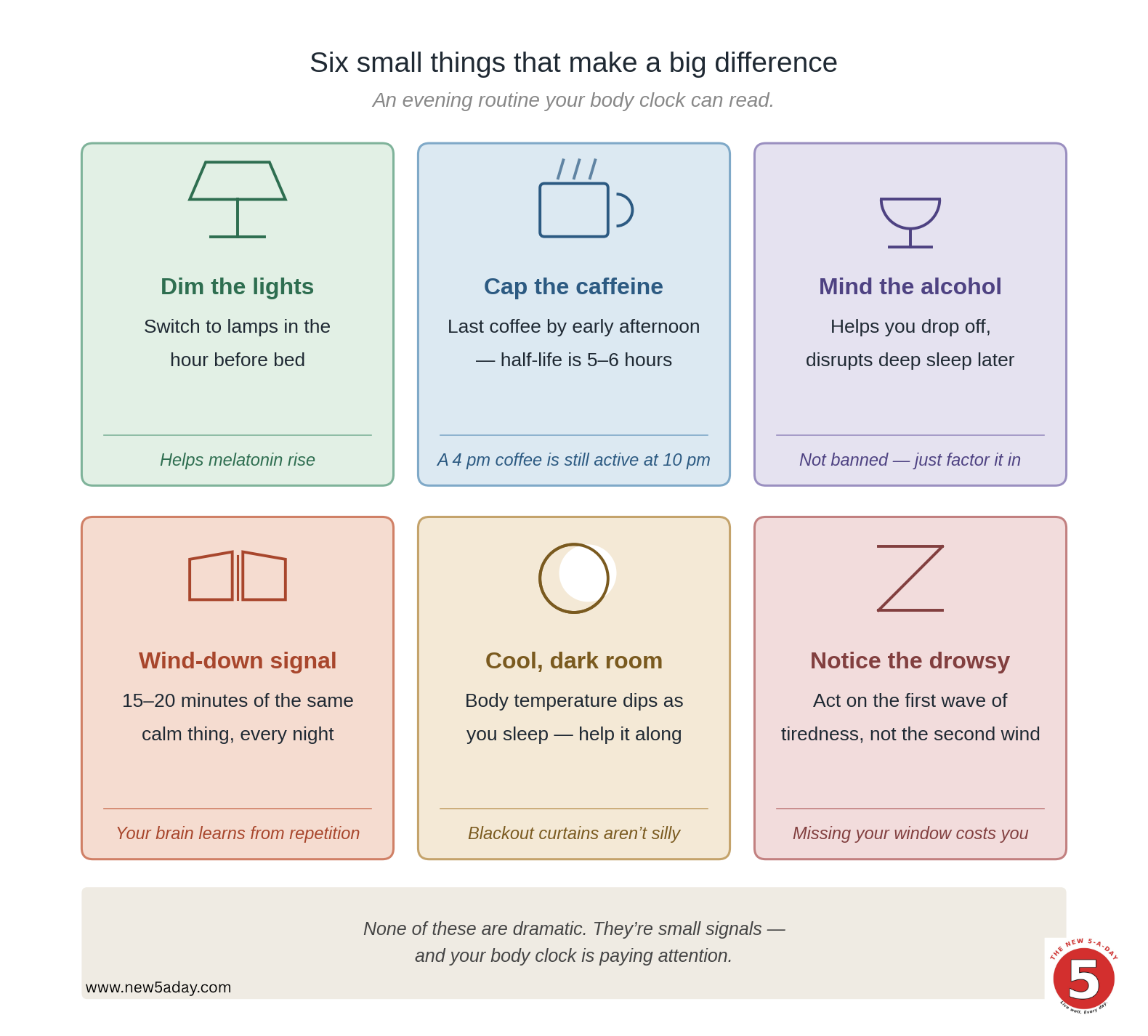
• Dim the lights in the hour before bed. Bright overhead lighting — and the blue light from screens — signals to your brain that it’s still daytime. Switching to lamps, warm tones, or simply turning some lights off can help your melatonin levels rise naturally.
• Cut caffeine by early afternoon. Caffeine has a half-life of around five to six hours in most adults. A 4 p.m. coffee still has a significant amount of caffeine active in your system at 10 p.m.
• Be honest about alcohol. A glass of wine may feel like it helps you drop off. In practice, alcohol disrupts the deeper, more restorative stages of sleep later in the night. It’s not banned — just worth factoring in if sleep quality is a problem.
• Create a wind-down signal. Your brain learns from repetition. A short, calm routine before bed — even just fifteen to twenty minutes of reading, a warm shower, or quiet music — starts to become a reliable signal that sleep is coming. It doesn’t need to be elaborate. It just needs to be consistent.
• Keep your bedroom cool and dark. Body temperature naturally drops as you fall asleep. A cooler room helps that process along. Darkness tells your body clock it’s genuinely night. Blackout curtains and a slightly open window are inexpensive upgrades that can make a real difference.
When life doesn’t cooperate
Real life — shift work, young children, late commutes, social occasions, the last episode of something genuinely unmissable — does not always bend to an ideal sleep schedule. That’s fine. The goal is not perfection; it’s a better average.
A late night on Friday is not going to ruin your health. A pattern of late nights, every night, with an alarm that doesn’t move, is what quietly erodes things over time. If you know a late night is coming, you might not be able to prevent the sleep loss, but you can at least protect the nights before and after.
For shift workers — a genuinely harder situation — the same principles apply where possible: consistency within your shift pattern, protecting your sleep window, and managing light exposure carefully (blackout curtains and morning sunglasses are not ridiculous; they’re practical). It’s a trickier puzzle, but not an unsolvable one.
Bringing it back to The New 5-a-Day
Sleep is one of the five pillars of The New 5-a-Day, and bedtime is one of the simplest levers you have. You don’t need to buy anything, follow a complicated protocol, or transform your evenings overnight.
The question ‘what time should I go to bed?’ is really three questions rolled into one:
• What time gives me enough sleep before I need to wake up?
• What time fits my natural body clock?
• What time can I actually sustain most nights?
Answer those honestly, and you’ve found your bedtime. Not a universal one. Yours.
Most of us know, somewhere in the back of our minds, what time we ‘should’ be going to sleep. We just keep choosing to have one more scroll, one more episode, one more cup of tea while the news plays. That’s not a moral failing — it’s just human. But over time, the gap between what we know and what we do is exactly where sleep debt quietly accumulates.
So: pick a bedtime that makes sense for your life. Make it roughly consistent. Give yourself a short wind-down before you expect to sleep. And if you wake up tomorrow morning feeling more human than usual — that’s the experiment working.
Good night.
A note on medical advice: The content in this post is intended to inform and inspire, not to replace professional medical guidance. If anything you've read raises questions or concerns about your own health, please speak to your GP or another qualified health professional.
Want to explore further? This post is the accessible introduction. A detailed evidence-based Deep Dive, a full Reference List, and a podcast episode are all available on this site.
