Your daily building blocks - Macronutrients and getting the balance right

Quick summary: Carbohydrates, protein, and fats are the three macronutrients your body runs on every single day. You don’t need to count grams or follow a complicated plan to get the balance right. You just need to understand what each one does, where to find them in everyday foods, and a few simple ways to nudge your meals in a more nourishing direction.
Every meal you eat is made up of the same basic ingredients. Not in a reductive way — food is far richer and more varied than that. But at the level of what your body actually does with it, almost everything on your plate comes down to three things: carbohydrates, protein, and fat.
These are the macronutrients — the big three that your body needs in relatively large amounts to function, repair itself, produce energy, and stay well. You’ve almost certainly heard the word macros thrown around in fitness and diet conversations. It tends to come packaged with tracking apps, percentage targets, and a faint whiff of anxiety. That’s not what this post is about.
This post is about understanding what these three nutrients actually do, where they live in the everyday foods you already eat, and how anyone — without counting a single gram — can shift the balance of their meals toward something that genuinely supports their health.
The big three: what they are and what they do
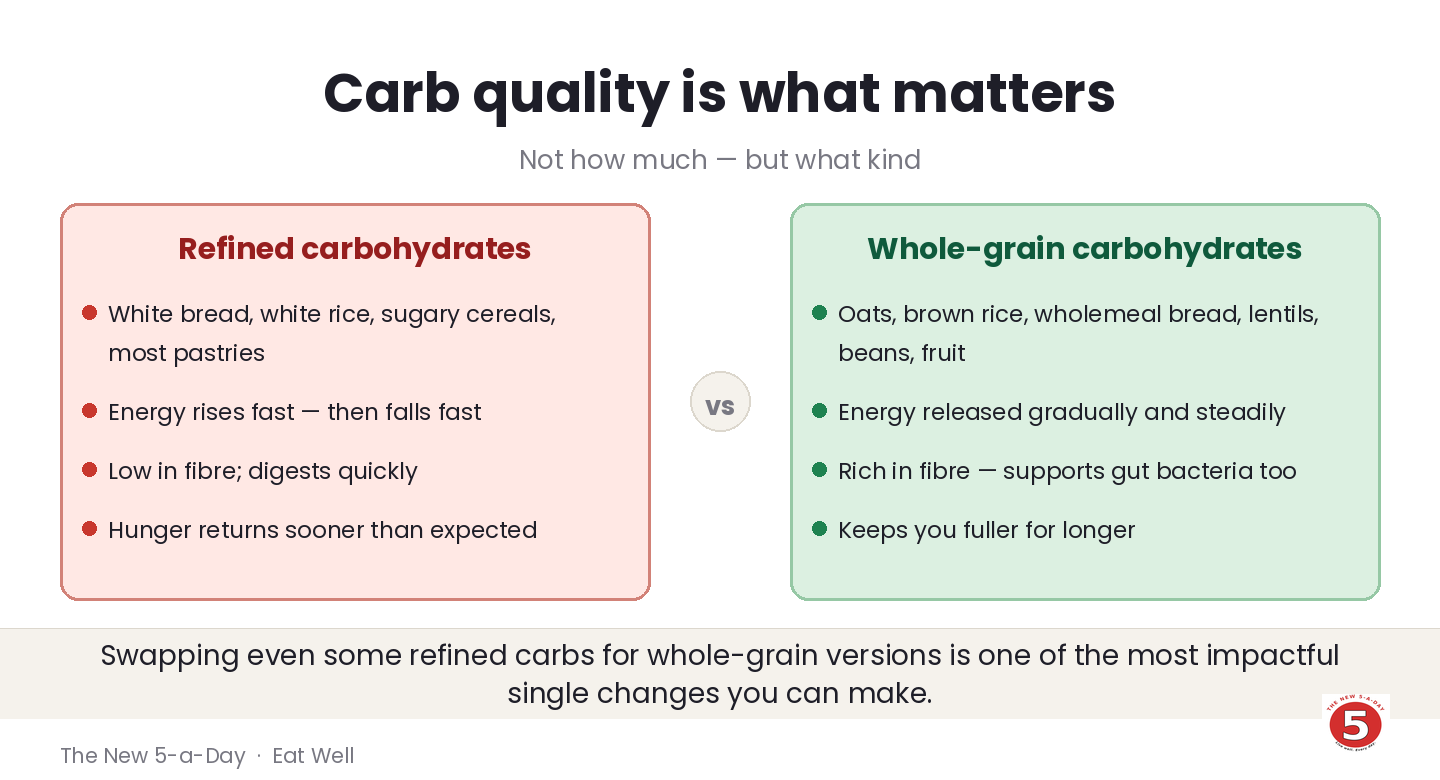
Carbohydrates are your body’s first choice for fuel — particularly for the brain and for muscles during physical activity. They break down into glucose, which your cells use as energy. The kind of carb you eat makes a real difference: whole grains, fruits, vegetables, beans, and lentils release energy gradually and come packed with fibre, while refined carbs — white bread, sugary cereals, pastries — tend to give a sharper spike followed by a more pronounced dip. Carbs are not the enemy. The quality of the carb is what matters.
Protein is the building material your body depends on. It’s involved in repairing muscles and tissues, producing enzymes and hormones, and supporting immune function. It also has a strong effect on how full you feel — meals with adequate protein tend to keep you satisfied for longer. Protein is found in both animal sources (meat, fish, eggs, dairy) and plant sources (beans, lentils, tofu, nuts, seeds), and a healthy diet can draw on either or both.
Fat is the macronutrient that has probably been most unfairly maligned over the past few decades. Dietary fat is essential for cell structure, hormone production, and the absorption of vitamins A, D, E, and K. Healthy fats — particularly the unsaturated kind found in olive oil, nuts, seeds, avocados, and oily fish — are consistently associated with good long-term health. It’s the type of fat that matters, not fat itself.
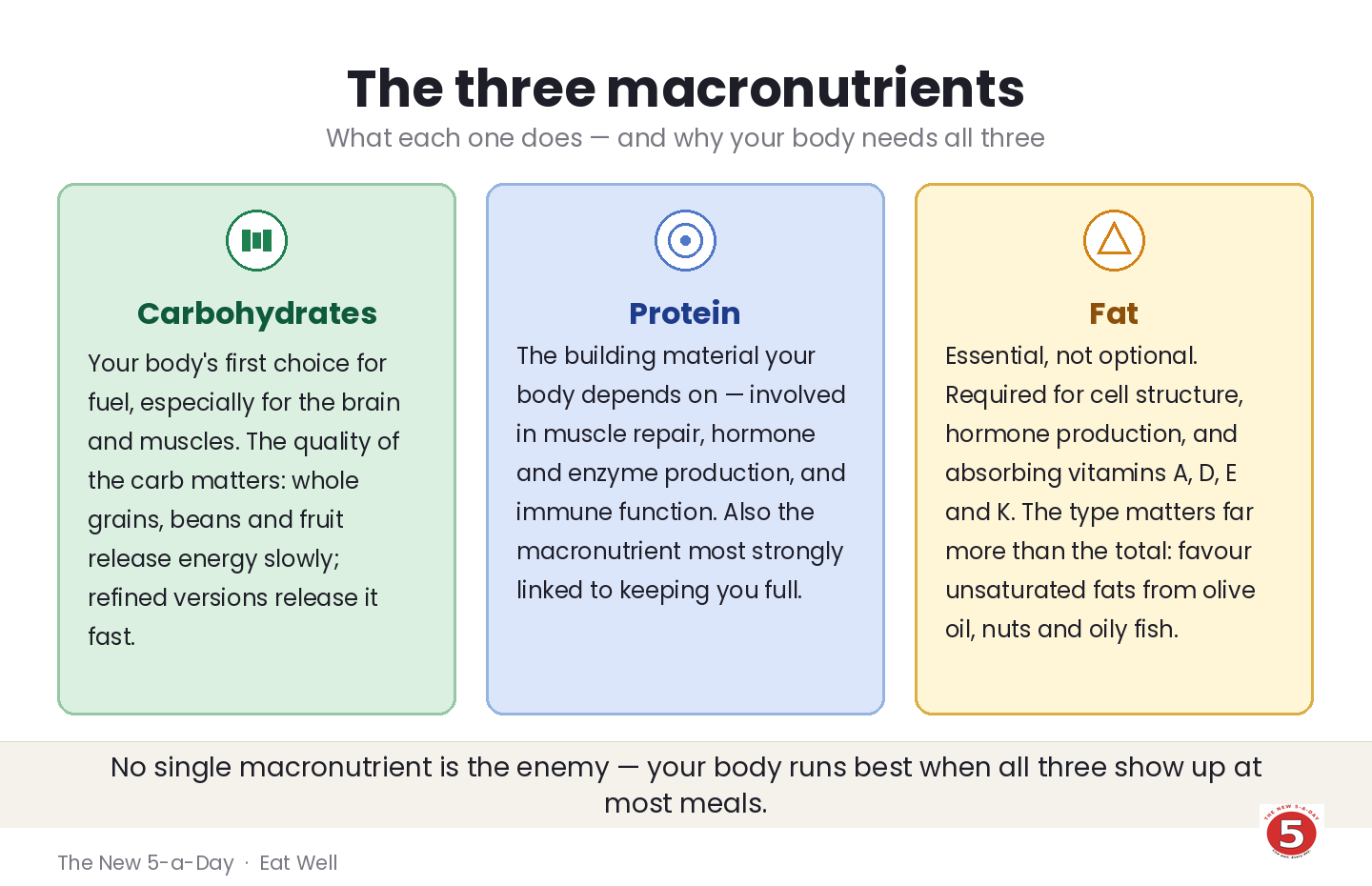
Together, these three macronutrients work in concert. A meal that leans heavily on just one at the expense of the others tends to work less well for your body — and often leaves you feeling less satisfied.
Where to find them in everyday foods
Most everyday meals already contain all three macronutrients. The goal isn’t to engineer something new from scratch — it’s to see what’s already there more clearly, so you can make small adjustments that genuinely help.
Carbohydrates are the most abundant macronutrient in most people’s diets. You’ll find them in bread, pasta, rice, potatoes, cereals, and oats — as well as in fruit, most vegetables, beans, and lentils. Whole-grain versions of starchy foods (brown rice, wholemeal bread, whole-wheat pasta, oats) deliver more fibre alongside their energy, which slows digestion and keeps you feeling fuller for longer. Fruit and beans bring natural sugars alongside fibre, vitamins, and minerals.
Protein turns up across a wider range of foods than many people realise. Chicken, turkey, fish, eggs, and dairy (milk, yoghurt, cheese) are the classic animal sources. But plant sources are equally valid and often underestimated: a tin of lentils, a handful of edamame, a portion of chickpeas, or a block of firm tofu all deliver meaningful amounts of protein alongside fibre and other nutrients that animal sources don’t always provide.
Fats are found throughout the diet, often quietly in the background. Olive oil, rapeseed oil, avocados, nuts (almonds, walnuts, cashews), seeds (chia, flax, sunflower), and oily fish like salmon or mackerel are all rich in unsaturated fats associated with heart and brain health. Butter, hard cheese, and fatty processed meats contain more saturated fat — fine in moderation, but worth not over-relying on as the main source.

What a lopsided plate can feel like
It’s worth understanding what happens when one macronutrient dominates at the expense of the others — because most of us have experienced this, even without having the language for it.
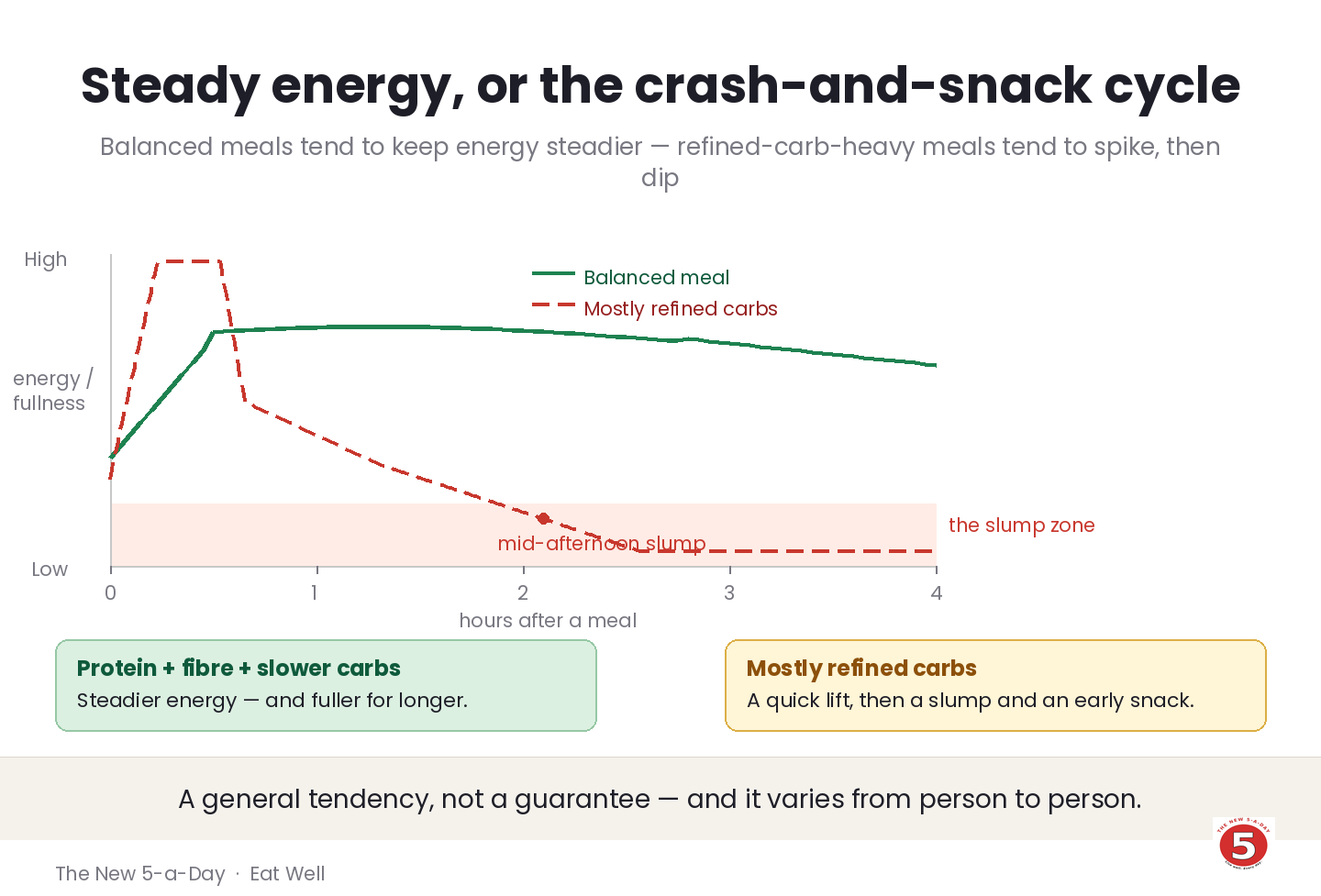
A very carb-heavy meal with little protein or fat — plain white toast, a bowl of sugary cereal, pasta with only a thin tomato sauce — can produce a fairly rapid energy rise followed by a slump and renewed hunger sooner than expected. The meal delivers fuel but not much structural support.
A meal very low in carbs — a large piece of meat with a side salad and little else — might feel filling briefly but can leave you short of fibre, certain vitamins, and the steady energy that carbs provide. Very low-carb diets tend to work best when they are genuinely well-planned.
Meals consistently low in protein can leave you feeling less satisfied, more likely to snack, and over the longer term may affect the body’s ability to maintain muscle and recover effectively.
None of this is meant to create anxiety about individual meals. It’s just worth knowing what imbalance tends to feel like — so that when your energy dips in the mid-afternoon or you’re hungry again an hour after eating, you have a useful framework for thinking about why.
What balance looks like on a plate
You don’t need a calculator or a tracking app. A simple visual approach maps onto something familiar: the plate.
A broadly balanced main meal looks something like this:
• About half the plate is vegetables or fruit — colourful, varied, and the main source of vitamins, minerals, and fibre.
• About a quarter is protein — whatever form works for you. Chicken, fish, eggs, beans, lentils, tofu, or a combination.
• About a quarter is starchy carbohydrates — brown rice, whole-wheat pasta, potatoes, quinoa. Whole-grain where you can.
• A small amount of healthy fat — a drizzle of olive oil, a few nuts, half an avocado, or whatever fits the meal.
This is a rough guide, not a prescription. The exact proportions will shift depending on the meal, the day, your activity levels, and what you enjoy. The point is to have a simple mental model that brings all three macronutrients into view — and flags when one is largely missing.
The research broadly supports this kind of approach. While no single macronutrient ratio has been shown to be universally superior, there is strong consistent evidence that meals built around whole grains, varied vegetables, quality protein, and healthy fats support good health outcomes over time. The exact split matters far less than the overall quality and variety of what you’re eating.
Simple swaps that shift the balance
You don’t need to overhaul your diet in one go. Small, sustainable adjustments to the meals you already eat tend to be far more effective — and far easier to maintain — than dramatic changes that feel like an effort from the start.
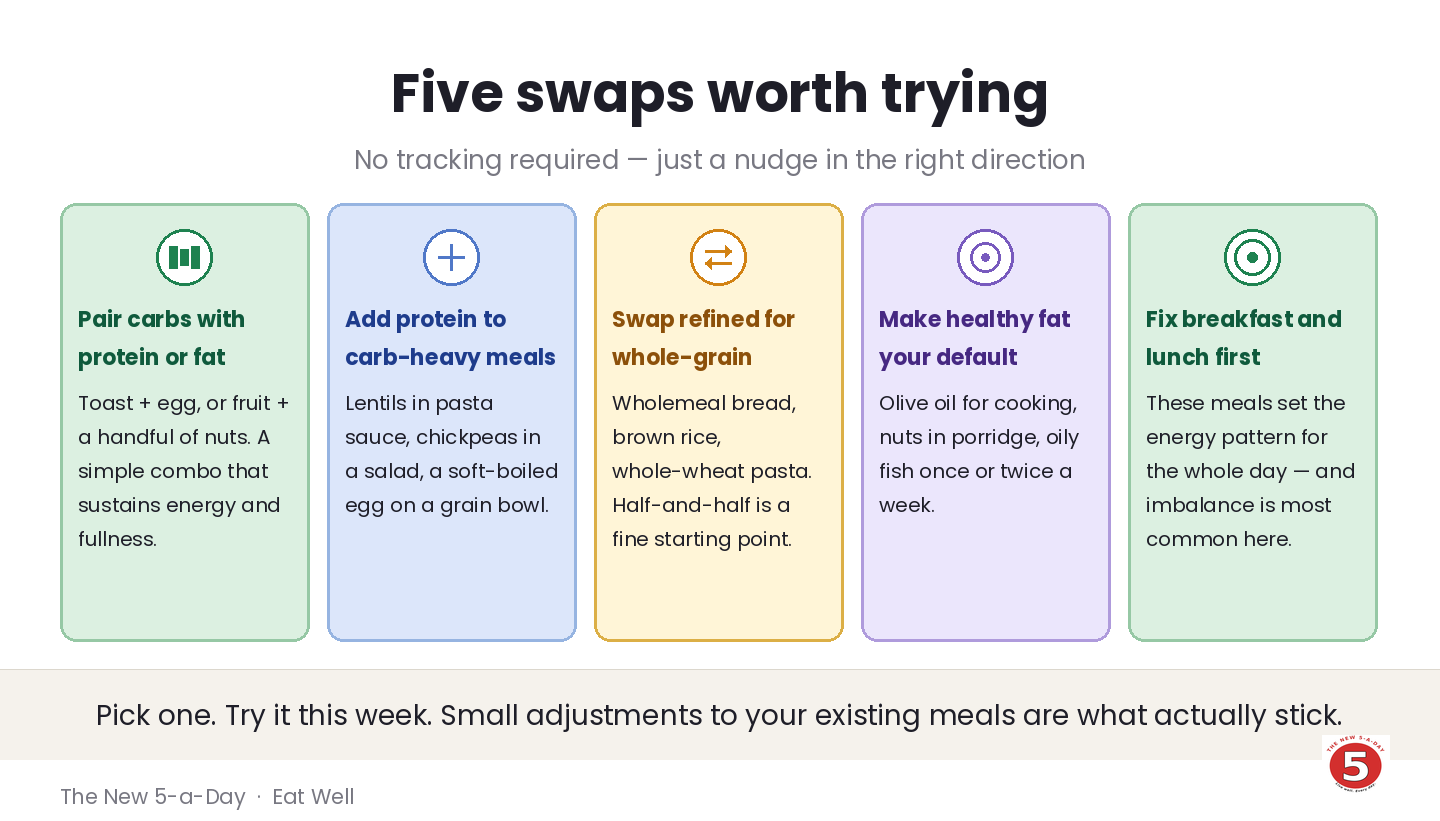
Pair carbs with protein or fat. Plain toast is mainly carbohydrate. Toast with peanut butter, an egg, or smoked salmon becomes a much better spread. Fruit with a handful of almonds or a dollop of Greek yoghurt delivers protein and fat alongside the natural sugars — which tends to keep you fuller.
Add protein to carb-heavy meals. Stir a tin of lentils into a pasta sauce, add chickpeas to a salad, or top a grain bowl with a soft-boiled egg. Meaningful protein, minimal effort, no need to change the meal’s basic character.
Swap refined carbs for whole-grain versions. Wholemeal bread instead of white, brown rice instead of white, whole-wheat pasta instead of regular. If the taste takes some getting used to, mixing half and half is a perfectly good starting point.
Use healthy fats as your default. Cook with olive oil or rapeseed oil, add nuts or seeds to porridge or salads, and choose oily fish (salmon, mackerel, sardines) once or twice a week.
Look at your breakfast and lunch first. These are the meals where imbalance is most common — heavy on refined carbs, light on protein and healthy fat. Porridge with nuts and seeds, eggs on wholemeal toast, or a salad with a protein source are simple defaults that carry the balance well through the day.
There’s no single right answer — and that’s fine
There is no universally perfect macronutrient ratio. The research consistently shows that several different balances — within broad reasonable ranges — are compatible with good health, as long as the food quality is there and extreme imbalances are avoided.
Someone who exercises a lot may find they need more carbohydrate than average. Someone trying to build muscle may benefit from a little more protein. Older adults often need to pay more attention to protein intake to preserve muscle mass. People managing blood sugar may find a lower-carb approach helpful with appropriate support.
The general principles hold up across all of these contexts: prioritise whole grains over refined ones, include protein at most meals, favour unsaturated fats, eat plenty of vegetables. The fine-tuning is personal.
Rather than chasing a specific ratio, it’s often more useful to pay attention to how you feel. More stable energy through the day, less hunger between meals, and a sense of genuine nourishment rather than just fullness are all reasonable signs that your macronutrient balance is working well for you.
Bringing it back to The New 5-a-Day
Eating well is Pillar Two of The New 5-a-Day. And understanding macronutrients is one of the most useful lenses for thinking about what eating well actually means in practice — not as a set of forbidden foods or a complicated plan, but as a way of seeing your meals more clearly.
Carbohydrates, protein, and fat all belong on your plate. None of them are the enemy. The goal is a diet where all three are present in reasonable proportions, sourced as much as possible from whole, minimally processed foods — because that’s the pattern the evidence consistently supports.
You don’t need to count anything. You don’t need to cut anything out. You just need a rough mental picture of what a balanced plate looks like — and a few practical habits that nudge your everyday meals a little closer toward it. That’s all. And for most people, that’s enough.
A note on medical advice: The content in this post is intended to inform and inspire, not to replace professional medical guidance. If anything you’ve read raises questions or concerns about your own health, please speak to your GP or another qualified health professional.
Want to explore further? This post is the accessible introduction. A detailed evidence-based Deep Dive, a full Reference List, and a podcast episode are all available on this site.
