Walking is surprisingly good for you!
Quick summary: Walking is one of the most effective and accessible forms of exercise available. Regular walking reduces risk of heart disease, type 2 diabetes, and depression; improves mood, sleep, and brain health; and you do not need to walk 10,000 steps to benefit — research shows meaningful gains begin well below that. The best walk is the one you will actually do.
There is a persistent idea in our culture that exercise has to be hard to count. That unless you are sweating, tracking your heart rate, or grimacing at a spinning class, you probably haven't done enough. Walking — just walking — sits at the other end of the spectrum. It feels almost too ordinary to be exercise.
And that, rather surprisingly, is one of the most compelling things about it.
Walking is free, low impact, requires no equipment, fits into a normal day, and can be done by almost anyone, at almost any age, in almost any state of health. It is also, it turns out, remarkably good for you. Not 'good for you in a minor polite way', but genuinely, meaningfully, measurably good for you across almost every system in the body.
Let's start with the 10,000 steps myth
You have almost certainly heard that 10,000 steps a day is the goal. It is printed on fitness trackers, cited in corporate wellness programmes, and repeated so often it feels like established science.
It isn't. The 10,000-step target originated as a marketing slogan for a Japanese pedometer sold in the 1960s — it was chosen because the Japanese character for 10,000 looks a bit like a person walking. There was no clinical research behind it.
That doesn't mean 10,000 steps is a bad idea — walking that much is genuinely good for you. But recent research gives us a much more nuanced and encouraging picture.
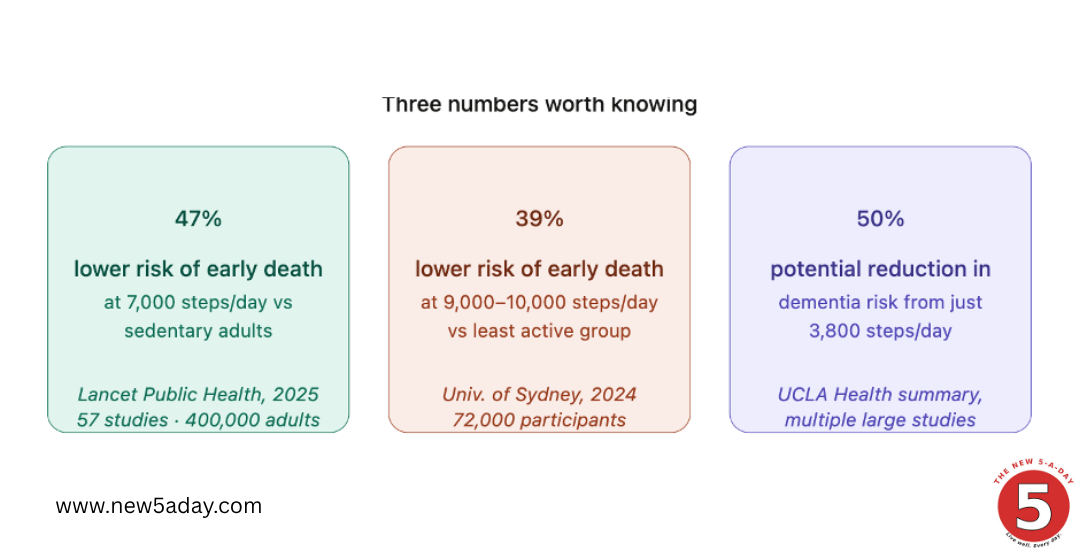
A landmark 2025 review — the most comprehensive analysis of its kind to date, drawing on nearly 400,000 adults across 57 studies — found that aiming for 7,000 steps a day is associated with clinically meaningful health improvements, including a 47% reduction in death from any cause compared with sedentary adults. And crucially, the researchers found that even going from 2,000 to 4,000 steps provides real, measurable benefits. You don't have to hit any particular number. You just have to move more than you currently do.
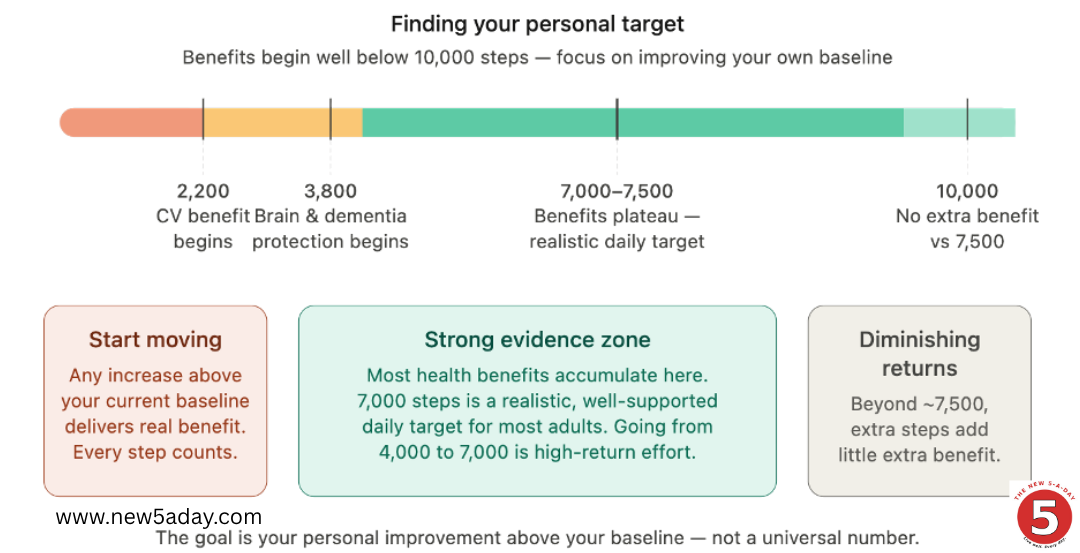
Harvard research supports this too: in a study of 17,000 older women, risk of death dropped steadily from 2,000 steps upwards and levelled off around 7,500 — the same risk as those hitting 10,000. The extra 2,500 steps made essentially no difference.
This is genuinely good news for anyone who finds the 10,000-step target intimidating or impossible. The bar is lower than you thought, and every step above your current baseline counts.
What walking actually does to your body
Your heart and cardiovascular system
Brisk walking is one of the most heart-friendly forms of exercise there is. It raises your heart rate gently, strengthens the heart muscle over time, improves circulation, and helps keep blood pressure in a healthy range. The British Heart Foundation notes that regular walking is associated with reduced risk of heart disease, stroke, and cardiovascular events.
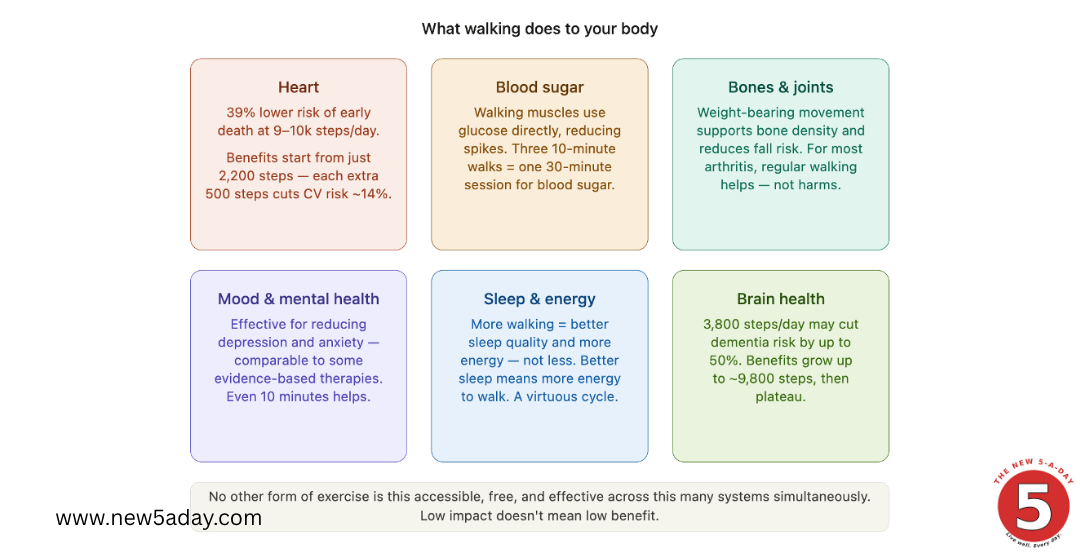
A 2024 study from the University of Sydney following over 72,000 participants found that people walking between 9,000 and 10,000 steps daily had a 39% lower risk of early death and a 21% lower risk of cardiovascular disease — but even those walking significantly less saw meaningful reductions. Each additional 500 steps is associated with around a 14% improvement in cardiovascular outcomes.
Blood sugar and diabetes risk
Walking helps your muscles use glucose more efficiently, which supports better blood sugar regulation. The American Diabetes Association recommends at least 30 minutes of walking five days a week as a meaningful way to reduce type 2 diabetes risk. It doesn't have to be all at once — three 10-minute walks are just as good as one 30-minute session.
For those already managing blood sugar, walking after meals has been shown in several studies to be particularly effective at reducing post-meal glucose spikes.
Bones, muscles, and joints
Walking is often described as low impact — and it is, which is part of what makes it so sustainable. But low impact doesn't mean ineffective. Weight-bearing movement like walking supports bone density, keeps joints lubricated, and builds and maintains muscle — particularly in the legs and core.
For older adults, this matters enormously. Falls are one of the leading causes of injury and loss of independence in later life. Regular walking improves balance, coordination, and leg strength in ways that directly reduce fall risk. For people with arthritis, walking can actually ease pain and improve function — gentle movement helps rather than harms.
Your mood and mental health
This might be the benefit most people underestimate. Walking is good for the mind in ways that go well beyond 'clearing your head'.
A 2024 review — covering trials across thousands of participants — found that various forms of walking were effective in reducing symptoms of both depression and anxiety, with effects comparable to other moderate-intensity exercise and some evidence-based therapy. Walking, the researchers concluded, can be adopted as an evidence-based intervention for reducing depression and anxiety.
Part of this is biochemical — physical activity triggers the release of endorphins – your “happy hormones”. But part of it is also behavioural: a walk creates a genuine pause in the day. It takes you away from screens, interrupts the spiral of worried thinking, and puts you in contact with the outside world. An outdoor walk adds natural light, fresh air, and a change of scene — each of which has independent evidence for mood benefits. If you can walk in a green or natural environment — a park, a canal towpath, woodland, or near water — there is growing evidence that this provides additional stress-reduction and mood benefits beyond the same walk in an urban or indoor setting. It doesn’t have to be countryside; a local park counts. The combination of movement and nature appears to be particularly restorative.
Even a short walk helps. Ten or twenty minutes can be enough to shift how you feel. You don't need to save it for when you have a full hour free.
Sleep and energy
Here's a slightly counterintuitive one: walking more tends to make you sleep better and feel more energetic, not more tired. Regular physical activity improves sleep quality, helps regulate the body clock, and can reduce the stress hormones that make it harder to wind down at night.
The relationship tends to be self-reinforcing in a positive direction: more walking leads to better sleep, which leads to more energy, which makes it easier to walk the next day. Getting started is the hard part. Once the loop is running, it tends to keep itself going.
Brain health
Walking appears to support brain health as well as physical health. Research suggests that higher daily step counts are associated with lower risk of cognitive decline and dementia, with meaningful associations beginning from around 3,800 steps a day and continuing up to approximately 9,800 steps. The evidence is strongest for cardiovascular and metabolic outcomes; the conclusions for cognitive benefits are less concrete, despite being consistently observed in studies. That said, the associations are encouraging and consistent enough to make this a genuine reason to keep moving.
The mechanisms are still being studied, but increased blood flow to the brain, reduced inflammation, and lower levels of chronic stress all appear to play a role. Walking also turns out to be a surprisingly good thinking space — many people find that walking helps them process problems, make decisions, or simply let the mind rest in a way that sitting at a desk doesn't allow.
How to actually make it happen
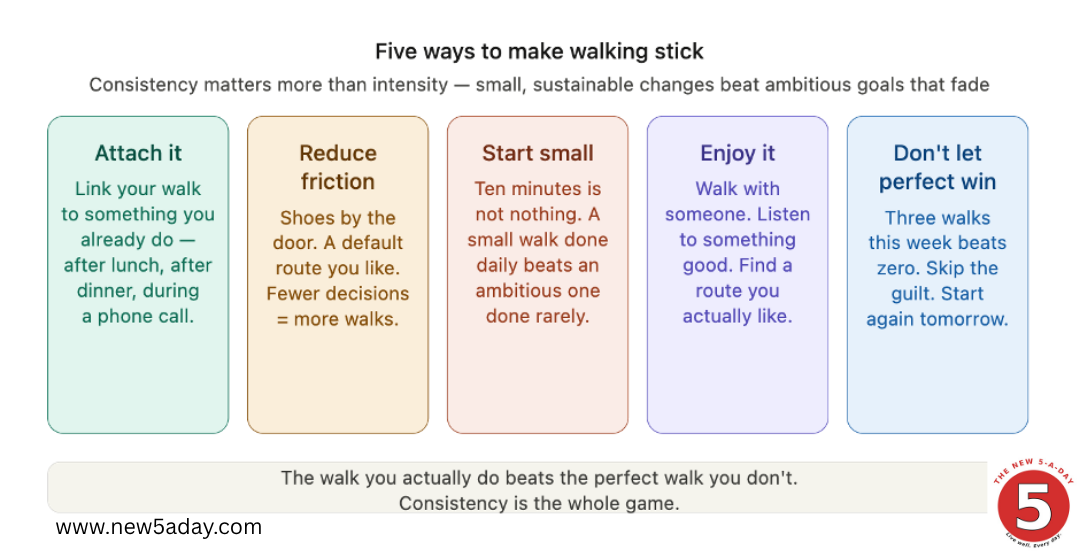
The research is clear that consistency matters more than intensity for most of these benefits. A walk most days beats an occasional long hike followed by weeks of nothing. So the practical question isn't 'how do I walk further?' — it's 'how do I make walking feel easy and normal?'
A few things that tend to help:
• Attach it to something you already do. After lunch, after dinner, during a phone call. The easiest habit to build is one that rides on an existing routine.
• Remove the friction. Keep shoes by the door. Have a go-to route you know is safe and pleasant. Reduce the number of decisions involved.
• Start smaller than feels worthwhile. If ten minutes feels like nothing, start with ten minutes. It's not nothing — and it's much better than zero.
• Make it enjoyable. Walk with someone. Listen to a podcast or music. Find a route you actually like. The walk you enjoy is the one you'll repeat.
• Think in steps, not miles. If tracking helps you, use it. If it creates anxiety, ignore it. Either approach is fine.
If you have health concerns, pain, or haven't been active for a while, it's worth a quick chat with your GP before significantly increasing your activity. But for most people, walking is among the safest forms of exercise to begin — precisely because it's so adaptable to where you are right now.
Bringing it back to The New 5-a-Day
Be Active is Pillar Three of The New 5-a-Day — and walking is perhaps the purest expression of what this pillar is about. Not peak performance. Not gym memberships or race entries or protein shakes. Just moving your body, regularly, in a way that fits your life.
The science couldn't be clearer: walking works. It helps your heart, your blood sugar, your bones, your mood, your sleep, and your brain. It's free, it's accessible, and it starts working from your very first extra steps.
One walk today. A few more this week. That's all it takes to begin.
A note on medical advice: The content in this post is intended to inform and inspire, not to replace professional medical guidance. If anything you've read raises questions or concerns about your own health, please speak to your GP or another qualified health professional.
Want to explore further? This post is the accessible introduction. A detailed evidence-based Deep Dive, a full Reference List, and a podcast episode are all available on this site.
[Read the Deep Dive →] [View the References →] [Listen to the Episode →]
The New 5-a-Day | Be Active 3-1 | Live well. Every day.
