
Quick summary: Every night, while you are fast asleep, your brain quietly gets to work — replaying the day, sorting memories, processing emotions, and generating the mental clarity you will need tomorrow. This happens largely during REM sleep: a remarkable stage that accounts for roughly a quarter of your night. You cannot force more of it into existence, but you can easily sabotage it — and many of us do, without realising. Here is what REM sleep is, why it matters, and what you can do to protect it.
So, what actually is REM sleep?
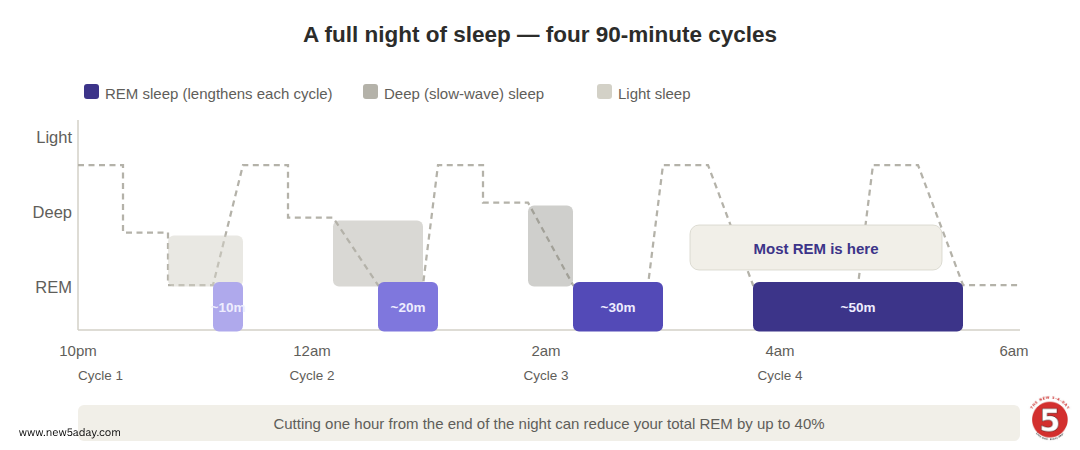
Sleep is not a single, uniform state. It is more like a series of stages your brain moves through in roughly 90-minute cycles, each one doing something different. You start in lighter sleep, drop into deeper, slow-wave sleep — the restorative stage where your body does most of its physical repair work — and then swing back up into REM sleep.
REM stands for Rapid Eye Movement, which is exactly what it sounds like: during this stage, your eyes dart around beneath your closed eyelids, your brain activity surges to levels similar to being awake, and your muscles go largely limp. This is the stage most closely associated with vivid, story-like dreaming. It is also the stage where a great deal of the most important mental work of the night gets done.
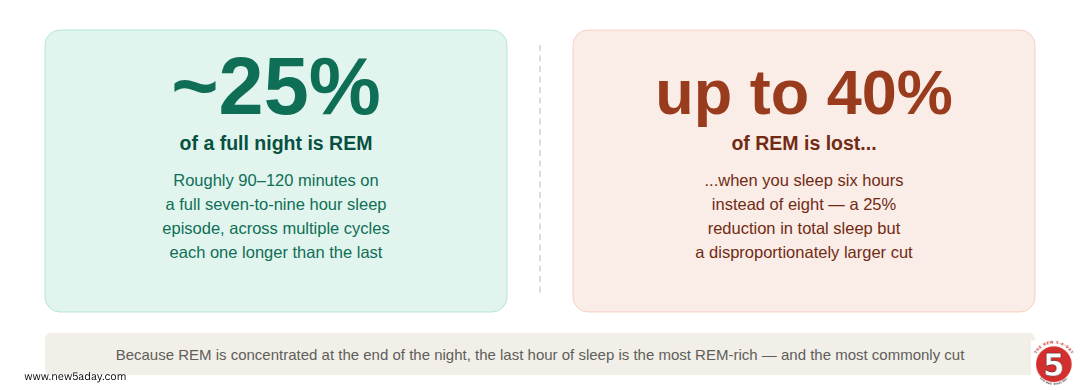
One thing worth knowing: REM sleep is heavily concentrated in the later hours of the night. The earlier cycles of sleep give you more deep sleep; the later ones give you more REM. This means that if you cut your night short — even by an hour or two — you are cutting disproportionately into your REM time. It is a bit like leaving a party early and missing the part of the evening when the good conversations actually happened.
For most healthy adults, REM sleep makes up roughly 20–25% of total sleep. With a full seven to eight hours in bed, that adds up to about 90 to 120 minutes of REM per night — multiple cycles’ worth, each one a little longer than the last.
What is REM sleep actually doing for you?
Quite a lot, it turns out. Researchers have linked REM sleep to several things that most of us care about.
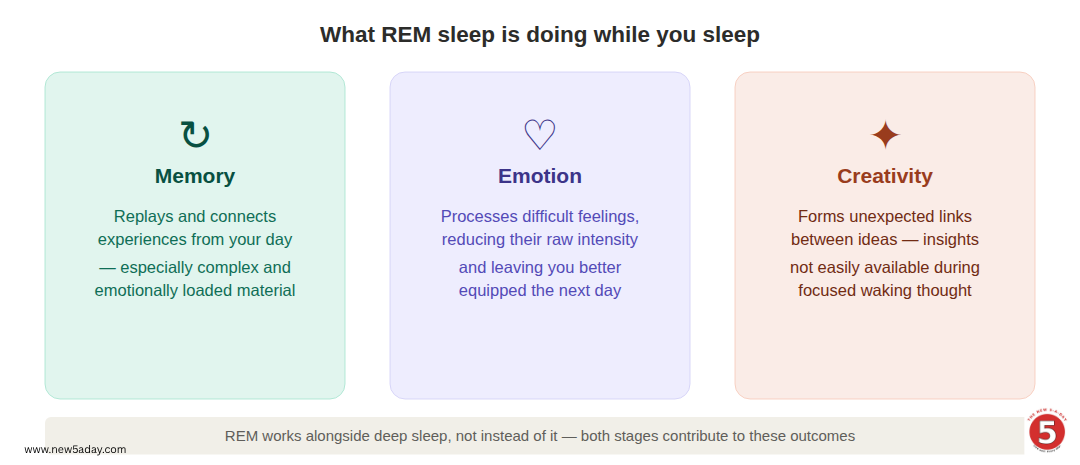
Memory and learning. During REM, your brain replays and consolidates the information you encountered during the day, weaving new knowledge into existing mental frameworks. It appears especially good at processing complex or emotionally loaded information, and at building the kinds of flexible, creative connections between ideas that cannot easily be made in waking hours. This is why you sometimes wake up with a solution to a problem that stumped you the night before.
Emotional balance. REM sleep appears to play a significant role in emotional processing — helping to reduce the raw intensity of difficult experiences and leave you better equipped to handle stress the next day. Research suggests that the amygdala, the brain’s emotional alarm centre, is particularly active during REM, and that this activity is involved in ‘digesting’ emotional memories. When REM is consistently disrupted — by poor sleep habits, alcohol, or an underlying sleep problem — people often find themselves more irritable, more anxious, and less able to manage everyday frustrations.
Creativity and problem-solving. After a good night’s sleep, and especially after REM-rich sleep, the brain tends to be more flexible and associative in its thinking — quicker at spotting patterns, making lateral connections, and generating ideas. This is not mystical. It appears to reflect the brain’s genuine work during the night: reorganising and integrating information in ways that produce new insights.
Daytime energy and sharpness. You can technically clock eight hours in bed and still wake up feeling foggy and flat if your sleep architecture has been disrupted. REM, along with deep sleep, is closely tied to how refreshed, alert, and mentally sharp you feel the following day.
What gets in the way?
Before looking at what helps, it is worth being honest about what does not. Several common habits have a measurable impact on REM sleep, often without people realising.
• Not getting enough sleep overall. Because REM is concentrated at the end of the night, even an hour’s less sleep can significantly reduce your total REM time. Consistently sleeping less than seven hours tends to chip away at this stage more than any other.
• Alcohol in the evening. Alcohol is one of the more reliable suppressors of REM sleep. It may help you fall asleep faster, but it disrupts the normal cycling of sleep stages, particularly reducing REM in the first half of the night. Research shows this effect is dose-dependent: the more you drink, and the closer to bedtime, the bigger the impact.
• Caffeine too late in the day. Caffeine has a longer half-life in the body than most people appreciate. It can delay the time your brain naturally shifts into REM promotion and reduce overall REM duration, sometimes without noticeably affecting how quickly you fall asleep.
• An irregular schedule. Going to bed and getting up at wildly different times from one day to the next disrupts your body clock. This internal clock plays a key role in regulating when REM sleep occurs and for how long. Inconsistency throws the timing off.
• Undiagnosed sleep disorders. Conditions like sleep apnea — where breathing repeatedly pauses during sleep — can fragment or significantly reduce REM sleep. If you regularly snore loudly, wake feeling exhausted despite a full night in bed, or have been told you stop breathing in your sleep, it is worth speaking to a doctor.
How to actually protect your REM sleep
You cannot dial up your REM sleep directly, in the way you might set an alarm. But you can create the conditions under which your brain is most likely to complete its full, natural sleep cycles. Think of it less as engineering and more as not getting in the way.
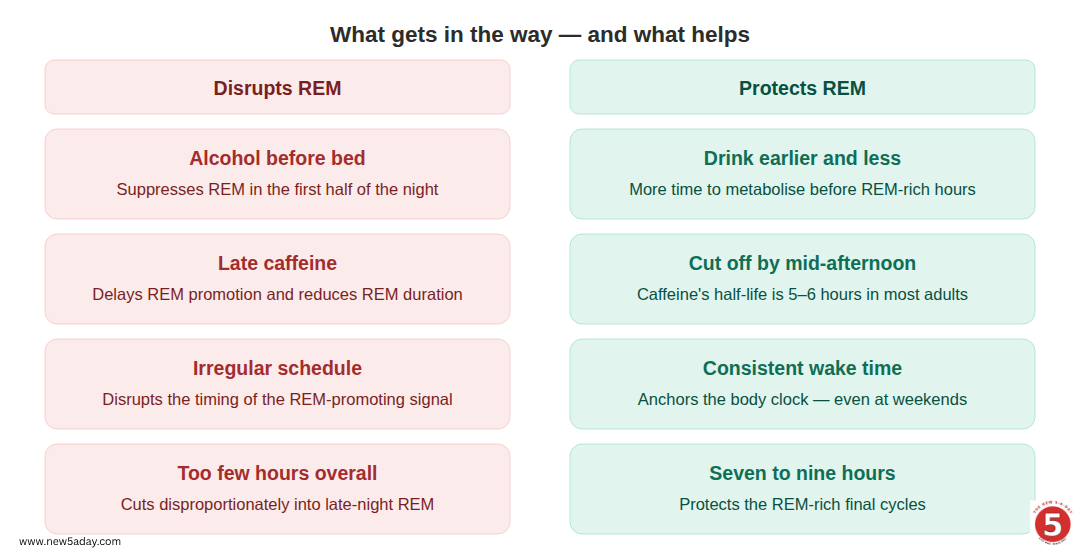
Give yourself enough time in bed. This is the single most impactful thing you can do. Most adults need seven to nine hours. If you are regularly getting six or fewer, REM will be the first casualty. If you cannot make a big change immediately, try nudging your bedtime earlier by fifteen or twenty minutes every few nights until you land somewhere that feels sustainable.
Keep a consistent schedule. Going to bed and getting up at roughly the same time every day — yes, including weekends — helps anchor your body clock. A regular wake time in particular is one of the strongest signals your brain uses to time its sleep stages. The more consistent you are, the more reliably your REM cycles will land where they are supposed to.
Watch the alcohol. This does not have to mean cutting it out entirely, but it is worth being aware of the effect. Drinking earlier in the evening, and drinking less of it, reduces the impact on your sleep architecture. A couple of alcohol-free nights per week is also a reasonable practical step for most people.
Be mindful of late caffeine. A good rule of thumb is to stop caffeinated drinks by mid-afternoon. For people who are more sensitive to caffeine, or who are trying to improve their sleep, cutting off even earlier can make a noticeable difference. Herbal teas or decaf are perfectly reasonable alternatives once the afternoon is underway.
Build a proper wind-down. Your brain needs a transition from the busyness of the day into sleep. A gradual wind-down — dimming the lights, stepping away from screens, doing something calm and low-stimulus in the hour before bed — helps your nervous system settle. A warm shower or bath in that window can also help, because the drop in body temperature that follows gives your brain a useful sleep cue.
Make your bedroom work for sleep. A cool, dark, quiet room makes it easier to stay asleep long enough for your later REM cycles to complete. Blackout curtains or an eye mask, keeping the heating down overnight, and reducing noise where possible are all practical steps. The bedroom should be a place your brain associates with rest, not scrolling or working.
Move your body regularly. Regular physical activity is one of the most reliable ways to improve overall sleep quality. It does not need to be intense: a brisk daily walk, a swim, a cycle, or a fitness class all count. Try to avoid vigorous exercise in the last couple of hours before bed, as it can leave your nervous system too activated to fall asleep easily.
Manage stress where you can. REM sleep is closely tied to emotional processing, and a mind that is wired and anxious at bedtime is not well-placed to move smoothly through its sleep cycles. Simple things — writing down your worries or tomorrow’s to-do list before bed, a few minutes of slow breathing, or a short mindfulness practice — can help quieten the mental chatter enough to sleep properly.
Do you need to track your REM sleep?
Sleep-tracking devices and wearables are more popular than ever, and many of them report on REM. They can be a useful prompt to pay attention to your sleep — but treat the numbers with some caution. Consumer devices vary in their accuracy, and obsessing over percentages can itself become a source of anxiety that makes sleep worse.
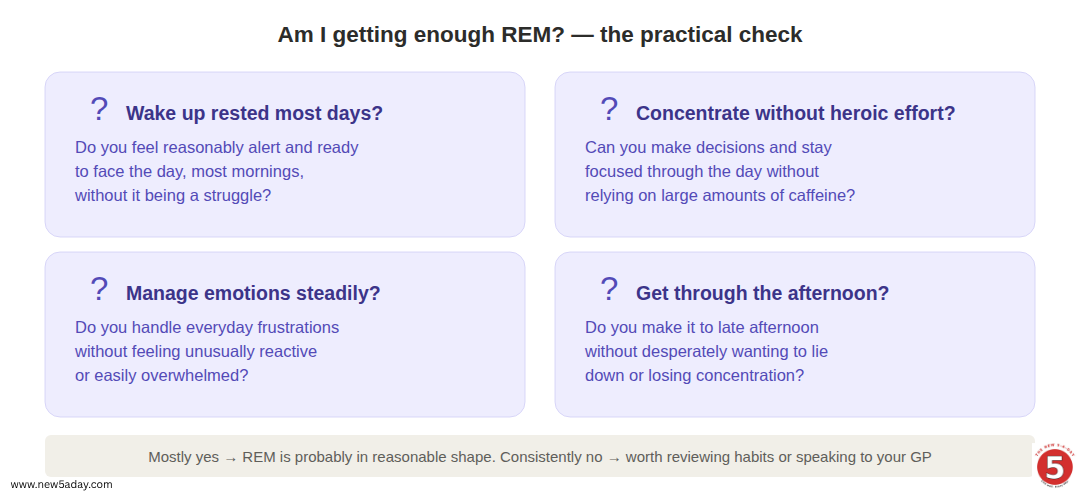
The more reliable signals are the simpler ones: Do you feel reasonably alert and clear-headed during the day? Can you concentrate, make decisions, and manage your emotions without a lot of effort? Do you wake up most mornings without an alarm feeling more or less ready to go? If the answers are broadly yes, your REM is probably in reasonable shape.
If the answers are consistently no — if you regularly feel exhausted despite enough hours in bed, if you struggle with mood and concentration, if a partner has flagged that you snore or seem to stop breathing — it is worth talking to a doctor rather than simply adjusting your wind-down routine.
The quiet investment
REM sleep does not announce itself. You do not feel it happening. But the effects of getting enough of it — or not getting enough — show up clearly in how you think, feel, and function the following day.
Clearer thinking. More balanced emotions. Better recall of what you learned yesterday. A greater capacity to find creative solutions to problems. More resilience when things do not go to plan. These are not small things. They are the building blocks of most of what makes a day go well.
None of the steps that protect REM sleep are complicated. They do not require a gadget, a supplement, or an overhaul of your life. They mostly require giving sleep the time and conditions it needs: a consistent schedule, a proper wind-down, a bedroom set up for rest, and a bit of honesty about the habits — the late coffee, the nightcap, the scrolling until midnight — that quietly chip away at what happens while you are sleeping.
Most of those changes are small. Their effects, over time, are not.
Bringing it back to The New 5-a-Day
Sleep is Pillar One of The New 5-a-Day — and REM sleep sits at the heart of why sleep matters so much. It is the stage where your brain processes the day just gone, makes sense of difficult emotions, consolidates what you have learned, and prepares you for whatever tomorrow brings. It is not a luxury. It is a core part of what good sleep actually does.
The good news is that protecting your REM sleep does not require anything complicated. It mostly requires protecting your sleep full stop — giving it enough time, keeping a consistent schedule, and not actively disrupting it with late alcohol, late caffeine, or a bedroom that works against you. These are the same habits that support every other dimension of good sleep. REM is simply the reminder that those habits pay dividends you do not always see, but will always feel.
A note on medical advice: The content in this post is intended to inform and inspire, not to replace professional medical guidance. Sleep disorders such as sleep apnea require proper diagnosis and treatment — lifestyle changes alone are not a substitute. If you regularly wake unrefreshed despite adequate time in bed, snore loudly, or suspect you may have a sleep problem, please speak to your GP or another qualified health professional.
Want to explore further? This post is the accessible introduction. A detailed evidence-based Deep Dive, a full Reference List, and a podcast episode are all available on this site.
The New 5-a-Day | Sleep Well 1-6 | Live well. Every day.
