Sleep well 1 - How much sleep do we really need?
The most powerful thing you’re probably not doing enough of
Quick summary: Most healthy adults need between 7 and 9 hours of sleep a night. That is not a suggestion or a lifestyle preference — it is what the evidence consistently shows, backed by sleep researchers and medical bodies around the world. Yet a significant number of people are regularly getting less, and most of them think they’re coping fine. This post looks at what sleep actually does for you, what happens when you cut it short, how to find your own personal sweet spot, and a few simple changes that make better sleep more likely — without requiring you to become a different person.
If you’ve ever proudly announced “I’m fine on five hours” while clutching a coffee the size of your head, this post is for you. And before you say you’re different — almost everyone thinks they are.
Sleep is one of the rare levers you can pull that influences almost everything you care about — energy, mood, weight, blood pressure, creativity, patience, even how much you enjoy your evenings. It is not a luxury or a sign of laziness. It is the most powerful piece of free health infrastructure available to you, and most of us are quietly underusing it.
This is Post One in Sleep Well — Pillar One of The New 5-a-Day — and it starts with the most fundamental question: how much sleep do you actually need?
What the research actually says
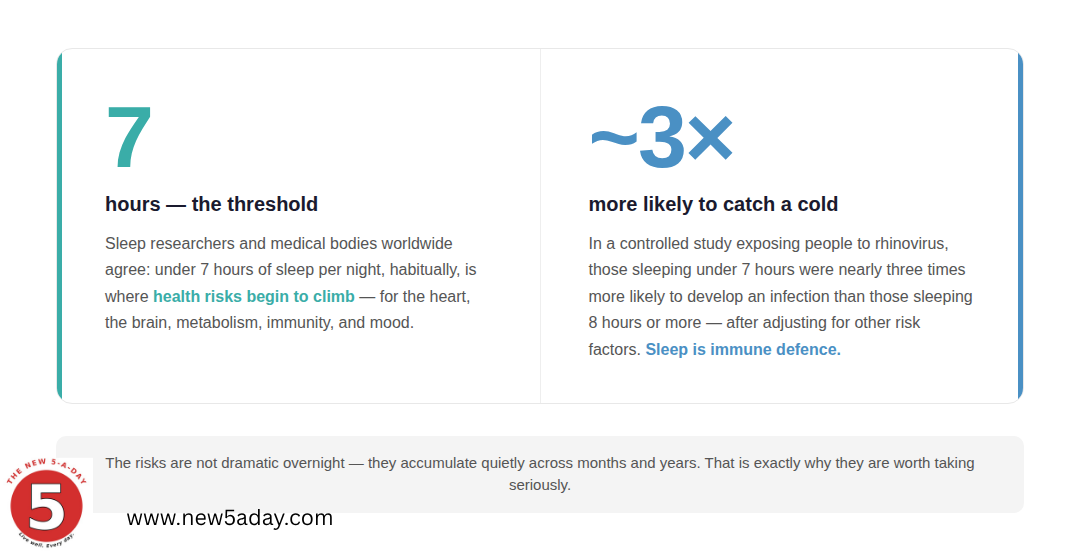
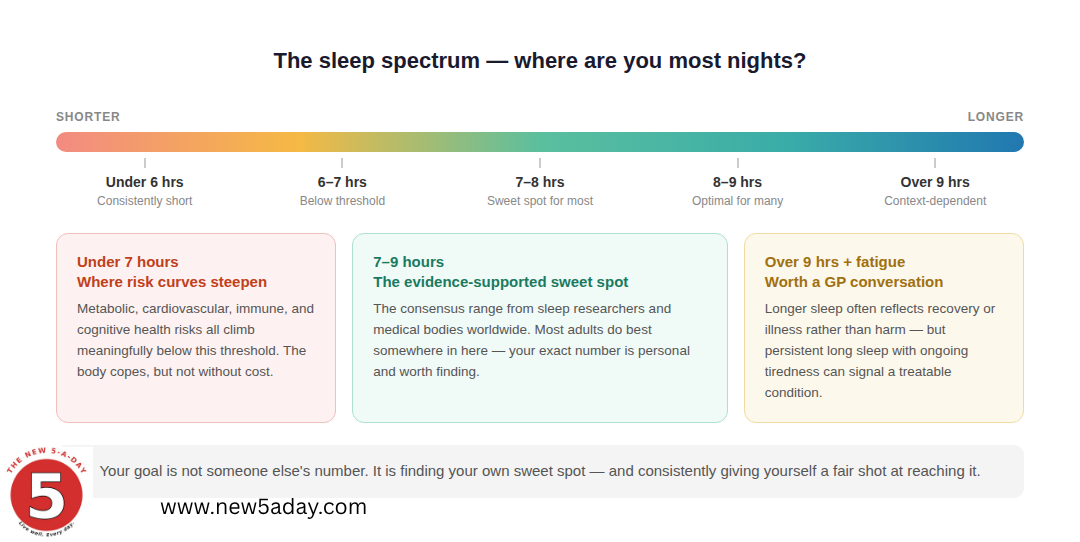
The headline finding is clear: most healthy adults need somewhere between 7 and 9 hours of sleep a night to function well over the long term. Sleep researchers and medical bodies across the world broadly agree on this range, and they agree on one simple rule of thumb: under 7 hours, night after night, is where the health risks start to climb.
That said, it is a range, not a fixed number. Some people genuinely feel best on around 7 hours; others closer to 9. Sleep needs also shift across a lifetime — teenagers need 8 to 10 hours (yes, your 15-year-old who could sleep until noon is not lazy; their brain genuinely needs more), while older adults often do well on 7 to 8. But if you are regularly clocking 5 or 6 hours and calling it normal, there is a good chance your body disagrees. It has simply learned to cope — the way you cope with a slow internet connection. Things get done, but everything is harder and slower than it needs to be.
What happens when we cut sleep short
This is where the story moves from “a bit tired” to “this is quietly affecting everything”.
Your brain goes into low-power mode. Concentration slips, reaction times slow, and memory suffers. You may not fall asleep at your desk, but you are more likely to reread the same email three times, make small errors you would normally catch, and take longer to process decisions. This is why sleep-deprived people are significantly more likely to have car accidents and workplace incidents.
Your mood takes a hit too. Little things feel bigger. You are quicker to snap and slower to recover. Over time, regularly short sleep is linked with a higher risk of depression and anxiety — not as the only cause, but consistently as one of the most fixable pieces of the puzzle.
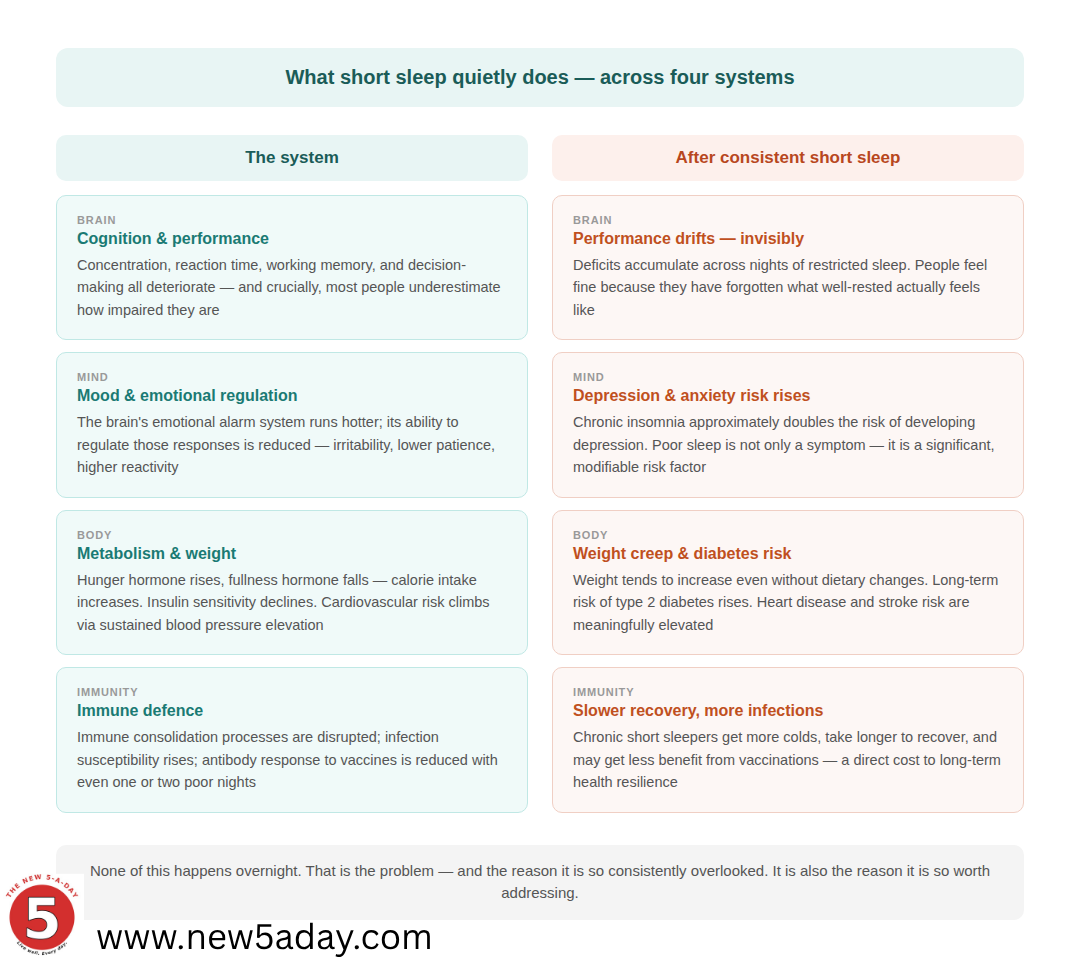
Your body quietly changes the rules. Appetite hormones get out of balance — the “I’m full” signal quietens, the “I’m hungry” signal gets louder, especially for high-calorie foods. Weight tends to creep up even without changes to diet. Blood pressure and inflammation rise. The risk of type 2 diabetes increases. And there is growing evidence that chronically poor sleep impairs the brain’s overnight “clean-up” process — the one that clears the waste products associated with dementia.
None of this happens overnight. That is precisely the problem. It is a slow drift, not a cliff edge — which is exactly why it is so easy to ignore, and so valuable to correct early.
The myth of the 5-hour superhero
Modern life loves a hustle story. There is a persistent idea that truly driven people sleep 5 hours a night and thrive on it. In reality, when researchers test self-proclaimed short sleepers in the lab, most show subtle but real deficits: slower reactions, more errors, mood instability, and metabolic changes. They feel fine because they have forgotten what “great” feels like.
Think of it like always driving with your fuel light on. You learn to live with it. But life would be easier if you started the day with a full tank.
Finding your sleep sweet spot
Instead of treating sleep as something you “should” do, try treating it as a personal experiment. The aim is not perfection; it is feeling a bit better, a bit more often.
Pick a week when you have a little more control over your mornings. Choose a consistent bedtime that allows for your target sleep, minimise alarms if you can, and note roughly when you fall asleep, wake up, and how you feel during the day. After a few nights, your body tends to settle into what it naturally wants. That information is genuinely useful.
Then ask yourself the daytime questions: Can I stay awake in meetings without fighting for it? Can I get through the morning without relying on coffee as a life-support system? Do I feel reasonably even-tempered rather than on a hair trigger? If the answer to most of those is “no”, you are probably not meeting your sleep need — even if you are technically hitting 7 hours.
Simple changes that make a real difference
Improving sleep does not have to mean a 9pm bedtime and total abstinence from Netflix or a late-night glass of wine. Small changes add up. A few that give the most return for the effort:
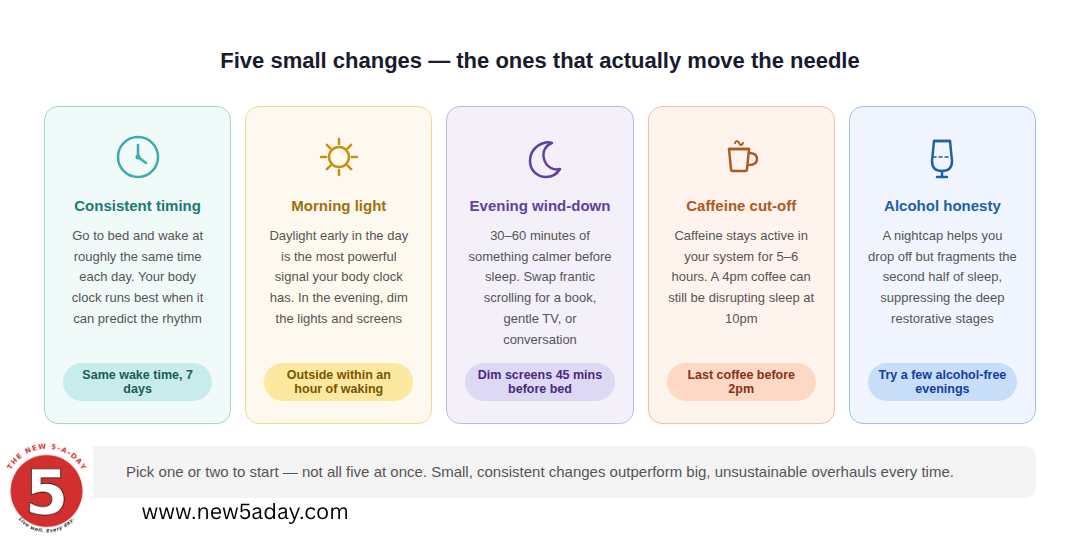
• Regular-ish timing. Go to bed and get up at roughly the same time most days, including weekends. You do not have to be perfect, but big swings confuse your body clock.
• Light in the morning, dim in the evening. Daylight early in the day helps your body know when morning is. In the evening, think “cosy pub” rather than “supermarket lighting”.
• Wind down before bed. You do not need to ban screens, but try swapping frantic scrolling for something calmer in the 30 to 60 minutes before sleep — a book, gentle TV, or a conversation with someone in the actual room.
• Caffeine timing. Coffee is not the enemy, but it can linger in your system for hours. Many people sleep better when they keep caffeine to the morning or early afternoon.
• Alcohol honesty. A nightcap can make you feel sleepy, but it tends to fragment sleep and reduce its quality. If you are struggling, a few alcohol-free nights can be surprisingly revealing.
When to talk to your GP
Sometimes, more sleep opportunity and better habits are not enough — and that is not a personal failing. It may simply mean there is something medical worth addressing. It is worth seeking help if you allow yourself enough time in bed but still struggle to fall or stay asleep most nights; if you snore loudly or your partner notices you seem to stop breathing; if you wake unrefreshed no matter how long you sleep; or if your sleep problems are affecting your mood, work, or safety.
Conditions like sleep apnoea and insomnia are common, often underdiagnosed, and very treatable. Asking for help is not making a fuss. It is a practical step towards feeling better now and protecting your long-term health.
Bringing it back to The New 5-a-Day
Sleep Well is Pillar One on The New 5-a-Day for a good reason — and it is hard to overstate how much sleep threads through everything else in The New 5-a-Day. Better sleep makes it easier to eat well, to exercise, to manage stress, and to show up for the people around you. It is foundational in a way that almost nothing else is.
You do not have to become a different person. You do not need a perfect routine or a Pinterest-ready bedroom. You just need to tilt the balance a little in your favour:
• Aim for at least 7 hours when you reasonably can.
• Notice how you feel when you get closer to your personal sweet spot.
• Protect the simple habits that make good nights more likely.
• Ask for help if you suspect something more is going on.
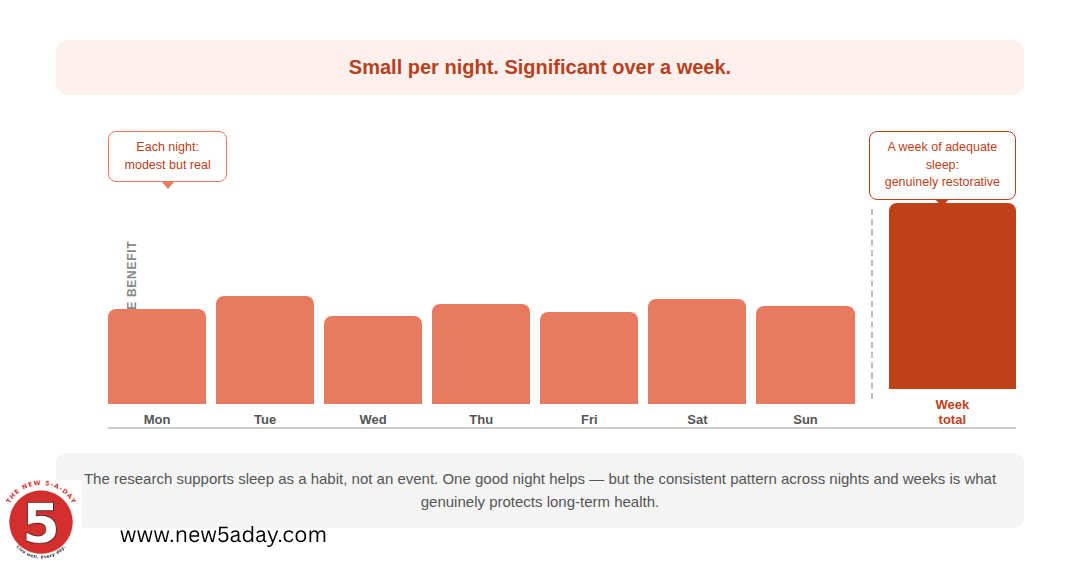
Think of it as upgrading your default setting from “always running on low battery” to “usually charged enough to enjoy your life”. That is what better sleep is really about — not perfection, but giving yourself a fair shot at a longer, healthier, more enjoyable time on this planet, one night at a time.
A note on medical advice: The content in this post is intended to inform and inspire, not to replace professional medical guidance. If anything you’ve read raises questions or concerns about your own health, please speak to your GP or another qualified health professional.
Want to explore further? This post is the accessible introduction. A detailed evidence-based Deep Dive, a full Reference List, and a podcast episode are all available on this site.
[Read the Deep Dive →] [View the References →] [Listen to the Episode →]
The New 5-a-Day | Sleep Well 1 | Live well. Every day.
