Music - a soundtrack for peace and quiet
Quick summary: Music is one of the most accessible and genuinely effective tools for managing stress and anxiety — and the research behind it is more solid than you might expect. Regular listening to music you find calming can lower your heart rate, reduce stress hormones, ease anxiety, and improve the quality of your sleep. It works with other physical activities too, making your walks, stretches, and wind-down routines noticeably more restorative. You probably already have everything you need. All that remains is to press play.
Think about the last time a piece of music stopped you in your tracks. Not stopped you to pay attention — actually stopped you. The unexpected guitar break on a half-remembered song. A piece of classical music drifting from a neighbouring café. A melody you haven't heard since you were a teenager that somehow pulls you back to exactly where you were standing the first time you heard it.
Music does something to us that very few other things can. It reaches past the part of the brain that handles logic and analysis and goes straight somewhere else — somewhere older, quieter, and rather more in charge of how we actually feel.
And while the emotional power of music has been recognised for centuries, science has spent the last few decades catching up. What it has found is both unsurprising and genuinely encouraging: listening to music, especially music you find relaxing or personally meaningful, is good for you. Not in a vague, feel-better way. In a measurable, body-responding, stress-hormone-dropping way.
What actually happens when you listen
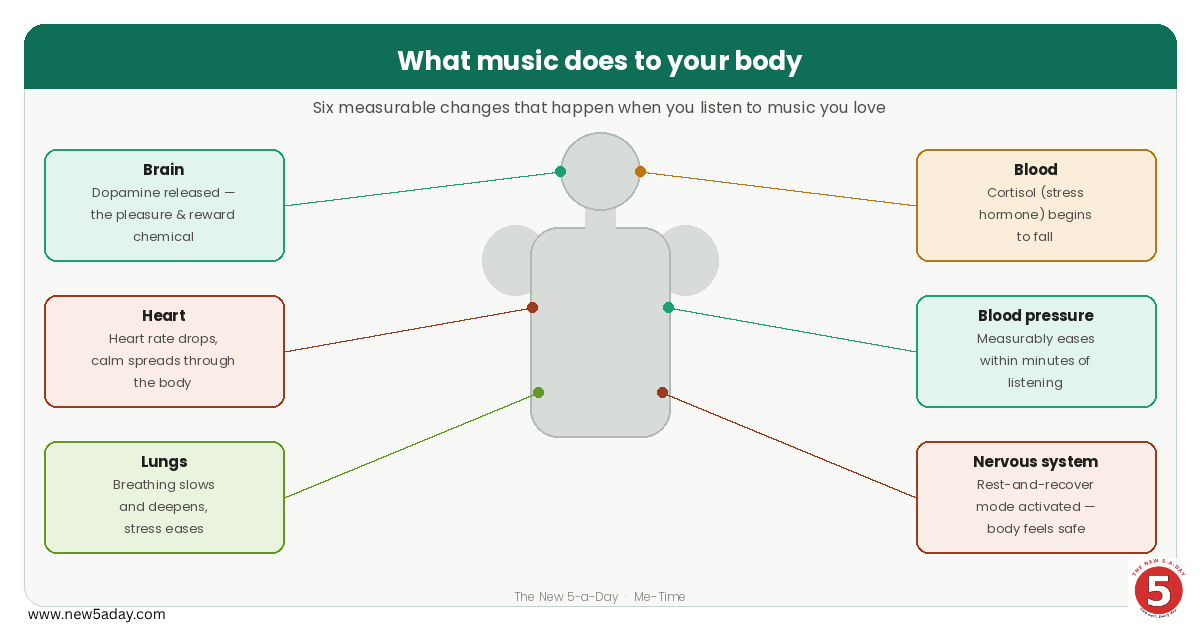
When you hear music that your brain finds pleasing, it responds. The brain releases dopamine — the same chemical associated with pleasure, motivation, and reward. At the same time, the part of your nervous system responsible for rest and recovery — sometimes called the rest-and-digest system — becomes more active.
In practical terms, this means your breathing slows. Your heart rate drops. Blood pressure eases. Stress hormones, including cortisol — the chemical your body produces when it's under pressure — begin to fall. This isn't just how it feels. It's what instruments in a laboratory can measure.
Multiple large reviews of the research have confirmed these effects across a wide range of settings — from everyday listening at home to patients in hospitals preparing for surgery. The consistency of the findings is genuinely striking. Music, reliably and measurably, tells your body it is safe to relax.
The stress connection
One of the clearest things the research shows is that music helps with stress and anxiety. Not just the feeling of stress — the physical signs of it.
When life becomes overwhelming, worry can become a kind of loop: your thoughts race, your body tenses in response, and the tension makes it harder to think clearly, which feeds the worry. Music can interrupt this cycle. It shifts focus, gives the mind somewhere else to go, and slows the physical arousal that keeps the loop going.
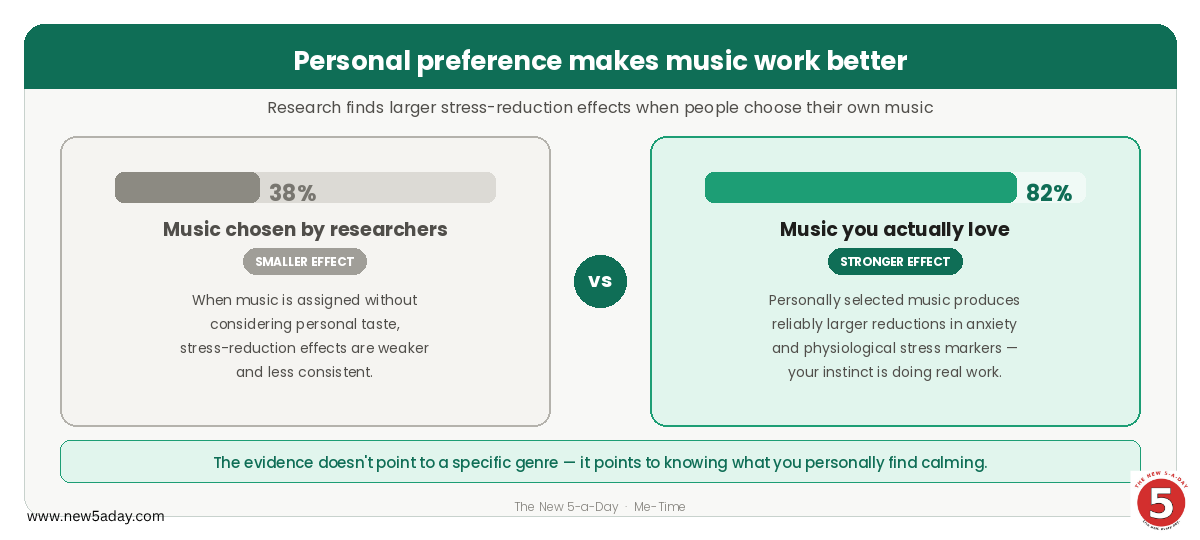
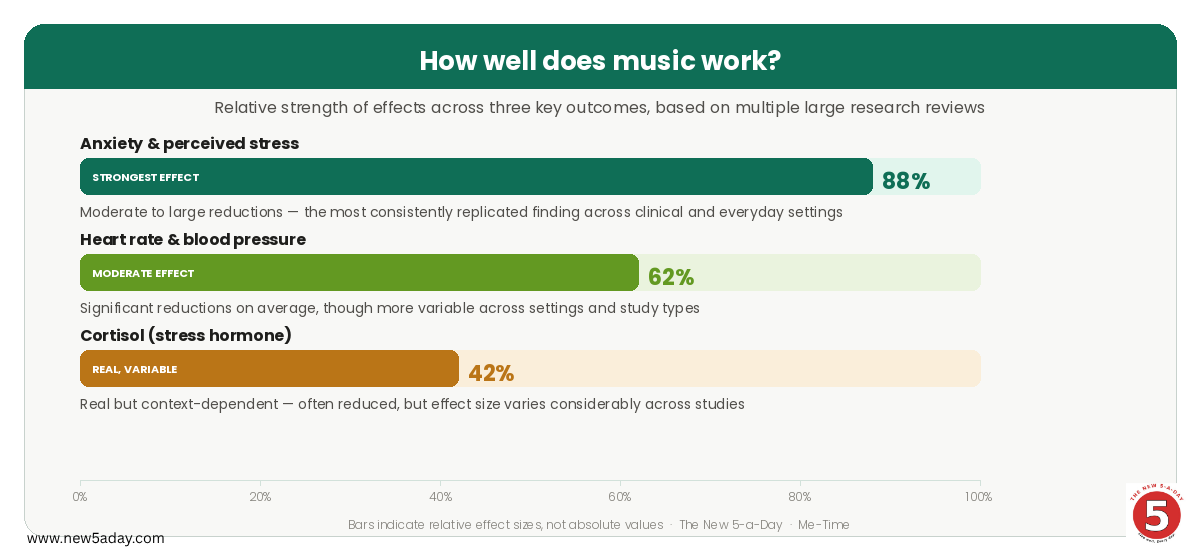
Across clinical and non-clinical populations — meaning both people dealing with significant anxiety and those managing the ordinary pressures of everyday life — music listening has been shown to produce reliable reductions in anxiety and perceived stress. This effect tends to be strongest with music you find personally calming: familiar melodies, slower tempos, and genres associated with relaxation outperform unfamiliar or stimulating music in the research.
It is worth noting that not all music is equally helpful. Slow, soft, or personally meaningful tracks tend to work well. Very loud, aggressive, or emotionally agitating music can have the opposite effect — raising rather than reducing arousal. The good news is that most of us have a reasonably good instinct for which category our favourites fall into.
Music and sleep
One of the most practically useful things music can do for stress is improve sleep — and the evidence here is particularly strong.
Stress and poor sleep have a frustrating habit of feeding each other. When you're anxious, your mind won't settle. When you haven't slept, everything feels harder and more stressful. Music offers a way into this cycle from both ends.
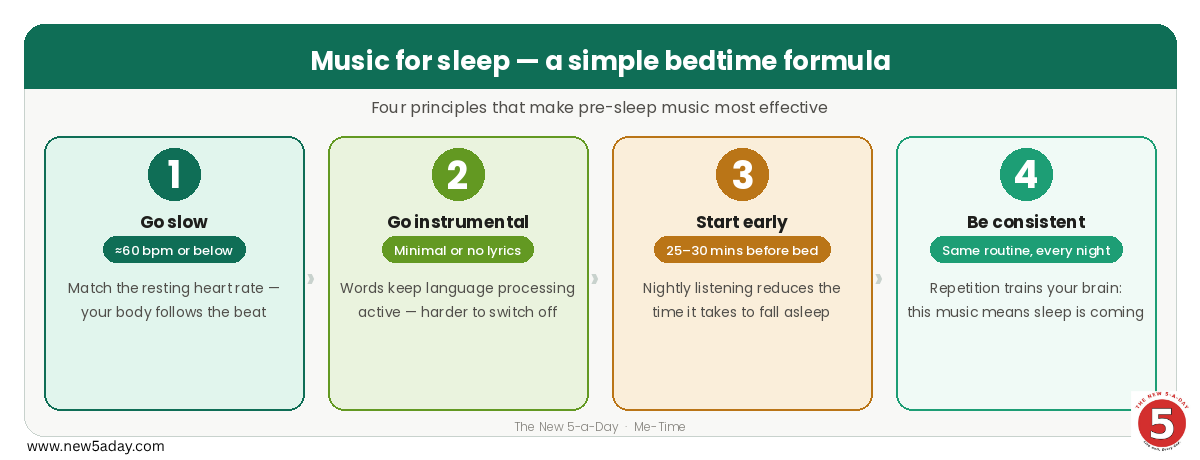
Research into adults with insomnia has found that nightly music listening — even just twenty-five to thirty minutes before bed — can improve sleep quality and reduce the time it takes to fall asleep. The effect accumulates over time: the more consistently you listen, the more reliable the benefit becomes. Over weeks and months of regular use, music can become a genuine signal to your body and brain that sleep is approaching.
The best music for sleep tends to be slow — ideally around sixty beats per minute or below, which roughly matches the resting heart rate — instrumental rather than lyric-heavy, and free from sudden loud moments or dramatic shifts in pace. Ambient, classical, or lo-fi music tends to work well. The particular genre matters less than the overall feel: calm, unhurried, safe.
Music as a companion to movement
There is a reason almost everyone who exercises with headphones in won't let you anywhere near their playlist. Music and movement are a natural pairing — and not just because a good beat helps you keep pace.
Music makes physical activity feel less effortful. It provides distraction from discomfort, improves mood, and can help sustain effort for longer. But it also amplifies the restorative quality of gentler activities — the kind of movement that Be Active is really about.
A walk with music you love is a different experience to the same walk in silence. Not necessarily better — sometimes silence is exactly what you need — but different. The music gives your mind a place to rest while your body moves, and the combination can produce a genuine sense of calm that stays with you afterwards.
The same is true of stretching, yoga, and any deliberate wind-down routine. Music slows the pace of the experience, encourages deeper breathing, and makes it easier to stay present rather than rushing through to the next thing. If you find it difficult to give yourself permission to rest, music can help create the conditions in which rest becomes possible.
A word on what music can and can't do
It would be doing the research a disservice not to say this: music is a tool, not a treatment. It is particularly helpful as part of a broader approach to managing stress — alongside sleep, movement, time outside, and connection with other people. Used alongside those things, it can make a real difference. Used instead of them, or instead of professional support when that's what is genuinely needed, it will fall short.
Some of the more expansive claims made about music — that it can heal the body, resolve depression, or produce profound long-term changes in physical health on its own — outrun what the current evidence actually supports. What is well-supported is meaningful enough: music reduces anxiety, lowers physical stress responses, and improves sleep. For something this accessible and this free, that's quite a lot.
How to start — or start again
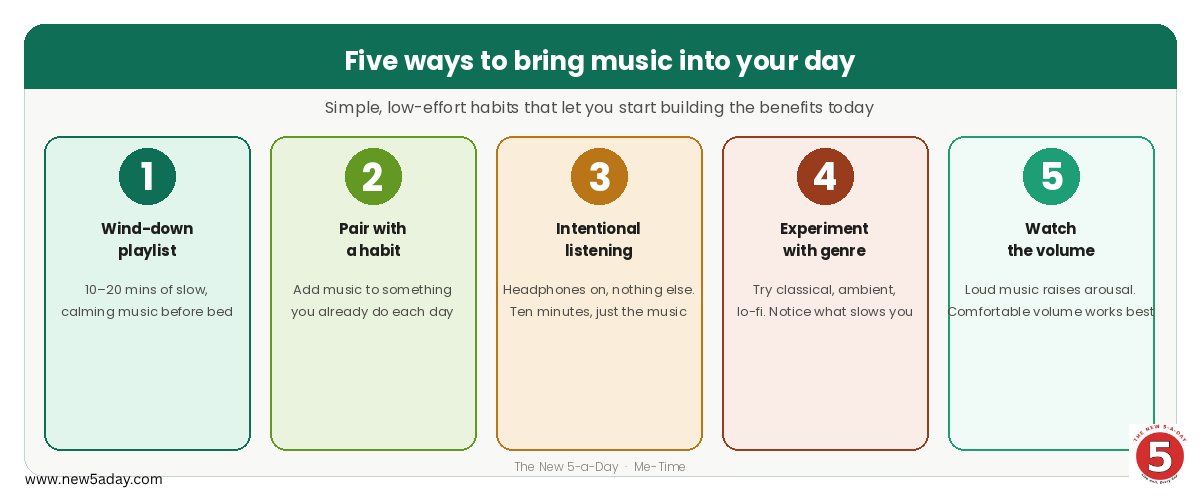
The good news about adding music to your life for stress and relaxation is that there is almost nothing to set up. You almost certainly already have the means. Here are a few places to begin:
Create a short wind-down playlist. Ten to twenty minutes of slow, calming music to play before bed or during a deliberate rest break. Revisit it regularly and adjust it to what actually works for you.
Pair it with something you already do. Your morning coffee, an evening walk, a stretch before bed. The habit doesn't need to be new — the music just joins it.
Experiment with genre. Classical, ambient, jazz, lo-fi, nature sounds with soft instrumentation — there is no universally correct answer. The question is what actually slows you down. Try things. Notice what works.
Try intentional listening. Not music as background noise while you work, but music as the actual activity. Sit down. Put headphones on. Let it be what you are doing for ten minutes. It sounds simple because it is.
Bringing it back to The New 5-a-Day
Me-Time is Pillar Four of The New 5-a-Day — and music sits right at the heart of what this pillar is really about. Not a grand gesture. Not an hour carved out of an impossible schedule. Just a moment that belongs to you: a few minutes with something you love, that asks nothing of you except to listen.
Music does that. Quietly, simply, with almost no effort on your part. It is one of those rare health tools that works better the more you enjoy it — and that asks nothing of you except to pay a little attention to what you listen to, and when.
In a world that rarely stops demanding things from you, that feels like rather a good deal.
A note on medical advice: The content in this post is intended to inform and inspire, not to replace professional medical guidance. If anything you've read raises questions or concerns about your own health, please speak to your GP or another qualified health professional.
Want to explore further? This post is the accessible introduction. A detailed evidence-based Deep Dive, a full Reference List, and a podcast episode are all available on this site.
