Macronutrients and metabolic health: what the evidence actually shows

Key takeaways: The macronutrient framework — carbohydrates, protein, and dietary fat — is among the most robustly studied areas in nutritional science. The evidence supports several clear conclusions: carbohydrate quality (whole-grain versus refined) is a stronger predictor of metabolic health outcomes than carbohydrate quantity alone; higher-protein diets consistently demonstrate advantages for satiety, body composition, and lean mass preservation; and dietary fat type — unsaturated versus saturated — is more clinically meaningful than total fat intake. No single macronutrient ratio has been universally shown to be optimal. Overall dietary pattern quality, rather than macro arithmetic, is the most consistent predictor of long-term health.
This Deep Dive examines the evidence across four main areas: how macronutrients supply and regulate energy; the metabolic effects of carbohydrate quality and quantity; the role of protein in satiety and body composition; and the evidence on dietary fat type and cardiovascular health. Where claims from the Open Post require qualification, those are noted.
How macronutrients supply and regulate energy
The three macronutrients differ in energy density and in the metabolic pathways through which they are processed. Carbohydrates and protein each provide approximately 4 kilocalories per gram; dietary fat provides approximately 9 kilocalories per gram.
The actual metabolic impact of any macronutrient depends on several additional variables. The thermic effect of food — the energy cost of digestion and processing — is highest for protein at approximately 25–30% of calories consumed, lower for carbohydrate at 5–10%, and lowest for fat at 0–3%. A calorie of protein therefore has a meaningfully lower net energy impact than a calorie of fat. The glycaemic response — the speed and magnitude of blood glucose rise following carbohydrate consumption — varies substantially with fibre content, degree of processing, and food matrix. And different macronutrients trigger distinct hormonal responses governing appetite and satiety, with downstream effects on total energy intake.
The simplified “calories in, calories out” framework captures a meaningful truth about energy balance but obscures the extent to which macronutrient composition influences the hormonal environment governing appetite and energy expenditure. This is the mechanistic basis for the argument that macro composition matters beyond calorie counting alone.
Carbohydrate quality versus quantity
The most important finding from decades of carbohydrate research is that quality — defined by degree of processing, fibre content, and glycaemic profile — is a substantially more reliable predictor of health outcomes than total carbohydrate quantity.
KEY RESEARCH
Shan, Z., Rehm, C., Rogers, G., Ruan, M., Wang, D., Hu, F., Mozaffarian, D., Zhang, F., & Bhupathiraju, S. (2019). Trends in dietary carbohydrate, protein, and fat intake and diet quality among US adults, 1999–2016. JAMA, 322(12), 1178–1187. https://doi.org/10.1001/jama.2019.13771
This nationally representative analysis confirmed that although overall carbohydrate intake declined modestly over two decades, the quality of carbohydrates consumed remained poor — refined grains, added sugars, and starchy vegetables continuing to dominate. The finding underscores a persistent gap between public health messaging to reduce carbohydrates and the more clinically meaningful goal of improving carbohydrate quality.
The glycaemic index, dietary fibre, and metabolic health
The glycaemic index (GI) and glycaemic load (GL) quantify the blood glucose response to carbohydrate-containing foods. High-GI foods — refined white bread, sugary beverages, most processed breakfast cereals — produce rapid and substantial rises in blood glucose and insulin. Low-GI foods — legumes, oats, intact whole grains, most fruit — produce smaller, more gradual responses. Large prospective cohort studies and meta-analyses have found consistent associations between higher dietary GI and GL and increased risk of type 2 diabetes and cardiovascular disease, independent of total carbohydrate or calorie intake. Effect sizes are modest but replicate across multiple study populations and designs.
Dietary fibre has independent mechanistic importance. Soluble fibre — found in oats, legumes, barley, and fruit pectin — forms a gel in the gastrointestinal tract that slows glucose absorption, reduces cholesterol reabsorption, and supports the growth of beneficial gut microbiota. Insoluble fibre — from whole wheat, vegetables, and nuts — adds bulk, supports gut motility, and is associated with reduced colorectal cancer risk. UK population fibre intake averages around 18 grams per day, substantially below the recommended 30 grams.
KEY RESEARCH
Arshad, M., Maqsood, S., Altalhi, R., Shamlan, G., Ahmed, I., Ikram, A., & Abdullahi, M. (2025). Role of dietary carbohydrates in cognitive function: A review. Food Science & Nutrition, 13. https://doi.org/10.1002/fsn3.70516
This 2025 review confirms that high intake of simple sugars and refined carbohydrates is associated with poorer cognitive outcomes, while diets rich in complex carbohydrates and dietary fibre from legumes, whole grains, and vegetables are associated with better cognitive performance and reduced risk of cognitive decline. Proposed mechanisms include effects on neuroinflammation, brain glucose metabolism, and the gut-brain axis.
Protein: satiety, body composition, and lean mass preservation
Protein is the macronutrient with the strongest and most consistent evidence for effects on satiety, body composition, and lean mass maintenance. The thermic effect of protein — approximately 25–30% of calories consumed — is substantially higher than that of carbohydrate or fat, meaning that higher-protein diets produce modestly greater energy expenditure for equivalent food intake. Protein also exerts robust effects on appetite-regulating hormones: high-protein meals suppress ghrelin (the primary hunger-stimulating hormone) more effectively than isocaloric carbohydrate or fat meals, and more strongly stimulate peptide YY and GLP-1 — hormones associated with satiety.
KEY RESEARCH
Carreiro, A., Dhillon, J., Gordon, S., Higgins, K., Jacobs, A., McArthur, B., Redan, B., Rivera, R., Schmidt, L., & Mattes, R. (2016). The macronutrients, appetite, and energy intake. Annual Review of Nutrition, 36, 73–103. https://doi.org/10.1146/annurev-nutr-121415-112624
This comprehensive review confirmed protein as the macronutrient with the most robust satiety effects, while noting important individual variation and the dependence of protein effects on total energy balance and eating context. It also highlighted that predicting body weight or appetite from macronutrient composition alone is limited — food quality and eating behaviour matter alongside macro ratios.
For body composition, the evidence for higher protein intake is particularly strong in the context of energy restriction and resistance exercise. Meta-analyses consistently find that higher-protein diets preserve lean mass more effectively than lower-protein diets during weight loss. The sports nutrition literature typically cites approximately 1.6–2.2 grams per kilogram of body weight per day as optimal for muscle protein synthesis in those engaged in regular resistance training, though individual variation is considerable. For older adults, the progressive loss of skeletal muscle with ageing — sarcopenia — makes adequate protein intake particularly important, with evidence suggesting older adults may require somewhat higher intakes than current UK population recommendations (0.75g/kg/day) to preserve muscle mass.
Dietary fat: type matters more than total intake
The history of dietary fat guidance is one of the more instructive episodes in nutritional epidemiology. The low-fat consensus that dominated public health messaging from the 1960s through the 1990s rested on associations between saturated fat, LDL cholesterol, and cardiovascular disease. Subsequent research has substantially complicated and refined this picture.
The current evidence indicates that dietary fat type is a more clinically meaningful variable than total fat intake. Replacing saturated fat with unsaturated fat — particularly polyunsaturated fat from vegetable oils, nuts, seeds, and oily fish — is associated with reduced cardiovascular risk in large prospective cohort studies and several controlled trials. Critically, replacing saturated fat with refined carbohydrates does not improve and may worsen cardiovascular risk profiles — which is what occurred in many populations during the low-fat era, as food manufacturers substituted sugar and refined starch for fat in processed products.
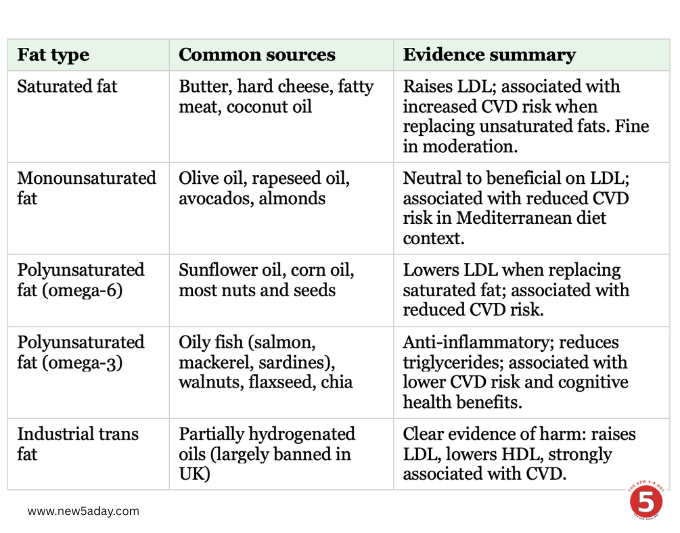
The practical implication: the priority is not to reduce total fat intake but to shift the balance toward unsaturated sources — olive oil, nuts, seeds, oily fish, and avocado — and to moderate rather than eliminate saturated fat from meat and dairy.
Is there an optimal macronutrient ratio?
KEY RESEARCH
Lou, Y., Wang, H., Wang, L., Huang, S., Xie, Y., Song, F., Lu, Z., Wang, F., Jiang, Q., & Cao, S. (2025). Comparison with dietary groups of various macronutrient ratios on body weight and cardiovascular risk factors in adults: A systematic review and network meta-analysis. Nutrients, 17. https://doi.org/10.3390/nu17162683
This 2025 network meta-analysis compared multiple dietary patterns with different macronutrient profiles on weight and cardiovascular risk factor outcomes in adults. Its principal finding was that several different macronutrient combinations can achieve meaningful improvements, and that differences between dietary groups were often modest and not clearly superior across outcomes. Food quality — the degree of processing and specific sources of each macronutrient — explained more variance in outcomes than macro ratios alone.
KEY RESEARCH
Kwon, Y., Lee, H., Park, J., & Lee, J. (2020). Associating intake proportion of carbohydrate, fat, and protein with all-cause mortality in Korean adults. Nutrients, 12. https://doi.org/10.3390/nu12103208
This large prospective cohort study found that both very low and very high carbohydrate intakes were associated with increased all-cause mortality risk, with lowest risk at approximately 50–60% of total energy from carbohydrate. This U-shaped relationship supports the general case for moderation across macronutrients rather than extreme restriction of any single category.
The current balance of evidence does not support recommending a specific macronutrient ratio for the general population. The most consistent finding across large epidemiological datasets and clinical trials is that dietary patterns characterised by a predominance of whole grains, legumes, vegetables, fruits, lean protein, and unsaturated fats are associated with the best long-term health outcomes — regardless of the precise macro percentages those patterns happen to produce.
The limits of macronutrient science
Several important caveats accompany any evidence-based account of macronutrient research. Most nutritional epidemiology relies on self-reported dietary recall or food frequency questionnaires with well-documented measurement limitations. People systematically under-report intake of foods they perceive as unhealthy and over-report intake of foods they perceive as healthy — measurement error that can both inflate and attenuate associations.
Macronutrient intake is highly correlated with other aspects of diet, lifestyle, and socioeconomic status, making it difficult to isolate the effects of specific macro ratios from overall dietary pattern or confounding variables. A person eating more whole-grain carbohydrates is typically also eating more vegetables and less processed food; attributing observed health benefits specifically to the carbohydrate is methodologically challenging.
Individual variation is substantial and underappreciated. Glycaemic responses to identical foods can vary dramatically between individuals, as demonstrated by large continuous glucose monitoring studies in non-diabetic populations. Protein requirements vary with age, body composition, physical activity, and metabolic phenotype. These population-level averages mask important individual variation, counselling against overconfidence in precise recommendations and strongly supporting a pattern-based rather than arithmetic approach to eating well.
Bringing it back to The New 5-a-Day
Eating well is Pillar Two of The New 5-a-Day. The macronutrient evidence base supports an approach that is principle-driven rather than ratio-driven: prioritise whole-grain and high-fibre carbohydrates; include quality protein at most meals from varied sources; favour unsaturated fats from olive oil, nuts, seeds, and oily fish; and view the overall dietary pattern — across days and weeks, not individual meals — as the thing that matters most.
The science does not point to a revolutionary new approach. It largely confirms that traditional, varied, predominantly whole-food diets are well-designed for human metabolic health. The modern departure from those patterns — toward heavily processed, refined, and nutritionally degraded food — rather than macronutrient arithmetic, is the primary public health concern. That is a useful reframe: the goal is not to optimise a ratio but to return, as much as practically possible, to food that resembles what it was before industrial processing got to it.
A note on medical advice: This Deep Dive is intended for readers who want to engage with the evidence in more depth. It does not replace professional medical or nutritional advice. If you are managing a health condition affected by diet — including diabetes, cardiovascular disease, or kidney disease — please speak to your GP or a qualified dietitian.
Want to read further? Full citations for all research referenced in this post are available in the accompanying Reference List.
