
Diet-quality constructs, the pattern-based evidence for healthy eating, the physiology of satiety and energy stability, why restrictive diets underperform, and the case for judging balance over time
Companion to: Eat Well Open Post 2-6 — Balance, not perfection: what a balanced diet really means and how to actually live it. This Deep Dive examines the evidence base in greater technical depth. Readers seeking the accessible introduction should begin with the Open Post.
Key takeaways: “Balance” is not a vague aspiration but a measurable construct: diet-quality indices formalise it as the combination of variety, adequacy, moderation, and proportion, and higher scores on these indices are associated with more favourable cardiometabolic risk profiles. Greater dietary variety independently increases the probability of meeting micronutrient requirements. The strongest and most consistent evidence in nutrition concerns dietary patterns rather than single nutrients: patterns rich in vegetables, fruit, whole grains, legumes, nuts, and unsaturated fats, and low in refined grains, processed meat, and sugary foods, are associated with reduced risk of cardiovascular disease, type 2 diabetes, obesity, several cancers, and premature death. Carbohydrate quality predicts outcomes more reliably than carbohydrate quantity. Meals higher in protein, fibre, and slower-digesting carbohydrates support satiety and steadier energy through well-characterised physiological mechanisms. Restrictive “fad” diets are frequently nutritionally inadequate, hard to sustain, prone to weight cycling, and not superior to flexible balanced patterns over the long term. No single macronutrient ratio is established as universally optimal; overall pattern quality, judged across weeks rather than meals, is the more consistent predictor of long-term health. The plate model is a public-health communication tool rather than a tested intervention, but it is consistent with the pattern-based evidence.
This Deep Dive accompanies Open Post 2-6 of Eat Well. It examines what “balance” means in formal nutritional terms, the evidence for a pattern-based rather than nutrient-by-nutrient approach to healthy eating, the physiology underlying satiety and energy stability, why restrictive diets tend to underperform, and the rationale for judging dietary balance over extended timeframes. Where the Open Post offers accessible guidance, this post engages the mechanistic and epidemiological detail, and notes methodological limitations where they bear on interpretation.
How researchers study balanced eating
The evidence base draws on several designs. Diet-quality indices — composite scores that grade a person’s intake against defined criteria — allow researchers to quantify “balance” and relate it to health outcomes. Large prospective cohort studies link dietary patterns, derived statistically or by index, to disease incidence and mortality across years of follow-up; they detect associations reliably but cannot establish causation, and residual confounding is always possible because diet correlates with income, education, and other lifestyle factors. Randomised controlled trials provide stronger causal evidence for shorter-term, mechanistic outcomes such as satiety, glycaemic response, and lipid changes, but rarely run long enough to capture hard endpoints. Most observational nutrition research also relies on self-reported intake, which is subject to systematic under- and over-reporting. These limitations counsel a pattern-based interpretation and appropriate humility about precise prescriptions.
Defining balance: variety, adequacy, moderation, and proportion
In nutritional science, “balance” is operationalised through diet-quality indices that combine four constructs: variety (a range of foods across groups), adequacy (enough of the nutrients the body needs), moderation (limiting components associated with harm, such as added sugar and processed meat), and proportion or balance between food groups. This is the formal version of the Open Post’s “variety, proportion, and consistency.”
KEY RESEARCH
Foote, J., Murphy, S., Wilkens, L., Basiotis, P., & Carlson, A. (2004). Dietary variety increases the probability of nutrient adequacy among adults. Journal of Nutrition, 134(7), 1779–1785. https://doi.org/10.1093/jn/134.7.1779
This analysis found that greater dietary variety across food groups increases the probability of meeting micronutrient requirements, independent of energy intake — an empirical basis for the intuition that no single food supplies everything the body needs.
KEY RESEARCH
Sharifi, M., Izadpanah, P., Hosseini, M., & Vojoudi, M. (2022). Relationship between dietary variety, adequacy, moderation, and balanced diet and cardiovascular risk factors. BMC Nutrition, 8. https://doi.org/10.1186/s40795-022-00514-x
This study reported that composite indices combining variety, adequacy, moderation, and balance are associated with more favourable lipid profiles and waist circumference. The findings are observational and drawn from a specific clinical population, so they support rather than prove the value of balanced intake — but the direction is consistent with the wider literature.
Why patterns matter more than single nutrients
The most robust message from modern nutrition science is that overall dietary patterns predict long-term health more reliably than any single nutrient or food.
KEY RESEARCH
Vepsäläinen, H., & Lindström, J. (2024). Dietary patterns – A scoping review for Nordic Nutrition Recommendations 2023. Food & Nutrition Research, 68. https://doi.org/10.29219/fnr.v68.10541
This scoping review found strong-to-moderate evidence that patterns high in vegetables, fruit, whole grains, legumes, nuts, lower-fat dairy, and fish, and low in processed meat, refined grains, and sugary foods, are associated with reduced risk of cardiovascular disease, type 2 diabetes, obesity, several cancers, and premature death.
KEY RESEARCH
Reynolds, A., Mann, J., Cummings, J., Winter, N., Mete, E., & Te Morenga, L. (2019). Carbohydrate quality and human health: a series of systematic reviews and meta-analyses. Lancet, 393(10170), 434–445. https://doi.org/10.1016/s0140-6736(18)31809-9
This series of meta-analyses found that higher intake of dietary fibre and whole grains is associated with lower all-cause and cardiovascular mortality and reduced incidence of major non-communicable diseases, with the best outcomes at approximately 25–29 g of fibre per day — well above typical UK intakes. This is the technical basis for the Open Post’s emphasis on whole-grain over refined carbohydrate: quality is a stronger predictor than quantity.
Plant-forward patterns such as the Mediterranean and DASH approaches, which emphasise a variety of plant foods rather than exclusion, show broad cardiometabolic benefits and are framed in the literature as sustainable ways of eating rather than time-limited diets (Shapira, 2019).
KEY RESEARCH
Pagidipati, N., Taub, P., Ostfeld, R., & Kirkpatrick, C. (2024). Dietary patterns to promote cardiometabolic health. Nature Reviews Cardiology, 22, 38–46. https://doi.org/10.1038/s41569-024-01061-7
This review concludes that meals higher in water, fibre, and protein and lower in energy density improve “satiety per calorie,” supporting both weight management and the steadier-energy experience described in the Open Post.
Satiety, energy stability, and the “crash and snack” cycle
The Open Post’s claim that combining fibre, protein, and slower-digesting carbohydrates produces steadier energy has a clear physiological basis.
KEY RESEARCH
Stubbs, J., Horgan, G., Robinson, E., Hopkins, M., Dakin, C., & Finlayson, G. (2023). Diet composition and energy intake in humans. Philosophical Transactions of the Royal Society B, 378. https://doi.org/10.1098/rstb.2022.0449
This work confirms that protein exerts the strongest effect on satiety and on the thermic effect of food (the energy cost of digestion), followed by carbohydrate, then fat. Higher-protein meals more strongly suppress the hunger-signalling hormone ghrelin and stimulate the satiety hormones peptide YY and GLP-1 than equivalent carbohydrate or fat meals.
Fibre contributes through complementary mechanisms: soluble fibre slows gastric emptying and the rate of glucose absorption, blunting the sharp post-meal glucose rise and subsequent dip that drives renewed hunger. Lower-energy-density meals — more water and fibre per calorie — increase fullness for fewer calories, and fibre intake more broadly is implicated in appetite regulation and energy balance (Hervik & Svihus, 2019). Together these mechanisms explain why a meal balanced across the groups tends to sustain energy and reduce grazing, while a refined-carbohydrate-dominant meal produces the familiar spike-and-slump pattern. Effects vary by individual and by fibre type, so this is a tendency rather than a guarantee.
Fad diets: why restrictive approaches underperform
Restrictive “fad” diets take the opposite approach to balance, and the evidence on them is consistent.
KEY RESEARCH
Tahreem, A., Rakha, A., Rabail, R., Nazir, A., Socol, C., Maerescu, C., & Aadil, R. (2022). Fad Diets: Facts and Fiction. Frontiers in Nutrition, 9. https://doi.org/10.3389/fnut.2022.960922
This review characterises fad diets as popular, quick-fix patterns that promise rapid weight loss, impose rigid rules, and frequently exclude whole food groups; their nutritional adequacy is questionable and their long-term safety uncertain. Diets that exclude macronutrients or food groups raise the risk of nutrient deficiencies, and their short-term benefits are largely attributable to calorie restriction rather than any special property of the rules themselves (Kraszkiewicz et al., 2024). Reviews consistently conclude that such diets are difficult to adhere to, raise the risk of weight regain and weight cycling, and are not superior to conventional, flexible healthy-eating patterns over the long term.
Balance over time: days, weeks, and the longer pattern
A defining feature of the pattern-based evidence is that it concerns habitual intake over months and years, not individual meals. Diet-quality indices and cohort studies measure usual intake, and the disease associations they detect reflect sustained patterns. This is the technical justification for the Open Post’s daily, weekly, and monthly framing.
Across a day, the relevant outcomes — satiety, glycaemic response, energy stability — operate meal to meal. Across weeks, variety accumulates: because meeting micronutrient adequacy depends on the range of foods eaten over time, the week is a more meaningful unit than the meal. Across months and years, it is the persistent pattern that is associated with cardiometabolic risk, not any single deviation. The practical implication is that occasional departures carry little weight against a consistent overall pattern — a conclusion that follows directly from how the evidence is generated.
The limits of the evidence
Several caveats apply. Most pattern evidence is observational; diet correlates strongly with socioeconomic status and other behaviours, making it difficult to isolate the effect of any one dietary feature. Self-reported intake is imprecise. Glycaemic and satiety responses to identical meals vary substantially between individuals. And the “half-plate vegetables, quarter protein, quarter whole grains” model is a public-health communication tool rather than a directly tested intervention — consistent with the pattern-based evidence, but not an experimentally validated formula. No single macronutrient ratio has been established as universally optimal; the consistent finding is that several balanced patterns, built from minimally processed foods, support good health.
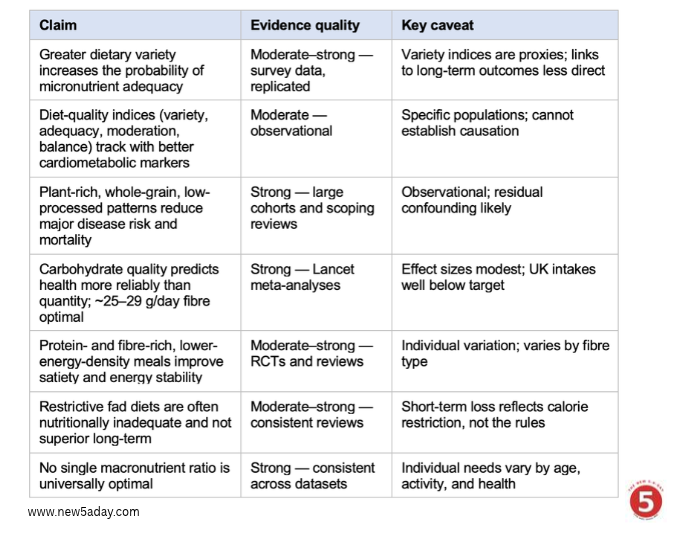
Summary of the evidence
The evidence supports the following conclusions:
Bringing it back to The New 5-a-Day
Eat Well is Pillar Two of The New 5-a-Day. The evidence supports a position that is principle-driven rather than rule-driven: prioritise variety and food quality, build meals around vegetables, whole grains, quality protein, and unsaturated fats, and judge the result across weeks rather than meals. The science does not point to a single optimal diet or a magic ratio. It points, repeatedly, to varied, predominantly whole-food patterns eaten consistently over time — and to the reassuring conclusion that balance, not perfection, is what the evidence actually rewards.
A note on medical advice: This Deep Dive is intended for readers who want to engage with the evidence in more depth. It does not replace professional medical or nutritional advice. If you are managing a health condition affected by diet — including diabetes, cardiovascular disease, kidney disease, or a history of disordered eating — please speak to your GP or a registered dietitian.
Want to read further? Full citations for all research referenced in this post are available in the accompanying Reference List.
[View the References →] [Read the Open Post →] [Listen to the Episode →]
The New 5-a-Day | Eat Well 2-6 | Live well. Every day.
