What is a balanced diet, anyway..?
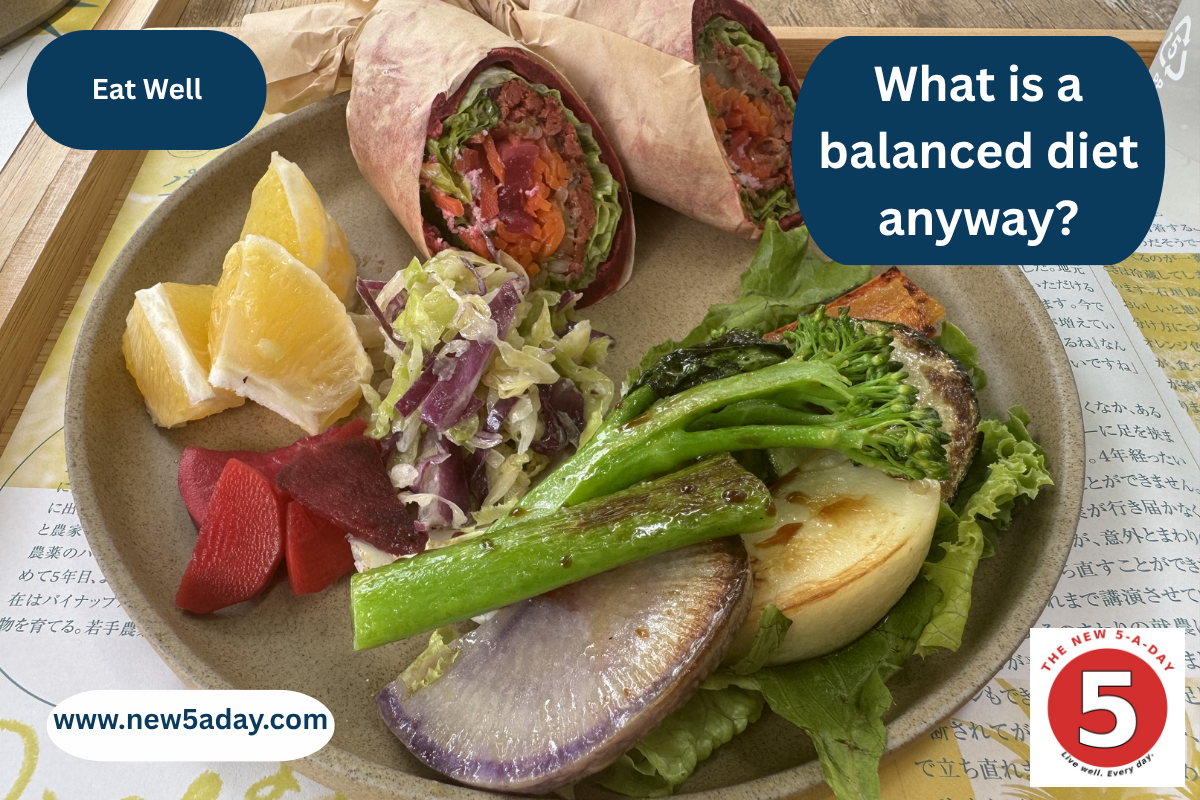
Quick summary: A balanced diet means variety, proportion, and consistency over time — not perfection at every meal. The NHS Eatwell Guide gives a useful framework. The overall weekly pattern matters far more than any single food or meal. Heavily processed foods are worth limiting, but no food needs to be banned forever.
If you’ve ever stood in a supermarket aisle feeling vaguely guilty about what’s in your trolley, or gone down a rabbit hole of contradictory nutrition advice online and emerged more confused than when you started — this post is for you.
“Eat a balanced diet” is one of those phrases that’s everywhere and means almost nothing on its own. Balanced how? Balanced compared to what? And does it have to involve giving up everything you enjoy?
The short answer: no, it doesn’t. The longer answer is actually more interesting — and a lot more reassuring — than most nutrition coverage would have you believe.
So what does “balanced” actually mean?
At its core, a balanced diet is simpler than the internet makes it look. It means eating a wide variety of foods, in broadly sensible proportions, most of the time — so that your body gets the nutrients it needs to work well and feel good.
That’s it. Not a specific calorie target. Not an exact macro split. Not a list of foods you’re never allowed to eat again. Just variety, proportion, and consistency over time.
In the UK, the NHS Eatwell Guide gives us a useful way to picture this. It divides food into five main groups and suggests roughly how much of each should make up our overall diet:
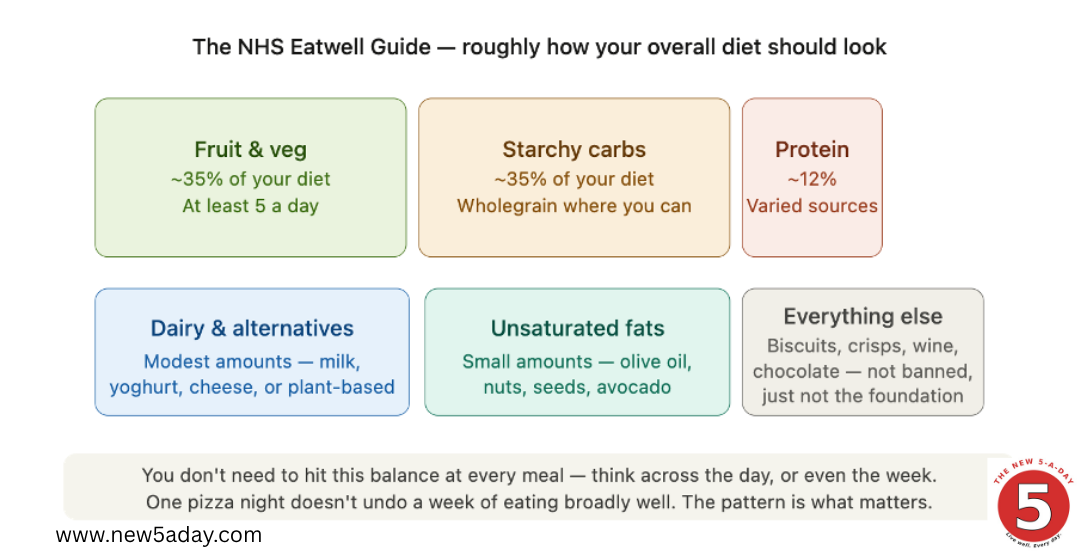
• Fruit and vegetables — just over a third of what we eat. Aim for at least five portions a day, across as many different colours and types as you can manage. Fresh, frozen, tinned, and dried all count.
• Starchy carbohydrates — also about a third. Bread, pasta, rice, potatoes. Wholegrain versions where you can, but regular versions are not the enemy.
• Protein — a smaller portion: meat, fish, eggs, beans, pulses, tofu. You don’t need as much as most of us eat, but you do need some.
• Dairy or alternatives — a modest amount. Milk, yoghurt, cheese, or plant-based alternatives with added calcium.
• Unsaturated fats — a small amount. Olive oil, vegetable oils, nuts, seeds, avocado.
And then there’s everything else — the cakes, biscuits, crisps, chocolate, wine — which the Eatwell Guide sensibly sits outside the main model. Not banned. Not a moral failing. Just not the foundation.
One thing worth saying clearly: you don’t need to hit this balance at every single meal. Think across the day, or even the week. A plate of pasta at dinner doesn’t need to be a nutritional masterclass. That’s the whole point of “over time”.
The myth of the perfect plate
Here’s where a lot of nutrition advice goes wrong: it presents eating well as a binary state. You’re either “being good” or you’ve “fallen off the wagon”. You’re on the diet or you’ve abandoned it.
This framing is not only unhelpful — it’s actively counterproductive. Research consistently shows that rigid, all-or-nothing approaches to eating are harder to sustain and often lead to the cycle of restriction and overindulgence that leaves people feeling worse than when they started.
A more useful mental model is this: think about what you eat across a week, not a day, and across a pattern, not a meal. One pizza night doesn’t undo a week of eating reasonably well. One salad at lunch doesn’t compensate for everything else. It’s the overall pattern that matters.
If most of your meals, most of the time, include plenty of vegetables, some whole grains, a reasonable amount of protein, and aren’t dominated by heavily processed foods — you’re doing well. That’s what a balanced diet actually looks like in practice.
Why does it matter? The brief version
A diet roughly in line with these principles is consistently linked to a lower risk of some of the most significant health conditions we face: heart disease, stroke, type 2 diabetes, and some types of cancer. It supports a healthy weight, better energy levels, more stable mood, and — as we explored in our Sleep Well post — better sleep.
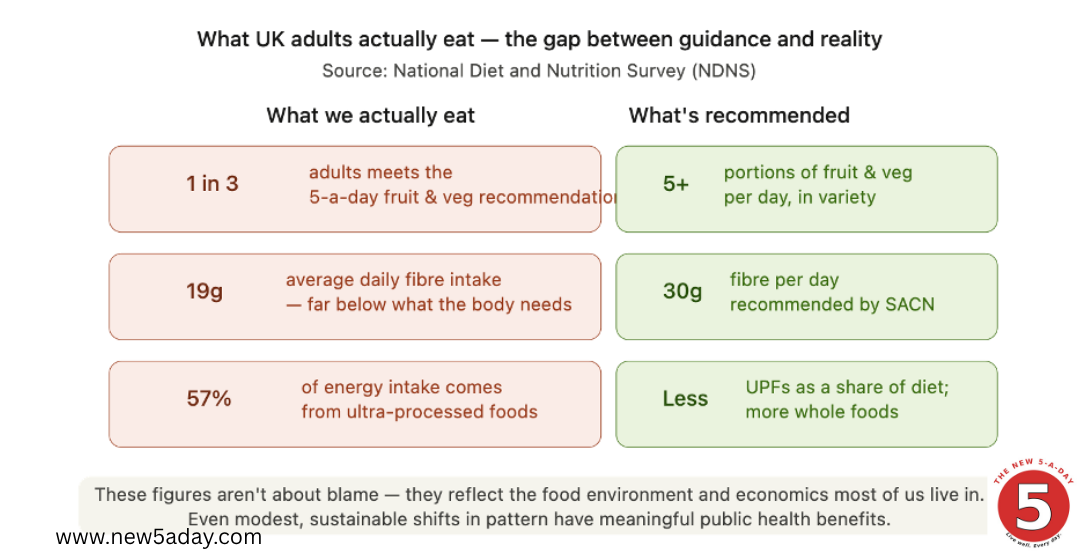
It also matters for the long game. What we eat over years and decades shapes our health-span: not just how long we live, but how well we live in those years. Eating well isn’t about looking a certain way or hitting a number on the scale. It’s about giving your body and brain the best possible materials to work with.
The ultra-processed food question
You’ve probably heard about ultra-processed foods — UPFs — because they’ve been all over the news. So what’s the story?
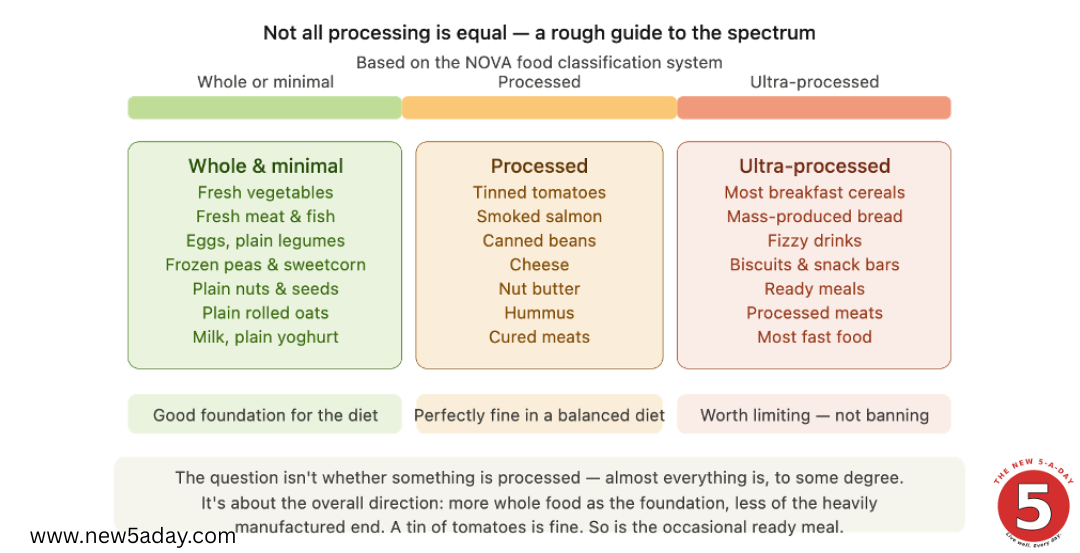
UPFs are broadly defined as foods that have been significantly transformed from their original state and typically contain ingredients you wouldn’t find in a home kitchen: emulsifiers, stabilisers, artificial flavours, preservatives, added sugars and fats in combinations designed to make them highly palatable and very easy to overeat. Think mass-produced bread, most breakfast cereals, ready meals, biscuits, fizzy drinks, processed meats, and many snack foods.
The evidence linking high UPF consumption to poor health outcomes has been growing steadily. A major analysis published in the BMJ in 2024 — covering data from millions of people — found associations between high UPF intake and increased risk of heart disease, type 2 diabetes, obesity, depression, and several other conditions. The UK’s Parliamentary Office of Science and Technology summarised the evidence in early 2026 as showing that regular high consumption of UPFs is linked to worse health outcomes across multiple systems.
It’s worth being honest about what the evidence does and doesn’t show. Most of this research is observational — it shows associations, not definitive causes. The science is still developing, and experts note that not all UPFs are equally problematic, and that separating the effects of processing itself from the effects of high fat, sugar, and salt content is genuinely complicated.
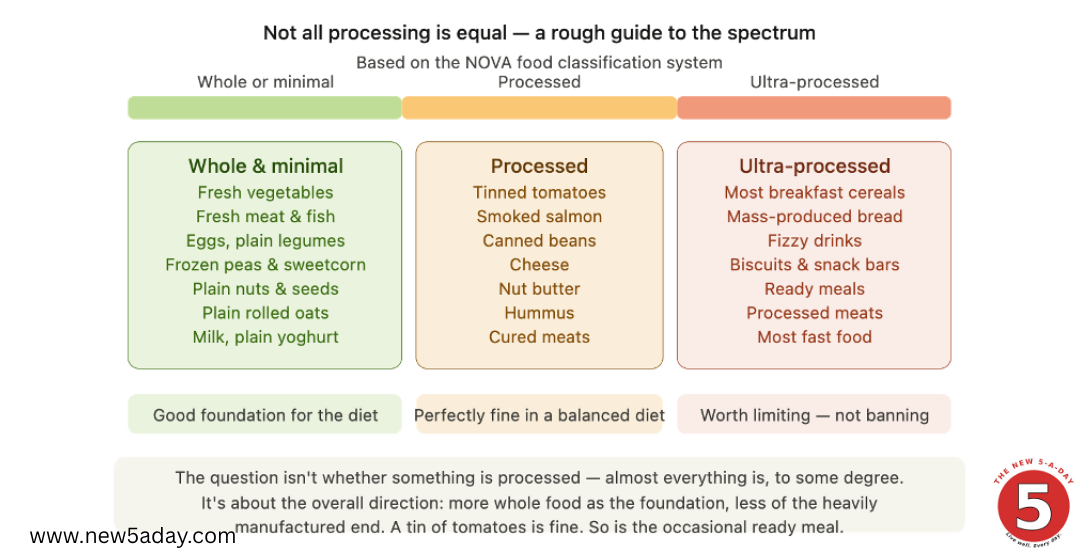
But the broad picture is becoming clearer: the more of your diet that comes from heavily processed, industrially produced foods — and the less that comes from whole or minimally processed ingredients — the higher the risk. That’s a nudge in a direction, not a reason to panic about every ingredient label.
Does this mean I have to cook everything from scratch?
No. And this is important, because the “cook everything from scratch” message is one of the most exclusionary in all of nutrition. It assumes time, money, equipment, energy, and skills that not everyone has — and it makes people who rely on convenience foods feel bad about something that is often not a free choice.
A tin of tomatoes is minimally processed and brilliant. Frozen peas are frozen at the point of harvest and retain most of their nutrients. A packet of smoked salmon, a tub of hummus, a jar of nut butter — these are processed foods that are also perfectly fine parts of a balanced diet.
The question isn’t whether you’ve prepared everything from raw ingredients. It’s more like: does your overall diet include plenty of vegetables and fruit, some whole grains, reasonable protein sources, and not too much of the heavily manufactured stuff? If the answer is broadly yes — even if your Tuesday dinner comes from a supermarket bag — you’re doing fine.
What about all the conflicting advice?
One week carbs are the enemy. The next, it’s fat. Then sugar. Then red meat. Then dairy. The Mediterranean diet is in. Then the carnivore diet. Then intermittent fasting. Then something involving seed oils that your cousin keeps posting about.
It can feel like nutrition science is constantly contradicting itself, which makes it tempting to either follow every new trend or give up entirely and eat whatever you like.
Here’s what’s actually going on. Nutrition science is genuinely hard to do well. People don’t eat controlled diets in labs — they eat complicated, varied, social meals over lifetimes. Self-reported food surveys are imprecise. Many studies are small, short-term, or funded by industries with an interest in the outcome. And individual variation is real: the same diet can affect different people differently.
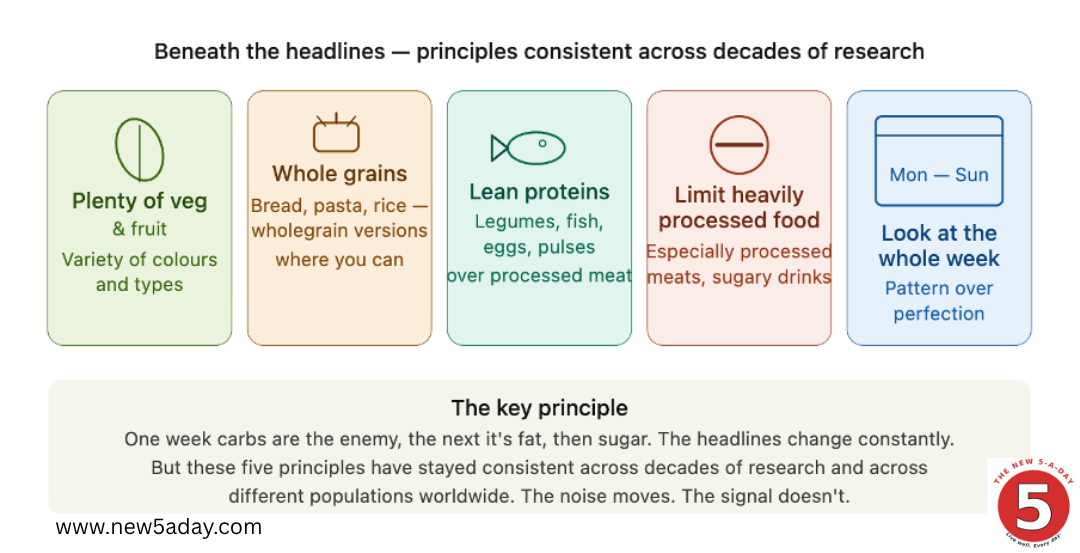
But underneath the noise, a few things have remained remarkably consistent across decades of research and across different populations:
• Eat plenty of vegetables and fruit.
• Include whole grains where you can.
• Favour beans, pulses, fish, and lean proteins.
• Keep heavily processed foods as a smaller part of the overall picture.
• Don’t drink a lot of sugar.
• Don’t worry too much about individual foods — look at the overall pattern.
These principles haven’t changed. The headlines have. That’s the difference.
Finding your own version of balanced
Here’s the thing about “balanced” — it has to work for your life. Your schedule, your budget, your culture, your preferences, the people you eat with, your relationship with food.
A diet that’s nutritionally optimal but that you hate and can’t sustain is not, in any meaningful sense, a balanced diet. A diet that makes you feel well, that you can keep up across months and years, that includes some pleasure and flexibility — that’s closer to the goal.
Some practical starting points, if you’re not sure where to begin:
• Add before you subtract. Rather than starting by cutting things out, try adding one extra portion of vegetables to a meal you already make. It’s easier, and it crowds out less nutritious choices naturally.
• Frozen is fine. Frozen vegetables, fruit, fish, and pulses are just as nutritious as fresh, often cheaper, and less likely to go to waste at the back of the fridge.
• Variety over perfection. Eating a wider range of different vegetables, proteins, and grains is more valuable than eating the same “healthy” foods on repeat. Diversity in the diet supports diversity in the gut microbiome — and that matters for health in ways science is only beginning to understand.
• Look at the whole week. Monday to Sunday. Not Tuesday lunch versus Tuesday dinner. If across the week you can see plenty of veg, some fruit, reasonable protein, and a few home-cooked or minimally processed meals — you’re in good shape.
• Give yourself permission to enjoy food. The evidence for stress, guilt, and a difficult relationship with eating doing damage to health is real too. Eating is one of life’s consistent pleasures. Protecting that, while broadly eating well, is the goal — not replacing it.
When talking to a professional helps
If you have specific health conditions — type 2 diabetes, coeliac disease, IBD, eating disorders, kidney disease, or significant dietary restrictions — general guidance like this is a starting point, not a prescription. A registered dietitian can give you advice that’s tailored to your actual situation, which is genuinely different from general healthy-eating guidance.
Your GP can refer you, or you can find a registered dietitian independently through the British Dietetic Association.
Bringing it back to The New 5-a-Day
Eating well is Pillar Two of The New 5-a-Day — and it connects to everything else. What you eat affects your energy for being active. It affects your sleep. It affects your mood and your ability to manage stress. It even affects how you connect with other people, because food is social in a way that almost nothing else is.
The goal isn’t a perfect diet. It’s a diet that’s good enough, most of the time, that you actually enjoy — and that gives your body what it needs to keep doing all the other things you want to do with your life.
That’s what balanced means. Not a ratio. Not a rule. A relationship with food that works for you, over the long term.
The New 5-a-Day | Eat Well 2-1 | Live well. Every day.
