Your heart says “Move!”
Quick summary: Cardio — any activity that raises your heart rate for a sustained stretch of time — is one of the most powerful things you can do for your long-term health. It reduces the risk of heart disease, type 2 diabetes, and some cancers. It lifts mood, sharpens thinking, improves sleep, and gives you more energy for everyday life. The best part? You do not need a gym, a running kit, or a free hour. Small, consistent increases in daily movement are enough to make a real difference. This post will show you how to find them.
There is a reason doctors keep telling us to move more. It’s not just good advice — it is, genuinely, one of the most effective things any of us can do for our health. And yet most of us, if we’re honest, are not doing enough of it.
That’s not a judgment. Modern life is not set up for movement. We sit to commute. We sit to work. We sit to decompress. The average person in a developed country moves far less than their body was designed for — and the gap between what we do and what would serve us well has quietly widened over the past few decades.
Cardio — short for cardiovascular exercise — is one of the Four Macros of Being Active, Pillar Three of The New 5-a-Day. Not because it is the most glamorous part of a healthy lifestyle, but because the evidence for its benefits is, quite simply, extraordinary. And because, it turns out, you do not need to do very much of it to start seeing results.
What cardio actually is
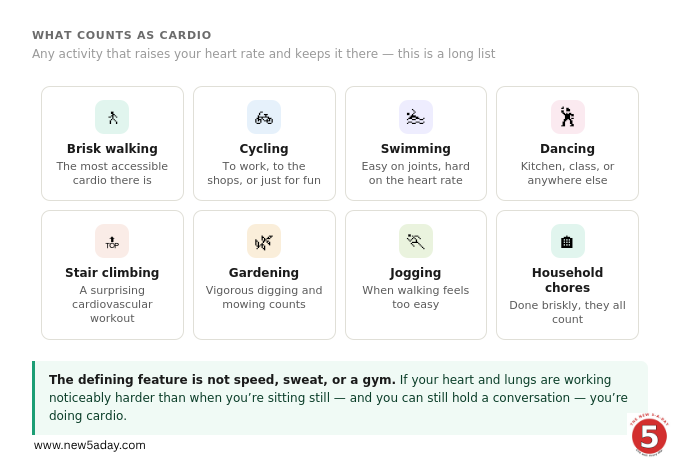
Cardiovascular exercise is any activity that gets your heart beating faster and keeps it there for a sustained period, while using large muscle groups. Walking briskly, swimming, cycling, dancing, jogging, even vigorous gardening — all of these count. The defining feature is not speed or sweat or a particular sport. It’s simply that your heart and lungs are working noticeably harder than they do when you’re sitting still.
The word “cardio” can conjure images of people grimly pounding treadmills in gyms, which puts a lot of people off before they’ve even started. That’s a shame, because most cardio looks nothing like that. A twenty-minute walk with the dog is cardio. Cycling to the shops is cardio. A bit of enthusiastic dancing in the kitchen on a Friday evening is absolutely cardio.
The case for cardio — and it’s a strong one
The research on cardio is some of the most consistent in all of health science. Regardless of age, fitness level, or starting point, regular aerobic activity is linked to a dramatically lower risk of the conditions that shorten and diminish life.
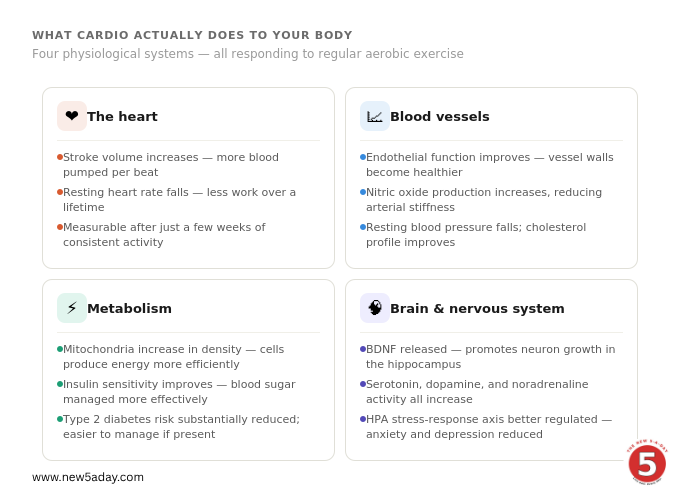
Heart disease and stroke. Regular cardio strengthens the heart muscle, reduces blood pressure, improves cholesterol levels, and keeps blood vessels more flexible. People who are regularly active have substantially lower rates of cardiovascular disease — the leading cause of death in most high-income countries.
Type 2 diabetes. Aerobic exercise improves the body’s ability to manage blood sugar, and the evidence here is particularly clear: regular activity both reduces the risk of developing type 2 diabetes and helps manage it in people who already have it.
Cancer risk. Active people have lower rates of several cancers, including bowel, breast, and womb cancers. The mechanisms are still being studied, but the association is robust.
Mental health. Exercise reliably reduces symptoms of anxiety and depression, with effects comparable in some studies to medication for mild to moderate cases. It releases natural mood-lifting chemicals in the brain, reduces the body’s stress response, and improves sleep — which in turn supports everything else.
Brain health. Regular aerobic activity is associated with better memory, sharper concentration, and a lower risk of cognitive decline as we age. This is a newer area of research, but the evidence is growing and compelling.
And then there is the simple, everyday stuff: more energy, less fatigue, better sleep, a general sense of feeling more capable. These effects are felt quite quickly once you start moving regularly — often within a few weeks.
The step count story — and why it matters
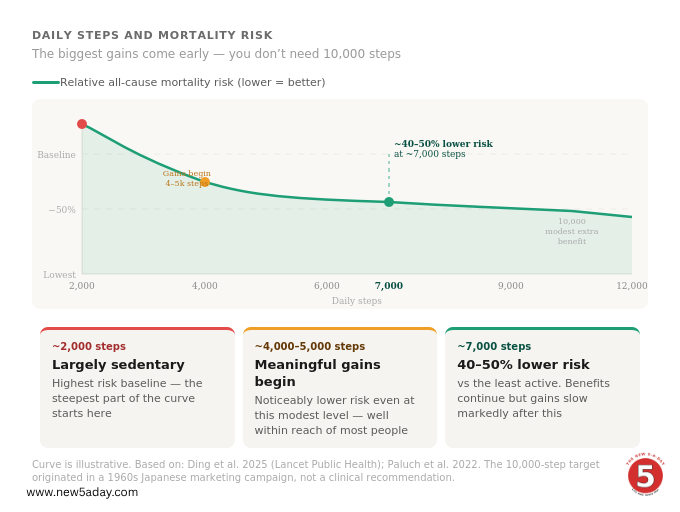
One of the clearest recent findings in this area concerns something very simple: daily step count. Large-scale reviews of the evidence — pooling data from millions of people across many countries — have found a remarkably consistent picture.
Getting to around 7,000 steps a day is associated with roughly a 40 to 50 per cent lower risk of dying from any cause compared with people who are largely sedentary. That’s a striking number. What’s equally striking is that you don’t have to reach 10,000 steps to see meaningful benefit — even getting from very low activity to 4,000 or 5,000 steps noticeably reduces risk. The benefits don’t stop at 10,000, but the biggest gains come in the early increases.
The message here is not that you need to hit some magic number. It’s that any meaningful increase from where you currently are is worth making — and that walking, the most accessible form of movement most people have, is doing serious health work.
How much is ‘enough’?
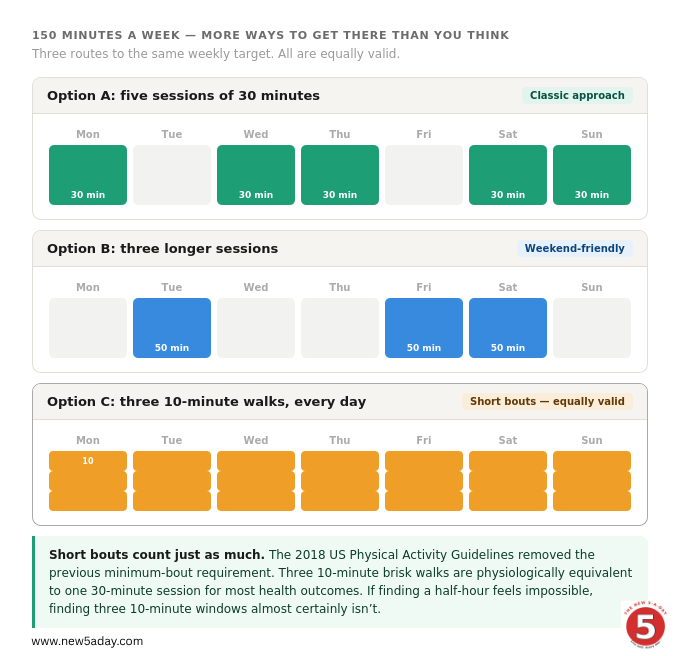
Current health guidelines for adults suggest aiming for around 150 minutes of moderate activity per week — that’s about 25 to 30 minutes on most days. ‘Moderate’ means working hard enough to feel slightly breathless but still able to hold a conversation. A brisk walk qualifies. So does cycling at a comfortable pace, or a swim that gets your heart rate up a little.
Two things are worth knowing about this number. First, you do not have to do it all at once. Three ten-minute brisk walks in a day have similar health benefits to a single thirty-minute session. If finding a half-hour feels impossible, finding three ten-minute windows is almost certainly not. Second, this is a target, not a threshold. Some activity is much better than none. Starting with what you can actually manage — even if it’s ten minutes three times a week — is more useful than waiting until you can do the ‘proper’ amount.
Building it in — simple ideas that actually work
The most effective approach to building cardio activity into your life is not to add a structured workout to your schedule — though that’s great if it appeals to you — but to look for the movement that is already latent in your day, and release it. Here are some of the most practical ways to do that.
• Walk after meals. A ten to fifteen-minute walk after eating is one of the most evidence-backed simple health habits there is. It helps manage blood sugar, aids digestion, and counts meaningfully towards your daily activity. It also gives you a natural pause in the day that many people find they come to value.
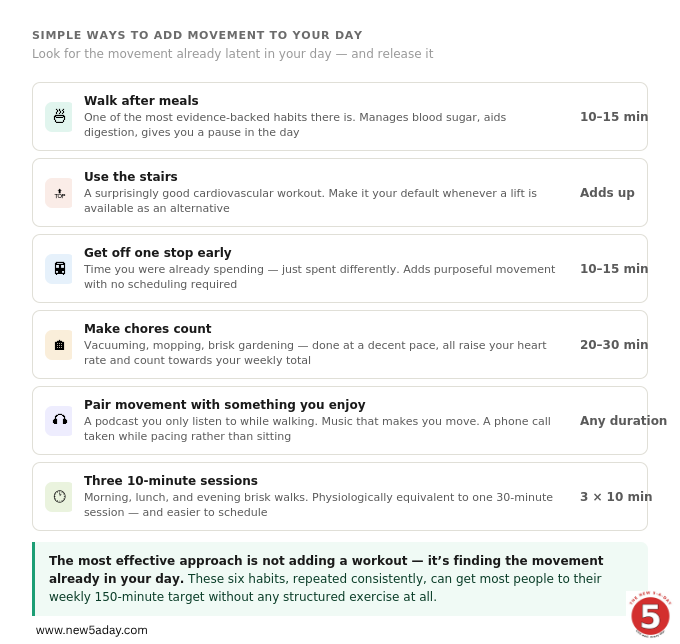
• Use the stairs. It sounds like a cliché because it’s genuinely effective. Stair climbing is a surprisingly good cardiovascular workout — short, practical, and available in most offices and buildings. Making it your default whenever there is a lift as an alternative adds up over the course of a week.
• Get off one stop early. If you commute by bus or train, getting off a stop earlier and walking the rest gives you ten or fifteen minutes of purposeful movement that requires no special scheduling. It’s time you were spending anyway — just spent differently.
• Make chores count. Vacuuming, mopping, scrubbing the bath, brisk gardening — done at a decent pace, all of these raise your heart rate and contribute to your weekly activity total. They are not glamorous, but they are real.
• Pair movement with something you already enjoy. A podcast you only listen to while walking. A playlist that makes you want to move. A phone call you take while pacing rather than sitting. Music, stories, or a friend on the other end of the phone can transform a walk from a chore into something you actually look forward to.
• Try the ‘three short sessions’ approach. If a continuous block of activity feels like too much right now, aim for three ten-minute brisk walks spread across the day. Morning, lunchtime, and evening works well for many people. The health benefit is comparable — and for some people, this format is far easier to maintain than a single longer session.
Starting from scratch — and why that’s fine
If you have been largely sedentary for a while, the instinct might be to wait until you feel ready, or to assume that very small efforts won’t make much difference. Both of those instincts are wrong.
The research is clear that the largest gains from becoming more active come at the lower end of the scale — moving from very little to a modest amount. The person going from almost nothing to a twenty-minute walk three times a week is doing more for their cardiovascular health than the person going from running 5k to running 10k. You do not need to be fit before you start getting the benefits of becoming more active.
A sensible starting point, if you are currently doing very little: aim for ten to fifteen minutes of comfortable walking, three to five times a week. Do that for two to three weeks. Then extend the time a little, or add a gentle increase in pace. The body adapts surprisingly quickly when given consistent, moderate stimulus — and what feels like an effort now will feel quite manageable sooner than you expect.
The most important thing in the early stages is not intensity — it’s showing up. Ten minutes today beats an hour you talked yourself out of.
A note on intensity — and the ‘talk test’
You do not need to be working hard to be doing cardio that is good for you. The threshold for ‘moderate’ activity is lower than most people assume. If you feel slightly warm, slightly breathless, and can still hold a conversation (though you’d rather not run up a flight of stairs at that moment) — that’s the zone. That’s where the benefits described in this post live.
More vigorous activity — where conversation becomes difficult, where you are genuinely working hard — does provide additional benefits, and if you enjoy it or it becomes part of your routine, that’s excellent. But it is not required for meaningful health gains. Most of what the research supports can be achieved through the kind of movement described in this post: regular, moderate, woven into ordinary life.
Making it stick
The habit science here is pretty well established. Behaviours that require us to create time from scratch are harder to maintain than behaviours that are attached to something we already do. So rather than ‘I’m going to go for a walk’ as a free-floating intention, the more effective approach is: ‘I’m going to walk for fifteen minutes after dinner’ or ‘I’ll walk during my lunch break on Tuesdays, Wednesdays, and Thursdays’.
A few other things that tend to help:
• Start smaller than you think you need to. Consistency matters more than volume, especially at the beginning. Five minutes every day builds a habit. Forty-five minutes once a week is harder to sustain and provides less consistent benefit.
• Track something simple, if that helps you. Step counts, minutes walked, days active in a week — any simple measure that makes your effort visible can provide useful feedback and a small sense of momentum. The New 5-a-day Tracker App is a great place to start!
• Walk with someone, if you can. Social activity and physical activity reinforce each other. A walking companion gives you accountability, company, and a reason to show up even on days when motivation is low. (This is actually a topic for Pillar Five — but the crossover is real.)
• Choose activities you actually like. There is no objective hierarchy of cardio activities. Swimming, dancing, cycling, walking, football, badminton — what matters is that it raises your heart rate and you will do it again. Enjoyment is not a bonus extra. It is central to whether any of this works.
Bringing it back to The New 5-a-Day
Be Active is Pillar Three — and cardio might be the most important of the Four Macros of Being Active. Not because other kinds of movement (strength, flexibility, rest) don’t matter, but because the cardiovascular system is the engine everything else runs on. A stronger heart, healthier blood vessels, better blood sugar, a calmer nervous system — these are not abstract health statistics. They are what it feels like to have energy in the afternoon, to sleep well, to feel capable rather than depleted by ordinary life.
None of this requires a dramatic overhaul. It requires small, consistent choices made over time. A walk that becomes a habit. Stairs that become your default. Ten minutes after dinner that becomes the part of your evening you didn’t know you were missing.
The body responds to being used. And it does not ask for much before it starts responding.
A note on medical advice: The content in this post is intended to inform and inspire, not to replace professional medical guidance. If you have a heart condition, diabetes, high blood pressure, or any other health concern, please speak to your GP or a qualified health professional before making significant changes to your activity levels.
Want to explore further? This post is the accessible introduction. A detailed evidence-based Deep Dive, a full Reference List, and a podcast episode are all available on this site.
