Now touch your toes! Stretching is so good for you!
Quick summary: Stretching is one of the most underrated things you can do for your body. Done regularly, it improves flexibility and range of motion, keeps your joints moving freely, supports healthy posture, and can bring a genuine sense of calm. It does not require a gym, special kit, or hours of your time. A few minutes a day, done consistently, is enough to make everyday movement feel noticeably easier — and that matters more than most people realise.
Let’s be honest. Stretching is usually an afterthought.
It’s the bit you skip at the end of a workout when you’re already mentally in the shower. It’s the thing your PE teacher kept telling you to do before you started, and you did a half-hearted hamstring stretch for thirty seconds while your mind was somewhere else entirely. It is, in the popular imagination, about as exciting as flossing.
And yet — like flossing — it turns out to be rather more important than we tend to give it credit for.
This post is not going to tell you that stretching will transform your life. But it will make the case that a small amount of regular stretching can make your body feel meaningfully better, help you move more comfortably as you age, and even give your mind a genuine moment of quiet in a busy day. That’s a decent return on a few minutes.
What stretching actually does
At its simplest, stretching helps your muscles and joints move through a fuller range of motion. That might sound like a technical benefit, but the practical implications are everywhere in daily life.
Reaching for something on a high shelf. Turning to look behind you before reversing the car. Bending to pick something up off the floor. Getting in and out of the bath. None of these feel like feats of athletic achievement — until, gradually, they start to feel a little harder than they used to.
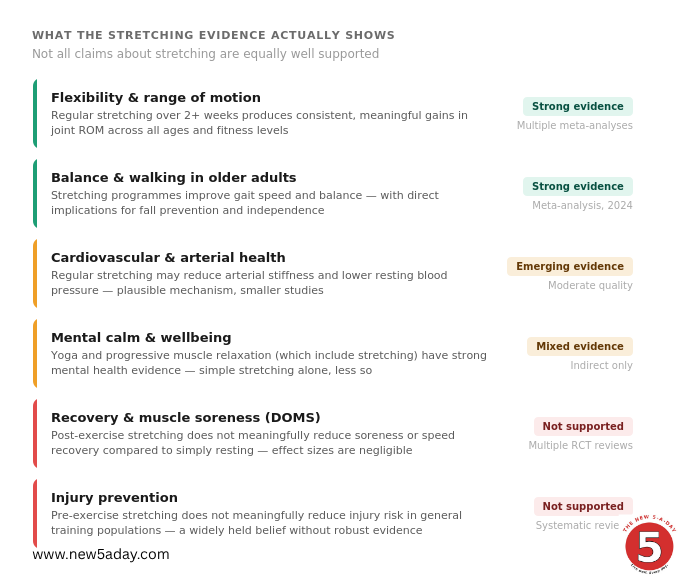
The research here is genuinely robust. Multiple large reviews of the evidence have confirmed that regular stretching — done consistently over several weeks — produces meaningful gains in flexibility and joint range of motion. This is one of the best-supported claims in the stretching literature: stretching works for this, reliably, across different ages and fitness levels.
There is also good evidence that stretching improves walking speed and balance in older adults — which translates, in practice, to walking more easily and being less likely to fall. For anyone in or approaching later life, that is not a trivial thing.
Flexibility vs mobility — and why both matter
Two terms often used around stretching are flexibility and mobility. They are related but slightly different.
Flexibility is about how far a muscle can lengthen — how much it can stretch. Mobility is about how freely a joint can move through its full range. You can have flexible muscles but stiff joints, or vice versa. Both matter for comfortable, efficient movement.
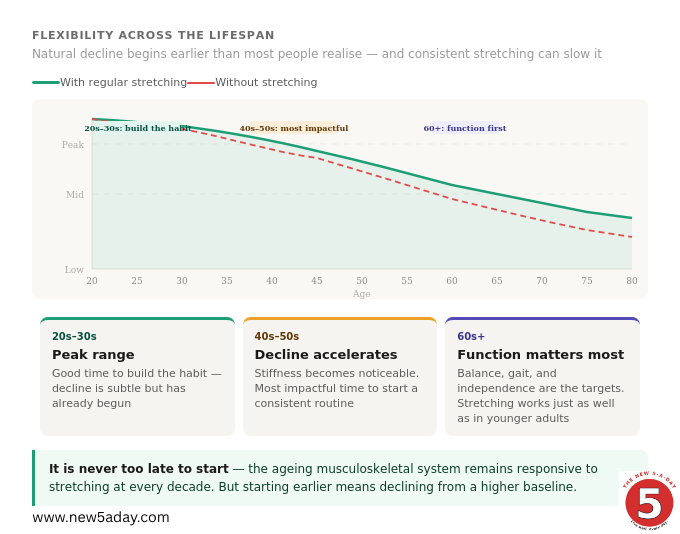
Many people don’t notice their flexibility declining until it becomes noticeable — which is usually well after it has begun. Movement that once felt easy becomes effortful. Certain positions become uncomfortable or impossible. Stretching can help slow that decline and keep joints moving as freely as possible.
It is worth noting that strength training can also produce improvements in flexibility — similar in some studies to dedicated stretching. So if you’re already doing resistance exercise, you may be getting some of this benefit already. For most people, though, a combination of both is the approach that serves them best.
Sitting is not your friend
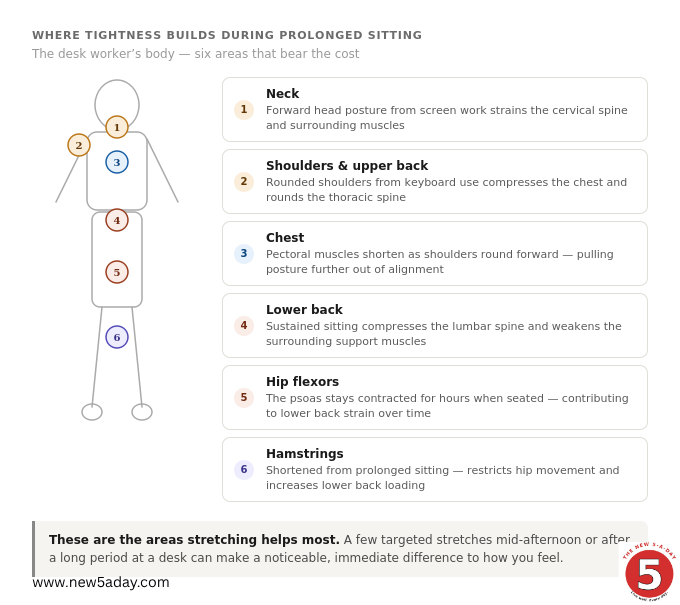
If you have a desk job — or spend significant parts of your day sitting in a car, on a sofa, or in front of a screen — you are doing something to your body that it was not particularly designed for. Sustained sitting tightens the hip flexors, rounds the shoulders, and compresses the lower back. Over time, this contributes to the kind of background stiffness and postural tension that many people experience as just ‘normal’.
Stretching can help counteract this. Targeting the areas that tend to tighten under prolonged sitting — hips, chest, shoulders, upper and lower back — can reduce the feeling of physical restriction that sets in after hours at a desk.
A word of caution here: stretching alone will not ‘fix’ posture, which is a more complex picture involving muscle strength, habitual movement patterns, and ergonomics. But it is a meaningful part of the toolkit — and for many people, a few targeted stretches during the working day make a noticeable, immediate difference to how they feel.
Does stretching help with recovery?
One thing worth addressing honestly: the popular idea that stretching after exercise speeds up recovery and reduces muscle soreness is not well supported by the evidence.
Multiple systematic reviews — the most rigorous form of research — have found that post-exercise stretching does not meaningfully reduce delayed-onset muscle soreness (the aching you feel a day or two after exercise) compared with simply resting. Similarly, pre-exercise stretching does not appear to reduce injury risk in the way many people assume.
This doesn’t mean post-exercise stretching is pointless. It can still be a pleasant transition out of activity, it helps maintain the flexibility gains you are building, and many people find it genuinely calming. But if you’re doing it primarily because you think it’ll fix your aching legs, the evidence suggests it probably won’t.
The real recovery toolkit is simpler and less glamorous: sensible training loads, enough sleep, good hydration, and adequate nutrition. Stretching is a fine addition — just not the core of the story.
A surprising heart health connection
Here is something that may genuinely surprise you. There is emerging evidence that regular stretching can have modest benefits for cardiovascular health — specifically, that it may help reduce arterial stiffness and lower resting blood pressure in middle-aged and older adults.
Arteries, like muscles, can become less flexible over time. Stiffer arteries make the heart work harder to pump blood. The research suggesting that regular stretching can counteract this — improving the health of the inner lining of blood vessels — is still relatively small and mixed, so this is not a reason to ditch your walking or your cardio sessions. But it is a hint that flexibility work may have broader health benefits than simply making it easier to bend over.
The calm at the end of a stretch
Many people who stretch regularly report something that goes beyond the physical: a feeling of calm, of settling. Slow, deliberate movement paired with steady breathing tends to be inherently quieting. In that way, stretching can function as a brief reset — a few minutes in which you are paying attention to your body rather than your inbox.
It is worth being honest about what the research does and doesn’t say here. The strong evidence for stretching and mental well-being comes largely from broader relaxation-based practices like yoga and progressive muscle relaxation, which combine stretching with breathing and mindfulness. The evidence for simple stretching on its own having measurable mental health effects is less clear.
That said — the experience of stretching quietly before bed, or taking five minutes mid-afternoon to move rather than scroll, is real. If it creates a moment of stillness in a busy day, that is a genuine benefit, even if it is hard to put a number on.
Stretching and ageing well
If there is one group who have the most to gain from regular stretching, it is probably people in their forties, fifties, and beyond — though starting earlier is never a bad idea.
Flexibility and mobility decline naturally with age. This is not inevitable — or rather, it is not unchangeable — but it requires a degree of consistent effort to counteract. The evidence shows that stretching works for older adults just as well as for younger ones, and that the gains it produces are practically meaningful: being able to get up from the floor, step into a bath, carry shopping, move around without stiffness or hesitation.
These might sound like small things. They are not. Maintaining physical independence and ease of movement is one of the strongest predictors of quality of life in later years. Stretching, done regularly, is one of the simplest ways to protect it.
How to actually do it
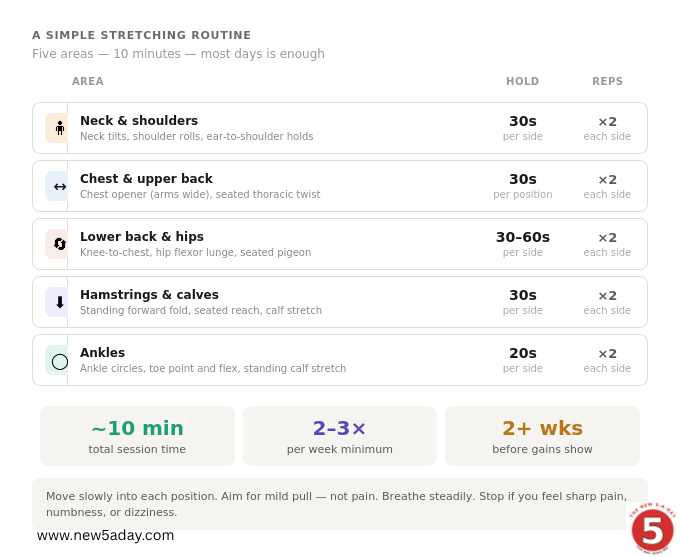
The good news is that stretching does not require a lot. Health guidance suggests flexibility work for all major muscle groups at least two to three times a week, though many people benefit from a little most days. The most important thing is consistency over intensity — a five-minute routine you actually do regularly beats an hour-long session you manage once a fortnight.
The main areas worth focusing on are the ones that tend to tighten up most in modern life:
• Neck and shoulders
• Chest and upper back
• Lower back and hips
• Hamstrings and calves
• Ankles
A few simple principles to keep in mind:
• Warm up a little first if you are doing deeper stretches — after a walk or some light movement is ideal.
• Move slowly into each position and breathe normally.
• Aim for a feeling of mild pull, not sharp pain. If something hurts, ease off.
• Hold stretches rather than bouncing — static holds tend to produce the best long-term flexibility gains.
• Stop if you experience sharp pain, numbness, or dizziness.
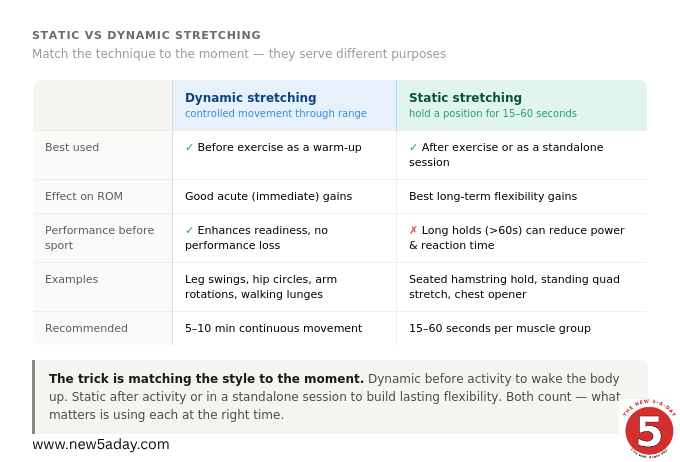
On the dynamic versus static question: dynamic stretching (gentle, controlled movement through a range) is often used as a warm-up before activity. Static stretching (holding a position for time) is generally better suited to a calm flexibility routine or a wind-down after exercise. Both have their place — the trick is matching the style to the moment.
Making it stick
Like most health habits, the best stretching routine is the one that is realistic enough to actually repeat. A few things that tend to help:
• Attach it to something you already do. Stretching after a morning shower, while the kettle boils, after an evening walk, or before getting into bed are all natural attachment points.
• Start very small. Even five minutes is genuinely useful. Perfection is the enemy of consistency.
• Focus on areas that feel tight rather than trying to stretch everything every time.
• Pair it with breathing. Slow, deliberate breaths make the experience noticeably more relaxing and can help you ease a little further into each stretch.
Flexibility gains are slow but cumulative. You will not touch your toes after a week. But over months, with consistency, most people notice a real difference in how their body feels — not just when they are stretching, but throughout the day.
Bringing it back to The New 5-a-Day
Be Active is Pillar Three of The New 5-a-Day — and stretching sits right at the heart of what this pillar is really about. Not performance. Not punishment. Not the burning feeling of having pushed yourself to your limits.
Just moving your body in a way that keeps it comfortable, capable, and genuinely yours for longer.
You do not have to be flexible to start. You just have to start. A few stretches today. A few more tomorrow. The body, it turns out, is remarkably responsive to small, consistent efforts made over time.
A note on medical advice: The content in this post is intended to inform and inspire, not to replace professional medical guidance. If anything you’ve read raises questions or concerns about your own health, please speak to your GP or another qualified health professional.
Want to explore further? This post is the accessible introduction. A detailed evidence-based Deep Dive, a full Reference List, and a podcast episode are all available on this site.
